Eliquis 5 mg film-coated tablet
Spain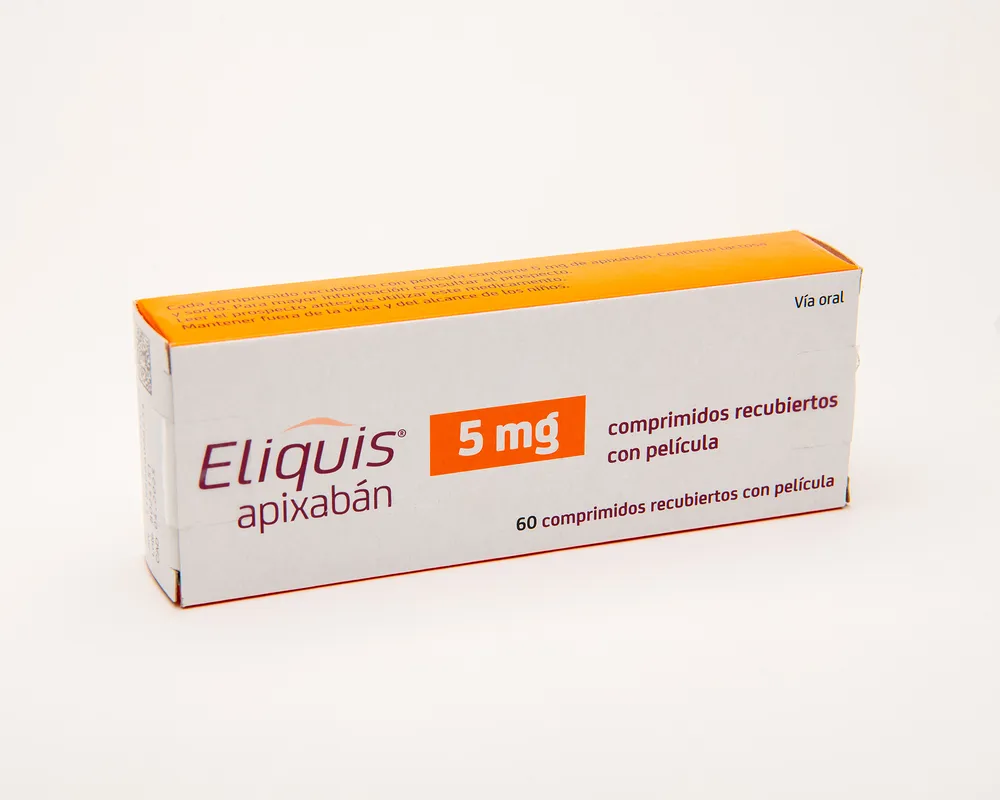
Table of Contents
Package leaflet: Information for the user
Introduction
Package leaflet: information for the user
Eliquis 5mg film-coated tablets
apixaban
Read the entire leaflet carefully before you start taking this medicine because it contains important information for you.
- Keep this leaflet, as you may need to read it again.
- If you have any questions, ask your doctor, pharmacist or nurse.
- This medicine has been prescribed for you only and must not be given to other people, even if they have the same symptoms as you, since it may harm them.
- If you experience any adverse effects, consult your doctor, pharmacist or nurse, even if these are effects not listed in this leaflet. See section 4.
Leaflet contents:
- What Eliquis is and what it is used for
- What you need to know before taking Eliquis
- How to take Eliquis
- Possible side effects
- How to store Eliquis
- Contents of the pack and other information
1. What Eliquis is and what it is used for
Eliquis contains the active substance apixaban and belongs to a group of medicines called anticoagulants. This medicine helps prevent the formation of blood clots by blocking Factor Xa, an important component in blood coagulation.
Eliquis is used in adults:
- to prevent the formation of blood clots in the heart in patients with an irregular heartbeat (atrial fibrillation) and at least one additional risk factor. Blood clots may dislodge, travel to the brain and cause a stroke, or travel to other organs and block blood supply to those organs (also known as systemic embolism). A stroke can be life-threatening and requires immediate medical attention.
- to treat blood clots in the veins of the legs (deep vein thrombosis) and in the blood vessels of the lungs (pulmonary embolism), and to prevent these blood clots from recurring in the blood vessels of the legs and/or lungs.
Eliquis is used in children from 28 days up to less than 18 years of age to treat blood clots and to prevent these blood clots from recurring in the veins and blood vessels of the lungs.
For the recommended dose according to body weight, see section 3.
2. What you need to know before you start taking Eliquis
Do not take Eliquis if
- you are allergic to apixaban or to any of the other ingredients of this medicine (listed in section 6);
- you are bleeding excessively;
- you have a disease in an organ of the body that increases the risk of serious bleeding (such as an active or recent stomach or intestinal ulcer, or recent intracranial hemorrhage);
- you have a liver disease that increases the risk of bleeding (hepatic coagulopathy);
- you are taking medications to prevent blood clotting (e.g., warfarin, rivaroxaban, dabigatran, or heparin), except when switching anticoagulant therapy, while you have an arterial or venous line and are being treated with heparin to keep that line open, or when a catheter is inserted into a blood vessel (catheter ablation) to treat an irregular heartbeat (arrhythmia).
Warnings and precautions
Tell your doctor, pharmacist, or nurse before taking this medicine if you have any of the following conditions:
- an increased risk of bleeding, such as:
- bleeding disorders, including conditions that result in reduced platelet function;
- very high blood pressure that is not controlled by medical treatment;
- you are over 75 years of age;
- you weigh 60 kg or less;
- you have severe kidney disease or are undergoing dialysis;
- you have a liver problem or a history of liver problems;
- this medicine should be used with caution in patients showing signs of impaired liver function;
- you have had a catheter or received an injection in your spine (for anesthesia or pain relief); your doctor will advise you to wait at least 5 hours after removing the catheter before taking this medicine;
- you have a heart valve prosthesis;
- if your doctor determines that your blood pressure is unstable or you are scheduled to receive another treatment or undergo surgery to remove a blood clot from your lungs.
Take special care with Eliquis
- if you know you have a condition called antiphospholipid syndrome (an immune system disorder that increases the risk of blood clots), inform your doctor so they can decide whether your treatment needs to be adjusted.
If you need surgery or a procedure that may cause bleeding, your doctor will instruct you to temporarily stop taking this medicine for a period of time. If you are unsure whether a procedure may cause bleeding, consult your doctor.
Children and adolescents
The use of this medicine is not recommended in children and adolescents with a body weight below 35 kg.
Taking Eliquis with other medicines
Tell your doctor, pharmacist, or nurse if you are taking, have recently taken, or might need to take any other medicines.
Some medicines may increase the effects of Eliquis, while others may reduce its effects. Your doctor will decide whether you should be treated with Eliquis if you are taking these medicines and whether you need to be more closely monitored.
The following medicines may increase the effects of Eliquis and raise the risk of unwanted bleeding:
- some medicines for fungal infections (e.g., ketoconazole, etc.);
- some antiviral medicines for HIV/AIDS (e.g., ritonavir);
- other medicines to reduce blood clotting (e.g., enoxaparin, etc.);
- anti-inflammatory drugs or medicines to relieve pain (e.g., acetylsalicylic acid or naproxen). In particular, if you are over 75 years of age and taking acetylsalicylic acid, your risk of bleeding is higher;
- medicines for high blood pressure or heart problems (e.g., diltiazem);
- antidepressants known as selective serotonin reuptake inhibitors or serotonin-norepinephrine reuptake inhibitors.
The following medicines may reduce Eliquis' ability to prevent blood clots:
- medicines for epilepsy or seizures (e.g., phenytoin, etc.);
- St. John’s wort (a herbal medicine used to treat depression);
- medicines for treating tuberculosis or other infections (e.g., rifampicin).
Pregnancy and breastfeeding
If you are pregnant or breastfeeding, think you may be pregnant, or are planning to become pregnant, consult your doctor, pharmacist, or nurse before using this medicine.
The effects of Eliquis on pregnancy and the fetus are unknown. You should not take this medicine if you are pregnant. Inform your doctor immediately if you become pregnant while taking this medicine.
It is not known whether Eliquis is excreted in human milk. Ask your doctor, pharmacist, or nurse before taking this medicine while breastfeeding. They will advise you whether to stop breastfeeding or whether to stop or not start taking this medicine.
Driving and using machines
Eliquis has no influence on the ability to drive or use machines.
Eliquis contains lactose (a type of sugar) and sodium
If your doctor has informed you of an intolerance to certain sugars, speak with them before taking this medicine.
This medicine contains less than 1 mmol of sodium (23 mg) per tablet; this is essentially “sodium-free”.
3. How to take Eliquis
Follow exactly the instructions for using this medicine given by your doctor or pharmacist. If in doubt, consult your doctor, pharmacist, or nurse.
Dosage
Take the tablet with water. Eliquis may be taken with or without food.
Try to take the tablets at the same time each day to achieve the best treatment effect.
If you have difficulty swallowing the tablet whole, speak with your doctor about other possible ways of taking Eliquis. The tablet can be crushed and mixed with water, 5% glucose in water, apple juice, or apple puree, immediately before administration.
Instructions for crushing:
- Crush the tablets using a mortar.
- Carefully transfer all the powder into a suitable container, mixing the powder with a small amount, e.g., 30 mL (2 tablespoons), of water or any of the liquids listed above to make the mixture.
- Swallow the mixture.
- Rinse the mortar and pestle used for crushing the tablet and the container with a small amount of water or one of the other liquids (e.g., 30 mL), and swallow this liquid as well.
If necessary, your doctor may also administer crushed Eliquis tablets mixed in 60 mL of water or 5% glucose in water through a nasogastric tube.
Take Eliquis according to the following recommendations:
To prevent the formation of a blood clot in the heart in patients with irregular heartbeat and at least one additional risk factor.
The recommended dose of Eliquis is one Eliquis 5 mg tablet twice daily.
The recommended dose is one Eliquis 2.5 mg tablet twice daily if:
- you have severely reduced kidney function;
- you meet two or more of the following criteria:
- your blood test results suggest poor kidney function (serum creatinine level is 1.5 mg/dL (133 micromoles/L) or higher);
- you are 80 years of age or older;
- your body weight is 60 kg or less.
The recommended dose is one tablet twice daily; for example, take one tablet in the morning and one at night.
Your doctor will tell you how long you should continue treatment.
To treat blood clots in the veins of the legs and in the blood vessels of the lungs
The recommended dose is two tablets of Eliquis 5 mg twice daily for the first 7 days; for example, two tablets in the morning and two at night.
After 7 days, the recommended dose is one tablet of Eliquis 5 mg twice daily; for example, one tablet in the morning and one at night.
To prevent recurrence of blood clots after 6 months of treatment
The recommended dose is one Eliquis 2.5 mg tablet twice daily; for example, one tablet in the morning and one at night.
Your doctor will tell you how long you should continue treatment.
Use in children and adolescents
For the treatment of blood clots and to prevent recurrence of these blood clots in the veins and blood vessels of the lungs.
Follow exactly the instructions for taking or administering this medicine given by the child’s doctor or pharmacist. If in doubt, consult the child’s doctor, pharmacist, or nurse.
Try to take or administer the dose at the same time each day to achieve the best treatment effect.
The dose of Eliquis depends on body weight and will be calculated by the doctor.
The recommended dose for children and adolescents weighing at least 35 kg is two tablets of Eliquis 5 mg twice daily for the first 7 days; for example, two tablets in the morning and two at night.
After 7 days, the recommended dose is one tablet of Eliquis 5 mg twice daily; for example, one tablet in the morning and one at night.
For parents and caregivers: observe the child to ensure the full dose is taken.
It is important to keep scheduled doctor’s appointments, as the dose may need to be adjusted based on changes in body weight.
Your doctor may change your anticoagulant treatment as follows:
- Switching from Eliquis to anticoagulant medicines
Stop taking Eliquis. Start treatment with anticoagulant medicines (e.g., heparin) at the time you would have taken your next dose.
- Switching from anticoagulant medicines to Eliquis
Stop taking anticoagulant medicines. Start treatment with Eliquis at the time you would have taken your next dose of anticoagulant medicine, then continue as usual.
- Switching from anticoagulant treatment containing vitamin K antagonists (e.g., warfarin) to Eliquis
Stop taking the medicine containing a vitamin K antagonist. Your doctor will need to perform blood tests and advise you when to start taking Eliquis.
- Switching from Eliquis to anticoagulant treatment containing a vitamin K antagonist (e.g., warfarin)
If your doctor instructs you to start taking a medicine containing a vitamin K antagonist, continue taking Eliquis for at least 2 days after your first dose of the vitamin K antagonist medicine. Your doctor will need to perform blood tests and advise you when to stop taking Eliquis.
Patients undergoing cardioversion
If your heartbeat needs to be restored through a procedure called cardioversion, take this medicine at the times your doctor indicates to prevent blood clots in the blood vessels of the brain and other blood vessels in the body.
If you take more Eliquis than you should
Inform your doctor immediately if you have taken more than the prescribed dose of Eliquis. Take the medicine pack with you to the doctor, even if no tablets remain.
If you take more Eliquis than the recommended dose, your risk of bleeding may increase. If bleeding occurs, surgery, blood transfusions, or other treatments to reverse anti–factor Xa activity may be required.
If you forget to take Eliquis
- If you forget your morning dose, take it as soon as you remember, and you may take it together with your evening dose.
- If you forget your evening dose, you may only take it during that same night. Do not take two doses the next morning; instead, continue taking the medicine the next day as usual, twice daily as recommended.
If you have any doubts about what to do or if you have missed more than one dose, ask your doctor, pharmacist, or nurse.
If you stop taking Eliquis
Do not stop treatment with this medicine without first speaking to your doctor, as the risk of developing a blood clot may be higher if treatment is stopped too early.
If you have any further questions about the use of this medicine, ask your doctor, pharmacist, or nurse.
4. Possible adverse effects
Like all medicines, this medicine can cause adverse effects, although not everyone will experience them. The most common adverse effect of this medicine is bleeding, which can be life-threatening and requires immediate medical attention.
The following adverse effects have been reported when taking Eliquis to prevent blood clots in the heart in patients with irregular heartbeat and at least one additional risk factor.
Frequent adverse effects (may affect up to 1 in 10 people)
-
Bleeding, including:
-
in the eyes;
-
in the stomach or intestines;
-
from the rectum;
-
blood in the urine;
-
from the nose;
-
from the gums;
-
bruising and swelling;
-
Anaemia, which may cause tiredness or paleness;
-
Low blood pressure that may cause fainting or a faster heartbeat;
-
Nausea (feeling unwell);
-
Blood tests may show:
-
an increase in gamma-glutamyl transferase (GGT).
Uncommon adverse effects (may affect up to 1 in 100 people)
-
Bleeding:
-
in the brain or spinal cord;
-
in the mouth or coughing up blood;
-
in the abdomen or vagina;
-
bright/red blood in stools;
-
bleeding after surgery, including bruising and swelling, discharge of blood or fluid from the surgical wound/incision (suppuration) or injection site;
-
haemorrhoidal bleeding;
-
tests showing blood in stools or urine;
-
Decrease in the number of platelets in the blood (which may affect clotting);
-
Blood tests may show:
-
abnormal liver function;
-
increase in some liver enzymes;
-
increase in bilirubin, a substance derived from red blood cells, which may cause yellowing of the skin and eyes;
-
Skin rash;
-
Itching;
-
Hair loss;
-
Allergic reactions (hypersensitivity) which may cause: swelling of the face, lips, mouth, tongue and/or throat, and difficulty breathing. Contact your doctor immediately if you experience any of these symptoms.
Rare adverse effects (may affect up to 1 in 1,000 people)
-
Bleeding:
-
in the lungs or throat;
-
into the space behind the abdominal cavity (retroperitoneal haemorrhage);
-
into a muscle.
Very rare adverse effects (may affect up to 1 in 10,000 people)
- Skin rash which may blister and resemble small targets (dark spots in the centre surrounded by a paler area, with a dark ring around it) (erythema multiforme).
Frequency not known (cannot be estimated from available data)
- Inflammation of blood vessels (vasculitis), which may cause skin rash, appearance of small round smooth red spots under the skin surface or bruising.
- Bleeding in the kidney, sometimes with blood in the urine, leading to impaired kidney function (anticoagulant-related nephropathy).
The following adverse effects have been reported when taking Eliquis to treat or prevent recurrence of blood clots in the veins of the legs and in the blood vessels of the lungs.
Frequent adverse effects (may affect up to 1 in 10 people)
-
Bleeding, including:
-
from the nose;
-
from the gums;
-
blood in the urine;
-
bruising and swelling;
-
from the stomach, intestines or rectum;
-
in the mouth;
-
vaginal bleeding;
-
Anaemia, which may cause tiredness or paleness;
-
Decrease in the number of platelets in the blood (which may affect clotting);
-
Nausea (feeling unwell);
-
Skin rash;
-
Blood tests may show:
-
an increase in gamma-glutamyl transferase (GGT) or alanine aminotransferase (GPT).
Uncommon adverse effects (may affect up to 1 in 100 people)
-
Low blood pressure that may cause fainting or a faster heartbeat;
-
Bleeding:
-
in the eyes;
-
in the mouth or coughing up blood;
-
bright/red blood in stools;
-
tests showing blood in stools or urine;
-
bleeding after surgery, including bruising and swelling, discharge of blood or fluid from the surgical wound/incision (suppuration) or injection site;
-
haemorrhoidal bleeding;
-
into a muscle;
-
Itching;
-
Hair loss;
-
Allergic reactions (hypersensitivity) which may cause: swelling of the face, lips, mouth, tongue and/or throat and difficulty breathing. Contact your doctor immediately if you experience any of these symptoms;
-
Blood tests may show:
-
abnormal liver function;
-
increase in some liver enzymes;
-
increase in bilirubin, a substance derived from red blood cells, which may cause yellowing of the skin and eyes.
Rare adverse effects (may affect up to 1 in 1,000 people)
-
Bleeding:
-
in the brain or spinal cord;
-
in the lungs.
Frequency not known (cannot be estimated from available data)
-
Bleeding:
-
in the abdomen or the space behind the abdominal cavity (retroperitoneal haemorrhage).
-
Skin rash which may blister and resemble small targets (dark spots in the centre surrounded by a paler area, with a dark ring around it) (erythema multiforme);
-
Inflammation of blood vessels (vasculitis), which may cause skin rash, appearance of small round smooth red spots under the skin surface or bruising.
-
Bleeding in the kidney, sometimes with blood in the urine, leading to impaired kidney function (anticoagulant-related nephropathy).
Additional adverse effects in children and adolescents
Contact the child's doctor immediately if you notice any of the following symptoms:
- Allergic reactions (hypersensitivity) which may cause: swelling of the face, lips, mouth, tongue and/or throat and difficulty breathing. These adverse effects are frequent (may affect up to 1 in 10 people).
In general, the adverse effects observed in children and adolescents treated with Eliquis were of a similar type to those observed in adults and were mainly mild to moderate in intensity. The adverse effects most frequently observed in children and adolescents were nosebleeds and abnormal vaginal bleeding.
Very frequent adverse effects (may affect more than 1 in 10 people)
-
Bleeding, including:
-
vaginal;
-
nasal.
Frequent adverse effects (may affect up to 1 in 10 people)
-
Bleeding, including:
-
from the gums;
-
blood in the urine;
-
bruising and swelling;
-
from the intestines or rectum;
-
bright/red blood in stools;
-
bleeding after surgery, including bruising and swelling, discharge of blood or fluid from the surgical wound/incision (suppuration) or injection site;
-
Hair loss;
-
Anaemia, which may cause tiredness or paleness;
-
Decrease in the number of platelets in the child's blood (which may affect clotting);
-
Nausea (feeling unwell);
-
Skin rash;
-
Itching;
-
Low blood pressure that may cause the child to faint or have a faster heartbeat;
-
Blood tests may show:
-
abnormal liver function;
-
increase in some liver enzymes;
-
increase in alanine aminotransferase (GPT).
Frequency not known (cannot be estimated from available data)
-
Bleeding:
-
in the abdomen or the space behind the abdominal cavity (retroperitoneal haemorrhage);
-
in the stomach;
-
in the eyes;
-
in the mouth;
-
haemorrhoidal;
-
in the mouth or coughing up blood;
-
in the brain or spinal cord;
-
in the lungs;
-
into a muscle;
-
Skin rash which may blister and resemble small targets (dark spots in the centre surrounded by a paler area, with a dark ring around it) (erythema multiforme);
-
Inflammation of blood vessels (vasculitis), which may cause skin rash, appearance of small round smooth red spots under the skin surface or bruising;
-
Blood tests may show:
-
an increase in gamma-glutamyl transferase (GGT);
-
tests showing blood in stools or urine.
-
Bleeding in the kidney, sometimes with blood in the urine, leading to impaired kidney function (anticoagulant-related nephropathy).
Reporting of adverse effects
If you experience any adverse effect, talk to your doctor, pharmacist or nurse, even if it is a possible adverse effect not listed in this leaflet. You can also report them directly through the national reporting system listed in Appendix V. By reporting adverse effects, you can help provide more information on the safety of this medicine.
5. Storage of Eliquis
Keep this medicine out of the sight and reach of children.
Do not use this medicine after the expiry date stated on the carton and on each blister, following EXP. The expiry date refers to the last day of the month indicated.
This medicine does not require any special storage conditions.
Medicines should not be disposed of via wastewater or household waste. Ask your pharmacist how to dispose of medicines and packaging you no longer need. This will help protect the environment.
6. Contents of the pack and other information
Composition of Eliquis
-
The active substance is apixaban. Each tablet contains 5 mg of apixaban.
-
The other components are:
-
Tablet core: lactose (see section 2 "Eliquis contains lactose (a type of sugar) and sodium"), microcrystalline cellulose, sodium croscarmellose (see section 2 "Eliquis contains lactose (a type of sugar) and sodium"), sodium lauryl sulfate, magnesium stearate (E470b);
-
Film coating: monohydrate lactose (see section 2 "Eliquis contains lactose (a type of sugar) and sodium"), hypromellose (E464), titanium dioxide (E171), triacetin, red iron oxide (E172).
Appearance of the product and contents of the pack
The film-coated tablets are oval (10 mm x 5 mm), pink in colour, and marked with "894" on one side and "5" on the other.
- Blister packs are presented in cartons containing 14, 20, 28, 56, 60, 168, and 200 film-coated tablets.
- Single-dose blisters are also available, supplied in clinical packs containing 100 x 1 film-coated tablet.
Only certain pack sizes may be marketed.
Patient Card: managing information
Inside the Eliquis package, together with the package leaflet, you will find a Patient Card or your doctor may provide you with a similar card.
This Patient Card includes useful information for you and alerts other doctors that you are being treated with Eliquis. You must carry this card with you at all times.
- Take the card.
- Separate the language you need (this is facilitated by perforated edges).
- Complete the following sections or ask your doctor to complete them:
- Name:
- Date of birth:
- Indication:
- Dose: ........mg twice daily
- Doctor's name:
- Doctor's telephone number:
- Fold the card and carry it with you at all times.
Marketing Authorisation Holder
Bristol‑Myers Squibb/Pfizer EEIG
Plaza 254
Blanchardstown Corporate Park 2
Dublin 15, D15 T867
Ireland
Manufacturer
CATALENT ANAGNI S.R.L.
Loc. Fontana del Ceraso snc
Strada Provinciale Casilina, 41
03012 Anagni (FR)
Italy
Pfizer Manufacturing Deutschland GmbH
Mooswaldallee 1
79108 Freiburg Im Breisgau
Germany
Swords Laboratories Unlimited Company T/A Bristol‑Myers Squibb Pharmaceutical Operations,
External Manufacturing
Plaza 254
Blanchardstown Corporate Park 2
Dublin 15, D15 T867
Ireland
Pfizer Ireland Pharmaceuticals
Little Connell Newbridge
Co. Kildare
Ireland
Further information about this medicinal product is available by contacting the local representative of the Marketing Authorisation Holder:
Belgium/Belgium/Belgium N.V. Bristol-Myers Squibb Belgium S.A. Tel/Tel: + 32 2 352 76 11 | Lithuania Pfizer Luxembourg SARL branch in Lithuania Tel. +370 5 251 4000 |
| Luxembourg/Luxembourg N.V. Bristol-Myers Squibb Belgium S.A. Tel/Tel: + 32 2 352 76 11 |
Czech Republic Pfizer, spol. s r.o. Tel.: +420 283 004 111 | Hungary Pfizer Kft. Tel.: + 36 1 488 37 00 |
Denmark Bristol-Myers Squibb Denmark Tlf: + 45 45 93 05 06 | Malta Vivian Corporation Ltd. Tel: +356 21344610 |
Germany Bristol-Myers Squibb GmbH & Co. KGaA Tel: 0800 0752002 (+ 49 89 121 42 350) | Netherlands Bristol-Myers Squibb B.V. Tel: + 31 (0)30 300 2222 |
Estonia Pfizer Luxembourg SARL Estonia branch Tel: +372 666 7500 | Norway Bristol-Myers Squibb Norway AS Tlf: + 47 67 55 53 50 |
Greece Pfizer Hellas S.A. Tel: +30 210 6785800 | Austria Bristol-Myers Squibb GesmbH Tel: + 43 1 60 14 30 |
Spain Bristol-Myers Squibb, S.A. Tel: + 34 91 456 53 00 | Poland Pfizer Polska Sp. z o.o. Tel.: +48 22 335 61 00 |
France Bristol-Myers Squibb SAS Tél: + 33 (0)1 58 83 84 96 | Portugal Bristol-Myers Squibb Farmacêutica Portuguesa, S.A. Tel: + 351 21 440 70 00 |
Croatia Pfizer Croatia d.o.o. Tel: + 385 1 3908 777 | Romania Pfizer Romania S.R.L Tel: +40 (0)21 207 28 00 |
Ireland Bristol-Myers Squibb Pharmaceuticals uc Tel: 1 800 749 749 (+ 353 (0)1 483 3625) | Slovenia Pfizer Luxembourg SARL Pfizer, branch for consulting in pharmaceutical affairs, Ljubljana Tel: + 386 (0) 1 52 11 400 |
Iceland Icepharma hf. Tel: +354 540 8000 | Slovakia Pfizer Luxembourg SARL, organisational unit Tel: +421-2-3355 5500 |
Italy Bristol-Myers Squibb S.r.l. Tel: + 39 06 50 39 61 | Finland Oy Bristol-Myers Squibb (Finland) Ab Tel: + 358 9 251 21 230 |
Cyprus Pfizer Hellas S.A. (Cyprus Branch) Tel: +357 22817690 | Sweden Bristol-Myers Squibb Aktiebolag Tel: + 46 8 704 71 00 |
Latvia Pfizer Luxembourg SARL branch in Latvia Tel.: +371 670 35 775 |
Date of the most recent review of this leaflet: {MM/YYYY}.
Detailed information on this medicine is available on the website of the European Medicines Agency: https://www.ema.europa.eu/.