Ebastine CINFA 20 mg film-coated tablets EFG
Spain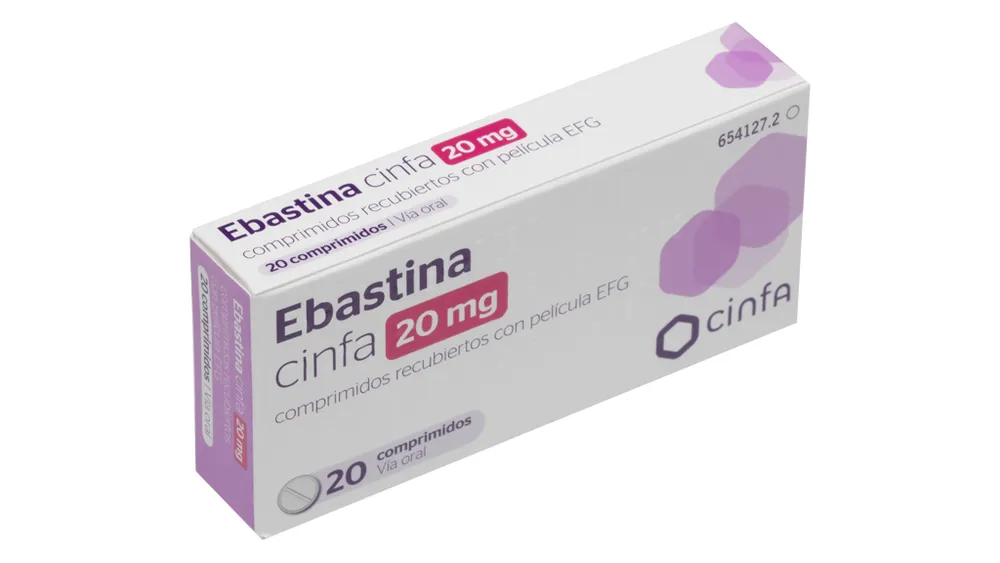
Table of Contents
Package leaflet: Information for the user
Introduction
Package leaflet: information for the user
ebastine cinfa 20 mg film-coated tablets EFG
Read the entire leaflet carefully before you start taking this medicine, because it contains important information for you.
- Keep this leaflet, as you may need to read it again.
- If you have any questions, ask your doctor or pharmacist.
- This medicine has been prescribed for you only, and you must not give it to other people even if they have the same symptoms as you, because it could harm them.
- If you experience any adverse effects, consult your doctor or pharmacist, even if they are adverse effects not listed in this leaflet. See section 4.
Contents of the leaflet
- What ebastine cinfa is and what it is used for
- What you need to know before taking ebastine cinfa
- How to take ebastine cinfa
- Possible side effects
- How to store ebastine cinfa
- Contents of the pack and other information
1. What ebastina cinfa is and what it is used for
Ebastine belongs to a group of medicines called antihistamines (antiallergic agents).
ebastina cinfa is indicated for the symptomatic treatment of allergic conditions such as seasonal or perennial allergic rhinitis, with or without allergic conjunctivitis (such as runny nose, nasal itching, eye itching, tearing, and sneezing), chronic urticaria, and allergic dermatitis.
2. What you need to know before starting ebastine cinfa
Do not take ebastine cinfa
If you are allergic to ebastine or to any of the other ingredients of this medicine (listed in section 6).
Warnings and precautions
Consult your doctor or pharmacist before starting to take ebastine cinfa.
This medicine should be used with caution:
- if your electrocardiogram (ECG) results are abnormal (QT interval prolongation).
- if you have abnormal blood potassium levels.
- if you have severe liver disease (see section “How to take ebastine cinfa”).
- if you are being treated with a type of medicine used to treat fungal infections called azole antifungals or with medicines used to treat certain infections called macrolide antibiotics (see section “Other medicines and ebastine cinfa”).
- if you are being treated with rifampicin, a type of medicine used to treat tuberculosis.
Do not use this medicine if you have an acute allergic emergency, as ebastine (the active substance in this medicine) takes 1 to 3 hours to take effect.
Children
Ebastine should not be administered to children under 12 years of age.
Other medicines and ebastine cinfa
Tell your doctor or pharmacist if you are taking, have recently taken, or might need to take any other medicines.
The following medicines may interact with ebastine; in such cases it may be necessary to adjust the dose or discontinue one of the treatments:
- Ebastine may enhance the effect of other medicines used to treat allergy (antihistamines).
- Ebastine should be used with caution in patients taking medicines called ketoconazole and itraconazole, used to treat fungal infections, or with a macrolide antibiotic called erythromycin (as they may cause changes in your ECG).
- The antihistaminic effect of ebastine may be reduced in patients taking a medicine called rifampicin, used to treat tuberculosis.
No interactions have been reported between ebastine and theophylline, warfarin, cimetidine, diazepam, or alcohol.
Interference with diagnostic tests
Ebastine may interfere with skin allergy test results; therefore, such tests should not be performed until 5–7 days after stopping treatment.
Taking ebastine cinfa with food and drink
The tablets can be taken with or without food.
Pregnancy and breastfeeding
If you are pregnant or breastfeeding, think you may be pregnant, or are planning to become pregnant, consult your doctor or pharmacist before using this medicine.
Pregnancy
There is no experience in pregnant women; therefore, it is recommended to consult a doctor before taking ebastine. The doctor will decide whether or not treatment should be initiated.
Breastfeeding
It is unknown whether this medicine passes into breast milk; therefore, it should not be used during breastfeeding.
Driving and using machines
No effects on psychomotor function or on the ability to drive or operate machinery have been observed at the recommended therapeutic doses. However, since somnolence and dizziness are listed among the adverse effects, you should assess your response to the medication before driving or operating machinery.
ebastine cinfa contains sodium
This medicine contains less than 1 mmol of sodium (23 mg) per tablet; i.e., essentially “sodium-free”.
3. How to take ebastine cinfa
Follow exactly the instructions for administering this medicine as given by your doctor or pharmacist. If in doubt, consult your doctor or pharmacist again.
Remember to take your medicine.
Your doctor will tell you how long to take ebastine for.
Posology
The recommended dose for adults and children over 12 years of age is 10 mg of ebastine (1 tablet of ebastine cinfa 10 mg) once daily, although some patients may require a dose of 20 mg (1 tablet of ebastine cinfa 20 mg) once daily.
Use in patients with severe liver disease: The dose of ebastine should not exceed 10 mg per day. In this case, the 10 mg formulation (ebastine cinfa 10 mg) is recommended.
Method of administration:
Ebastine tablets are for oral use. They may be taken with or without food. The tablets should be swallowed whole, without chewing, with a glass of liquid, preferably water.
The tablet's score line is intended only to facilitate breaking the tablet if you have difficulty swallowing it whole.
If you think that the effect of ebastine is too strong or too weak, inform your doctor or pharmacist.
If you take more ebastine cinfa than you should
Treatment of poisoning with this medicine consists of gastric lavage and administration of appropriate medication.
In case of overdose or accidental ingestion, contact your doctor or pharmacist immediately, or call the Toxicology Information Service at telephone number 91 562 04 20, indicating the medicine and the amount ingested.
If you forget to take ebastine cinfa
Do not take a double dose to make up for missed doses. Take the missed dose as soon as you remember, then continue with your regular dosing schedule. However, if it is almost time for your next dose, do not take the missed dose and wait to take the next dose at the usual time.
If you stop taking ebastine cinfa
Your doctor will advise you on how long to continue treatment with ebastine. Do not stop treatment early, as your symptoms may worsen.
If you have any further questions about the use of this medicine, ask your doctor or pharmacist.
4. Possible adverse effects
Like all medicines, this medicine may cause adverse effects, although not everyone experiences them.
The following adverse effects have been observed in clinical trials and post-marketing experience:
Very common (may affect more than 1 in 10 people): headache.
Common (may affect up to 1 in 10 people): somnolence, dry mouth.
Rare (may affect up to 1 in 1,000 people): hypersensitivity reactions: allergic reactions (such as anaphylaxis and angioedema), restlessness, insomnia, dizziness, decreased sensation or sensitivity to touch, decreased or altered taste, palpitations, tachycardia, abdominal pain, vomiting, nausea, digestive disturbances, liver inflammation (hepatitis), cholestasis, abnormal liver function tests (increased transaminases, gamma-GT, alkaline phosphatase and bilirubin), urticaria, skin rash, dermatitis, menstrual disorders, edema (swelling due to fluid accumulation), fatigue.
Frequency not known (cannot be estimated from available data): weight gain, increased appetite.
Reporting of adverse effects
If you experience any type of adverse effect, consult your doctor or pharmacist, even if it is a possible adverse effect not listed in this leaflet. You may also report them directly via the Spanish Pharmacovigilance System for Human Medicinal Products: https://www.notificaram.es. By reporting adverse effects, you can help provide more information on the safety of this medicine.
5. Storage of ebastine cinfa
Keep this medicine out of the sight and reach of children.
This medicine does not require any special storage conditions.
Do not use this medicine after the expiry date stated on the packaging after EXP. The expiry date refers to the last day of the month indicated.
Medicines must not be disposed of via wastewater or household waste. Instead, dispose of unused medicines and their packaging at a SIGRE point at your pharmacy. If you have any doubts, ask your pharmacist how to properly dispose of unused medicines and their packaging. This will help protect the environment.
6. Contents of the pack and other information
Composition of ebastina cinfa
The active substance is ebastine. Each tablet contains 10 mg of ebastine.
The other components are:
- Core: anhydrous colloidal silica, microcrystalline cellulose, sodium croscarmellose, and magnesium stearate.
- Coating: Opadry Y-1-7000 (hypromellose, titanium dioxide, and macrogol 400).
Appearance of the product and contents of the pack
ebastina cinfa is presented as white, cylindrical, biconvex, film-coated tablets, scored on one side and coded on the other.
It is available in PVC/PVDC-Aluminum blisters. Each pack contains 20 tablets.
Marketing Authorization Holder and Manufacturer
Laboratorios Cinfa, S.A.
Carretera Olaz-Chipi, 10. Polígono Industrial Areta
31620 Huarte (Navarra) - Spain
Date of the most recent review of this leaflet: September 2021
Detailed information on this medicinal product is available on the website of the Spanish Agency for Medicines and Health Products (AEMPS) (http://www.aemps.gob.es/)
You can access detailed and up-to-date information about this medicine by scanning with your mobile phone (smartphone) the QR code included in the leaflet and packaging. You can also access this information at the following internet address: https://cima.aemps.es/cima/dochtml/p/67674/P_67674.html
QR code a: https://cima.aemps.es/cima/dochtml/p/67674/P_67674.html