Dulcolax bisacodyl 10 mg suppositories
Spain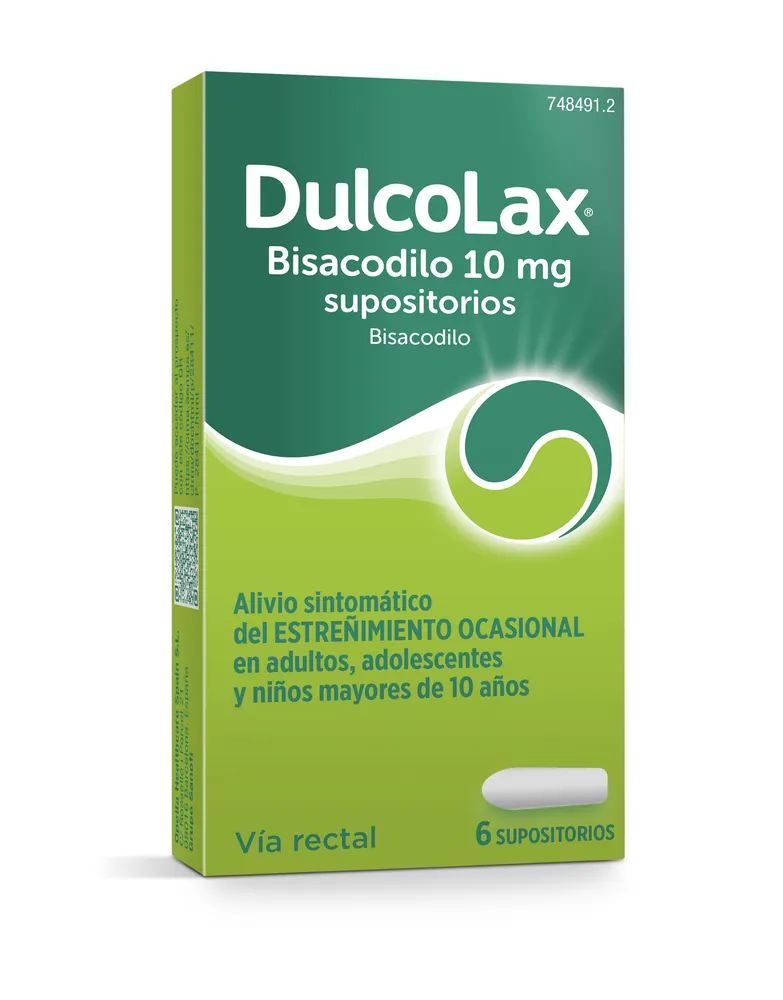
Table of Contents
Package leaflet: Information for the user
Introduction
Package leaflet: Information for the user
DulcoLax Bisacodyl 10 mg suppositories
Bisacodyl
Read all of this leaflet carefully before you start using this medicine, because it contains important information for you.
Always follow exactly the instructions for administration of the medicine as described in this leaflet or as given by your doctor or pharmacist.
- Keep this leaflet, as you may need to read it again.
- If you need advice or more information, consult your pharmacist.
- If you experience any adverse effects, consult your doctor or pharmacist, even if they are adverse effects not listed in this leaflet. See section 4.
- You should consult a doctor if your condition worsens, if no bowel movement occurs within 12 hours, or if there is no improvement after 7 days of treatment.
Contents of the leaflet
- What DulcoLax is and what it is used for
- What you need to know before using DulcoLax
- How to use DulcoLax
- Possible adverse effects
- How to store DulcoLax
- Contents of the pack and other information
1. What DulcoLax is and what it is used for
Bisacodyl, the active substance in this medicine, belongs to the group of stimulant laxatives, which act through direct contact with the intestinal mucosa, stimulating the nerve endings in the intestinal wall, thereby increasing intestinal motility.
It is indicated for the symptomatic relief of occasional constipation in adults, adolescents, and children over 10 years of age.
You should consult a doctor if your condition worsens or does not improve after 7 days of treatment.
2. What you need to know before using DulcoLax
Do not use DulcoLax:
- If you are allergic to bisacodyl or to any of the other ingredients of this medicine (listed in section 6).
- If you have abdominal pain of unknown origin.
- If you have intestinal obstruction or paralytic ileus.
- If you have appendicitis or intestinal perforation.
- If you have gastrointestinal bleeding or inflammatory bowel diseases (ulcerative colitis, Crohn's disease).
- If the patient is under 10 years of age, as this medicine contains 10 mg of bisacodyl.
- If you have disturbances in water or electrolyte metabolism.
- If you have hemorrhoids or anal fissures.
Warnings and precautions
- This medicine should not be used continuously on a daily basis or for prolonged periods without investigating the cause of constipation.
- If you are over 65 years of age or if you are a weakened patient, you should drink plenty of fluids and electrolytes, and inform your doctor that you are using a laxative so that they can monitor your electrolyte levels and prevent dehydration. Symptoms of dehydration include excessive thirst and reduced urination.
- If during the use of this medicine you experience dizziness and/or fainting, these may be due to constipation and not necessarily to the use of this medicine. These symptoms may occur as a result of straining during defecation or in response to abdominal pain.
- Stimulant laxatives, including DulcoLax, do not assist with weight loss.
Consult your doctor or pharmacist before starting to use DulcoLax:
- If, in addition to constipation, you have symptoms of appendicitis such as nausea, vomiting, or abdominal cramps, it is recommended that you see a doctor to determine whether you have appendicitis.
- If you suffer from chronic constipation, as the underlying cause should be investigated.
- If you have anal fissures or inflammation of the anal mucosa (ulcerative proctitis), as the use of suppositories may cause local pain and irritation.
Children and adolescents
Children under 10 years of age must not use this medicine.
Use of DulcoLax with other medicines
Inform your doctor or pharmacist if you are taking, have recently taken, or might need to take any other medicines.
In particular, if you are taking any of the following medicines, treatment may need to be interrupted or the dose adjusted:
- Medicines used to treat heart rhythm disorders: Antiarrhythmics (quinidine).
- Anti-inflammatory medicines (corticosteroids).
- Medicines used to increase urine elimination: Thiazide diuretics.
- Medicines used to treat heart conditions: Cardiac glycosides such as digoxin.
- Licorice-based medicines.
- Other laxatives.
- Should not be used with other medicines administered rectally.
Interference with diagnostic tests
- The use of this medicine may interfere with laboratory test results, as prolonged use of laxatives may lead to decreased potassium levels in the blood (hypokalemia).
Use of DulcoLax with food and drink
Do not consume licorice while using this medicine.
Pregnancy, breastfeeding, and fertility
If you are pregnant or breastfeeding, think you may be pregnant, or are planning to become pregnant, consult your doctor or pharmacist before using this medicine.
Driving and using machines
During the use of this type of laxative, a vasovagal response (e.g. abdominal cramps) may cause dizziness and/or syncope. If you experience abdominal cramps, you should avoid potentially hazardous tasks such as driving or operating machinery.
3. How to use DulcoLax
Follow exactly the administration instructions for this medicine provided in this leaflet or those indicated by your doctor or pharmacist. If in doubt, consult your doctor or pharmacist again.
The recommended dose for adults is:
1 suppository (10 mg of bisacodyl).
This medicine is administered rectally.
The suppository should be unwrapped and inserted into the rectum with the pointed end first.
The effect usually occurs within 20 minutes of administration (between 10 and 30 minutes).
If symptoms worsen, if no bowel movement occurs after 12 hours, or if symptoms persist after 7 days of treatment, you must consult your doctor.
Use in children and adolescents
Adolescents and children over 10 years of age
The recommended dose is 1 suppository (10 mg of bisacodyl).
Children under 10 years of age must not use this medicine, as it contains 10 mg of bisacodyl.
If you use more DulcoLax than you should
If you have used more DulcoLax than you should, consult your doctor or pharmacist immediately.
The most frequent symptoms of overdose are: abdominal cramps, vomiting, mucous and diarrheal stools, and loss of fluid, potassium, and other electrolytes, fatigue or weakness.
Treatment in these cases will consist of discontinuing the use of the laxative and subsequent rehydration with saline solution, fluids, and administration of mineral salts. These measures are especially important in the elderly and young people.
In case of overdose or accidental ingestion, go to your doctor or call the Toxicology Information Service (telephone: 91 562 04 20), indicating the medicine and the amount ingested.
4. Possible adverse effects
Like all medicines, this medicine may cause adverse effects, although not everyone experiences them.
During the period of use of bisacodil-containing medicines, the following adverse effects have been observed, although their frequency cannot be accurately determined. The most commonly occurring adverse effects are abdominal pain and diarrhoea. Other possible effects include abdominal discomfort, anorectal irritation, gastrointestinal disturbances such as pain or abdominal cramps (which may be associated with nausea and/or vomiting), bloody stools (haematochezia), flatulence, abdominal distension, reduced intestinal motility, and colitis. Less frequently, allergic reactions, skin rashes, dehydration, and swelling of the face, lips, mouth, tongue, or throat that may cause difficulty in swallowing or breathing (angioedema) may also occur.
Prolonged use of bisacodil-containing medicines, the active substance in this medicine, may lead to increased loss of water, potassium salts, and other electrolytes. This may result in disturbances of cardiac function, muscle weakness, and fatigue, particularly if administered concomitantly with diuretics and corticosteroids.
In addition, cases of dizziness and syncope have been reported. Dizziness and syncope occurring after taking bisacodil-containing medicines may be due to a vasovagal response (e.g. abdominal spasm, defecation).
Reporting of adverse effects:
If you experience any type of adverse effect, consult your doctor or pharmacist, even if it is a possible adverse effect not listed in this leaflet. You can also report them directly via the Spanish Pharmacovigilance System for Human Medicinal Products: https://www.notificaram.es. By reporting adverse effects, you can help provide more information on the safety of this medicine.
5. Storage of DulcoLax
Keep this medicine out of the sight and reach of children.
Do not store above 25°C.
Expiry date
Do not use this medicine after the expiry date stated on the packaging after EXP. The expiry date refers to the last day of the month indicated.
Medicines must not be disposed of via wastewater or household waste. Return unused medicines and their packaging to the SIGRE collection point at your pharmacy. If you are unsure, ask your pharmacist how to properly dispose of unused medicines and their packaging. This will help protect the environment.
6. Contents of the package and other information
Composition of DulcoLax
- The active substance is bisacodyl. Each suppository contains 10 mg of bisacodyl.
- The other components (excipients) are: solid semisynthetic glycerides q.s.
Appearance of the product and contents of the package
DulcoLax suppositories are yellowish-white in colour.
They are available in packages containing an aluminium blister strip of 6 or 12 suppositories.
Marketing Authorization Holder and Manufacturer
Marketing Authorization Holder:
Opella Healthcare Spain, S.L.
C/Rosselló i Porcel, 21
08016 Barcelona,
Spain
Manufacturer:
Istituto de Angeli, S.r.l.
Località Prulli, 103/C
50066 Reggello (Florence),
Italy
Date of the most recent revision of this package leaflet: November 2025
You can access detailed information about this medicine by scanning with your mobile phone (smartphone) the QR code included in the package leaflet. You can also access this information at the following internet address: https://cima.aemps.es/cima/dochtml/p/28411/P_28411.html
Detailed and up-to-date information on this medicine is available on the website of the Spanish Agency for Medicines and Health Products (AEMPS) http://www.aemps.gob.es/.