Droperidol Hikma 2.5 mg/ml solution for injection EFG
Spain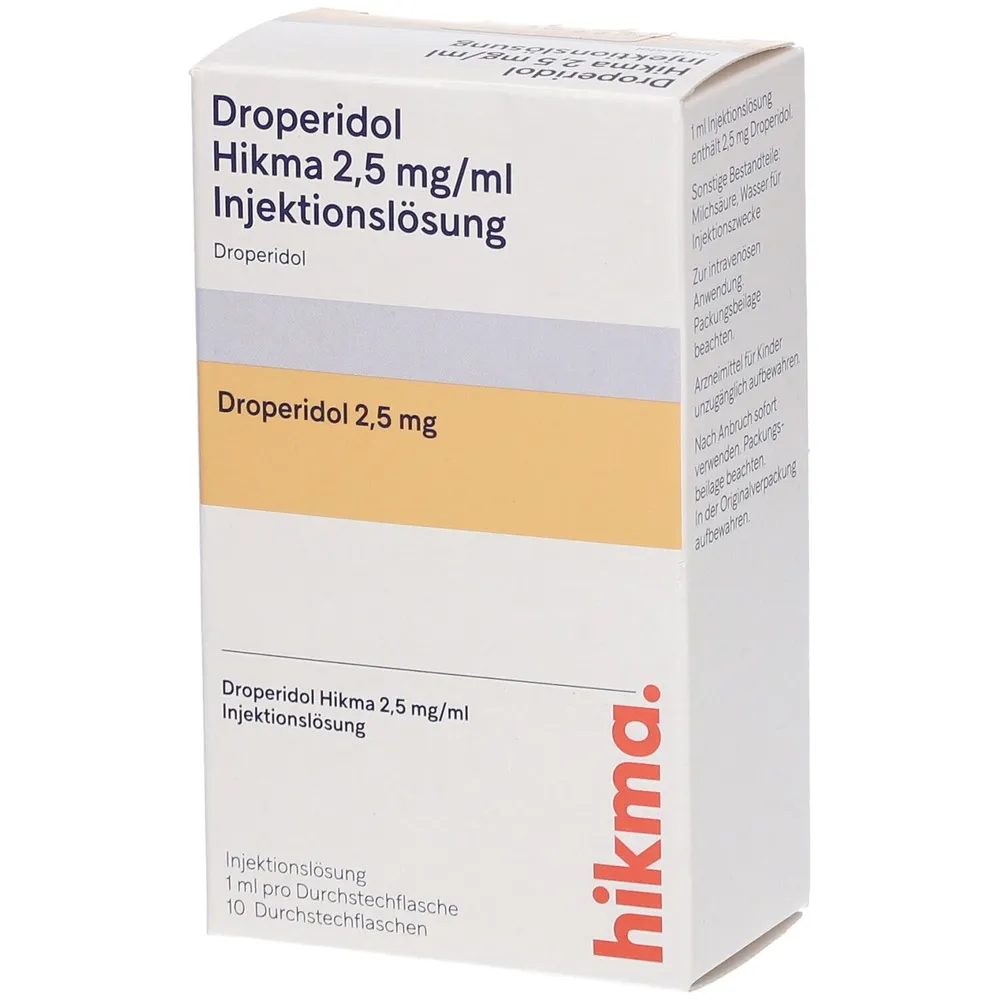
Table of Contents
- Package leaflet: Information for the user
- Introduction
- 1. What Droperidol Hikma is and what it is used for
- 2. What you need to know before Droperidol Hikma is administered to you
- 3. How to use Droperidol Hikma
- 4. Possible adverse effects
- 5. Storage of Droperidol Hikma
- 6. Contents of the pack and other information
Package leaflet: Information for the user
Introduction
Package leaflet: Information for the user
Droperidol Hikma 2.5 mg/ml solution for injection EFG
Read all of this leaflet carefully before you start using this medicine, because it contains important information for you.
- Keep this leaflet, as you may need to read it again.
- If you have any questions, ask your doctor or pharmacist.
- This medicine has been prescribed for you only and must not be given to other people, even if they have the same symptoms as you, because it may harm them.
- If you experience any adverse effects, consult your doctor or pharmacist, even if they are adverse effects not listed in this leaflet. See section 4.
Contents of the leaflet:
- What Droperidol Hikma is and what it is used for
- What you need to know before using Droperidol Hikma
- How to use Droperidol Hikma
- Possible side effects
- How to store Droperidol Hikma
- Contents of the pack and other information
1. What Droperidol Hikma is and what it is used for
Droperidol Hikma is an injectable solution of droperidol, used in adults, children (2 to 11 years of age), and adolescents (12 to 18 years of age) to prevent nausea or vomiting when waking up after surgery, or in adults to prevent nausea or vomiting when receiving morphine-derived analgesics after surgery.
The active substance of Droperidol Hikma is droperidol. Droperidol belongs to a group of antipsychotics known as butyrophenone derivatives.
2. What you need to know before Droperidol Hikma is administered to you
Do not use Droperidol Hikma if:
- you are allergic to droperidol or to any of the other ingredients of this medicine (listed in section 6).
- you are allergic to a group of medicines used to treat psychiatric disorders called butyrophenones (e.g. haloperidol, triperidol, benperidol, melperone, domperidone).
- you have, or someone in your family has, abnormalities in the electrocardiogram (ECG).
- you have low levels of potassium or magnesium in the blood.
- you have a heart rate below 55 beats per minute (your doctor or nurse will check this), or you are taking medicines that may cause this condition.
- you have a tumor of the adrenal gland (pheochromocytoma).
- you are in a coma.
- you have Parkinson's disease.
- you have severe depression.
Warnings and precautions
You should discuss with your doctor or pharmacist before starting to use droperidol, especially if:
- you have epilepsy or a history of epilepsy.
- you have heart problems or a history of heart disease.
- there is a family history of sudden death.
- you have kidney disorders (especially if undergoing long-term dialysis).
- you have any lung disease or breathing difficulties.
- you have prolonged vomiting or diarrhea.
- you are using insulin.
- you are taking diuretics that cause potassium loss (e.g. furosemide or bendroflumethiazide).
- you are taking laxatives.
- you are taking glucocorticoids (a type of steroid hormone).
- you or someone in your family has a history of blood clots, as this type of medicine has been associated with blood clot formation.
- you are or have been a heavy drinker (of alcohol).
Other medicines and Droperidol Hikma
Tell your doctor or pharmacist if you are taking, have recently taken, or might need to take any other medicines.
Do not use Droperidol Hikma if you are taking any of the following medicines:
What the medicine is used for | Medicine(s) |
Heart diseases | Quinidine, disopyramide, procainamide, amiodarone or sotalol |
Antibiotics | Erythromycin, clarithromycin, sparfloxacin |
Allergies | Astemizole, terfenadine |
Mental illnesses such as schizophrenia, etc. | Chlorpromazine, haloperidol, pimozide, thioridazine |
Malaria | Chloroquine, halofantrine |
Heartburn | Cisapride |
Infection | Pentamidine |
Nausea or vomiting | Domperidone |
Opioid dependence; pain | Methadone |
Concomitant use of metoclopramide and other neuroleptics should be avoided during treatment with droperidol, as this increases the risk of movement disorders induced by these medicines.
Droperidol, the active substance in Droperidol Hikma, may enhance the effects of sedatives such as barbiturates, benzodiazepines, and morphine-derived products. It may also increase the effects of medications used to lower blood pressure (antihypertensives) and of other medicines, such as certain antifungals, antivirals, and antibiotics. Some medicines may also increase the effects of droperidol, for example cimetidine (for gastric ulcers), ticlopidine (to prevent blood clotting), and mibefradil (for angina pectoris). If you have any further questions, please consult your doctor or nurse.
Use of Droperidol Hikma with food and alcohol
Avoid consuming alcoholic beverages during the 24 hours before and after administration of droperidol.
Pregnancy, breastfeeding, and fertility
If you are pregnant or breastfeeding, think you may be pregnant, or are planning to become pregnant, consult your doctor or pharmacist before taking this medicine.
If you are breastfeeding and need to take droperidol, a single dose is recommended. You may resume breastfeeding after the procedure.
Driving and use of machines
Droperidol has a marked effect on the ability to drive and use machines.
Do not drive or operate machinery for at least 24 hours after taking droperidol.
3. How to use Droperidol Hikma
Droperidol will be administered by a doctor as an injection into a vein.
The amount and manner in which droperidol is administered will depend on the situation. Your doctor will determine the dose of droperidol you require based on various criteria, including your weight, age, and medical condition.
The recommended dose in adults is between 0.625 and 1.25 mg, reduced to 0.625 mg for elderly patients (over 65 years of age) and for patients with hepatic or renal impairment. The recommended dose in children (2 to 11 years of age) and adolescents (12 to 18 years of age) is based on body weight (10 to 50 micrograms/kg), up to a maximum of 1.25 mg. The use of droperidol is not recommended in children under 2 years of age.
If you have any further questions about the use of this medicine, ask your doctor or nurse.
In case of overdose or accidental ingestion, contact your doctor or pharmacist immediately or call the Toxicology Information Service at telephone number: 91 562 04 20.
4. Possible adverse effects
Like all medicines, this medicine can cause adverse effects, although not everyone will experience them.
Contact your doctor immediately if you experience any increase in body temperature, muscle stiffness, tremors, rapid swelling of the face or throat, or if you feel chest pain after taking this medicine.
The following adverse effects have been reported: If any of these effects are severe, or if you notice any effects not listed in this leaflet, please inform your doctor, nurse, or pharmacist.
Common side effects (may affect up to 1 in 10 people) |
|
Uncommon side effects (may affect up to 1 in 100 people) |
|
Rare side effects (may affect up to 1 in 1,000 people) |
|
Very rare side effects (may affect up to 1 in 10,000 people) |
|
Other possible side effects with unknown frequency (frequency cannot be estimated from available data) are: |
|
Reporting of adverse reactions
If you experience any type of adverse reaction, consult your doctor or pharmacist, even if it is a possible adverse reaction not listed in this leaflet. You may also report them directly through the Spanish Pharmacovigilance System for Human Medicinal Products: www.notificaRAM.es. By reporting adverse reactions, you can help provide more information on the safety of this medicine.
5. Storage of Droperidol Hikma
Keep this medicine out of the sight and reach of children.
Do not use this medicine after the expiry date stated on the packaging and vial following Exp. The expiry date refers to the last day of the month indicated.
Store in the original packaging.
The solution should be used immediately after opening.
Compatibility of droperidol with morphine sulfate in 0.9% sodium chloride (14 days at room temperature) has been demonstrated in plastic syringes. From a microbiological standpoint, the diluted product should be used immediately. If not used immediately, the time and conditions under which the product has been stored after opening, prior to use, are the responsibility of the user and should normally not exceed 24 hours, stored at a temperature between 2 and 8 °C, unless the solution has been stored under validated, controlled, aseptic conditions.
Do not use Droperidol Hikma if there are any visible signs of degradation. The product should be inspected visually before use, and only clear solutions free from particles should be administered.
Medicines must not be disposed of via wastewater or household waste. Ask your pharmacist how to dispose of medicines and packaging you no longer require. This will help protect the environment.
6. Contents of the pack and other information
Composition of Droperidol Hikma
- The active substance is droperidol; each millilitre of solution contains 2.5 mg of droperidol.
- The other components are lactic acid and water for injectable preparations.
Appearance of the product and contents of the pack
Droperidol Hikma is a clear, colourless injectable solution contained in 2 ml amber glass vials. Each vial contains 1 ml of solution and is packaged in boxes containing 10 or 25 vials.
Only certain pack sizes may be marketed.
Marketing Authorisation Holder and Manufacturer
Hikma Farmacêutica (Portugal), S.A.
Estrada do Rio da Mó, 8 - Terrugem
2705-906 Sintra
Portugal
For further information about this medicinal product, please contact the local representative of the Marketing Authorisation Holder:
Hikma España, S.L.U.
Calle Anabel Segura nº11, Edificio A, planta 1ª, oficina 2
28108 - Alcobendas, Madrid
Spain
This medicinal product is authorised in the European Economic Area member states under the following names:
Portugal: Droperidol Hikma
Spain: Droperidol Hikma 2.5 mg solution for injection EFG
France: Dropéridol Hikma 2.5 mg/1 ml, solution injectable
Germany: Droperidol Hikma 2.5 mg/ml Injektionslösung
Italy: Droperidolo Hikma
United Kingdom: Droperidol 2.5 mg/ml Solution for injection
Date of the most recent review of this leaflet: December 2017
Detailed information on this medicinal product is available on the website of the Spanish Agency of Medicines and Health Products (AEMPS) http://www.aemps.gob.es/.
The following information is intended for healthcare professionals only:
In addition to the information included in section 3, the following practical information on preparation/handling of the medicinal product is provided:
Incompatibilities:
Incompatible with barbiturates.
Instructions for use, handling and disposal
For single use only. Any unused solution must be discarded.
The solution should be inspected visually before use. Only clear, colourless solutions free from visible particles should be used.
For use in PCA: Withdraw droperidol and morphine with a syringe and adjust to the desired volume with 0.9% sodium chloride for injection.
Disposal of unused medicine and of all materials that have come into contact with it must be carried out in accordance with local regulations.