Ditropan 5 mg tablets
Spain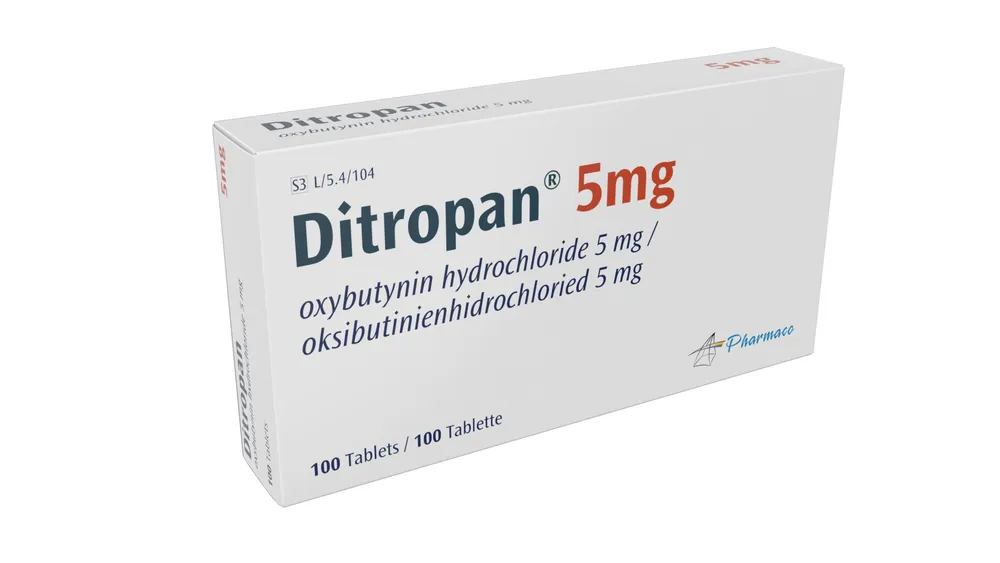
Table of Contents
Package leaflet: Information for the user
Introduction
Package leaflet: Information for the user
Ditropan 5 mg tablets
oxybutynin hydrochloride
Read the entire leaflet carefully before you start taking this medicine because it contains important information for you.
- Keep this leaflet as you may need to read it again.
- If you have any questions, ask your doctor or pharmacist.
- This medicine has been prescribed for you only, and you should not give it to other people, even if they have the same symptoms as you, because it may harm them.
- If you experience any adverse effects, consult your doctor or pharmacist, even if they are adverse effects not listed in this leaflet. See section 4.
Leaflet contents
- What Ditropan is and what it is used for
- What you need to know before taking Ditropan
- How to take Ditropan
- Possible side effects
- How to store Ditropan
- Contents of the pack and other information
1. What Ditropan is and what it is used for
Ditropan belongs to a group of medicines called urinary antispasmodics.
This medicine acts on bladder contractions and delays the urge to urinate. It can be used to treat certain types of incontinence and other urinary problems.
Ditropan may be used in children aged 5 years or older to treat:
- involuntary loss of urine (urinary incontinence)
- increased need or urgency to urinate
- involuntary loss of urine during the night, in combination with non-pharmacological treatment, when other treatments have not been effective
2. What you need to know before starting Ditropan
Please read the following sections carefully:
Do not take Ditropan
- if you are allergic to oxybutynin hydrochloride or to any of the other ingredients of this medicine (listed in section 6).
- if you have a urinary tract disorder with possible urine retention.
- if you have obstructive gastrointestinal disorders, intestinal atony (lack of intestinal tone), or paralytic ileus (functional intestinal obstruction).
- if you have toxic megacolon (abnormal, persistent dilation of the large intestine).
- if you have severe ulcerative colitis (a disease causing chronic diarrhea).
- if you have myasthenia gravis (muscle weakness).
- if you have glaucoma (increased eye pressure) or a shallow anterior chamber of the eye.
- if you have increased urinary frequency and nocturnal urination due to kidney or heart problems.
Warnings and precautions
Consult your doctor or pharmacist before starting Ditropan.
Special caution is required:
- if you have Parkinson's disease, as you may be at higher risk of adverse reactions to the medicine.
- if you have autonomic neuropathy (a neurological disorder).
- if you have intestinal disease (including intestinal obstruction), or liver or kidney problems.
- if you have clinically significant bladder obstruction, as this may worsen and lead to urinary retention.
- if you have gastrointestinal disorders, as Ditropan may reduce gastrointestinal motility.
- if you have hiatal hernia/gastroesophageal reflux and/or are taking medications such as bisphosphonates, as these may cause or worsen esophagitis.
- if you have a urinary tract infection, as appropriate antibacterial treatment should be initiated.
- if you are taking other anticholinergic medicines.
- because Ditropan may worsen cognitive disorders, symptoms of prostatic hypertrophy (enlarged prostate), and tachycardia (increased heart rate). Therefore, it should be used with caution in cases of hyperthyroidism (overactive thyroid gland), congestive heart failure, cardiac arrhythmia (abnormal heart rhythm), coronary artery disease, and hypertension (high blood pressure).
- because Ditropan may produce anticholinergic effects on the central nervous system, e.g., hallucinations, agitation, sleep disturbances, confusion, blurred vision, and drowsiness, and alcohol consumption may further increase drowsiness.
- because Ditropan could cause acute angle-closure glaucoma. Therefore, if you experience sudden loss of visual acuity or eye pain, contact a doctor immediately.
- because Ditropan could reduce saliva production, which may lead to dental caries, gum inflammation, or oral fungal infections.
- if you are in a high-temperature environment or have a fever, you may experience heat exhaustion due to decreased sweating caused by this medicine.
Elderly patients
Ditropan should be used with caution in elderly patients, as they are at higher risk of adverse reactions and cognitive decline.
Children
Children under 5 years of age
The use of this medicine is not recommended in children under 5 years of age.
Children aged 5 years and older
Children in this age group have an increased risk of experiencing adverse reactions to the medicine.
Other medicines and Ditropan
Tell your doctor or pharmacist if you are taking, have recently taken, or might need to take any other medicines.
Ditropan may affect the absorption of concomitantly administered medicines.
In particular, inform your doctor if you are currently taking any of the following medicines:
- phenothiazines, butyrophenones, clozapine (used in mental illnesses)
- medicines used to treat dementia, e.g., donepezil, rivastigmine, galantamine, or tacrine (cholinesterase inhibitors)
- tricyclic antidepressants (used to treat depression)
- antihistamines (used to treat allergies)
- amantadine, biperiden, levodopa (used for Parkinson's disease)
- quinidine (used to treat heart problems)
- certain antifungal medicines (e.g., ketoconazole and fluconazole) or certain antibiotics such as erythromycin
- atropine and related compounds (used to prevent muscle contractions)
- other anticholinergic medicines
- dipyridamole (used to prevent blood clots)
- prokinetics (used to increase gastrointestinal motility)
- bisphosphonates (used to treat osteoporosis)
- digitalis (used to stimulate the heart)
Ditropan and alcohol
Concomitant use of Ditropan and alcohol may increase drowsiness.
Pregnancy and breastfeeding
If you are pregnant or breastfeeding, think you may be pregnant, or are planning to become pregnant, consult your doctor or pharmacist before using this medicine.
Pregnancy
If you are pregnant or suspect you may be pregnant while taking Ditropan, inform your doctor immediately. It is recommended not to take this medicine during pregnancy unless your doctor considers it necessary.
Breastfeeding
Ditropan passes into breast milk. The use of this medicine is not recommended during breastfeeding. If your doctor considers its use necessary, breastfeeding should be discontinued.
Driving and using machines
Ditropan may cause drowsiness or blurred vision. Therefore, you should exercise caution when performing activities requiring mental alertness, such as driving, operating machinery, or performing hazardous work while taking this medicine.
Abuse and dependence
Oxybutynin dependence has been observed in patients with a history of substance dependence or abuse (see section 4).
Ditropan contains lactose
This medicine contains lactose. If your doctor has informed you that you have an intolerance to certain sugars, consult with your doctor before taking this medicine.
Ditropan contains sodium
This medicine contains less than 1 mmol of sodium (23 mg) per dose unit; hence, it is essentially "sodium-free".
3. How to take Ditropan
Follow exactly the administration instructions for this medicine as indicated by your doctor or pharmacist. If in doubt, consult your doctor or pharmacist again.
Dosage
Adults
The recommended dose in adults is 3 tablets (15 mg of oxybutynin hydrochloride) per day, divided into three doses. However, the 3 tablets may also be taken together at the end of the day in case of nocturnal urinary problems. The dose may be increased up to 4 tablets (20 mg of oxybutynin hydrochloride) per day and may also be reduced to a lower maintenance dose.
Use in children and adolescents
Children under 5 years of age
The safety and efficacy of Ditropan in children under 5 years of age have not yet been established.
Children aged 5 years or older
A dose of 2 tablets (10 mg of oxybutynin hydrochloride) per day is recommended. At least 4 hours should elapse between one dose and the next.
Elderly patients
In elderly patients, a dose of 2 tablets per day is usually sufficient.
If you think that the effect of Ditropan is too strong or too weak, consult your doctor or pharmacist.
Method of administration
Remember to take your medicine. Ditropan should be taken regularly as directed by your doctor throughout the treatment.
Ditropan is intended for oral use only.
The tablet should be swallowed whole or may be split and taken with a large amount of liquid to ensure passage through the esophagus. The taste of the tablets is unpleasant.
If you take more Ditropan than you should
In case of overdose or accidental ingestion, contact your doctor or pharmacist immediately or call the Toxicology Information Service at: 91 562 04 20, indicating the medicine and the amount taken.
If you have taken too much Ditropan, you may experience certain symptoms, e.g.: restlessness, excitement, psychotic behavior, flushing, decreased blood pressure, respiratory problems, paralysis, and coma.
If you forget to take Ditropan
If you miss a dose, wait until the next scheduled dose. Do not take a double dose to make up for missed doses.
If you stop taking Ditropan
If you have any further questions about the use of this medicine, ask your doctor or pharmacist.
4. Possible adverse effects
Like all medicines, this medicine may cause adverse effects, although not everyone experiences them.
Very common adverse effects (may affect more than 1 in 10 people):
Dry mouth, constipation, nausea, dizziness, drowsiness, blurred vision, difficulty in urination, dry skin, headache.
Common adverse effects (may affect up to 1 in 10 people):
Asthenia, diarrhoea, vomiting, dysgeusia (disturbance of taste sensation), flatulence, confusion, atrial arrhythmia, nodal arrhythmia, supraventricular extrasystoles, strong heartbeats which may be rapid or irregular, dry eyes, urinary retention, haematuria (presence of blood in urine), nocturia (need to urinate at night), pyuria (presence of leukocytes in urine), pharyngitis (inflammation of the pharynx), skin redness.
Uncommon adverse effects (may affect up to 1 in 100 people):
Abdominal discomfort, anorexia (lack of appetite), decreased appetite, dysphagia (difficulty swallowing), cough, epistaxis (nosebleed), vulvovaginitis (inflammation of the vulva and vagina).
Rare adverse effects (may affect up to 1 in 1,000 people):
Photosensitivity (sensitivity to light), thrombocytopenia (reduced number of platelets).
Frequency not known (cannot be estimated from available data):
Gastro-oesophageal reflux, gastritis, pseudo-obstruction in at-risk patients (in elderly patients or patients with constipation and those being treated with other medicines that reduce intestinal motility), hallucinations, agitation, seizures, anxiety, nightmares, paranoia (suspiciousness, delusions), cognitive disorders especially in elderly patients, symptoms of depression and oxybutynin dependence (in patients with a history of substance dependence or abuse), tachycardia (increased heart rate), arrhythmia, closed-angle glaucoma (increased intraocular pressure), mydriasis (pupil dilation), increased intraocular pressure, urinary tract infection, adverse reactions such as generalized cutaneous erythema, urticaria, angioedema (generalized swelling of feet, hands, throat, lips and airways), skin rashes, hypohidrosis (reduced sweating), heat stroke, hypersensitivity, muscular disorders (pain, cramps or weakness).
Reporting of adverse effects
If you experience any type of adverse effect, consult your doctor or pharmacist, even if it is a possible adverse effect not listed in this leaflet. You may also report them directly via the Spanish Pharmacovigilance System for Human Medicinal Products: https://www.notificaRAM.es. By reporting adverse effects, you can help provide more information on the safety of this medicine.
5. Storage of Ditropan
Keep this medicine out of the sight and reach of children.
Store in the original packaging. Store below 30 °C.
Do not use this medicine after the expiry date stated on the pack after EXP. The expiry date refers to the last day of the month indicated.
Do not use this medicine if you notice that the tablets look different (for example, if they change colour).
Medicines must not be disposed of via wastewater or household waste. Unused containers and medicines should be returned to the SIGRE Point at your pharmacy. Ask your pharmacist how to dispose of containers and medicines you no longer need. This will help protect the environment.
6. Contents of the pack and other information
Composition of Ditropan
- The active substance is oxibutynin hydrochloride. Each tablet contains 5 mg of oxibutynin hydrochloride.
- The other components (excipients) are: lactose, indigo carmine aluminium lake (E132), microcrystalline cellulose and calcium stearate.
Appearance of the product and contents of the pack
Ditropan is presented as tablets. Each pack contains 60 tablets. The tablets are round, biconvex, light blue in colour, with a central break-line on one side and the imprint “OXB5” on the opposite side.
Marketing Authorisation Holder and Manufacturer
Marketing Authorisation Holder
CHEPLAPHARM Arzneimittel GmbH
Ziegelhof 24
17489 Greifswald
Germany
Manufacturer
Sanofi Winthrop Industrie
Avenue Gustave Eiffel, 30-36
37100 Tours
France
or
Fidelio Healthcare Limburg GmbH
Mundipharmastraße 2
65549 Limburg an der Lahn
Germany
Local Representative
Laboratorios Rubió, S.A.
Industria, 29
Pol. Ind. Comte de Sert
08755 Castellbisbal (Barcelona)
Spain
Date of the most recent review of this leaflet: June 2023.
Other sources of information
Detailed information on this medicinal product is available on the website of the Spanish Agency for Medicines and Health Products (AEMPS) http://www.aemps.gob.es/.