Diclofenac Lepori 1 mg/ml eye drops solution
Spain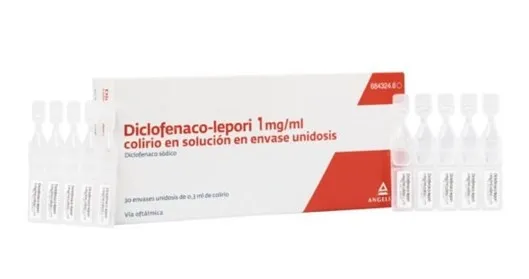
Table of Contents
- Package leaflet: Information for the user
- Introduction
- 1. What Diclofenac-lepori eye drops solution is and what it is used for
- 2. What you need to know before using Diclofenaco-lepori eye drops solution
- 3. How to use Diclofenac-lepori eye drops solution
- 4. Possible adverse effects
- 5. Storage of Diclofenac-lepori eye drops solution
- 6. Contents of the container and other information
Package leaflet: Information for the user
Introduction
Package leaflet: information for the user
Diclofenaco-lepori 1 mg/ml eye drops solution
Sodium diclofenac
Read all of this leaflet carefully before you start using this medicine, because it contains important information for you.
- Keep this leaflet as you may need to read it again.
- If you have any questions, ask your doctor or pharmacist.
- This medicine has been prescribed for you only, and you should not give it to others, even if they have the same symptoms as you, because it could harm them.
- If you experience any adverse effects, consult your doctor or pharmacist, even if they are adverse effects not listed in this leaflet. See section 4.
Leaflet contents:
- What Diclofenaco-lepori eye drops solution is and what it is used for
- What you need to know before using Diclofenaco-lepori eye drops solution
- How to use Diclofenaco-lepori eye drops solution
- Possible adverse effects
- How to store Diclofenaco-lepori eye drops solution
- Contents of the pack and other information
1. What Diclofenac-lepori eye drops solution is and what it is used for
This medicine belongs to the group of topical ophthalmological medications. It contains sodium diclofenac as the active substance, which is a non-steroidal anti-inflammatory drug (NSAID).
Diclofenac-lepori eye drops solution is used for:
- Postoperative treatment of inflammation of the anterior segment of the eye.
- Treatment to inhibit miosis (pupil constriction) during and after cataract surgery.
- Symptomatic treatment of chronic non-infectious conjunctivitis.
- Treatment of ocular inflammation, ocular pain, and photophobia following refractive surgery (performed to correct myopia, astigmatism, and hyperopia).
2. What you need to know before using Diclofenaco-lepori eye drops solution
Do not use Diclofenaco-lepori eye drops solution
- If you are allergic to the active substance or to any of the other components of this medicine (listed in section 6).
- if you suffer from asthma attacks, urticaria, or acute rhinitis when administered acetylsalicylic acid or other drugs with similar prostaglandin synthetase-inhibiting activity.
- if you know you are sensitive to acetylsalicylic acid, or to phenylacetic acid derivatives—which belong to the same chemical group as the active substance in this medicine—or to other non-steroidal anti-inflammatory drugs (NSAIDs), as there may be cross-sensitivity to these drugs.
Warnings and precautions
Consult your doctor or pharmacist before starting to use Diclofenaco-lepori eye drops solution.
- In case of infection or when there is a risk of infection, your doctor may prescribe Diclofenaco-lepori eye drops solution together with another appropriate treatment (e.g., antibiotics). Non-steroidal anti-inflammatory drugs (NSAIDs) may mask an acute infectious process.
- If you have problems stopping bleeding or are taking any medication that may prolong bleeding time, inform your doctor before using Diclofenaco-lepori eye drops solution (see section “Other medicines and Diclofenaco-lepori eye drops solution”).
- If you are using non-steroidal anti-inflammatory drugs such as diclofenac, or corticosteroids in the form of eye drops, consult your doctor before using this medicine.
Do not exceed the recommended dose stated in the dosage instructions, as more frequent application than recommended may lead to complications in the cornea.
If you wear soft contact lenses, it is advisable to instill the eye drops from the container only when lenses are not worn (see section “Diclofenaco-lepori eye drops solution contains benzalkonium chloride”).
Children
Diclofenaco-lepori eye drops solution is not indicated for use in children, as experience with use in this population is limited.
Use of Diclofenaco-lepori eye drops solution with other medicines
Inform your doctor or pharmacist if you are using, have recently used, or might need to use any other medicines.
If you are taking non-steroidal anti-inflammatory drugs such as diclofenac, or corticosteroids, consult your doctor before using this medicine, as there may be a risk of complications.
Wait at least 5 minutes between the application of different ophthalmic medications.
Pregnancy, breastfeeding and fertility
If you are pregnant or breastfeeding, think you may be pregnant, or plan to become pregnant, consult your doctor or pharmacist before using this medicine.
Diclofenaco-lepori eye drops should not be used during the last 3 months of pregnancy. You should not use Diclofenaco-lepori eye drops during the first 6 months of pregnancy unless strictly necessary and recommended by your doctor. If treatment is required during this period, the lowest possible dose for the shortest possible duration should be used.
Oral formulations (e.g., tablets) of Diclofenaco-lepori may cause adverse effects on the fetus. It is unknown whether the same risk applies to Diclofenaco-lepori eye drops when used in the eyes.
Although no adverse effects have been reported following its use, its use during breastfeeding is not recommended unless the expected benefits outweigh the potential risks.
Driving and using machines
After instillation of Diclofenaco-lepori eye drops solution, transient blurred vision may occur. If this happens, do not drive or operate machinery until this effect has disappeared.
Diclofenaco-lepori eye drops solution contains benzalkonium chloride and boron
This medicine contains 10 mg of benzalkonium chloride per 100 ml.
Benzalkonium chloride can be absorbed by soft contact lenses and may alter their color. Remove contact lenses before using this medicine and wait 15 minutes before reinserting them.
Benzalkonium chloride may cause ocular irritation, especially if you have dry eye or other corneal diseases (the transparent layer on the front of the eye). Consult your doctor if you experience a foreign body sensation, stinging, or eye pain after using this medicine.
Do not administer to children under 12 years of age, as this medicine contains boron and may affect future fertility.
3. How to use Diclofenac-lepori eye drops solution
Follow exactly the instructions for use of this medicine as given by your doctor. If in doubt, consult your doctor or pharmacist again.
The correct dosage for the conditions indicated below is as follows:
-
Before surgery: 1 drop of the eye drops 3 to 5 times within the 3 hours prior to surgery, administered at regular time intervals, meaning a maximum of 5 drops.
-
After surgery: 3 drops of the eye drops administered at regular time intervals, starting immediately after surgery. Afterwards, for the required period, 1 to 2 drops of the eye drops 3 to 5 times daily, meaning a maximum daily dose of 10 drops.
-
Other indications: 1 to 2 drops of the eye drops 3 to 4 times daily, depending on the severity of the condition, meaning a maximum daily dose of 8 drops.
If you feel that the effect of Diclofenac-lepori eye drops solution is too strong or too weak, inform your doctor or pharmacist.
Use in elderly patients
There is no indication that the dose needs to be modified in elderly patients.
Use in children
The use of Diclofenac-lepori eye drops solution is not indicated in children.
Instructions for administration
Tilt your head backwards, pull down the lower eyelid and instill the drop into the conjunctival sac (space between the eye and eyelid) while looking upwards. Gently close your eyes and keep them closed for 5 minutes. This increases effectiveness and reduces the risk of adverse reactions. Wait at least 5 minutes before using other ophthalmic medications.
As this is a sterile medicine, it is recommended to follow these instructions:
- Each patient should use their own container.
- The eye drops should be administered with maximum care, avoiding contact with the dropper tip whenever possible.
- After each use, close the container tightly.
- After completion of treatment, the medicine should be discarded, even if not completely used up.
Your doctor will indicate how long you should use Diclofenac-lepori 1 mg/ml eye drops solution. Do not stop treatment earlier than advised.
If you use more Diclofenac-lepori eye drops solution than you should
In case of overdose or accidental ingestion, consult your doctor or pharmacist immediately, or call the Toxicology Information Service at: 91 562 04 20.
If you forget to use Diclofenac-lepori eye drops solution
Do not use a double dose to make up for missed doses. If you forget a dose, take it as soon as possible, unless it is almost time for the next dose; then return to your regular dosing schedule. If you forget several doses, consult your doctor.
If you have any further questions about the use of this medicine, ask your doctor or pharmacist.
4. Possible adverse effects
Like all medicines, this medicine can cause adverse effects, although not everyone will experience them.
Talk to your doctor or pharmacist if you experience any of the following adverse effects:
Very common
Eye disorders: eye pain
Common
Eye disorders: eye irritation
Uncommon
Eye disorders: eye itching, eye redness, blurred vision, corneal disorder
Rare
Immune system disorders: hypersensitivity
Eye disorders: small spots on the surface of the eye (punctate keratitis), inflammation and ulceration of the cornea (ulcerative keratitis), corneal thinning, defect in the outermost layer of the cornea, inflammation of the cornea.
Respiratory, thoracic and mediastinal disorders: dyspnea (difficulty breathing), worsening of asthma.
Skin and subcutaneous tissue disorders: redness (erythema), itching
Frequency not known
Infections and infestations: rhinitis
Eye disorders: redness of the surface of the eye (conjunctival hyperemia), allergic conjunctivitis, redness of the eyelids (eyelid erythema), ocular allergy, eyelid inflammation, eyelid itching
Respiratory, thoracic and mediastinal disorders: cough
Skin and subcutaneous tissue disorders: urticaria, rash, eczema.
Reporting of adverse effects:
If you experience any adverse effect, consult your doctor or pharmacist, even if it is a possible adverse effect not listed in this leaflet. You may also report them directly via the Spanish Pharmacovigilance System for Human Medicines: https://www.notificaram.es.
By reporting adverse effects, you can help provide more information on the safety of this medicine.
5. Storage of Diclofenac-lepori eye drops solution
Keep this medicine out of the sight and reach of children.
Do not store above 30°C. Close the container tightly after each use.
After opening the container, the prepared eye drops, stored under normal environmental conditions, may be used for a period not exceeding one month.
Do not use this medicine after the expiry date stated on the packaging after EXP. The expiry date refers to the last day of the month indicated.
Medicines must not be disposed of via wastewater or household waste. Dispose of unused medicines and their containers at the SIGRE collection point at your pharmacy. If you are in doubt, ask your pharmacist how to dispose of unused medicines and their containers. This will help protect the environment.
6. Contents of the container and other information
Composition of Diclofenac-lepori eye drops solution
- The active substance is sodium diclofenac. One ml of eye drops contains 1 mg of this active substance.
- The other components are L-lysine monohydrate, boric acid (E-284), sodium borate (borax) (E-285), sodium chloride, polyoxethylated 35 castor oil, benzalkonium chloride, sodium edetate, water for injections.
Appearance of the product and contents of the container
Diclofenac-lepori 1 mg/ml eye drops in solution are supplied in cardboard packs containing a polyethylene dropper bottle with a polypropylene cap, holding 5 ml of eye drops solution.
Marketing Authorization Holder and Manufacturer
Marketing Authorization Holder
ANGELINI PHARMA ESPAÑA, S.L.
c/ Antonio Machado, 78-80
3rd floor, module A-Edificio Australia
08840 Viladecans, Barcelona (Spain)
Manufacturer
TUBILUX PHARMA S.P.A.
Via Costarica, 20/22
00040 Pomezia (Rome, Italy)
Date of the most recent revision of this summary: August 2024
Detailed and up-to-date information on this medicinal product is available on the website of the Spanish Agency of Medicines and Medical Devices (AEMPS) http://www.aemps.gob.es/