Dexchlorpheniramine maleate Accord 5 mg/ml solution for injection EFG
Spain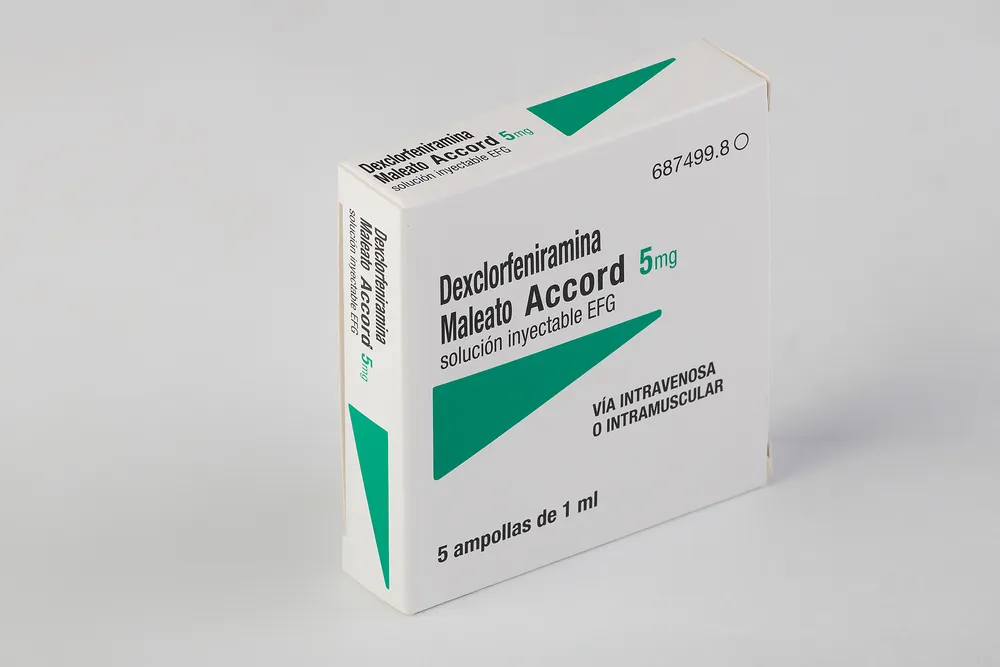
Table of Contents
- Package leaflet: Information for the user
- Introduction
- 1. What Dexclorpheniramine Maleate Accord injectable solution is and what it is used for
- 2. What you need to know before using Dexchloropheniramine Maleate Accord injectable solution
- 3. How to use Dexchloropheniramine Maleate Accord injectable solution
- 4. Possible adverse effects
- 5. Storage of Dexchlorpheniramine Maleate Accord injectable solution
- 6. Contents of the pack and other information
Package leaflet: Information for the user
Introduction
Package leaflet: information for the user
Dexchlorpheniramine Maleate Accord 5 mg injectable solution EFG
Read all of this leaflet carefully before you start using this medicine, because it contains important information for you.
- Keep this leaflet. You may need to read it again.
- If you have any further questions, ask your doctor, pharmacist or nurse.
- This medicine has been prescribed for you only, and you should not give it to others, even if they have the same symptoms as you. It may harm them.
- If you get any side effects, talk to your doctor, pharmacist or nurse. This includes any side effects not listed in this leaflet.
Contents of the leaflet
- What Dexchlorpheniramine Maleate Accord injectable solution is and what it is used for
- What you need to know before using Dexchlorpheniramine Maleate Accord injectable solution
- How to use Dexchlorpheniramine Maleate Accord injectable solution
- Possible side effects
- How to store Dexchlorpheniramine Maleate Accord injectable solution
- Contents of the pack and other information
1. What Dexclorpheniramine Maleate Accord injectable solution is and what it is used for
Dexchlorpheniramine belongs to a group of medicines known as antihistamines, which compete with histamine for receptors on effector cells. Dexchlorpheniramine Maleate Accord 5 mg/ml injectable solution is presented as an injectable solution.
Dexchlorpheniramine Maleate Accord 5 mg injectable solution is indicated for the symptomatic treatment of acute urticaria when oral administration is not practicable.
You should consult a doctor if your condition worsens or does not improve.
2. What you need to know before using Dexchloropheniramine Maleate Accord injectable solution
Do not use Dexchloropheniramine Maleate Accord injectable solution:
- if you are allergic (hypersensitive) to the active substance or to any of the other components of this medicine (listed in section 6) or to other antihistamines with a similar chemical structure.
- Dexchloropheniramine Maleate Accord must not be administered to children under 30 months of age.
- if you are currently being treated with, or have been treated within the previous two weeks, with a type of antidepressant known as monoamine oxidase inhibitors (MAOIs).
- if you are at risk of closed-angle glaucoma.
- if you are at risk of urinary retention due to urethral or prostate problems.
- if you are in the third trimester of pregnancy.
Warnings and precautions
Consult your doctor, pharmacist, or nurse before starting to use Dexchloropheniramine Maleate Accord.
The use of this medicine should not delay the administration of adrenaline.
Dexchloropheniramine maleate should be used with caution:
- in elderly patients who may have increased sensitivity to orthostatic hypotension, dizziness, and sedation, as well as in those with chronic constipation or possible prostate hypertrophy.
- in cases of severe renal and/or hepatic impairment.
Children
- in the pediatric population, as it may cause excitation.
Interaction of Dexchloropheniramine Maleate Accord injectable solution with other medicines
Inform your doctor or pharmacist if you are taking, have recently taken, or might need to take any other medicines.
In particular, inform your doctor if you are taking:
- sedative antidepressants, barbiturates, benzodiazepines, clonidine and similar agents, hypnotics (central nervous system depressants).
- morphine derivatives (analgesics and antitussives).
- methadone, neuroleptics, anxiolytics.
- imipramine-type antidepressants, antiparkinsonian agents, anticholinergics, atropine-like antispasmodics, disopyramide, phenothiazine neuroleptics (atropine and other atropine-like substances).
Do not use dexchloropheniramine maleate with central nervous system depressants, as it may lead to increased central depression and impaired alertness.
Use of Dexchloropheniramine Maleate Accord with food, beverages and alcohol
You should avoid alcoholic drinks or medications containing alcohol. Alcohol increases the sedative effect of H1 antihistamines. Alertness may be reduced, which could be dangerous when driving vehicles or operating machinery.
Pregnancy, lactation and fertility
If you are pregnant or breastfeeding, think you may be pregnant, or plan to become pregnant, consult your doctor or pharmacist before using this medicine.
Pregnancy
Dexchloropheniramine maleate must not be administered during the third trimester of pregnancy, nor to newborns or premature infants.
During the first two trimesters of pregnancy, Dexchloropheniramine Maleate Accord should be used only if considered necessary by your doctor.
Lactation
Dexchloropheniramine Maleate Accord injectable solution is excreted in breast milk. There is insufficient information on the effects of dexchloropheniramine in newborns.
Dexchloropheniramine Maleate Accord 5 mg/ml injectable solution must not be used during breastfeeding.
Fertility
There are no adequate data on the effect of dexchloropheniramine on patient fertility.
Driving and use of machines
Dexchloropheniramine Maleate Accord 5 mg/ml injectable solution may cause drowsiness, impairing mental and/or physical abilities. If you experience these effects, avoid driving vehicles or operating machinery.
3. How to use Dexchloropheniramine Maleate Accord injectable solution
Follow exactly the instructions for using this medicine as given by your doctor or pharmacist. If in doubt, consult your doctor or pharmacist again.
The recommended dose is 5 mg (1 ampoule) administered intravenously or intramuscularly.
The maximum daily dose is 20 mg (4 ampoules). In case of a reaction during a blood transfusion, do not administer dexchloropheniramine maleate through the transfusion line, but separately.
The dose should be individualized according to the patient's needs and response.
Use in children
The safety and efficacy of dexchloropheniramine maleate in children under 30 months of age have not been established. No data are available.
If you use more Dexchloropheniramine Maleate Accord than you should
In case of overdose or accidental ingestion, consult your doctor or pharmacist immediately or call the Toxicology Information Service at telephone number 91 562 04 20, indicating the medicine and the amount ingested.
If you forget to use Dexchloropheniramine Maleate Accord
Do not take a double dose to make up for forgotten doses. Take the usual dose at the next scheduled time (according to section 3, "How to use Dexchloropheniramine Maleate Accord injectable solution").
If you stop using Dexchloropheniramine Maleate Accord injectable solution
If you have any further questions about the use of this medicine, ask your doctor, pharmacist, or nurse.
4. Possible adverse effects
Like all medicines, Dexchlorpheniramine Maleate Accord may cause adverse effects, although not everyone experiences them.
Nervous system disorders:
-
Sedation or drowsiness (more pronounced at the beginning of treatment).
-
Orthostatic hypotension.
-
Balance disorders, dizziness, decreased memory or concentration (more frequent in the elderly).
-
Motor incoordination.
-
Mental confusion, hallucinations.
-
Agitation, nervousness, insomnia.
Skin and subcutaneous tissue disorders:
-
Skin rash, eczema, pruritus, purpura, urticaria, occasionally very extensive.
-
Edema.
Immune system disorders:
- Anaphylactic shock.
Blood and lymphatic system disorders:
-
Leukopenia, neutropenia.
-
Thrombocytopenia.
-
Haemolytic anaemia.
General disorders and administration site conditions:
- Dryness of mucous membranes, constipation, ocular accommodation disorders, mydriasis, cardiac palpitations, risk of urinary retention.
Reporting of adverse effects
If you experience any type of adverse effect, consult your doctor or pharmacist, even if it is a possible adverse effect not listed in this leaflet. You may also report them directly through the Spanish Pharmacovigilance System for Human Medicines: https://www.notificaram.es. By reporting adverse effects, you can help provide more information on the safety of this medicine.
5. Storage of Dexchlorpheniramine Maleate Accord injectable solution
Keep this medicine out of the sight and reach of children.
This medicine does not require any special storage conditions.
Do not use this medicine after the expiry date stated on the carton. The expiry date is the last day of the month indicated.
Medicines should not be disposed of via wastewater or household waste. Unwanted medicines and their containers should be returned to a SIGRE collection point at your pharmacy. If you are unsure, ask your pharmacist how to dispose of unwanted medicines and containers. This will help protect the environment.
6. Contents of the pack and other information
Composition of Dexchloropheniramine Maleate Accord
- The active substance is dexchloropheniramine maleate, 5 mg per ml.
- The other component is water for injections.
Appearance of the product and contents of the pack
Dexchloropheniramine Maleate Accord 5 mg injectable solution is presented as an injectable solution. Each box contains 5 ampoules of 1 ml.
Marketing Authorisation Holder:
Accord Healthcare S.L.U.
World Trade Center. Moll de Barcelona, s/n,
Edifici Est, 6th floor.
08039, Barcelona
Spain
Manufacturer:
Laboratorio Italiano Biochimico Farmaceutico
Lisapharma S.p.A.
Via Licinio, 11 – Erba (CO), Italy
This medicinal product is authorised in the Member States of the European Economic Area under the following names:
Spain: Dexchloropheniramine Maleate Accord 5 mg solution for injection EFG
Portugal: Dexchloropheniramine Maleate Accord 5 mg/ml injectable solution MG
Date of the most recent review of this leaflet: January 2012
Detailed and up-to-date information on this medicinal product is available on the website of the Spanish Agency of Medicines and Health Products (AEMPS) http://www.aemps.gob.es/