Deltyba 50 mg film-coated tablets
Spain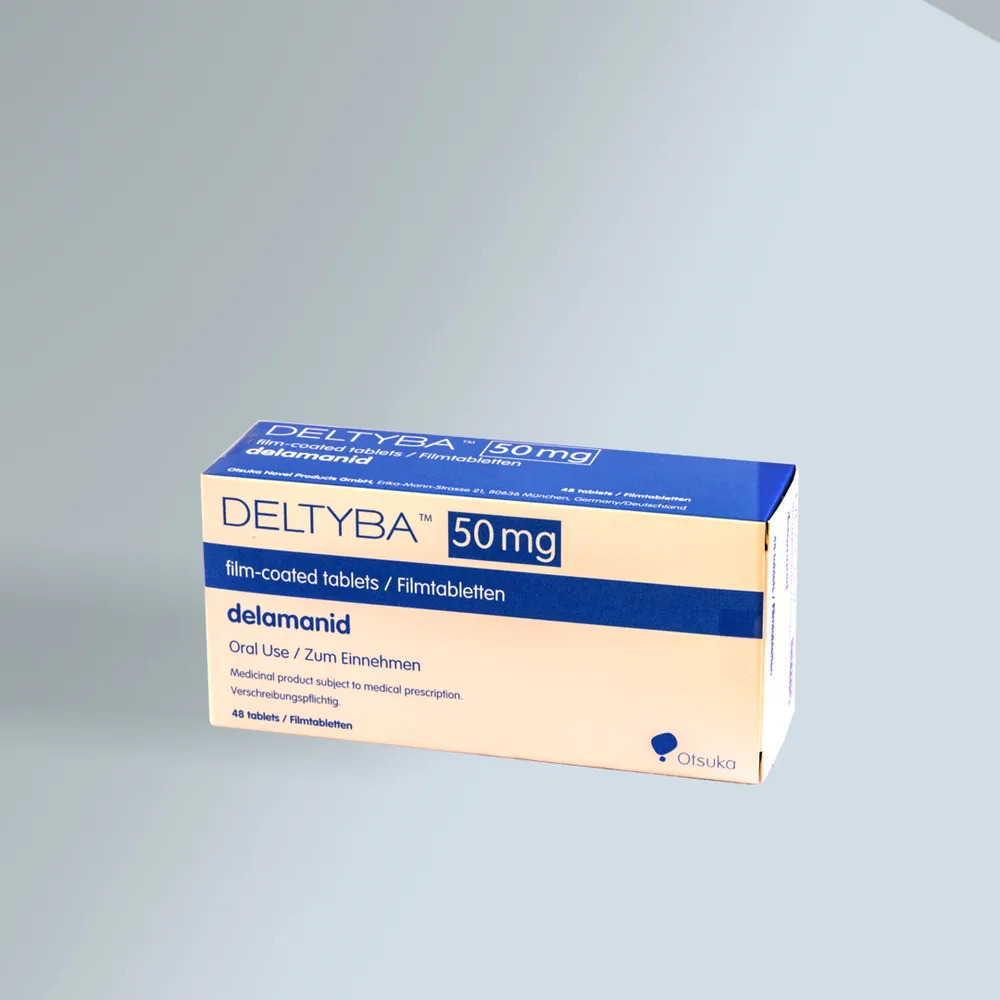
Table of Contents
Patient Information Leaflet
Introduction
Package Leaflet: Information for the Patient
Deltyba 50mg Film-coated Tablets
delamanid
This medicinal product is subject to additional monitoring, which will facilitate the rapid identification of new safety information. You can help by reporting any adverse reactions you may experience. Information on how to report adverse reactions is included at the end of section 4.
Read this leaflet carefully before you start taking this medicine, as it contains important information for you.
- Keep this leaflet, as you may need to read it again.
- If you have any questions, ask your doctor, pharmacist, or nurse.
- This medicine has been prescribed for you only, and you should not give it to other people, even if they have the same symptoms as you, because it may harm them.
- If you experience any adverse reactions, consult your doctor, pharmacist, or nurse, even if they are adverse reactions not listed in this leaflet. See section 4.
Leaflet Contents
- What Deltyba is and what it is used for
- What you need to know before taking Deltyba
- How to take Deltyba
- Possible adverse reactions
- How to store Deltyba
- Contents of the pack and other information
1. What Deltyba is and what it is used for
Deltyba contains the active substance delamanid, an antibiotic for the treatment of pulmonary tuberculosis caused by bacteria that are not eliminated by the antibiotics most frequently used to treat tuberculosis.
It must always be taken together with other medicines for the treatment of tuberculosis.
Deltyba is used in adults, adolescents, children, and infants weighing at least 10 kg.
2. What you need to know before taking Deltyba
Do not take Deltyba
- if you are allergic to delamanid or to any of the other ingredients of this medicine (listed in section 6).
- if you have very low levels of albumin in your blood.
- if you are taking medicines that strongly increase the activity of a specific liver enzyme called "CYP450 3A4" (e.g., carbamazepine, a medicine used to treat epilepsy and prevent seizures).
Warnings and precautions
Talk to your doctor, pharmacist, or nurse before starting to take Deltyba.
Before starting treatment with Deltyba, and during treatment, your doctor may check the electrical activity of your heart using an ECG (electrocardiogram) to obtain an electrical recording of the heart. Your doctor may also perform a blood test to check the levels of certain minerals and proteins important for heart function.
Tell your doctor if you have any of the following conditions:
- low levels of albumin, potassium, magnesium, or calcium in your blood.
- you have been diagnosed with heart problems, for example, a slow heart rate (bradycardia), or have a history of heart attack (myocardial infarction).
- you have a condition called congenital long QT syndrome or a serious heart disease or problems with heart rhythm.
- you have liver disease or severe kidney disease.
Tell your doctor immediately while taking this medicine:
- if you experience a return or worsening of tuberculosis symptoms (see section 4. Possible side effects).
Children and adolescents
Deltyba is not suitable for children with a body weight of less than 10 kg because there is insufficient data in these patients to determine the correct doses.
Other medicines and Deltyba
Tell your doctor:
- if you are taking, have recently taken, or might need to take any other medicines.
- if you are taking medicines for abnormal heart rhythm (e.g., amiodarone, disopyramide, dofetilide, ibutilide, procainamide, quinidine, hydroquinidine, sotalol).
- if you are taking medicines for psychosis (e.g., phenothiazines, sertindole, sulpiride, chlorpromazine, haloperidol, mesoridazine, pimozide, or thioridazine) or depression.
- if you are taking certain antibacterial agents (e.g., erythromycin, clarithromycin, moxifloxacin, sparfloxacin, bedaquiline, or pentamidine).
- if you are taking antifungal medicines containing triazoles (e.g., fluconazole, itraconazole, voriconazole).
- if you are taking certain medicines for allergic reactions (e.g., terfenadine, astemizole, mizolastine).
- if you are taking certain medicines for malaria (e.g., halofantrine, quinine, chloroquine, artesunate/amodiaquine, dihydroartemisinin/piperaquine).
- if you are taking any of the following medicines: cisapride (used for stomach disorders), droperidol (used for vomiting and migraine), domperidone (used for nausea and vomiting), difemethiazine (used for stomach disorders or excessive sweating), probucol (reduces cholesterol levels in the bloodstream), levomethadyl or methadone (used for opioid addiction treatment), vinca alkaloids (anticancer agents), or arsenic trioxide (used for treatment of certain types of leukemia).
- if you are taking HIV medicines containing lopinavir/ritonavir or saquinavir.
You may be at increased risk of dangerous changes in heart rhythm.
Pregnancy and breastfeeding
Deltyba could be harmful to the developing fetus. Its use during pregnancy is generally not recommended.
If you are pregnant or breastfeeding, think you may be pregnant, or plan to become pregnant, consult your doctor before using this medicine. Your doctor will weigh the benefits for you against the risks to your baby if you take Deltyba during pregnancy.
It is not known whether delamanid passes into human breast milk. Breastfeeding is not recommended during treatment with Deltyba.
Driving and using machines
Deltyba is expected to have a moderate influence on your ability to drive and use machines. If you experience side effects that could affect your ability to concentrate or react, do not drive or use machines.
Deltyba 50 mg film-coated tablets contain lactose monohydrate.
If your doctor has informed you of an intolerance to certain sugars, consult him before taking this medicine.
3. How to take Deltyba
Follow exactly the instructions given by your doctor for taking this medicine. If you are unsure, consult your doctor or pharmacist.
The recommended dose as advised by your doctor is:
Adults, adolescents and children with a body weight of 50 kg or more: two 50 mg film-coated tablets twice daily (in the morning and in the evening) for 24 weeks.
Children with a body weight of 30 kg or more and less than 50 kg: one 50 mg film-coated tablet taken twice daily for 24 weeks.
For children with a body weight below 30 kg, please refer to the Deltyba 25 mg dispersible tablets package leaflet.
Your doctor may decide to prescribe the 50 mg film-coated tablets for longer than 24 weeks.
The film-coated tablets should be taken during or immediately after a meal. Swallow the tablets with water.
If you take more Deltyba than you should
If you take more tablets than prescribed, contact your doctor or the nearest hospital. Remember to bring the packaging with you so that it is clear which medicine you have taken.
If you forget to take Deltyba
If you forget to take a dose, take it as soon as you remember. However, if it is almost time for your next dose, do not take the missed dose.
Do not take a double dose to make up for a missed dose.
If you stop taking Deltyba
DO NOT stop taking the tablets unless your doctor tells you to do so. Stopping treatment too early may allow the bacteria to recover and become resistant to delamanid.
If you have any further questions about the use of this medicine, ask your doctor or pharmacist.
4. Possible side effects
Like all medicines, this medicine can cause side effects, although not everyone gets them.
Very common side effects (may affect more than 1 in 10 people) reported in clinical studies with Deltyba were:
-
Decreased appetite
-
Disturbed sleep, including nightmares*
-
Dizziness
-
Feeling unwell (nausea)
-
Headache
-
Stomach irritation (gastritis)
-
Vomiting
-
Cases reported occurred mainly in children.
Common side effects (may affect up to 1 in 10 people) reported in clinical studies with Deltyba were:
-
Chest pain
-
Reduced activity of the thyroid gland (hypothyroidism)
-
Heart rhythm disorder that may lead to fainting, dizziness, and palpitations (prolonged QT interval on electrocardiogram)
-
Depression
-
Feeling of anxiety (anxiety)
-
Hallucinations (seeing, hearing, or feeling things that do not exist)*
-
Irregular heart rhythm (first-degree atrioventricular block)
-
Indigestion (dyspepsia)
-
Irregular heartbeats (ventricular extrasystoles)
-
Muscle weakness
-
Muscle spasms
-
Numbness, reduced sensation in the hands and/or feet (hypoesthesia)
-
Strong heartbeats (palpitations)
-
Increased blood cortisol levels
-
Tremor (often in the hands)
-
Signs of psychosis: loss of contact with reality, such as hearing voices or seeing things that do not exist
-
Throat irritation
-
Cases reported occurred mainly in children.
Uncommon side effects (may affect up to 1 in 100 people) reported in clinical studies with Deltyba were:
- Lack of energy (lethargy)
Other side effects reported with the use of Deltyba: frequency cannot be estimated from the available data
- Paradoxical drug reactions (tuberculosis symptoms may reappear or new symptoms may occur after initial improvement during treatment).
Reporting of side effects
If you experience any type of side effect, talk to your doctor, pharmacist, or nurse, even if it is a possible side effect not listed in this leaflet. You can also report them directly through the national reporting system included in Appendix V.
By reporting side effects, you can help provide more information on the safety of this medicine.
5. Storage of Deltyba
Keep this medicine out of the sight and reach of children.
Do not use this medicine after the expiry date stated on the carton or blister pack following «CAD:» or «EXP:». The expiry date refers to the last day of the month indicated.
Store in the original packaging to protect from moisture.
Medicines should not be disposed of via wastewater or household waste. Ask your pharmacist how to dispose of unused containers and medicines. This helps protect the environment.
6. Contents of the pack and other information
Composition of Deltyba 50 mg film-coated tablets
-
One film-coated tablet contains 50 mg of the active substance delamanid.
-
The other components are hypromellose phthalate, povidone, α-tocopherol (racemic mixture), microcrystalline cellulose, sodium carboxymethylstarch, calcium carmellose, colloidal hydrated silica, magnesium stearate, lactose monohydrate, hypromellose, macrogol 8000, titanium dioxide, talc, iron oxide (E172).
Appearance of the Deltyba 50 mg film-coated tablets and contents of the pack
Deltyba 50 mg film-coated tablets are round and yellow in colour.
Deltyba is available in packs of 48 film-coated tablets in aluminium/aluminium blisters.
Marketing Authorisation Holder and Manufacturer
Marketing Authorisation Holder
Otsuka Novel Products GmbH
Erika-Mann-Straße 21
80636 Munich
Germany
Tel: +49 (0)89 206020 500
Manufacturer
R-Pharm Germany GmbH
Heinrich-Mack-Straße 35
89257 Illertissen
Germany
For further information about this medicinal product, please contact the local representative of the Marketing Authorisation Holder:
BE Otsuka Novel Products GmbH Tel: +49 (0)89 206020 500 | LT Otsuka Novel Products GmbH Tel: +49 (0)89 206020 500 |
BG Otsuka Novel Products GmbH Tel: +49 (0)89 206020 500 | LU Otsuka Novel Products GmbH Tel: +49 (0)89 206020 500 |
CZ Otsuka Novel Products GmbH Tel: +49 (0)89 206020 500 | HU Otsuka Novel Products GmbH Tel.: +49 (0)89 206020 500 |
DK Otsuka Novel Products GmbH Tlf: +49 (0)89 206020 500 | MT Otsuka Novel Products GmbH Tel: +49 (0)89 206020 500 |
DE Otsuka Novel Products GmbH Tel: +49 (0)89 206020 500 | NL Otsuka Novel Products GmbH Tel: +49 (0)89 206020 500 |
EE Otsuka Novel Products GmbH Tel: +49 (0)89 206020 500 | NO Otsuka Novel Products GmbH Tlf: +49 (0)89 206020 500 |
EL Otsuka Novel Products GmbH Tel: +49 (0)89 206020 500 | AT Otsuka Novel Products GmbH Tel: +49 (0)89 206020 500 |
ES Otsuka Pharmaceutical S.A. Tel: +34 93 208 10 20 | PL Otsuka Novel Products GmbH Tel.: +49 (0)89 206020 500 |
FR Otsuka Pharmaceutical France SAS Tel: +33 (0)1 47 08 00 00 | PT Otsuka Novel Products GmbH Tel: +49 (0)89 206020 500 |
HR Otsuka Novel Products GmbH Tel: +49 (0)89 206020 500 | RO Swixx Biopharma S.R.L. Tel: +40 37 1530 850 |
IE Otsuka Novel Products GmbH Tel: +49 (0)89 206020 500 | SI Otsuka Novel Products GmbH Tel: +49 (0)89 206020 500 |
IS Otsuka Novel Products GmbH Tel: +49 (0)89 206020 500 | SK Otsuka Novel Products GmbH Tel: +49 (0)89 206020 500 |
IT Otsuka Pharmaceutical Italy S.r.l. Tel: +39 (0)2 00632710 | FI Otsuka Novel Products GmbH Tel: +49 (0)89 206020 500 |
CY Otsuka Novel Products GmbH Tel: +49 (0)89 206020 500 | SE Otsuka Novel Products GmbH Tel: +49 (0)89 206020 500 |
LV Otsuka Novel Products GmbH Tel: +49 (0)89 206020 500 |
Date of the most recent review of this leaflet:
This medicinal product has been authorised under a "conditional approval". This type of approval means that further information on this medicinal product is expected.
The European Medicines Agency will review the new information on this medicinal product at least once a year, and this leaflet will be updated when necessary.
Detailed information on this medicinal product is available on the website of the European Medicines Agency: http://www.ema.europa.eu. Links to other websites on rare diseases and orphan medicinal products are also available.