Cupripen 250 mg capsules
Spain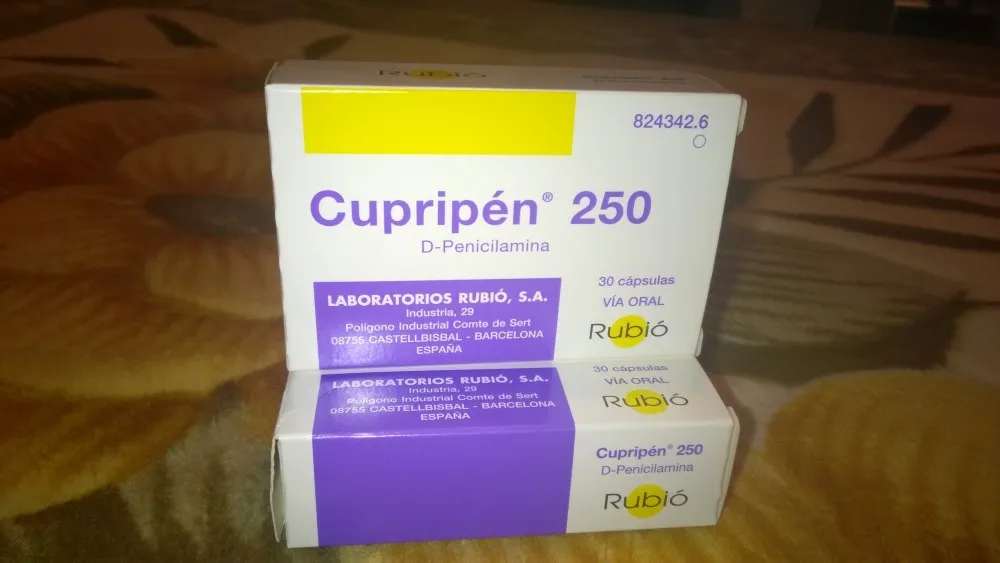
Table of Contents
Package leaflet: Information for the user
Introduction
Package leaflet: information for the user
Cupripen 250 mg hard capsules
penicillamine
Read the entire leaflet carefully before you start taking this medicine, because it contains important information for you.
- Keep this leaflet, as you may need to read it again.
- If you have any questions, ask your doctor or pharmacist.
- This medicine has been prescribed for you only, and you should not give it to others, even if they have the same symptoms as you, because it could harm them.
- If you experience any adverse effects, consult your doctor or pharmacist, even if these effects are not listed in this leaflet. See section 4.
Contents of the leaflet
-
What Cupripen is and what it is used for
-
What you need to know before taking Cupripen
-
How to take Cupripen
-
Possible side effects
-
How to store Cupripen
-
Contents of the pack and other information
1. What Cupripen is and what it is used for
Cupripen contains the active substance penicillamine, a chelating agent that works primarily by binding to certain metals in your body, including copper and lead, to help reduce the amounts of metals absorbed by your body. Penicillamine has the ability to form a soluble complex with cysteine.
Cupripen is indicated in adults, adolescents, and children 5 years of age and older for the treatment of:
- Wilson's disease, a condition in which the body cannot properly eliminate copper
- Heavy metal poisoning
A kidney disorder called cystinuria
2. What you need to know before taking Cupripen
Do not take Cupripen
- if you are allergic to penicillamine or to any of the other ingredients of this medicine (listed in section 6),
- if you are allergic to penicillins,
- if you have previously experienced liver disease, kidney disease, or serious blood disorders while taking penicillamine,
- if you have a condition called systemic lupus erythematosus,
- if you are taking medications containing gold salts, antimalarials, cytotoxic agents, oxyphenbutazone, or phenylbutazone.
Do not take Cupripen if you have any of the conditions listed above. If you are unsure, speak with your doctor or pharmacist before taking Cupripen, as this medicine may worsen these conditions.
Warnings and precautions
Talk to your doctor or pharmacist before starting to use Cupripen if:
- you are elderly,
- you are scheduled for or have recently undergone surgery,
- you have glucose-6-phosphate dehydrogenase deficiency,
- you have liver or kidney problems,
- you are pregnant or breastfeeding, think you may be pregnant, or plan to become pregnant, consult your doctor or pharmacist before using this medicine (see section “Pregnancy, breastfeeding, and fertility”).
Before starting treatment, inform your doctor or pharmacist if you have any of the conditions mentioned above. Your doctor will want to monitor how the medicine affects you.
Special precautionary measures for treatment with Cupripen:
Penicillamine may cause severe birth defects. You must avoid becoming pregnant while taking Cupripen and for at least six months and five days after stopping treatment. See also section “Pregnancy, breastfeeding, and fertility”.
Recommended follow-up tests and safety measures:
Even when administered at low doses, Cupripen may cause serious adverse effects. To detect them early, your doctor must perform regular blood and urine tests and check-ups.
Before starting treatment with Cupripen:
You will have blood and urine tests. If you have liver or kidney disease, additional tests will be performed to assess liver and kidney function.
During treatment:
The following tests will be performed at least once a week for the first two months of treatment, and then once a month:
- blood tests
- urine tests
Maintain the dosing schedule prescribed by your doctor to avoid symptoms of poor tolerance.
During prolonged treatment, your doctor may prescribe pyridoxine (Vitamin B6).
Other medicines and Cupripen
Inform your doctor or pharmacist if you are taking, have recently taken, or might need to take any other medicines.
If you are taking other medicines, penicillamine may affect their action or cause side effects. Therefore, it may be necessary to adjust the dose or discontinue one of the treatments. If you are taking any of the following medicines, consult your doctor or pharmacist before taking Cupripen:
- Aluminum or magnesium salts (medicines used to treat heartburn)
- Digoxin (a medicine used to treat heart conditions)
- Indomethacin (a medicine used to treat pain)
- Isoniazid (a medicine used to treat tuberculosis)
- Levodopa (a medicine used to treat Parkinson’s disease)
- Iron salts (medicines used to treat low iron levels or anemia)
- Gold salts (a medicine used to treat rheumatoid arthritis)
- Phenylbutazone or oxyphenbutazone (medicines used to treat pain and inflammation)
- Antimalarials (medicines used to treat malaria)
- Cytotoxic agents (medicines used to treat cancer)
If you are unsure whether any of the medicines you are taking are included in the list above, ask your doctor or pharmacist before taking Cupripen.
Taking Cupripen with food and drink
Take preferably on an empty stomach, 1 hour before or 2 hours after meals, as food interferes with its absorption.
The capsules should be swallowed whole with water.
Pregnancy, breastfeeding, and fertility
If you are pregnant or breastfeeding, think you may be pregnant, or plan to become pregnant, consult your doctor or pharmacist before using this medicine.
Pregnancy
The use of Cupripen during pregnancy is not recommended. Inform your doctor if you are pregnant or trying to become pregnant. Your doctor will decide whether you can take Cupripen during this time.
Breastfeeding
It is not known whether Cupripen passes into breast milk. For this reason, its use is not recommended during breastfeeding. Your doctor will decide whether you can take Cupripen during this period.
Male fertility
Penicillamine may be genotoxic, meaning it can cause genetic mutations. Therefore, you should avoid fathering a child or donating semen while taking Cupripen and for at least three months and five days after stopping treatment.
Driving and use of machines
Cupripen is unlikely to affect your ability to drive or operate tools or machinery.
3. How to take Cupripen
Follow exactly the instructions given by your doctor for taking this medicine. If in doubt, consult your doctor or pharmacist again.
Method of administration
Cupripen is for oral use.
The capsules should be swallowed whole with a glass of water on an empty stomach, at least 1 hour before or 2 hours after meals.
Dosage
Your doctor will determine the appropriate dose for you and will make any necessary adjustments, as dosing must be individualized.
Wilson's disease
Adults
Your doctor will tell you how many capsules to take each day. The usual dose is 6 to 8 capsules per day. Once your condition has improved, your doctor may reduce the dose to 3 to 4 capsules per day. Taking 8 capsules per day is not recommended for longer than 12 months.
Use in elderly patients
Your doctor will determine how many capsules you should take and how often during the day. The dose will depend on your body weight. The usual dose is 20 mg of penicillamine per day per kg of body weight. Your doctor will adjust the dose to the minimum level necessary to control your disease.
Use in adolescents (12 to < 18 years of age)
Your doctor will tell you how many capsules to take each day. The usual dose is 3 to 4 capsules per day.
Use in children (5 to < 12 years of age)
Your doctor will determine how many capsules the child should take and how often during the day. The dose will depend on the child's weight. The usual dose is 20 mg of penicillamine per day per kg of body weight, divided into two or three doses.
Patients with renal impairment
Special precautions should be taken in patients with kidney problems to monitor for adverse effects.
Heavy metal poisoning
Adults (including elderly patients)
Your doctor will tell you how many capsules to take each day. The dose is 4 to 6 capsules per day until your doctor determines that the amount of heavy metals in your urine is normal. If treatment is prolonged, the dose should not exceed 40 mg per day per kg of body weight.
Use in children and adolescents (5 to < 18 years of age)
Your doctor will tell you how many capsules to take each day. The dose will depend on the child's weight. The usual dose is 20 to 25 mg per day per kg of body weight. If necessary, a dose of up to 100 mg of penicillamine per day per kg of body weight may be administered, up to a maximum dose of 1,050 mg of penicillamine per day per kg of body weight.
Cystinuria
The dose must be individually adjusted based on the amount of cystine excreted in the urine.
Adults
If you are taking Cupripen to dissolve cystine stones, the dose is 4 to 12 capsules per day, divided into several doses. If you are taking Cupripen to prevent the formation of cystine stones, the dose is 2 to 4 capsules per day before bedtime; in this case, you must drink at least 3 liters of fluids per day.
Use in elderly patients
Your doctor will determine the appropriate dose for you, which should be the minimum required to keep cystine levels below 200 mg per liter of urine.
Use in children and adolescents (5 to < 18 years of age)
The dose will depend on the child's weight. The usual dose is 20 to 30 mg per day per kg of body weight, given in two or three divided doses taken 1 hour before meals. Your doctor may adjust the dose depending on the child's urine test results.
Patients with renal impairment
In patients with kidney problems at the start of treatment, initial doses lower than those recommended should be administered. Maintenance doses should be reviewed at least every 4 weeks.
If you take more Cupripen than you should
If you take more Cupripen than prescribed, consult your doctor immediately.
If you forget to take Cupripen
Do not take a double dose to make up for missed doses.
If you stop taking Cupripen
Do not stop or change your treatment without discussing it with your doctor, even if you feel better. If you have missed several doses, consult your doctor to determine the dosing schedule to follow until you reach your maintenance dose.
In case of overdose or accidental ingestion, contact your doctor or pharmacist immediately or call the Toxicology Information Service at: 91 562 04 20.
4. Possible adverse effects
Like all medicines, this medicine can cause adverse effects, although not everyone will experience them.
The frequency and severity of adverse effects depend on the dose and frequency of administration. It is important that your doctor carries out periodic monitoring, as serious adverse effects may occur even with the lowest doses. Your doctor will perform tests to monitor for abnormalities in the blood and changes in the kidneys and liver.
Frequent (may affect up to 1 in 10 people)
- nausea, loss of taste, altered taste, loss of appetite, and vomiting
- skin rashes
- redness of the skin (erythema)
- itching
- protein in the urine (detected by a urine test)
Uncommon (may affect up to 1 in 100 people)
- ringing in the ears (tinnitus)
- vision loss
- muscle weakness, joint pain (arthralgia)
- excessive excretion of protein in the urine (nephrotic syndrome)
- inflammatory kidney involvement (membranous glomerulonephritis)
Rare (may affect up to 1 in 1,000 people)
- diarrhea
- decreased number of blood cells (anemia, leucopenia, thrombocytopenia)
- mouth ulcers
- hair loss
- inflammation of lung tissue (pneumonitis)
- bronchiolitis
- yellowish discoloration of the nails (yellow nail syndrome)
- inflammatory disease causing muscle weakness (polymyositis)
- breast enlargement
Not known (cannot be estimated from available data)
- pseudoxanthoma elasticum (a connective tissue disease)
- perforating elastosis (a skin disease)
- lupus erythematosus (an allergic condition causing joint pain, skin rashes, and fever)
- myasthenia gravis (a disease causing muscle weakness)
Reporting of adverse effects
If you experience any type of adverse effect, consult your doctor, even if it is a possible adverse effect not listed in this leaflet. You may also report them directly through the Spanish Pharmacovigilance System for Human Medicines: www.notificaRAM.es. By reporting adverse effects, you can help provide more information on the safety of this medicine.
5. Storage of Cupripen
Keep this medicine out of sight and reach of children.
Store in the original packaging to protect it from moisture.
Do not use this medicine after the expiry date stated on the container. The expiry date refers to the last day of the month indicated.
Medicines must not be disposed of via wastewater or household waste. Dispose of unused medicines and their containers at the SIGRE point located at your pharmacy. Ask your pharmacist how to properly dispose of medicines and containers you no longer need. This will help protect the environment.
6. Contents of the pack and other information
Composition of Cupripen 250 mg hard capsules:
- The active substance is penicillamine. Each hard capsule of Cupripen contains 250 mg of penicillamine.
- The other components are:
Capsule contents: Magnesium stearate; Capsule shell: Gelatin, Titanium dioxide (E171), Quinoline yellow (E104).
Appearance of the product and contents of the pack
Cupripen 250 mg hard capsules:
Cupripen consists of oblong, hard gelatin capsules, white and yellow in colour.
It is supplied in a pack containing 30 capsules.
Marketing Authorization Holder and Manufacturer
Laboratorios Rubió, S. A.
C/ Industria, 29
Polígono Industrial Comte de Sert
08755 Castellbisbal – Barcelona
Spain
Date of the most recent revision of this leaflet: 10/2023.
Detailed information on this medicine is available on the website of the Spanish Agency for Medicines and Health Products (AEMPS) (http://www.aemps.gob.es/)