Colfinair 1 million IU powder for solution for inhalation by nebulizer
Spain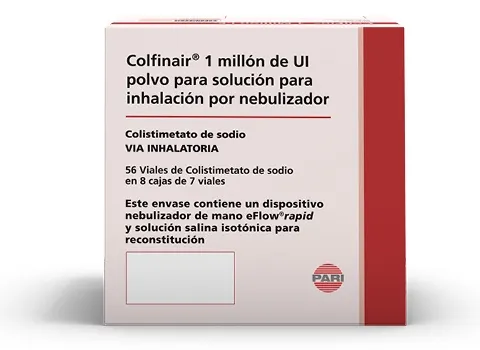
Instructions for Use
Package leaflet: Information for the user
Introduction
PACKAGE LEAFLET: INFORMATION FOR THE USER
Colfinair 1 million IU powder for solution for inhalation by nebuliser
colistimethate sodium
Read all of this leaflet carefully before you start using this medicine, because it contains important information for you.
- Keep this leaflet. You may need to read it again.
- If you have any questions, ask your doctor or pharmacist.
- This medicine has been prescribed for you only, and you must not give it to others, even if they have the same symptoms as you, because it may harm them.
- If you experience any adverse effects, talk to your doctor or pharmacist, even if they are adverse effects not listed in this leaflet. See section 4.
Leaflet contents:
- What Colfinair is and what it is used for
- What you need to know before using Colfinair
- How to use Colfinair
- Possible side effects
- How to store Colfinair
- Contents of the pack and other information
1. What Colfinair is and what it is used for
Colfinair is a medicine used for the treatment of mild to moderate pain in adults. It contains the active substance Acidum acetylsalicylicum (also known as acetylsalicylic acid), which belongs to a group of medicines called non-steroidal anti-inflammatory drugs (NSAIDs). This substance works by reducing the production of certain substances in the body called prostaglandins, which are responsible for pain, inflammation, and fever.
Colfinair is indicated for the short-term treatment of acute pain, such as headache, dental pain, menstrual pain, or pain associated with colds and flu. It also has antipyretic properties, helping to reduce fever.
Important: Colfinair should not be used in children or adolescents under 16 years of age due to the risk of Reye's syndrome, a rare but serious condition.
The medicine is available in tablet form and should be taken orally, preferably with food or a glass of water to minimize stomach irritation.
Antibiotics are used to treat bacterial infections and are not effective against viral infections. It is important to follow your doctor's instructions regarding dosage, dosing interval, and duration of treatment. Do not store or reuse this medication. If you have leftover antibiotics after completing the treatment, return them to the pharmacy for proper disposal. Medicines must not be disposed of via wastewater or household waste. |
Colfinair is administered by inhalation to treat chronic respiratory infections in patients with cystic fibrosis. Colfinair is used when these infections are caused by a specific bacterium called Pseudomonas aeruginosa.
2. What you need to know before using Colfinair
Do not use Colfinair
- If you are allergic (hypersensitive) to colistimethate sodium, colistin, or other polymyxins.
Warnings and precautions
Talk to your doctor, pharmacist, or nurse before starting to use Colfinair
- If you have or have had kidney problems
- If you suffer from myasthenia gravis
- If you suffer from porphyria
- If you suffer from asthma
Caution should be exercised when using Colfinair in premature infants and newborns, as their kidneys are not yet fully developed.
Cough and chest tightness may lead to discontinuation. This can be relieved by using an inhaled bronchodilator (e.g. salbutamol) before using Colfinair. Your doctor will supervise your first dose of Colfinair and will check your lung function before and after administration.
If you experience chest tightness despite using a bronchodilator, inform your doctor, as this may indicate an allergic reaction and treatment should be stopped.
Neurotoxicity may occur during treatment with Colfinair, possibly causing dizziness, confusion, or visual disturbances. If you experience any adverse effects such as dizziness, confusion, or visual disturbances, or any other not mentioned in this leaflet, inform your doctor.
Taking Colfinair with other medicines
- Medicines that may affect how your kidneys function. Taking such medicines at the same time as Colfinair may increase the risk of kidney damage.
- Medicines that may affect the nervous system. Taking such medicines together with Colfinair may increase the risk of adverse effects on the nervous system.
- Medicines known as muscle relaxants, often used during general anaesthesia. Colfinair may enhance the effects of these medicines. If you are to be given a general anaesthetic, inform your anaesthetist that you are using Colfinair.
If you have myasthenia gravis and are also taking other antibiotics called macrolides (such as azithromycin, clarithromycin, or erythromycin), or antibiotics known as fluoroquinolones (such as ofloxacin, norfloxacin, and ciprofloxacin), taking Colfinair further increases the risk of muscle weakness and breathing difficulties.
Receiving colistimethate sodium by intravenous infusion at the same time as receiving Colfinair by inhalation may increase your risk of experiencing adverse effects.
Colfinair must not be mixed with any other medicine in the nebulizer!
Pregnancy, breastfeeding and fertility
If you are pregnant or breastfeeding, think you may be pregnant, or are planning to become pregnant, consult your doctor or pharmacist before using this medicine.
Driving and use of machines
Colfinair has a moderate influence on the ability to drive and use machines. During treatment with Colfinair, neurotoxicity may occur, possibly causing dizziness, confusion, or visual disturbances. If you experience any adverse effects such as dizziness, confusion, or visual disturbances, do not drive or operate machinery and consult your doctor or pharmacist.
3. How to use Colfinair
Colfinair is for inhalation use only.
Follow exactly the administration instructions for this medicine given by your doctor. If in doubt, consult your doctor or pharmacist again.
Recommended dose is:
Recommended dose | Maximum dose per day | |
Adults, Adolescents (12 to 17 years), Children (2 to 11 years) | 1-2 million units two or three times daily | 6 million units |
Children under 2 years | 0.5 - 1 million units, twice daily | 2 million units |
Your doctor may decide to adjust the dose depending on your individual circumstances. If you are also taking other inhaled medications, your doctor will instruct you on the order in which they should be taken.
Please note that Colfinair is also available in a 2 million IU vial, which may be a more suitable dose depending on the prescribed regimen.
For use in children under 2 years of age, PARI LC SPRINT Baby (red nozzle adapter) with a mask is recommended.
Your doctor will tell you how long your treatment with Colfinair will last. Do not stop treatment prematurely, as it is important to complete the full course of treatment when treating bacterial infections in order to reduce the risk of development of resistance in the infectious bacteria.
Preparation for inhalation treatment
If you are being treated at home, your doctor or nurse will show you how to use Colfinair with your nebulizer when you start this treatment.
To start your treatment, you will need the following:
|
How to prepare Colfinair for inhalation
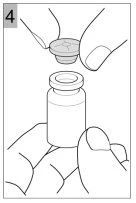
Before Colfinair can be placed into the nebulizer and inhaled, it must be dissolved with 3 ml of sterile 0.9% NaCl solution for inhalation. One ampoule contains the correct volume to dissolve Colfinair.
Colfinair must be used immediately after dissolution. Do not dissolve Colfinair until you are ready to administer a dose (see also section 5).
|
| |
|
| |
|
| |
|
|
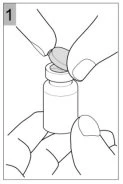
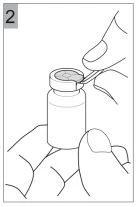
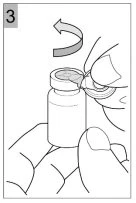
Step 5
- Add 3 ml of sterile 0.9% NaCl inhalation solution from Colfinair 1 million IU (red cap)
- Replace the rubber stopper and gently rotate the vial twice.
- Gently roll the vial between both hands to dissolve all visible Colfinair powder at the bottom and sides of the vial. Do not shake the vial vigorously, as this may cause foaming of the solution.
- Once most of the powder has dissolved, let the vial stand until foam disappears and any remaining powder dissolves. This may take a few minutes.
Use Colfinair only when all the powder has dissolved and no visible particles remain in the solution.
How to use Colfinair
Colfinair is for inhalation use with a suitable nebulizer (e.g. eFlowrapid or PARI LC SPRINT).
Carefully read the manufacturer's instructions for the nebulizer for further information on handling the nebulization system.
It is important that your nebulization system is functioning properly before starting treatment with Colfinair.
Place the components of your nebulizer on a clean, flat surface and follow the manufacturer's instructions.
Inhalation should be performed in a well-ventilated room.
After inhaling Colfinair
Refer to the manufacturer's instructions for your nebulizer regarding cleaning and disinfection.
If you use more Colfinair than you should
If you have used more Colfinair than prescribed, contact your doctor or pharmacist immediately. Accidental overdose may lead to serious effects, including kidney problems, muscle weakness, and breathing difficulties (even respiratory arrest).
In case of overdose or accidental ingestion, contact your doctor or pharmacist immediately, call the Toxicology Information Service at 915 620 420 (indicating the medication and amount ingested), or go to the nearest hospital.
If you forget to use Colfinair
If you are self-administering and have missed a dose, take the missed dose as soon as you remember, then take the next dose 8 or 12 hours later, continuing as directed from that point onward.
Do not take a double dose to make up for missed doses.
If you stop using Colfinair
Do not discontinue using Colfinair as prescribed without first consulting your doctor.
If you have any further questions about the use of this medicine, ask your doctor or pharmacist.
4. Possible adverse effects
Like all medicines, this medicine can cause adverse effects, although not everyone will experience them.
An allergic reaction may occur. Serious allergic reactions can even happen with the first dose and may include rapid onset of rashes, swelling of the face, tongue and neck, inability to breathe due to narrowing of the airways, and loss of consciousness. Urgent medical attention will be required.
If you think you are having an allergic reaction to Colfinair, inform your doctor immediately.
Some adverse effects may be serious
Very common: may affect more than 1 in 10 people.
- Chest tightness due to narrowing of the airways (this may not always be a true allergic reaction)
Frequency not known: cannot be estimated from available data.
- Patients with severe renal impairment and at the highest doses may experience adverse effects known with intravenous administration
- Confusion
- Psychotic disorder
- Visual disturbance
- Dizziness
If you experience any of these effects, inform your doctor immediately.
Other possible adverse effects
Very common: may affect more than 1 in 10 people.
- Mouth or throat ulcers
- Cough
- Breathing difficulty
- Wheezing
- Worsening of pulmonary function test results
- Transient absence of spontaneous breathing
If any of these problems affect you severely, inform your doctor.
Frequency not known: cannot be estimated from available data.
- Subjective skin sensations
- Speech disorder
- Vertigo
- Renal failure
Other possible adverse effects include oral or throat candidiasis.
Reporting of adverse effects
If you experience any type of adverse effect, consult your doctor or pharmacist, even if it is a possible adverse effect not listed in this leaflet. You may also report them directly via the Spanish Pharmacovigilance System for Human Medicinal Products: https://www.notificaram.es
By reporting adverse effects, you can help provide more information on the safety of this medicine.
5. Storage of Colfinair
Keep this medicine out of the sight and reach of children.
Do not use this medicine after the expiry date stated on the carton or on the label of the vial after EXP. The expiry date refers to the last day of the month indicated.
Do not store above 25°C.
Keep the vial in the outer cardboard container to protect it from light.
Colfinair solution for inhalation by nebulizer should be used immediately after preparation. If this is not possible, a Colfinair solution must be stored in a refrigerator (2°C - 8°C) and for no longer than 24 hours.
If not used immediately, the storage conditions and times are the responsibility of the user.
Any unused solution must be discarded.
For single use only.
Medicines should not be disposed of via wastewater. Ask your pharmacist how to dispose of medicines and packaging you no longer need. This will help protect the environment.
6. Contents of the container and other information
Composition of Colfinair
-
The active substance is colistimethate sodium.
-
Each 10 ml vial contains 1 million IU, equivalent to approximately 80 mg of colistimethate sodium.
Nature of the product and contents of the container
Colfinair is a powder for solution for inhalation by nebulizer.
1 million IU/vial: | White powder in a 10 ml colorless glass vial with a red stopper. |
Also available: 2 million IU/vial: | White powder in a 10 ml colorless glass vial with a lavender stopper. |
The product is available in the following pack sizes:
Carton box containing:
- 8 cardboard boxes, each with 7 vials (56 vials),
- 2 carton boxes of 0.9% NaCl inhalation solution, each with 30 ampoules of 3 ml (60 ampoules), and a handheld eFlowrapid nebulizer device.
Marketing Authorization Holder and Manufacturer
PARI Pharma GmbH
Moosstrasse 3
82319 Starnberg
Germany
Tel.: +49 (0) 89/74 28 46 – 10
For more information about this medicinal product, please contact the local representative of the Marketing Authorization Holder:
PARI Pharma Iberia S.L.
Miguel Yuste 17, 4th floor C
28037 Madrid
This medicinal product is authorized in the European Economic Area member states under the following names:
GermanyColiFin 1 Million. I.E. Pulver zur Herstellung einer Lösung für einen Vernebler
NetherlandsColiFin PARI 1.000.000 IE Poeder voor verneveloplossing
AustriaColiFin 1 Mio. I. E. Pulver zur Herstellung einer Lösung für einen Vernebler
SpainColfinair 1millóndeUIpolvo para solución para inhalación por nebulizador
ItalyColfinair 1.000.000 U Polvere per soluzione per nebulizzatore
Date of the most recent review of this leaflet: 05/2022
Detailed and up-to-date information on this medicinal product is available on the website of the Spanish Agency of Medicines and Health Products (AEMPS) http://www.aemps.gob.es/
Similar Medications
-
Colfinair 2 million IU powder for solution for inhalation by nebulizer
Form: powder for solution for inhalation by nebulizer
Active substance Dosage SODIUM COLISTIMETHATE 2 - Manufacturer: Pari Pharma Gmbh
-
Promixin 1 million international units (UI), powder for solution for inhalation by nebulizer
Form: powder for solution for inhalation by nebulizer
Active substance Dosage SODIUM COLISTIMETHATE 1000000 UI Manufacturer: Zambon S.P.A.
This page has been machine-translated and may contain inaccuracies. The original data is available in the manufacturing country's language.
Last data check: May 18, 2026 · Data source: CIMA — AEMPS