Clorxil with Alcohol 20 mg/ml + 0.63 ml/ml cutaneous solution
Spain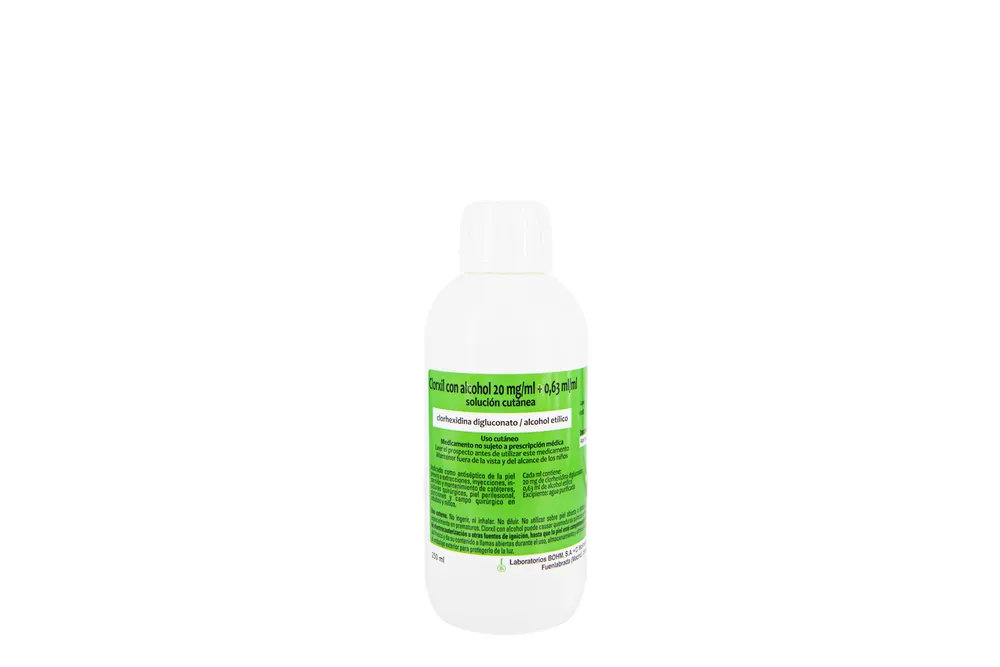
Table of Contents
- Package leaflet: Information for the user
- Introduction
- 1. What Clorxil with alcohol is and what it is used for
- 2. What you need to know before using Clorxil with alcohol
- 3. How to use Clorxil with alcohol
- 4. Possible adverse effects
- 5. Storage of Clorxil with alcohol
- 6. Contents of the pack and other information
Package leaflet: Information for the user
Introduction
Package leaflet: information for the user
Clorxil with alcohol 20 mg/ml + 0.63 ml/ml cutaneous solution
chlorhexidine digluconate / ethanol
Read all of this leaflet carefully before you start using this medicine, because it contains important information for you.
- Keep this leaflet, as you may need to read it again.
- If you need advice or more information, consult your pharmacist.
- If you experience any adverse reactions, consult your doctor or nurse, even if they are not listed in this leaflet. See section 4.
- You should consult a doctor if your condition worsens or does not improve.
Contents of this leaflet
- What Clorxil with alcohol is and what it is used for
- What you need to know before using Clorxil with alcohol
- How to use Clorxil with alcohol
- Possible adverse effects
- How to store Clorxil with alcohol
- Contents of the pack and other information
1. What Clorxil with alcohol is and what it is used for
Clorxil with alcohol contains chlorhexidine digluconate and ethyl alcohol, and is used as a skin antiseptic.
It is indicated as a skin antiseptic prior to blood draws, injections, catheter insertion and maintenance, surgical sutures, periwound skin, punctures, and surgical sites in adults and children.
2. What you need to know before using Clorxil with alcohol
Do not use Clorxil with alcohol
If you are allergic (hypersensitive) to chlorhexidine, ethyl alcohol, or any of the other components of this medicine (listed in section 6).
Warnings and precautions
Consult your doctor or pharmacist before starting to use Clorxil with alcohol.
This medicine is for external use only. Do not ingest or inhale.
The solution is flammable.
The risk of fire is high when an ignition source (electrosurgical units, lasers, fiber-optic light sources, high-speed drills/burs) is used in combination with a combustible material (such as cloths, towels) and an oxidizing agent (oxygen, air, nitrous oxide).
To reduce the risk of fire:
- Do not use electrocautery procedures or other ignition sources until the skin is completely dry.
- Remove any soaked materials, gauze, or drapes before starting the procedure.
- Do not use excessive amounts and avoid the solution pooling in skin folds, under the patient, or soaking sheets or other materials in direct contact with the patient. Do not allow the solution to pool or stagnate.
- When applying an occlusive dressing to areas previously exposed to Clorxil with alcohol, special care must be taken to ensure there is no excess product before applying the dressing.
- Reduce the supply of oxygen or any other oxidizing agent to the minimum necessary. Procedures performed on the head, neck, and upper chest (above T5), combined with the use of an ignition source near an oxidizing agent, place the patient at risk of surgical fire.
This medicine may, in rare cases, cause severe allergic reactions leading to a drop in blood pressure and even loss of consciousness. Early symptoms of a severe allergic reaction may include skin rash or asthma. If you notice these symptoms, stop using this medicine and contact your doctor as soon as possible (see section 4: "Possible side effects").
Avoid prolonged contact with the skin.
This medicine must not be applied:
- Near sensitive areas (mucous membranes), as it may cause irritation, pain, redness, and chemical burns. In case of accidental contact with the eyes or mucous membranes of body entry pathways, immediately rinse the affected area thoroughly with water.
- Clorxil with alcohol must not enter the eyes due to the risk of visual injury. If contact occurs, immediately and thoroughly rinse the eyes with plenty of water. In case of eye irritation, redness, pain, or visual disturbances, consult a doctor immediately.
Severe cases of persistent corneal injury (damage to the surface of the eye) have been reported, which may require corneal transplantation, when similar products have accidentally come into contact with the eyes during surgical procedures in patients under general anesthesia (induced painless deep sleep).
- On open wounds.
- On the inner part of the ear (middle ear).
- In direct contact with neural tissue (e.g., brain and spinal cord).
- Clothing that has been in contact with Clorxil with alcohol should not be washed with bleach or other hypochlorites, as this will cause a brownish discoloration of the fabric. Instead, wash with domestic detergents based on sodium perborate.
This medicine should only be applied gently to the skin. If the solution is applied too vigorously on fragile or sensitive skin, or after repeated use, a local skin reaction may occur, including erythema, inflammation, itching, dry and/or scaly skin, and localized pain at the site of application. At the first sign of any of these reactions, discontinue use of this medicine.
Children
Use with caution in neonates, especially in premature infants. Clorxil with alcohol may cause chemical burns on the skin.
This medicine should only be used in children under 30 months of age under medical prescription.
Other medicines and Clorxil with alcohol
Inform your doctor or pharmacist if you are using, have recently used, or might need to use any other medicines.
Inform your doctor or nurse if you have recently received a vaccine or an injection for a skin test (epicutaneous tests to detect allergies).
The simultaneous or sequential use of other antiseptics should be avoided to minimize the risk of possible interactions between them.
The product is incompatible with anionic derivatives (soaps); therefore, the skin must be thoroughly rinsed after cleansing.
Pregnancy, breastfeeding, and fertility
If you are pregnant or breastfeeding, think you might be pregnant, or are planning to become pregnant, consult your doctor before using this medicine.
It is unknown whether chlorhexidine digluconate or ethyl alcohol are excreted in breast milk. Since many medicines are excreted in breast milk, caution should be exercised when administering Clorxil with alcohol to breastfeeding women.
Driving and using machines
Clorxil with alcohol does not impair the ability to drive or operate machinery.
3. How to use Clorxil with alcohol
Gently apply the product to the area of skin that needs to be prepared. Apply as many times as necessary, depending on the medical procedure. Do not dilute.
The product should be applied directly to the area to be treated and allowed to dry before any procedure.
If in doubt, consult your doctor or nurse.
If you use more Clorxil with alcohol than you should
In case of overdose or accidental ingestion, immediately consult your doctor or pharmacist or call the Toxicology Information Service at telephone number: 91 562 0420, indicating the medication and the amount ingested.
4. Possible adverse effects
Like all medicines, this medicine may cause adverse effects, although not everyone experiences them.
Very rare adverse effects (less than 1 in 10,000 people) observed on the skin and subcutaneous tissue are:
Skin irritation, including: erythema, rash, urticaria, pruritus, and blisters or vesicles at the application site. Other local symptoms may include: skin burning sensation, pain, and inflammation.
Other adverse effects with unknown frequency (cannot be estimated from the available data) are:
-
Allergic reactions including anaphylactic shock.
-
Corneal injury (damage to the surface of the eye) and permanent eye injury, including permanent visual impairment (following accidental ocular exposure during surgical procedures on the head, face, and neck) in patients under general anesthesia (induced painless deep sleep).
-
Pain, hyperemia, and chemical burns in cases of accidental contact.
-
Dermatitis, eczema, urticaria, skin irritation, blisters.
-
Chemical burns in neonates.
Stop using Clorxil and seek immediate medical attention if you experience any of the following reactions: swelling of the face, lips, tongue or throat; red, itchy skin rash; wheezing or difficulty breathing; feeling faint or dizzy; unusual metallic taste in the mouth; collapse. You may be experiencing an allergic reaction.
Reporting of adverse effects
If you experience any type of adverse effect, consult your doctor or pharmacist, even if it is a possible adverse effect not listed in this leaflet. You may also report them directly through the Spanish Pharmacovigilance System for Human Medicines: http://www.notificaram.es. By reporting adverse effects, you can help provide more information on the safety of this medicine.
5. Storage of Clorxil with alcohol
This medicine is flammable. Avoid exposing the bottle and its contents to open flames during use, storage, and disposal of the product.
Keep this medicine out of the sight and reach of children.
Keep the bottle tightly closed to protect it from light.
Do not use this medicine after the expiry date stated on the label after EXP. The expiry date is the last day of the month indicated.
Medicines should not be disposed of via wastewater or household waste. Ask your pharmacist how to dispose of containers and medicines you no longer need. This will help protect the environment.
6. Contents of the pack and other information
Composition of Clorxil with alcohol
The active substances are: chlorhexidine digluconate and ethyl alcohol.
The excipient is purified water.
Each ml of solution contains: 20 mg of chlorhexidine digluconate and 0.63 ml of ethyl alcohol.
Appearance of the product and contents of the pack
Clear, colourless solution presented in plastic bottles (HDPE/LDPE or HDPE), white in colour, with white HDPE/LDPE closure caps. Available in:
- Clinical pack of 100 bottles of 10 ml
- Clinical pack of 100 bottles of 20 ml
- Clinical pack of 50 bottles of 100 ml
- Clinical pack of 50 bottles of 250 ml
- Clinical pack of 20 bottles of 500 ml
Marketing Authorization Holder and Manufacturer
LABORATORIOS BOHM, S.A.
C/ Molinaseca 23-25. Polígono Industrial Cobo Calleja.
28947 Fuenlabrada (Madrid)
Telephone: 91 642 18 18
Fax: 91 642 0572
Email: [email protected]
Date of the most recent review of the package leaflet: May 2024
Other sources of information
Detailed information on this medicinal product is available on the website of the Spanish Agency for Medicines and Health Products (AEMPS) http://www.aemps.gob.es/