Cinfatusina 3.54 mg/ml oral suspension
Spain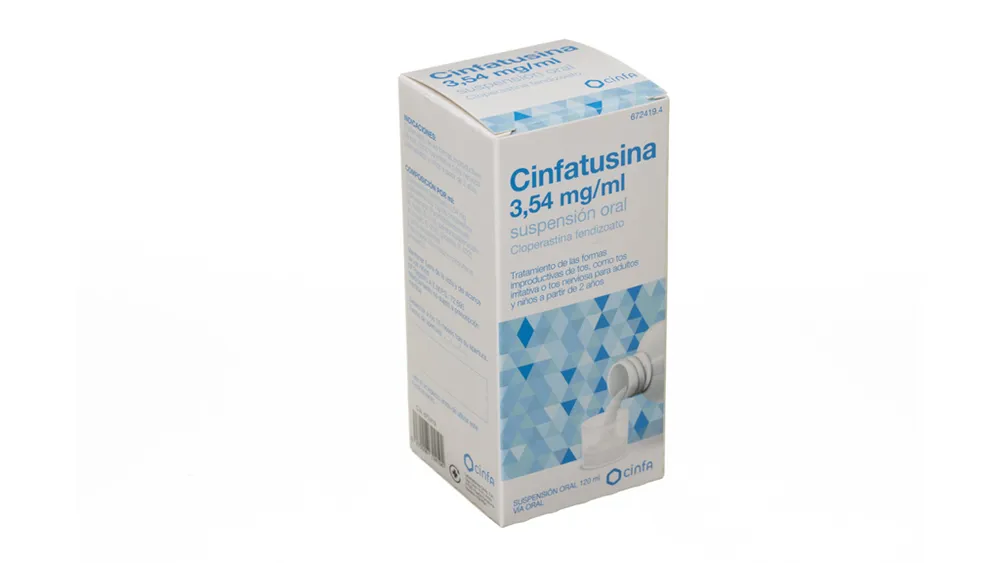
Table of Contents
Package leaflet: Information for the user
Introduction
Package leaflet: information for the user
cinfatusine 3.54 mg/ml oral suspension
Cloperastine fendizoate
Read the entire leaflet carefully before you start taking this medicine, because it contains important information for you.
Follow exactly the instructions for use of this medicine contained in this leaflet or those provided by your doctor or pharmacist.
- Keep this leaflet, as you may need to read it again.
- If you need advice or more information, consult your pharmacist.
- If you experience any adverse reactions, consult your doctor or pharmacist, even if they are adverse reactions not listed in this leaflet. See section 4.
- You should consult a doctor if you worsen or do not improve after 7 days.
Leaflet contents
- What cinfatusine is and what it is used for.
- What you need to know before taking cinfatusine.
- How to take cinfatusine.
- Possible adverse effects.
- How to store cinfatusine.
- Contents of the pack and other information.
1. What is cinfatusina and what is it used for
Cloperastine, the active ingredient in this medicine, is an antitussive that inhibits the cough reflex. Cinfatusina is a medicine indicated for the treatment of non-productive forms of cough, such as irritative cough or nervous cough, in adults and children from 2 years of age.
You should consult a doctor if your condition worsens or does not improve after 7 days of treatment.
2. What you need to know before taking cinfatusina
Do not take cinfatusina
- If you are allergic to cloperastine fendizoate or to any of the other ingredients of this medicine (listed in section 6).
- If you are allergic to allergy medications (antihistamines).
- If you are taking medicines for the treatment of depression.
- If you are pregnant or think you may be pregnant, or if you are breastfeeding.
- Do not administer cinfatusina to children under 2 years of age.
Warnings and precautions
Talk to your doctor or pharmacist before taking cinfatusina:
- If you have high intraocular pressure.
- If you have been diagnosed with prostate enlargement.
- If you have difficulty urinating.
- If you have high blood pressure.
- If you have heart problems.
- If you have a degenerative muscle disease called myasthenia gravis.
- If you have any type of gastric or intestinal obstruction, including ulcer.
- If you have chronic cough due to smoking, lung problems, or asthma.
- If your cough persists after 7 days of treatment.
Children
Cinfatusina is contraindicated in children under 2 years of age.
Other medicines and cinfatusina
Inform your doctor or pharmacist if you are taking, have recently taken, or might need to take any other medicines.
Cinfatusina may interact with other medicines such as:
- Medicines to help you sleep (sedatives, opioid analgesics, barbiturates, hypnotics, or benzodiazepines).
- Medicines for depression and medicines for the treatment of Parkinson’s disease, as they may enhance the adverse effects of this medicine.
- Expectorants and mucolytics used to eliminate excess mucus and phlegm, because when taken simultaneously with a cough medicine such as cinfatusina, they may prevent the elimination of mucus and cause choking.
Taking cinfatusina with food, drinks, and alcohol
Do not drink alcohol during treatment with cinfatusina, as it may increase the effects of alcohol.
Taking this medicine with food and drinks does not affect its efficacy.
Pregnancy and breastfeeding
If you are pregnant or breastfeeding, think you may be pregnant, or plan to become pregnant, consult your doctor or pharmacist before using this medicine.
Cinfatusina is contraindicated during pregnancy and breastfeeding.
Driving and using machines
Cinfatusina may cause drowsiness at usual doses. If this occurs, refrain from driving or operating heavy machinery.
Cinfatusina contains methyl parahydroxybenzoate and propyl parahydroxybenzoate.
It may cause allergic reactions (possibly delayed) because it contains methyl parahydroxybenzoate (E-218) and propyl parahydroxybenzoate (E-216).
Cinfatusina contains sodium.
This medicine contains less than 23 mg of sodium (1 mmol) per ml; therefore, it is essentially “sodium-free”.
3. How to take cinfatusine
Follow exactly the dosage instructions provided in this leaflet or those indicated by your doctor or pharmacist. If in doubt, consult your doctor or pharmacist.
The recommended dose is:
In adults and adolescents over 12 years of age: 10 ml, three times a day.
In children:
Between 7 and 12 years of age: 5 ml, twice a day.
Between 5 and 6 years of age: 3 ml, twice a day.
Between 2 and 4 years of age: 2 ml, twice a day.
Cinfatusine is contraindicated in children under 2 years of age.
Shake the bottle well before use.
This medicine is taken orally.
For accurate dosing, use the dosing cup or oral syringe provided in the package.
If you take more cinfatusine than you should
Symptoms of overdose may include: excitement and difficulty breathing.
In case of overdose or accidental ingestion, contact your doctor or pharmacist immediately, or call the Toxicology Information Service at telephone number 91 562 04 20, indicating the medicine and the amount ingested.
If you forget to take cinfatusine
Do not take a double dose to make up for a missed dose.
This treatment is symptomatic; do not take the medicine if you do not have a cough. If coughing returns, take the medicine as indicated in section 3. How to take cinfatusine.
4. Possible adverse effects
Like all medicines, this medicine may produce adverse effects, although not everyone experiences them.
The most commonly occurring adverse effects, although infrequent, are: drowsiness and dry mouth.
The adverse effects that may occur are:
Uncommon (may affect up to 1 in 100 patients): drowsiness, dry mouth (at high doses), movement disorders, tremors, and dizziness.
Very rare (may affect up to 1 in 10,000 patients): allergic reaction, urticaria.
Reporting of adverse effects
If you experience any type of adverse effect, consult your doctor or pharmacist, even if it is a possible adverse effect not listed in this leaflet. You may also report them directly via the Spanish Pharmacovigilance System for Human Medicinal Products: https://www.notificaram.es. By reporting adverse effects, you can help provide more information on the safety of this medicine.
5. Storage of cinfatusine
Keep this medicine out of the sight and reach of children.
This medicine does not require any special storage conditions.
Do not use this medicine after the expiry date stated on the container after EXP. The expiry date refers to the last day of the month indicated.
Do not use cinfatusine more than eighteen months after the container has been opened.
Medicines must not be disposed of via wastewater or household waste. Unused containers and medicines should be taken to the SIGRE point at your pharmacy. If you are unsure, please ask your pharmacist how to dispose of unused containers and medicines. This will help protect the environment.
6. Contents of the pack and other information
Composition of cinfatusina
The active substance in cinfatusina is cloperastine fendizoate. Each ml of oral suspension contains 3.54 mg of cloperastine fendizoate (equivalent to 2 mg of cloperastine hydrochloride).
The other components are: Methyl parahydroxybenzoate (E-218), Propyl parahydroxybenzoate (E-216), Xanthan gum (E-415), Glycerol (E-422), Carbomers (Carbopol 974 P), Macrogol stearate, Banana flavoring, Sodium saccharin (E-954), and Purified water.
Appearance of the product and contents of the pack
It is presented as an oral suspension. Each container holds 120 ml or 200 ml of oral suspension, together with a dosing cup with markings from 2.5 to 15 ml, and a dosing syringe with markings from 0.25 ml to 5 ml.
Marketing Authorization Holder and Manufacturer
Laboratorios Cinfa, S.A.
Carretera Olaz-Chipi, 10. Polígono Industrial Areta
31620 Huarte (Navarra) - Spain
Date of the most recent review of this leaflet: February 2021
Detailed and up-to-date information on this medicinal product is available on the website of the Spanish Agency for Medicines and Health Products (AEMPS) http://www.aemps.gob.es/