Chiclida 25 mg lozenges for sucking
Spain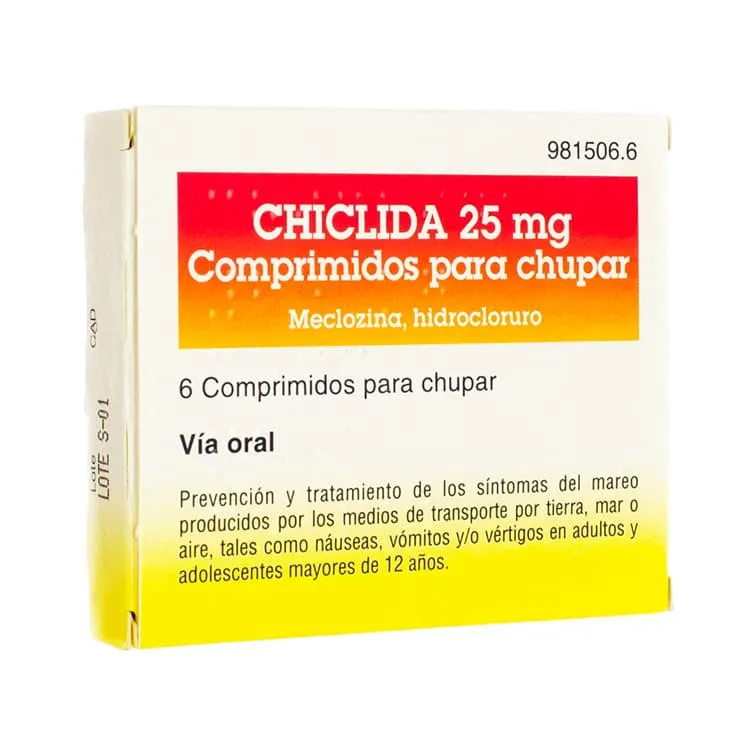
Table of Contents
Package leaflet: Information for the user
Introduction
PACKAGE LEAFLET: INFORMATION FOR THE USER
Chiclida 25 mg sucking tablets
Meclizine hydrochloride
Read the entire leaflet carefully before you start taking this medicine, as it contains important information for you. Always follow exactly the instructions for taking this medicine as described in this leaflet or as your doctor or pharmacist has told you.
|
Package leaflet contents:
- What Chiclida is and what it is used for
- What you need to know before taking Chiclida
- How to take Chiclida
- Possible adverse effects
- How to store Chiclida
- Contents of the pack and other information
1. What Chiclida is and what it is used for
Meclizine hydrochloride, the active ingredient in Chiclida, belongs to a group of medicines called antihistamines, used to prevent motion sickness caused by travel.
Chiclida is indicated for the prevention and treatment of symptoms of motion sickness caused by land, sea, or air travel, such as nausea, vomiting, and/or dizziness in adults and adolescents over 12 years of age.
You should consult a doctor if your condition worsens or does not improve after 7 days.
2. What you need to know before taking Chiclida
Do not take Chiclida
- If you are allergic to meclozine hydrochloride or to any of the other ingredients of this medicine (listed in section 6).
- If you have increased intraocular pressure (glaucoma).
- If you have an enlarged prostate (prostatic hypertrophy).
- If you have a condition causing gastrointestinal or urinary tract obstruction.
- If you have asthma.
- If you have diabetes.
- Children under 6 years of age.
Warnings and precautions
Consult your doctor or pharmacist before taking Chiclida:
- If you suffer from seizures involving convulsive movements, with or without loss of consciousness (epilepsy).
- If you are over 65 years of age, dry mouth, urinary retention, glaucoma, nausea, dizziness, sedation, confusion, low blood pressure (hypotension), or hyperexcitability may occur.
- If you are taking any medication that causes ototoxicity (ear toxicity), as symptoms of such toxic effects (such as tinnitus, dizziness, or vertigo) may be masked.
- If you have any liver or kidney disease or disorder, as this may increase the concentration of the active ingredient.
- If you have or have had heart conditions such as cardiac arrhythmia, high blood pressure, severe muscle weakness (myasthenia gravis), or stomach or intestinal ulcers.
- If you suspect you may have symptoms of appendicitis such as nausea, vomiting, or abdominal cramps. It is recommended to see a doctor to rule out the presence of appendicitis.
Avoid exposure to sunlight while taking this medicine.
If you are allergic to any other antihistamine, it is not recommended to take this medicine.
Interference with diagnostic tests
If you are scheduled to undergo a skin test using allergens, inform your doctor that you are taking this medicine, as it may alter test results.
It is recommended to discontinue this medicine at least 72 hours before the test.
Children
Do not use this medicine in children under 12 years of age.
Use of Chiclida with other medicines
Inform your doctor or pharmacist if you are taking, have recently taken, or might need to take any other medicines.
Concomitant use is not recommended with:
- Central nervous system depressants such as anesthetics, opioid analgesics, barbiturates (used as sedatives, anticonvulsants, and for sleep disorders), benzodiazepines (for sleep), antipsychotics.
- Antiparkinsonian agents.
- Antidepressants.
- Neuroleptics (used to calm excitement and neuromuscular hyperactivity).
Taking Chiclida with food, drinks, and alcohol
Alcoholic beverages may enhance the effects of meclozine; therefore, simultaneous use is not advised.
Pregnancy and breastfeeding
If you are pregnant or breastfeeding, think you may be pregnant, or are planning to become pregnant, consult your doctor or pharmacist before using this medicine.
This medicine should not be used during pregnancy unless strictly necessary. Do not administer during breastfeeding.
Driving and using machines
Chiclida may cause drowsiness and could therefore affect your ability to drive and/or operate machinery. Patients should avoid operating dangerous machinery, including automobiles, until they know how they tolerate the medicine.
Chiclida contains glucose and sucrose
This medicine contains glucose and sucrose. If your doctor has informed you that you have an intolerance to certain sugars, consult with him before taking this medicine.
It may cause dental caries.
3. How to take Chiclida
Follow exactly the instructions for use provided in this leaflet or those given by your doctor. In case of doubt, consult your doctor or pharmacist.
Adults and adolescents (over 12 years): 1 or 2 Chiclida tablets (25 mg–50 mg meclizine hydrochloride) approximately one hour before starting the journey. If necessary, repeat the dose every 24 hours. Do not exceed the dose of 2 Chiclida tablets (50 mg meclizine hydrochloride) per day.
Patients with renal and/or hepatic impairment: Dose reduction may be necessary (see section 2, Warnings and precautions).
Suck the tablet. Do not swallow.
Administer at least one hour before starting the journey.
If symptoms worsen or persist for more than 7 days, you must consult your doctor.
Use in children
Chiclida is contraindicated in children under 6 years of age.
This medicine is not recommended for children aged 6 to 12 years.
If you take more Chiclida than you should
Consult your doctor or pharmacist immediately.
Symptoms of overdose may vary, from sedation, difficulty breathing, loss of consciousness to insomnia, hallucinations, tremors, or seizures.
In case of overdose or accidental ingestion, contact your doctor, pharmacist, or the Toxicology Information Service immediately. Telephone 91 562 04 20, indicating the medication and the amount ingested.
If you forget to take Chiclida
Do not take a double dose to make up for missed doses.
If you have any further questions about the use of this medicine, ask your doctor or pharmacist.
4. Possible adverse effects
Like all medicines, this medicine may cause adverse effects, although not everyone experiences them.
If you consider any of the adverse effects you experience to be severe, or if you notice any adverse effect not mentioned in this leaflet, inform your doctor or pharmacist.
If you suffer a severe allergic reaction (anaphylactic shock) with rash, itching, or difficulty breathing, stop taking the medicine and seek immediate medical help.
The most frequent adverse reactions are drowsiness and sedation. Dry mouth, blurred vision, nausea, vomiting, and joint pain occur rarely (may affect up to 1 in 1,000 patients).
Other adverse reactions with unknown frequency (cannot be estimated from the available data) are:
- Abdominal pain, diarrhoea, and constipation.
- Sleepiness and sedation.
- Increased bronchial secretion.
- Increased appetite, anorexia.
- Anxiety, euphoria, irritability, hallucinations, insomnia, memory disorders, psychotic disorders, confusion, and paranoia.
- Dizziness, headache, movement disorders (e.g. Parkinsonism), paresthesia (tingling and numbness sensations).
- Double vision.
- Dizziness, tinnitus (ringing or noise in the ears).
- Dryness of throat and nose, bronchospasm (contraction of the bronchi), epistaxis (nosebleed).
- Dysuria (difficult, painful, and incomplete urination), polyuria (production and excretion of a large amount of urine), urinary retention.
- Fatigue, weakness.
- Tachycardia, palpitations, and/or arrhythmias.
- Hypotension (decrease in blood pressure).
- Hyperexcitability may occur, especially in children.
- Decrease in blood levels of red blood cells, white blood cells, leukocytes, and platelets.
- Allergic skin reactions and photosensitivity after intense sun exposure, which may cause itching and redness of the skin.
- Weight gain.
Reporting of adverse effects
If you experience any type of adverse effect, consult your doctor or pharmacist, even if it is a possible adverse effect not listed in this leaflet. You may also report them directly via the Spanish Pharmacovigilance System for Human Medicines: https://www.notificaram.es.
By reporting adverse effects, you can help provide more information on the safety of this medicine.
5. Storage of Chiclida
No special storage conditions are required.
Keep out of the sight and reach of children.
Do not use this medicine after the expiry date which is stated on the packaging after EXP. The expiry date is the last day of the month indicated.
Medicines should not be disposed of via wastewater or household waste. Dispose of containers and unused medicines at the SIGRE point at your pharmacy. If you have any doubts, ask your pharmacist how to dispose of containers and medicines you no longer need. This will help protect the environment.
6. Contents of the pack and other information
Composition of Chiclida
The active substance is Meclizine hydrochloride. Each pastille contains 25 mg of meclizine hydrochloride.
The other components are: Monohydrate glucose, sucrose, peppermint flavour, and magnesium stearate. See section 2, "Chiclida contains glucose and sucrose".
Appearance of the product and contents of the pack
White, oval-shaped pastilles.
Each pack contains 6 pastilles.
Marketing Authorisation Holder and Manufacturer
Marketing Authorisation Holder
Name: Fleer Española, S.L.
Address: Rambla Catalunya No. 53, ático
City: 08007-Barcelona
Manufacturer:
Name: Fleer Española, S.L.
Address: 08795 – Olesa de Bonesvalls (Barcelona)
Telephone: 93 898 40 11
Facsimile: 93 898 41 76
Date of the most recent revision of this leaflet: January 2015
Detailed and up-to-date information on this medicinal product is available on the website of the Spanish Agency for Medicines and Health Products (AEMPS):
http://aemps.gob.es