Cetirizine Teva-Ratiopharm 10 mg film-coated tablets EFG
Spain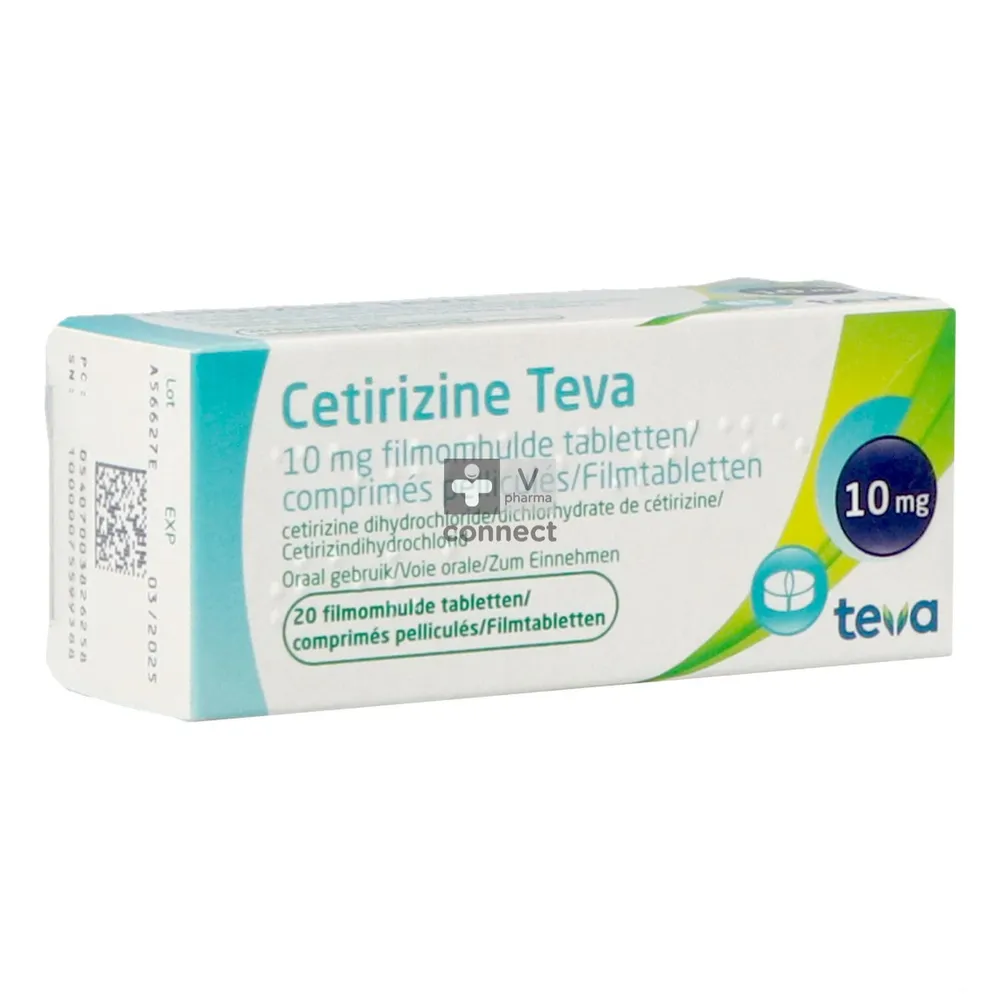
Table of Contents
- Patient Information Leaflet
- Introduction
- 1. What Cetirizina Teva-ratiopharm is and what it is used for
- 2. What you need to know before starting to take Cetirizine Teva-ratiopharm
- 3. How to take Cetirizine Teva-ratiopharm
- 4. Possible adverse effects
- 5. Storage of Cetirizine Teva-ratiopharm
- 6. Contents of the pack and other information
Patient Information Leaflet
Introduction
Patient Information Leaflet
Cetirizine Teva-ratiopharm 10 mg film-coated tablets EFG
cetirizine dihydrochloride
Read the entire leaflet carefully before you start taking this medicine, as it contains important information for you.
- Keep this leaflet, as you may need to read it again.
- If you have any questions, ask your doctor or pharmacist.
- This medicine has been prescribed for you only, and you should not give it to others, even if they have the same symptoms as you, because it could harm them.
- If you experience any adverse reactions, consult your doctor or pharmacist, even if they are adverse reactions not listed in this leaflet. See section 4.
Leaflet Contents
- What Cetirizine Teva-ratiopharm is and what it is used for
- What you need to know before taking Cetirizine Teva-ratiopharm
- How to take Cetirizine Teva-ratiopharm
- Possible adverse effects
- How to store Cetirizine Teva-ratiopharm
- Contents of the pack and other information
1. What Cetirizina Teva-ratiopharm is and what it is used for
Cetirizine dihydrochloride is the active substance in Cetirizina Teva-ratiopharm.
Cetirizina Teva-ratiopharm is an antiallergic medicine.
Cetirizina Teva-ratiopharm is indicated in adults and children aged 6 years and older:
- For the relief of nasal and ocular symptoms caused by seasonal and perennial allergic rhinitis.
- For the relief of urticaria.
2. What you need to know before starting to take Cetirizine Teva-ratiopharm
Do not take Cetirizine Teva-ratiopharm
- if you have severe kidney disease (requiring dialysis)
- if you are allergic to cetirizine dihydrochloride or to any of the other components of this medicine (listed in section 6), or to hydroxyzine or to piperazine derivatives (active substances closely related to other drugs)
Warnings and precautions
Talk to your doctor or pharmacist before taking Cetirizine Teva-ratiopharm.
If you have renal insufficiency, consult your doctor; if necessary, you may take a lower dose. Your doctor will determine the new dose.
If you have problems passing urine (such as spinal cord disorders, prostate or bladder problems), consult your doctor.
If you are an epileptic patient or a patient at risk of seizures, you should consult your doctor.
No clinically significant interactions have been observed between alcohol (blood alcohol levels of 0.5 per mille (g/l), corresponding to one glass of wine) and cetirizine used at the recommended doses. However, safety data are not available when cetirizine is administered at higher doses together with alcohol. Therefore, as with all antihistamines, it is recommended to avoid taking Cetirizine Teva-ratiopharm with alcohol.
If you are scheduled to undergo allergy testing, consult your doctor about whether you should stop taking Cetirizine Teva-ratiopharm several days before the test. This medicine may alter the results of allergy tests.
Children
Do not give this medicine to children under 6 years of age, because the tablet formulation does not allow for the necessary dose adjustments.
Taking Cetirizine Teva-ratiopharm with other medicines
Inform your doctor or pharmacist if you are taking, have recently taken, or might need to take any other medicines.
Taking Cetirizine Teva-ratiopharm with food and drink
Food does not affect the absorption of Cetirizine Teva-ratiopharm.
Pregnancy and breastfeeding
If you are pregnant or breastfeeding, think you might be pregnant, or are planning to become pregnant, consult your doctor or pharmacist before using this medicine.
Cetirizine Teva-ratiopharm should be avoided in pregnant women. Accidental use of the medicine by a pregnant woman will not cause any harmful effects on the fetus. However, this medicine should only be administered if necessary and after obtaining medical advice.
Cetirizine passes into breast milk. The risk of adverse effects in breastfed infants cannot be excluded. Therefore, you should not take Cetirizine Teva-ratiopharm during breastfeeding unless your doctor advises otherwise.
Driving and using machines
In clinical studies, there has been no clinical evidence of reduced attention, alertness, or impaired driving ability after taking cetirizine dihydrochloride at the recommended doses.
You should assess your individual response after taking Cetirizine Teva-ratiopharm if you intend to drive, perform hazardous activities, or operate machinery. Do not exceed the recommended dose.
Cetirizine Teva-ratiopharm contains lactose
If your doctor has informed you that you have an intolerance to certain sugars, consult with him before taking this medicine.
Cetirizine Teva-ratiopharm contains sodium
This medicine contains less than 1 mmol of sodium (23 mg) per film-coated tablet; thus, it is essentially “sodium-free”.
3. How to take Cetirizine Teva-ratiopharm
Follow exactly the instructions for use of this medicine as given by your doctor or pharmacist. If in doubt, consult your doctor or pharmacist again.
The tablets should be swallowed with a glass of liquid.
The tablet may be divided into equal doses.
Adults and adolescents over 12 years of age:
The recommended dose is 10 mg (1 tablet) once daily.
Other pharmaceutical forms may be suitable for children; ask your doctor or pharmacist.
Children between 6 and 12 years of age:
The recommended dose is 5 mg (half a tablet) twice daily.
Other pharmaceutical forms may be suitable for children; ask your doctor or pharmacist.
Patients with renal impairment
Patients with moderate renal impairment are recommended to take 5 mg once daily.
If you suffer from severe renal disease, contact your doctor or pharmacist so they can adjust your dose appropriately.
If your child suffers from severe renal disease, contact your doctor or pharmacist so they can adjust the dose appropriately to your child's needs.
If you feel that the effect of Cetirizine Teva-ratiopharm is too weak or too strong, contact your doctor.
Duration of treatment
The duration of treatment depends on the type, duration, and course of your symptoms and will be determined by your doctor.
If you take more Cetirizine Teva-ratiopharm than you should
If you think you have taken an overdose of Cetirizine Teva-ratiopharm, consult your doctor. Your doctor will decide what measures, if any, need to be taken.
After an overdose, the following adverse effects may occur with increased intensity: confusion, diarrhea, dizziness, fatigue, headache, malaise (feeling unwell), feeling unwell, pupillary dilation, itching, agitation, sedation, somnolence (drowsiness), stupor, abnormally rapid heartbeat, tremors, and urinary retention (difficulty completely emptying the bladder).
In case of overdose or accidental ingestion, contact the Toxicology Information Service by telephone: 91 562 04 20.
If you forget to take Cetirizine Teva-ratiopharm
Do not take a double dose to make up for the forgotten dose.
If you stop taking Cetirizine Teva-ratiopharm
Rarely, itching (intense pruritus) and/or hives (urticaria) may reappear if you stop taking Cetirizine Teva-ratiopharm.
If you have any questions about the use of this medicine, ask your doctor or pharmacist.
4. Possible adverse effects
Like all medicines, this medicine can cause adverse effects, although not everyone will experience them.
The following reactions are rare or very rare, but you should stop taking the medicine and inform your doctor immediately if you notice any of them:
- Allergic reactions, including severe reactions and angioedema (a serious allergic reaction causing swelling of the face or throat)
These reactions may begin when starting treatment or may occur later.
Frequent adverse reactions (may affect up to 1 in 10 people):
- Somnolence (drowsiness)
- Dizziness, headache
- Pharyngitis (sore throat), rhinitis (runny nose, nasal congestion) (in children)
- Diarrhea, nausea, dry mouth
- Fatigue
Uncommon adverse reactions (may affect up to 1 in 100 people):
- Agitation
- Paresthesia (abnormal sensations in the skin)
- Abdominal pain
- Pruritus (itching), rash
- Asthenia (extreme fatigue), malaise (feeling unwell)
Rare adverse reactions (may affect up to 1 in 1,000 people):
- Allergic reactions, some severe (very rare)
- Depression, hallucinations, aggression, confusion, insomnia
- Seizures
- Tachycardia (very rapid heartbeat)
- Abnormal liver function
- Urticaria (hives)
- Edema (swelling)
- Weight gain
Very rare adverse reactions (may affect up to 1 in 10,000 people):
- Thrombocytopenia (low platelet count in blood)
- Tics (spasmodic habits)
- Syncope (fainting), dyskinesia (involuntary movements), dystonia (prolonged abnormal muscle contractions), tremors, dysgeusia (altered taste)
- Blurred vision, accommodation disorders (difficulty focusing), oculogyric crisis (eyes with uncontrolled circular movement)
- Angioedema (serious reactions causing swelling of the face or throat), drug-related rash (drug allergy)
- Abnormal urination (bedwetting, pain and/or difficulty passing urine)
Adverse reactions with unknown frequency (cannot be estimated from available data):
- Increased appetite
- Suicidal ideation (recurring thoughts or preoccupation with suicide), nightmares
- Amnesia (memory loss), memory impairment
- Vertigo (sensation of spinning or movement)
- Urinary retention (inability to completely empty the urinary bladder)
- Pruritus (intense itching) and/or urticaria after discontinuation
- Limb pain, muscle pain
- Rash with pus-filled blisters
- Hepatitis (inflammation of the liver)
Reporting of adverse effects
If you experience any adverse effect, consult your doctor or pharmacist, even if it is a possible adverse effect not listed in this leaflet. You may also report them directly via the Spanish Pharmacovigilance System for Human Medicines website: www.notificaram.es. By reporting adverse effects, you can help provide more information on the safety of this medicine.
5. Storage of Cetirizine Teva-ratiopharm
Keep this medicine out of the sight and reach of children.
Do not use this medicine after the expiry date stated on the packaging and blister, after EXP. The expiry date refers to the last day of the month indicated.
This medicine does not require any special storage conditions.
Medicines must not be disposed of via wastewater or household waste. Dispose of empty containers and unused medicines at the SIGRE collection point at your pharmacy. If you have any doubts, ask your pharmacist how to dispose of containers and medicines you no longer need. This will help protect the environment.
6. Contents of the pack and other information
Composition of Cetirizina Teva-ratiopharm
- The active substance is cetirizine dihydrochloride. Each film-coated tablet contains 10 mg of cetirizine dihydrochloride.
- The other components are:
Core: monohydrate lactose, microcrystalline cellulose, sodium croscarmellose, anhydrous colloidal silica, magnesium stearate,
Coating: titanium dioxide (E-171), hypromellose (E464), macrogol 400.
Appearance of the medicine and contents of the pack
White to off-white film-coated tablet with a break line on one side.
Cetirizina Teva-ratiopharm is available in blister packs containing 2, 7, 10, 14, 20, 20x1, 30, 50, 90, 100 or 100 x 1 film-coated tablets.
Not all pack sizes may be marketed.
Marketing Authorization Holder and Manufacturer:
Marketing Authorization Holder:
Teva Pharma, S.L.U.
C/Anabel Segura, 11 Edificio Albatros B, 1ª Planta
28108 Alcobendas, Madrid
Manufacturers:
Merckle GmbH
Ludwig-Merckle-Straße 3
89143 - Blaubeuren (Germany)
This medicinal product is authorized in the European Economic Area countries under the following names:
Belgium Cetirizine Teva 10 mg filmomhulde tabletten
Norway Cetirizin ratiopharm 10 mg tabletter
Portugal Allertek
Spain Cetirizina Teva-ratiopharm 10 mg comprimidos recubiertos EFG
Date of the most recent revision of this leaflet: November 2025.
Detailed and up-to-date information on this medicine is available on the website of the Spanish Agency for Medicines and Health Products (AEMPS) http://www.aemps.gob.es/