Centilux 0.25 mg/ml eye drops in solution
Spain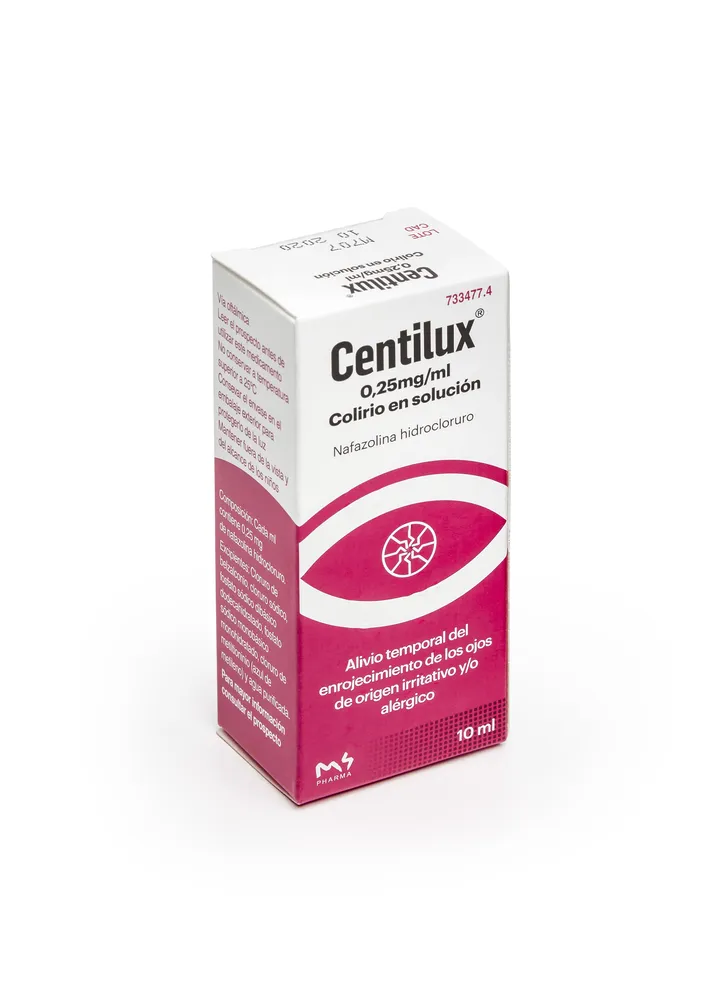
Table of Contents
- Package leaflet: Information for the user
- Introduction
- 1. What Centilux eye drops are and what they are used for
- 2. What you need to know before using Centilux eye drops
- 3. How to use Centilux eye drops
- 4. Possible adverse effects
- 5. Storage of Centilux eye drops
- 6. Contents of the pack and other information
Package leaflet: Information for the user
Introduction
Package leaflet: information for the user
Centilux 0.25 mg/ml eye drops solution
Naphazoline
Read the entire leaflet carefully before you start using this medicine, because it contains important information for you.
Follow exactly the instructions for use of the medicine contained in this leaflet or those indicated by your doctor or pharmacist.
- Keep this leaflet, as you may need to read it again.
- If you need advice or more information, consult your pharmacist.
- If you experience adverse effects, consult your doctor or pharmacist, even if they are adverse effects not listed in this leaflet. See section 4.
- You must consult a doctor if your condition worsens or if you do not improve after 3 days.
Contents of the leaflet
-
What Centilux eye drops are and what they are used for
-
What you need to know before using Centilux eye drops
-
How to use Centilux eye drops
-
Possible adverse effects
-
Storage of Centilux eye drops
-
Contents of the pack and other information
1. What Centilux eye drops are and what they are used for
Contains naphazoline as the active ingredient, which has a decongestant action (produces vasoconstriction or narrowing of the visible blood vessels in the eye).
Centilux is indicated for: Temporary relief of congestion, redness, and mild irritation in the eyes of irritative and/or allergic origin, caused by external agents such as: tobacco smoke, dust, pollution, dry or stuffy environments, sunlight, chlorinated or seawater, reading, or tasks requiring prolonged visual focus.
2. What you need to know before using Centilux eye drops
Do not use Centilux:
- if you are allergic to naphazoline or other adrenergic medicines (which among other effects may increase blood pressure) or to any of the other ingredients of this medicine (listed in section 6).
- if you have narrow-angle glaucoma in the eyes.
Warnings and precautions
Consult your doctor or pharmacist before starting to use Centilux.
You should exercise caution if any of the following apply to you:
- If you are being administered certain anesthetics (e.g., halothane, which makes the heart more sensitive to drugs like naphazoline)
- If you have bronchial asthma
- If you have any heart or circulatory disease
- If you have cerebral arteriosclerosis
- If you have high blood pressure
- If you have thyroid disease
- If you have diabetes
- If you are being treated with MAO inhibitors (monoamine oxidase inhibitors) (usually antidepressants) or during the two weeks following discontinuation of such treatment
- Do not use for longer than 3 to 5 days
- Do not wear contact lenses while using this medicine.
Children
Do not use Centilux in children; safety and efficacy have not been established in children.
Elderly patients
Caution should be exercised in patients over 65 years of age, particularly those with severe heart or circulatory diseases.
Other medicines and Centilux
Inform your doctor or pharmacist if you are taking, have recently taken, or might need to take any other medicines.
No interactions with other medicines are known.
Pregnancy and breastfeeding
If you are pregnant or breastfeeding, think you may be pregnant, or are planning to become pregnant, consult your doctor or pharmacist before using this medicine.
Centilux should only be administered during pregnancy if considered absolutely necessary and the potential benefit outweighs the potential risk to the fetus.
Do not use Centilux if you are breastfeeding.
Driving and use of machines
This medicine may cause temporary visual discomfort. Do not drive or operate machinery for a few minutes until transient blurred vision has disappeared.
Centilux contains benzalkonium chloride and phosphates
This medicine contains 0.1 mg of benzalkonium chloride per ml.
Benzalkonium chloride can be absorbed by soft contact lenses and may alter the color of contact lenses.
Remove contact lenses before using this medicine and wait at least 15 minutes before reinserting them.
Benzalkonium chloride may cause ocular irritation, particularly if you have dry eye or other corneal diseases (the transparent layer at the front of the eye). Consult your doctor if you experience a foreign body sensation, stinging, or eye pain after using this medicine.
This medicine contains 2.2 mg of phosphates per ml.
If you have severe damage to the transparent layer at the front of the eye (cornea), treatment with phosphates, in very rare cases, may lead to cloudy patches in the cornea due to calcium deposition.
3. How to use Centilux eye drops
Follow exactly the instructions for use provided in this leaflet or those given by your doctor or pharmacist. If in doubt, ask your doctor or pharmacist.
Recommended dose:
Ophthalmic use (in the eyes)
- Adults:
The dose is one or two drops of Centilux administered 2 to 4 times a day in the affected eye(s).
How to use:
- Wash your hands and, if possible, position yourself in front of a mirror.
- After opening the dropper container (bottle) for the first time, remove the plastic seal ring.
- Always take care not to touch anything with the tip of the dropper, as this could contaminate the
contents of the bottle.
- Hold the bottle upside down in one hand.
- With the other hand, gently pull down the lower eyelid of the affected eye and look upwards, tilting your head back.
- Place the tip of the dropper close to the eye, but without touching it, and gently squeeze the base of the
container so that the drops fall into the space between the eye and the eyelid.
- Gently close your eyes and keep them closed for a few seconds.
- Repeat steps 4, 5, and 6 for the other eye, if necessary.
- Close the bottle tightly after use.
If you are using more than one ophthalmic medication, applications should be spaced at least 5 minutes apart.
The duration of treatment should not exceed 3–5 days (rebound congestion may occur).
If symptoms do not resolve within this time period (72 hours), you must consult your doctor, who should examine the condition of your eyes.
If you use more Centilux than you should
Due to the characteristics of this medicine, intoxication phenomena are not expected with topical use at the recommended doses.
Taking a considerably larger amount of Alergoftal than the recommended dose, for example, if Centilux is accidentally swallowed, may cause serious adverse effects affecting the heart and blood circulation. Symptoms may include: reduced heart rate (bradycardia), acute headache, nausea, vomiting, breathing difficulties, increased heart rate (tachycardia), and chest pain.
An overdose can be removed by rinsing the eyes with lukewarm water. Do not apply additional drops until it is time for the next dose.
In case of accidental ingestion of the contents of a container, especially in children, signs of central nervous system (CNS) involvement may appear, such as marked sedation, CNS depression, decreased body temperature, and coma.
With very high doses of naphazoline, adverse effects on the heart or circulation may occur.
Other symptoms that may appear if the medicine is accidentally ingested, especially by children, include: nausea, vomiting, lethargy, breathing difficulty, etc.
In case of overdose or accidental ingestion, contact your doctor or pharmacist immediately, go to a medical center, or call the Toxicology Information Service at telephone number 91 562 04 20, indicating the medicine and the amount ingested.
If you forget to use Centilux
Do not use a double dose to make up for the missed dose.
Apply a single dose as soon as you remember. If it is almost time for the next dose, wait until the next scheduled dose and continue with your usual regimen.
If you have any further questions about the use of this medicine, ask your doctor or pharmacist.
4. Possible adverse effects
Like all medicines, this medicine can cause adverse effects, although not everyone will experience them.
It has been observed that the following may occur: pupil dilation, increased pressure inside the eye (intraocular pressure), effects due to absorption into the body (increased blood pressure, cardiac disorders, and elevated blood sugar), headache, and nausea.
Occasionally, itching after application has been observed.
Rarely, prolonged redness and eye irritation may occur.
Frequency not known: conjunctivitis, eye pain.
Very rarely: opaque spots on the cornea.
In predisposed patients, and with use exceeding the recommended amount or frequency, palpitations, tremor, weakness, and sweating may occur.
An allergic reaction to one of the components may also occur.
Reporting of adverse effects
If you experience any type of adverse effect, consult your doctor or pharmacist, even if it is a possible adverse effect not listed in this leaflet. You may also report them directly via the Spanish Pharmacovigilance System for Human Medicines: https://www.notificaram.es. By reporting adverse effects, you can help provide more information on the safety of this medicine.
5. Storage of Centilux eye drops
Keep this medicine out of the sight and reach of children.
Do not store above 25°C.
Keep the container in the outer packaging to protect it from light.
Do not use this medicine after the expiry date stated on the container and the box, after EXP. The expiry date refers to the last day of the month indicated.
Do not use this medicine if you notice any change in the colour of the solution or if it becomes cloudy.
Discard the bottle four weeks after first opening.
Medicines should not be disposed of via wastewater or household waste. Return unused medicines and their containers to the SIGRE point at your pharmacy. Ask your pharmacist how to dispose of medicines and containers you no longer need. This will help protect the environment.
6. Contents of the pack and other information
Composition of Centilux
- The active substance is naphazoline hydrochloride. One ml of eye drops contains 0.25 mg of naphazoline hydrochloride (0.025%).
- The other components are: benzalkonium chloride, sodium chloride, dibasic sodium phosphate dodecahydrate, monobasic sodium phosphate monohydrate, methylthioninium chloride (methylene blue), and purified water.
Appearance of the medicine and contents of the container
The medicine is an eye drop solution; a blue-colored liquid.
It is presented in a dropper container (plastic bottle) containing 10 ml of eye drop solution.
Marketing Authorization Holder and Manufacturer
Marketing Authorization Holder
Reva Health Europe, S.L.
Pl. Ausiàs March, 1, 4-6
08195 Sant Cugat del Vallès - Spain
Manufacturer
Tubilux Pharma S.P.A
Via Costa Rica, 20/22
00071-Pomezia (Roma)
Date of the most recent revision of this leaflet: June 2025
Detailed information about this medicine is available on the website of the Spanish Agency for Medicines and Health Products (AEMPS) http://www.aemps.gob.es/