Carbocal D 600 mg/400 IU chewable tablets
Spain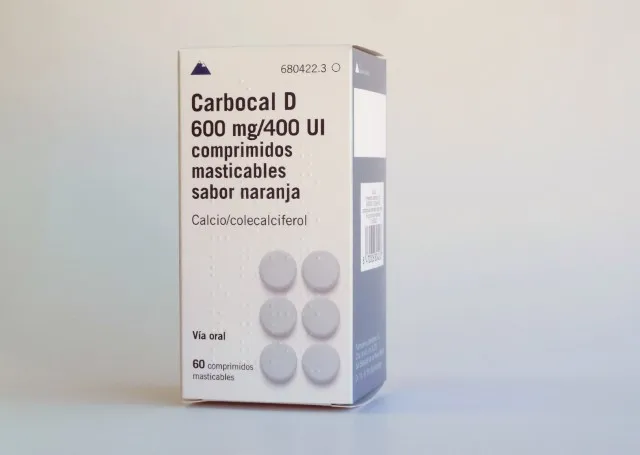
Table of Contents
Package leaflet: Information for the user
Introduction
Package leaflet: information for the patient
Carbocal D 600 mg/400 IU chewable tablets
Calcium / colecalciferol (vitamin D3)
Read the entire leaflet carefully before you start using this medicine, because it contains important information for you.
- Keep this leaflet, as you may need to read it again.
- If you have any questions, ask your doctor or pharmacist.
- This medicine has been prescribed for you only and must not be given to other people, even if they have the same symptoms as you, because it may harm them.
- If you experience any adverse effects, consult your doctor or pharmacist, even if they are adverse effects not listed in this leaflet. See section 4.
Leaflet contents
- What Carbocal D is and what it is used for
- What you need to know before taking Carbocal D
- How to take Carbocal D
- Possible side effects
- How to store Carbocal D
- Contents of the pack and other information
1. What Carbocal D is and what it is used for
Carbocal D is a calcium and vitamin D supplement.
Carbocal D is indicated for the treatment of calcium and vitamin D deficiency states. It may also be used as a supplement in the treatment of osteoporosis in patients with evident deficiency of calcium and vitamin D or who are at high risk of developing such deficiency.
2. What you need to know before taking Carbocal D
Do not take Carbocal D:
- if you are allergic to calcium carbonate, vitamin D3, or any of the other ingredients of this medicine (listed in section 6).
- if you have kidney stones.
- if you have severe renal insufficiency.
- if you have high levels of calcium in your blood or urine.
Warnings and precautions
Consult your doctor or pharmacist before starting to take Carbocal D.
- If you are taking other products containing vitamin D, you must inform your doctor, as you should stop taking them.
- If you suffer from any of the following conditions, remember to always inform your doctor before taking this medicine:
- If you have sarcoidosis (a granulomatous disease affecting different organs, including the skin, and which may be associated with elevated blood calcium levels).
- If you have renal insufficiency or a tendency to form kidney stones.
- If you have any heart disease.
Consult your doctor, even if any of the above-mentioned circumstances occurred in the past.
Children
The safety and efficacy of Carbocal D have not been established in children; therefore, its use is not recommended in this age group.
Other medicines and Carbocal D
Taking Carbocal D with other medicines.
Inform your doctor or pharmacist if you are taking, have recently taken, or might need to take any other medicines.
Carbocal D may interact with the following medicines:
- Cardiac glycosides, such as digoxin.
- The following antibiotics: tetracyclines, penicillin, neomycin, chloramphenicol.
- Certain diuretics: loop diuretics (furosemide, ethacrynic acid) and thiazide diuretics (hydrochlorothiazide).
- Antacids containing aluminium salts.
- Thyroid hormones.
- Cholestyramine.
- Corticosteroids.
- Mineral oils.
- Phenytoin.
- Barbiturates.
- Bisphosphonates.
- Sodium fluoride.
Taking Carbocal D with food, drinks, and alcohol
If you take Carbocal D chewable tablets together with foods containing oxalates (cabbage, spinach, chocolate), phosphates (red meat), or phytic acid (wholemeal bread, cereals), interactions may occur; therefore, it is advisable not to take Carbocal D with meals.
During treatment with Carbocal D, you should not consume foods that may be "fortified" with vitamin D.
Pregnancy, breastfeeding, and fertility
If you are pregnant or breastfeeding, think you might be pregnant, or plan to become pregnant, consult your doctor or pharmacist before using this medicine.
Your doctor will assess whether treatment is appropriate for you.
The use of Carbocal D is not recommended during pregnancy or breastfeeding.
Driving and using machines
No effects on the ability to drive or use machines have been observed.
Important information about some of the components of Carbocal D
This medicine contains 5 mg of aspartame per tablet.
Aspartame contains a source of phenylalanine, which may be harmful if you have phenylketonuria (PKU), a rare genetic disorder in which phenylalanine accumulates because the body cannot eliminate it properly.
This medicine contains lactose. If your doctor has informed you of an intolerance to certain sugars, consult him before taking this medicine.
This medicine contains 600 mg of sorbitol per tablet. Sorbitol is a source of fructose. If your doctor has informed you (or your child) of an intolerance to certain sugars, or if you (or your child) have been diagnosed with hereditary fructose intolerance (HFI), a rare genetic disorder in which the patient cannot break down fructose, consult your doctor before taking this medicine.
This medicine contains partially hydrogenated soybean oil. Do not use this medicine if you are allergic to peanuts or soy.
This medicine contains sucrose. If your doctor has informed you of an intolerance to certain sugars, consult him before taking this medicine.
3. How to take Carbocal D
Follow exactly the instructions for use of this medicine as given by your doctor or pharmacist. If in doubt, consult your doctor or pharmacist again.
Remember to take your medicine.
Adults and elderly patients
The recommended dose is 1 to 2 tablets per day.
Your doctor will determine the duration of your treatment with Carbocal D. Do not stop the treatment prematurely, as the desired effect will not be achieved.
Method of administration:
Carbocal D chewable tablets are for oral use. Chew the Carbocal D tablets, then drink some water if desired.
Alternatively, 1 or 2 tablets may be dispersed in half a glass of water and then ingested.
If you feel that the effect of Carbocal D is too strong or too weak, inform your doctor or pharmacist.
If you take more Carbocal D than you should
If you have taken more Carbocal D than you should, contact your doctor or pharmacist immediately.
In case of overdose, you may experience thirst, nausea, vomiting, dehydration, increased frequency of urination, and constipation.
In case of overdose or accidental ingestion, contact the Toxicology Information Service: Telephone 91 562 04 20.
If you forget to take Carbocal D
Do not take a double dose to make up for missed doses.
If you forget to take a dose, take the next dose as soon as possible and continue as before.
If you interrupt treatment with Carbocal D
If you have any further questions about the use of this medicine, ask your doctor or pharmacist.
4. Possible adverse effects
Like all medicines, this medicine may cause adverse effects, although not everyone experiences them.
The following adverse effects have been observed:
Rare (may affect up to 1 in 1,000 people): constipation, flatulence, nausea, abdominal pain, and diarrhoea.
With prolonged administration at high doses, elevated levels of calcium in blood and urine may occur, with symptoms such as loss of appetite, vomiting, nausea, headache, weakness, apathy, and drowsiness. Other more severe symptoms include thirst, dehydration, increased frequency of urination, abdominal pain, and irregular heartbeat.
If you notice any reaction not described in this leaflet, consult your doctor or pharmacist.
Reporting of adverse effects
If you experience any type of adverse effect, consult your doctor or pharmacist, even if it is a possible adverse effect not listed in this leaflet. You may also report them directly via the Spanish Pharmacovigilance System for Human Medicines: www.notificaram.es. By reporting adverse effects, you can help provide more information on the safety of this medicine.
5. Storage of Carbocal D
Do not store above 30°C. Keep in the original container.
Keep this medicine out of sight and reach of children.
Do not use this medicine after the expiry date stated on the container, after EXP. The expiry date refers to the last day of the month indicated.
Medicines must not be disposed of via wastewater or household waste. Dispose of unused medicines and their containers at the SIGRE collection point at your pharmacy. Ask your pharmacist how to dispose of medicines and containers you no longer need. This will help protect the environment.
6. Contents of the pack and other information
Composition of Carbocal D
-
The active substances are calcium (carbonate) and colecalciferol (vitamin D3). Each chewable tablet contains 600 mg of calcium and 400 IU of colecalciferol.
-
The other components (excipients) are: silicon dioxide, corn starch, sucrose, hydrolyzed bovine gelatin, partially hydrogenated soybean oil, DL-alpha-tocopherol, sodium saccharin, sorbitol (E 420), pregelatinized starch (from corn), polysorbate 80 (E 433), magnesium stearate (E 572), sodium croscarmellose, aspartame (E 951), monohydrate lactose, anise flavour, mint flavour and milk flavour.
Appearance of the product and contents of the pack
Carbocal D are white chewable tablets with an anise-mint flavour.
The chewable tablets are packed in opaque white high-density polyethylene (HDPE) bottles, with a polyethylene cap and a tamper-evident seal, contained in a cardboard outer package.
Pack sizes of 60 tablets are available.
Marketing Authorisation Holder
Farmasierra Laboratorios SL
Ctra de Irún km 26,200 San Sebastián de los Reyes
28706 Madrid. Spain
Manufacturer
Farmasierra Manufacturing SL
Ctra de Irún km 26,200 San Sebastián de los Reyes
28706 Madrid. Spain
Date of the most recent review of this leaflet: December 2025
Detailed information on this medicine is available on the website of the Spanish Agency of Medicines and Health Products (AEMPS) http://www.aemps.gob.es