Carbocal 600 mg tablets
Spain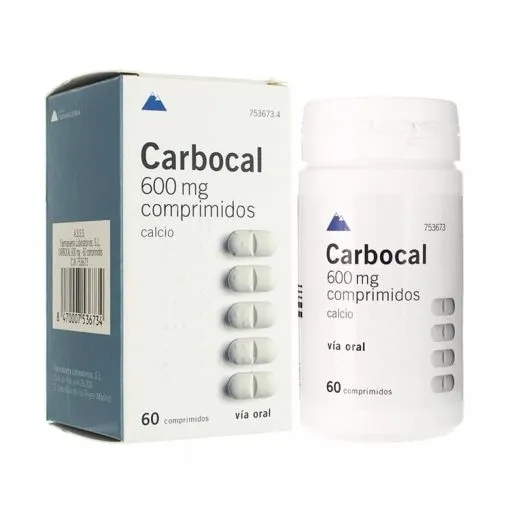
Table of Contents
Package leaflet: Information for the user
Introduction
Package leaflet: information for the patient
Carbocal 600 mg tablets
Calcium carbonate
Read all of this leaflet carefully before you start taking this medicine because it contains important information for you.
Follow exactly the instructions for use provided in this leaflet or those given by your doctor, pharmacist, or nurse.
- Keep this leaflet, as you may need to read it again.
- If you need advice or more information, consult your pharmacist.
- If you experience any adverse effects, consult your doctor, pharmacist, or nurse, even if they are effects not listed in this leaflet. See section 4.
- You should consult your doctor if you worsen or do not improve.
Leaflet contents
- What Carbocal is and what it is used for
- What you need to know before taking Carbocal
- How to take Carbocal
- Possible side effects
- How to store Carbocal
- Contents of the pack and other information
1. What Carbocal is and what it is used for
Carbocal is a calcium supplement.
It is indicated:
- For the prevention and treatment of calcium deficiency.
- As a supplement in the prevention and treatment of osteoporosis (fragile and brittle bones).
- For the treatment of hyperphosphatemia (elevated phosphate levels in the blood).
2. What you need to know before taking Carbocal
Do not take Carbocal
- If you are allergic to calcium or any of the other ingredients of this medicine (listed in section 6).
- If you have kidney stones.
- If you have high levels of calcium in your blood or urine.
Warnings and precautions
Talk to your doctor, pharmacist, or nurse before starting to take this medicine.
If you have kidney insufficiency or a tendency to form kidney stones, consult your doctor before starting to take this medicine.
Other medicines and Carbocal
Tell your doctor, pharmacist, or nurse if you are taking, have recently taken, or might need to take any other medicines. Certain medicines may interact with Carbocal. In such cases, it may be necessary to adjust the dose or discontinue treatment with one of the medicines.
It is important that you inform your doctor if you are taking or have recently taken any of the following medicines:
- Cardiac glycosides (medicines for the heart)
- Levothyroxine (thyroid hormone)
- Iron, zinc, and strontium ranelate preparations
- Tetracyclines and quinolones
- Thiazide diuretics (medicines that increase urine elimination)
- Systemic corticosteroids (anti-inflammatory steroid-derived medicines)
- Bisphosphonates (medicines for the treatment and prevention of osteoporosis: fragile and brittle bones)
- Sodium fluoride (stimulates remineralization of demineralized enamel)
Taking Carbocal with food and drinks
If you take Carbocal together with foods containing oxalic acid (found in spinach and rhubarb) or phytic acid (found in wholemeal bread and whole grains), interactions may occur. Therefore, it is recommended not to take Carbocal within two hours after consuming foods high in oxalic acid or phytic acid.
Pregnancy, breastfeeding, and fertility
If you are pregnant or breastfeeding, think you may be pregnant, or are planning to become pregnant, consult your doctor or pharmacist before using this medicine. Your doctor will assess whether treatment is appropriate for you.
During pregnancy, daily calcium intake should not exceed 2500 mg (including food and supplements).
Carbocal may be used during pregnancy in cases of calcium deficiency.
Carbocal may be used during breastfeeding. Calcium passes into breast milk.
Driving and using machines
No effects on the ability to drive or use machines have been observed.
3. How to take Carbocal
Follow exactly the instructions for use provided in this leaflet or those indicated by your doctor or pharmacist. If in doubt, consult your doctor or pharmacist. Remember to take your medicine.
Carbocal tablets are for oral use. Swallow the Carbocal tablets whole or split, with water, if desired.
The recommended dose is:
Calcium deficiency
Adults: The usual recommended dose is 1 to 2 tablets per day.
Children: The usual recommended dose is 1 tablet per day.
Osteoporosis
Adults: The usual recommended dose is 1 to 2 tablets per day.
Hyperphosphatemia (high levels of phosphate in the blood)
Your doctor will determine the dose individually. The usual dose is 3 to 13 tablets per day, divided into 2 to 4 doses. The tablets should be taken with meals to bind the phosphate from food.
Your doctor will determine the duration of your treatment with Carbocal. Do not stop treatment prematurely, as the desired effect will not be achieved.
If you feel that the effect of Carbocal is too strong or too weak, inform your doctor or pharmacist.
If you take more Carbocal than you should
If you have taken more Carbocal than you should, contact your doctor, pharmacist, or call the Toxicology Information Service immediately at telephone number 91-562-04-20, stating the medicine and the amount taken.
In case of overdose, you may experience thirst, nausea, vomiting, constipation, loss of appetite, abdominal pain, muscle weakness, fatigue, mental disturbances, polydipsia (excessive thirst), polyuria (increased frequency of urination), bone pain, nephrocalcinosis (high calcium levels in the kidneys), kidney stones, and in severe cases, cardiac arrhythmias (abnormal heart rate).
If you forget to take Carbocal
Do not take a double dose to make up for missed doses. If you forget to take a dose, take the next one as soon as possible and continue as before.
4. Possible adverse effects
Like all medicines, Carbocal may cause adverse effects, although not everyone experiences them.
The following adverse reactions are listed by organ systems and frequencies. Frequencies are defined as: uncommon (between 1 and 100 in every 1,000 people), rare (between 1 and 1,000 in every 10,000 people), or very rare (up to 1 in every 10,000 people).
Disorders of metabolism and nutrition
Uncommon: hypercalcemia (high levels of calcium in the blood) and hypercalciuria (high levels of calcium in urine)
Very rare: Milk-alkali syndrome (urgent need to urinate frequently, persistent headache, continuous loss of appetite, nausea or vomiting, unusual tiredness or weakness, hypercalcemia, alkalosis, and renal failure). This usually occurs only in cases of overdose (see section 4.9).
Gastrointestinal disorders
Rare: constipation, flatulence, nausea, abdominal pain, and diarrhoea.
Dyspepsia has occurred at an unknown frequency (frequency cannot be estimated from available data).
Skin and subcutaneous tissue disorders
Very rare: pruritus, exanthema (skin rash), and urticaria (itching).
Reporting of adverse effects
If you experience any type of adverse effect, consult your doctor, pharmacist, or nurse, even if these are possible adverse effects not listed in this leaflet. You may also report them directly via the Spanish Pharmacovigilance System for Human Medicines: https://www.notificaram.es. By reporting adverse effects, you can help provide more information on the safety of this medicine.
5. Storage of Carbocal
Keep this medicine out of sight and reach of children. This medicine does not require any special storage conditions. Keep the container tightly closed to protect it from moisture.
Do not use Carbocal after the expiry date stated on the packaging after EXP. The expiry date refers to the last day of the month indicated.
Medicines must not be disposed of via wastewater or household waste. Dispose of empty containers and unused medicines at the SIGRE collection point at your pharmacy. If in doubt, ask your pharmacist how to properly dispose of containers and unused medicines. This will help protect the environment.
6. Contents of the pack and other information
Composition of Carbocal
The active substance is calcium carbonate. Each tablet contains 1,500 mg of calcium carbonate (equivalent to 600 mg of calcium).
The other components (excipients) are: corn starch, pregelatinized starch (from corn), sodium starch glycolate type A (from potato), povidone, sodium lauryl sulfate, and magnesium stearate.
Appearance of the product and contents of the container
Carbocal is presented as white tablets.
Plastic bottle: 20 and 60 tablets.
Not all pack sizes may be marketed.
Marketing Authorization Holder
Farmasierra Laboratorios S.L.
Ctra. de Irún, km 26,200
28709, San Sebastián de los Reyes (Madrid)
Manufacturer:
Farmasierra Manufacturing, S.L.
Ctra. de Irún, km 26,200
28709, San Sebastián de los Reyes (Madrid)
Date of the most recent review of this leaflet: April 2023
Detailed and up-to-date information on this medicinal product is available on the website of the Spanish Agency for Medicines and Health Products (AEMPS) http://www.aemps.gob.es