Carbaglu 200 mg dispersible tablets
Spain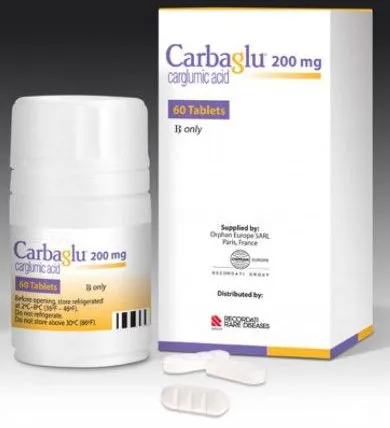
Table of Contents
Package leaflet: Information for the user
Introduction
Package leaflet: Information for the user
Carbaglu 200 mg dispersible tablets
carglumic acid
Read the entire leaflet carefully before you start taking this medicine because it contains important information for you.
- Keep this leaflet as you may need to read it again.
- If you have any questions, ask your doctor or pharmacist.
- This medicine has been prescribed for you only and must not be given to other people, even if they have the same symptoms, as it could harm them.
- If you experience any adverse effects, consult your doctor or pharmacist, even if they are effects not listed in this leaflet. See section 4.
Contents of the leaflet:
- What Carbaglu is and what it is used for
- What you need to know before taking Carbaglu
- How to take Carbaglu
- Possible side effects
- How to store Carbaglu
- Contents of the pack and other information
1. What Carbaglu is and what it is used for
Carbaglu can help reduce excessive plasma levels of ammonia (elevated ammonia levels in the blood). Ammonia is particularly toxic to the brain and, in severe cases, can lead to decreased level of consciousness and coma.
Hyperammonemia may be due to:
- deficiency of a specific liver enzyme, N-acetylglutamate synthase. Patients with this rare disorder are unable to eliminate nitrogenous waste, which increases after consuming protein.
This disorder persists throughout the patient's life, so lifelong treatment is necessary.
- isovaleric acidemia, methylmalonic acidemia, or propionic acidemia. Patients with one of these disorders require treatment during episodes of hyperammonemia.
2. What you need to know before starting to take Carbaglu
Do not take Carbaglu:
Do not take Carbaglu if you are allergic (hypersensitive) to carglumic acid or to any of the other components of Carbaglu (listed in section 6).
Do not take Carbaglu during breastfeeding.
Warnings and precautions
Talk to your doctor or pharmacist before starting to take Carbaglu.
Treatment with Carbaglu should be initiated under the supervision of a physician experienced in the management of metabolic disorders.
Your doctor will assess your individual response to carglumic acid before starting any long-term treatment.
The dose must be individually adjusted in order to maintain normal plasma ammonia levels.
Your doctor may prescribe arginine supplements or restrict your protein intake.
To monitor your disease and treatment, your doctor may periodically examine your liver, kidneys, heart, and blood.
Other medicines and Carbaglu
Inform your doctor or pharmacist if you are taking, have recently taken, or might need to take any other medicines.
Use of Carbaglu with food and drink
Carbaglu should be taken orally before main meals or food intake.
The tablets should be dispersed in a minimum of 5 to 10 ml of water and taken immediately. The suspension has a slightly acidic taste.
Pregnancy and breastfeeding
The effects of Carbaglu on pregnancy and the fetus are unknown.
If you are pregnant or breastfeeding, think you may be pregnant, or are planning to become pregnant, consult your doctor or pharmacist before using this medicine.
Driving and using machines
The effects on the ability to drive and use machines are unknown.
3. How to take Carbaglu
Follow exactly the instructions for administering this medicine as given by your doctor. If in doubt, consult your doctor or pharmacist again.
Usual dose:
The initial daily dose is usually 100 mg per kg of body weight, up to a maximum of 250 mg per kg of body weight (for example, if you weigh 10 kg, you should take 1 g per day, or 5 tablets). For patients with N-acetylglutamate synthase deficiency, the usual long-term daily dose ranges between 10 mg and 100 mg per kg of body weight.
Your doctor will determine the appropriate dose for you to maintain normal blood ammonia levels.
Carbaglu must be administered ONLY orally or through a nasogastric tube (using a syringe if necessary).
When the patient is in hyperammonaemic coma, Carbaglu is administered as a rapid bolus with a syringe through the feeding tube.
Inform your doctor if you have renal impairment. Your daily dose should be reduced.
If you take more Carbaglu than you should
Consult your doctor or pharmacist.
If you forget to take Carbaglu
Do not take a double dose to make up for missed doses.
If you stop taking Carbaglu:
Do not stop taking Carbaglu without informing your doctor.
If you have any further questions about the use of this medicine, ask your doctor or pharmacist.
4. Possible adverse effects
Like all medicines, this medicine can cause adverse effects, although not everyone experiences them.
The following adverse effects have been reported: very common (may affect more than 1 in 10 people), common (may affect up to 1 in 10 people), uncommon (may affect up to 1 in 100 people), rare (may affect up to 1 in 1,000 people), very rare (may affect up to 1 in 10,000 people), and frequency not known (cannot be estimated from available data).
- Common: increased sweating
- Uncommon: bradycardia (reduced heart rate), diarrhea, fever, increased aminotransferases, vomiting
- Frequency not known: rash
If you consider any of the adverse effects you experience to be severe, or if you notice any adverse effect not listed in this leaflet, inform your doctor or pharmacist.
Reporting of adverse effects
If you experience any type of adverse effect, consult your doctor or pharmacist, even if it is a possible adverse effect not listed in this leaflet. You may also report them directly through the national reporting system included in Appendix V. By reporting adverse effects, you can help provide more information on the safety of this medicine.
5. Storage of Carbaglu
Keep this medicine out of the sight and reach of children.
Do not use this medicine after the expiry date stated on the tablet container after EXP.
The expiry date refers to the last day of the month indicated.
Store in a refrigerator (between 2°C and 8°C).
After first opening the tablet container: do not refrigerate. Do not store above 30°C.
Keep the container tightly closed to protect it from moisture.
Write the date of opening on the tablet container. Discard 3 months after first opening.
Medicines must not be disposed of via wastewater or household waste. Ask your pharmacist how to dispose of medicines you no longer need. This will help protect the environment.
6. Contents of the package and other information
Composition of Carbaglu
- The active substance is carglumic acid. Each tablet contains 200 mg of carglumic acid.
- The other components are microcrystalline cellulose, sodium lauryl sulfate, hypromellose, sodium croscarmellose, colloidal anhydrous silica, sodium stearyl fumarate.
Nature of the product and contents of the pack
Carbaglu 200 mg tablets are bar-shaped tablets with 4 divisions on one side and 3 break lines. Carbaglu is available in plastic containers of 5, 15 and 60 tablets closed with a child-resistant cap.
Marketing Authorization Holder
Recordati Rare Diseases
Tour Hekla
52 avenue du Général de Gaulle
F-92800 Puteaux
France
Tel.: + 33 1 4773 6458
Fax: + 33 1 4900 1800
Manufacturer
Recordati Rare Diseases
Immeuble “Le Wilson”
70, Avenue du Général de Gaulle
92800 Puteaux
France
or
Recordati Rare Diseases
Eco River Parc
30, rue des Peupliers
F-92000 Nanterre
France
Further information on this medicinal product is available upon request by contacting the local representative of the Marketing Authorization Holder.
Belgium/Belgium/Belgium Recordati Tel/Tel: +32 2 46101 36 | Lithuania Recordati AB. Tel: + 46 8 545 80 230 Sweden |
| Luxembourg/Luxembourg Recordati Tel/Tel: +32 2 46101 36 Belgium |
Czech Republic Recordati Rare Diseases Tel: +33 (0)1 47 73 64 58 France | Hungary Recordati Rare Diseases Tel: +33 (0)1 47 73 64 58 France |
Denmark Recordati AB. Tlf : +46 8 545 80 230 Sweden | Malta Recordati Rare Diseases Tel: +33 1 47 73 64 58 France |
Germany Recordati Rare Diseases Germany GmbH Tel: +49 731 140 554 0 | Netherlands Recordati Tel: +32 2 46101 36 Belgium |
Estonia Recordati AB. Tel: + 46 8 545 80 230 Sweden | Norway Recordati AB. Tlf : +46 8 545 80 230 Sweden |
Greece Recordati Hellas Tel: +30 210 6773822 | Austria Recordati Rare Diseases Germany GmbH Tel: +49 731 140 554 0 Germany |
Spain Recordati Rare Diseases Spain S.L.U. Tel: + 34 91 659 28 90 | Poland Recordati Rare Diseases Tel: +33 (0)1 47 73 64 58 France |
France Recordati Rare Diseases Tel: +33 (0)1 47 73 64 58 | Portugal Jaba Recordati S.A. Tel: +351 21 432 95 00 |
Croatia Recordati Rare Diseases Tel: +33 (0)1 47 73 64 58 France | Romania Recordati Rare Diseases Tel: +33 (0)1 47 73 64 58 France |
Ireland Recordati Rare Diseases Tel: +33 (0)1 47 73 64 58 France | Slovenia Recordati Rare Diseases Tel: +33 (0)1 47 73 64 58 France |
Iceland Recordati AB. Tel: +46 8 545 80 230 Sweden | Slovak Republic Recordati Rare Diseases Tel: +33 (0)1 47 73 64 58 France |
Italy Recordati Rare Diseases Italy Srl Tel: +39 02 487 87 173 | Finland Recordati AB. Tel/Tel : +46 8 545 80 230 Sweden |
Cyprus Recordati Rare Diseases Tel : +33 1 47 73 64 58 France | Sweden Recordati AB. Tel : +46 8 545 80 230 |
Latvia Recordati AB. Tel: + 46 8 545 80 230 Sweden |
Date of the most recent review of this leaflet:
Detailed information on this medicine is available on the European Medicines Agency website: http://www.ema.europa.eu. There are also links to other websites on rare diseases and treatments.