Campral 333 mg film-coated tablets
Spain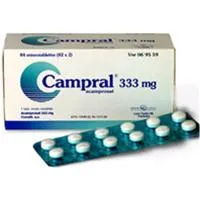
Table of Contents
Package leaflet: Information for the user
Introduction
Package leaflet: information for the user
Campral 333 mg film-coated tablets
Acamprosate
Read the entire leaflet carefully before you start taking this medicine, because it contains important information for you.
- Keep this leaflet as you may need to read it again.
- If you have any questions, ask your doctor or pharmacist.
- This medicine has been prescribed for you only, and you must not give it to other people, even if they have the same symptoms as you, because it may harm them.
- If you experience any adverse reactions, consult your doctor or pharmacist, even if they are adverse reactions not listed in this leaflet. See section 4.
Contents of the leaflet:
- What Campral is and what it is used for
- What you need to know before taking Campral
- How to take Campral
- Possible side effects
- Storage of Campral
- Contents of the pack and other information
1. What Campral is and what it is used for
Campral is a medication that acts on the brain. Its effect is mediated through brain substances involved in the development of alcohol dependence.
After the period of alcohol detoxification, Campral is indicated to prevent relapse into alcohol consumption by the patient. Treatment with Campral must always be accompanied by psychotherapy to achieve the maintenance of alcohol abstinence.
2. What you need to know before starting to take Campral
Do not take Campral:
- if you are allergic to acamprosate or to any of the other ingredients of this medicine (listed in section 6).
- if you have any kidney disease (blood creatinine level above 120 micromol/l).
- if you are breastfeeding.
Warnings and precautions
Consult your doctor or pharmacist before starting to take Campral:
- If you are under 18 years of age or over 65 years of age.
- If you have severe hepatic impairment.
- Because of the recognized and complex relationship between alcohol dependence, depression, and suicide rate, if you suffer from alcohol dependence and experience symptoms of depression or suicidal thoughts, consult your doctor or pharmacist.
Taking Campral with other medicines
Inform your doctor or pharmacist if you are taking, have recently taken, or might need to take any other medicines.
Taking Campral with food, drinks, and alcohol
Taking Campral with meals may reduce its effectiveness; therefore, it is recommended to take it before meals.
Although no interactions between Campral and alcohol have been reported, concomitant administration is not recommended.
Pregnancy, breastfeeding, and fertility
Although harmful effects have not been demonstrated, there are insufficient data on the use of Campral in pregnant women.
It is unknown whether Campral is excreted in human breast milk; however, since excretion has been demonstrated in animals, Campral must not be used in women who are breastfeeding.
It is unknown whether Campral may affect fertility in humans.
If you are pregnant or breastfeeding, think you may be pregnant, or are planning to become pregnant, consult your doctor or pharmacist before using this medicine.
Driving and using machines
Campral has no influence on the ability to drive or use machinery.
Campral contains sodium
This medicine contains less than 23 mg of sodium (1 mmol) per tablet; thus, it is essentially "sodium-free".
3. How to take Campral
Follow exactly the instructions for use of this medicine given by your doctor or pharmacist. If in doubt, consult your doctor or pharmacist again.
The recommended dose is:
-
in patients weighing more than 60 kg, 6 tablets per day divided into 3 doses (2 tablets in the morning, 2 at midday, and 2 at night);
-
in patients weighing less than 60 kg, 4 tablets per day divided into 3 doses (2 tablets in the morning, 1 at midday, and 1 at night).
Use in children and adolescents
The safety and efficacy of Campral in patients under 18 years of age has not been established; therefore, its use is not recommended in this population.
Method of administration
The tablets should be swallowed whole with some liquid.
The tablets should be taken before meals.
Duration of treatment
The recommended duration of treatment is 1 year.
If you take more Campral than you should
Contact your doctor or pharmacist immediately.
Depending on the amount of medicine taken, treatment interruption may be necessary.
Acute overdose is usually mild. In reported cases, the only symptom possibly related to overdose is diarrhea.
There have been no reported cases of hypercalcemia (increased calcium levels) as a result of overdose. However, if this occurs, treatment should be symptomatic.
In case of overdose or accidental ingestion, contact the Toxicology Information Service. Telephone: 91.562.04.20.
If you forget to take Campral
Do not take a double dose to make up for missed doses.
If you have any further questions about the use of this medicine, ask your doctor or pharmacist.
4. Possible adverse effects
Like all medicines, this medicine can cause adverse effects, although not everyone experiences them.
When adverse reactions occur, they are usually mild and transient.
The following adverse effects may occur during treatment with Campral:
Very common (may affect more than 1 in 10 people): diarrhoea
Common (may affect up to 1 in 10 people): nausea, vomiting, abdominal pain, flatulence, itching, skin rash, frigidity, decreased libido (sexual desire), and impotence.
Uncommon (may affect up to 1 in 100 people): increased libido.
Very rare (may affect up to 1 in 10,000 people): urticaria, angioedema (swelling under the skin, mainly affecting face and neck), anaphylactic reactions (severe, generalized allergic reaction).
Unknown (frequency cannot be estimated from available data): vesiculobullous skin eruptions.
Reporting of adverse effects
If you experience any type of adverse effect, consult your doctor or pharmacist, even if it is a possible adverse effect not listed in this leaflet. You may also report them directly via the Spanish Pharmacovigilance System for Human Medicinal Products: https://www.notificaram.es. By reporting adverse effects, you can help provide more information on the safety of this medicine.
5. Storage of Campral
Keep this medicine out of the sight and reach of children.
Do not use this medicine after the expiry date stated on the packaging after EXP. The expiry date refers to the last day of the month indicated.
Medicines must not be disposed of via wastewater or household waste. Dispose of unused medicines and their containers at the SIGRE collection point at your pharmacy. If in doubt, ask your pharmacist how to dispose of medicines and containers you no longer need. This will help protect the environment.
6. Contents of the pack and other information
Composition of Campral
- The active substance is acamprosate. Each tablet contains 333 mg of acamprosate.
- The other components are: microcrystalline cellulose, magnesium silicate, copolymer of methacrylic acid and ethyl acrylate (1:1), 30 percent dispersion, crospovidone, sodium carboxymethylstarch (type A) (from potato), magnesium stearate, talc, propylene glycol, colloidal anhydrous silica.
Appearance of the product and contents of the container
Campral is available in packs of 84 white, round, film-coated tablets marked with "333".
Marketing Authorization Holder and Manufacturer
Marketing Authorization Holder
Merck Santé s.a.s.
37, rue Saint Romain
69379 Lyon Cedex 08 – France
Manufacturer
MERCK SANTE S.A.S. SEMOY PRODUCTION SITE
2 rue du Pressoir Vert (Semoy) - F-45400 - France
MERCK S.L.
Merck Industrial Park (Mollet del Vallés (Barcelona)) - 08100 - Spain
For further information about this medicinal product, please contact the local representative of the Marketing Authorization Holder:
Spain
Merck, S.L.
Tel: +34 935.65.55.00
Date of the most recent revision of this leaflet: April 2019
Detailed and up-to-date information on this medicinal product is available on the website of the Spanish Agency of Medicines and Medical Devices (AEMPS) http://www.aemps.gob.es/