Calcium/vitamin D3 Sandoz 1000 mg/880 IU chewable tablets
Spain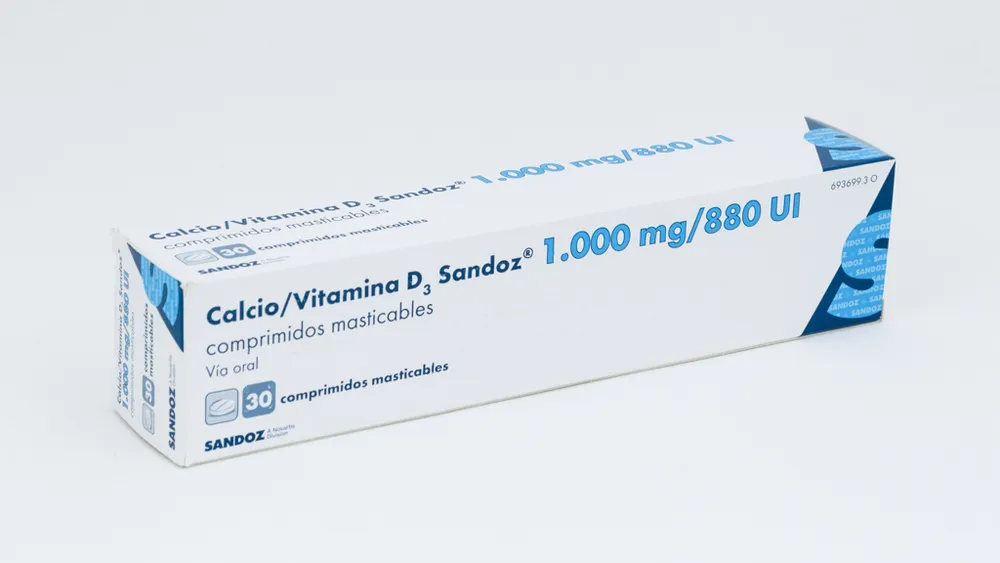
Table of Contents
- Package leaflet: Information for the user
- Introduction
- 1. What Calcio/Vitamina D3 Sandoz is and what it is used for
- 2. What you need to know before taking Calcio/Vitamina D3 Sandoz
- 3. How to take Calcio/Vitamina D3 Sandoz
- 4. Possible adverse effects
- 5. Storage of Calcio/Vitamina D3 Sandoz
- 6. Contents of the pack and other information
Package leaflet: Information for the user
Introduction
Package leaflet: information for the patient
Calcium/Vitamin D3 Sandoz 1000 mg/880 IU chewable tablets
calcium/colecalciferol
Read the entire leaflet carefully before you start taking this medicine, because it contains important information for you.
- Keep this leaflet, as you may need to read it again.
- If you have any questions, ask your doctor or pharmacist.
- This medicine has been prescribed for you only, and you must not give it to other people, even if they have the same symptoms as you, because it could harm them.
- If you experience any adverse effects, consult your doctor or pharmacist, even if they are adverse effects not listed in this leaflet. See section 4.
Contents of the leaflet
- What Calcio/Vitamina D3 Sandoz is and what it is used for
- What you need to know before taking Calcio/Vitamina D3 Sandoz
- How to take Calcio/Vitamina D3 Sandoz
- Possible side effects
- Storage of Calcio/Vitamina D3 Sandoz
Pack contents and other information
1. What Calcio/Vitamina D3 Sandoz is and what it is used for
Calcio/Vitamina D3 Sandoz contains the active substances calcium and vitamin D3 and is a calcium-vitamin D3 supplement.
Calcio/Vitamina D3 Sandoz is used
- to prevent and treat calcium and vitamin D deficiency states in elderly people.
- to provide vitamin D and calcium as complementary therapy in osteoporosis (fragile bones).
2. What you need to know before taking Calcio/Vitamina D3 Sandoz
Do not take Calcio/Vitamina D3 Sandoz
- if you are allergic to calcium, vitamin D3, or any of the other ingredients of this medicine (listed in section 6),
- if you have high levels of calcium in your blood (hypercalcemia),
- if you have high levels of calcium in your urine (hypercalciuria),
- if you have overactivity of the parathyroid glands (hyperparathyroidism),
- if you have bone marrow cancer (myeloma),
- if you have cancer that has spread to your bones (bone metastases),
- if you have limited limb movement (prolonged immobilization) accompanied by hypercalcemia and/or hypercalciuria,
- if you have kidney stones (nephrolithiasis),
- if you have calcium deposits in the kidneys (nephrocalcinosis),
- if you have excess vitamin D (hypervitaminosis D),
- if you have severe kidney problems,
- if you are under 18 years of age.
Warnings and precautions
Talk to your doctor or pharmacist before taking Calcio/Vitamina D3 Sandoz if any of the following apply to you:
- Long-term treatment
During prolonged treatment, calcium levels in blood and urine and kidney function should be monitored periodically. This is especially important if you are prone to developing kidney stones. Depending on blood levels, your doctor may reduce the dose or stop treatment.
- If you are receiving concomitant treatment with cardiac glycosides or thiazide diuretics (medicines that increase urine excretion) for heart problems
In this case, calcium levels in blood and urine and kidney function should be monitored regularly, especially if you are elderly. Depending on blood levels, your doctor may reduce the dose or stop treatment.
- Kidney problems
If you have kidney problems, you should take Calcio/Vitamina D3 Sandoz with special care. This is especially important if you are also taking other medicines containing aluminum, as the citric acid in Calcio/Vitamina D3 Sandoz may increase aluminum absorption. Your blood and urine calcium levels should be monitored. If you have severe kidney problems, use other forms of vitamin D instead of colecalciferol.
- Taking additional calcium and vitamin D supplements
Medical supervision is required, and your doctor will need to frequently monitor your blood and urine calcium levels.
- Sarcoidosis (an immune disorder that may affect the liver, lungs, skin, or lymph nodes)
Take special care when taking Calcio/Vitamina D3 Sandoz if you have sarcoidosis. There is a risk that the effect of this medicine may become too strong, leading to calcium overdose in the body. Blood and urine calcium levels should be monitored.
- Immobilization and osteoporosis
This medicine should be used with special care in these cases, as it could increase blood calcium levels.
Children and adolescents
Calcio/Vitamina D3 Sandoz is not indicated for use in children or adolescents under 18 years of age; see section 2 “Do not take Calcio/Vitamina D3 Sandoz”.
Taking Calcio/Vitamina D3 Sandoz with other medicines
Tell your doctor or pharmacist if you are taking, have recently taken, or might need to take any other medicines.
-
When taken together with digitalis glycosides (cardiac glycosides derived from the digitalis plant), cardiac arrhythmias may occur. Therefore, strict medical monitoring, including ECG and blood calcium level determination, is necessary.
-
When taken together with diuretics of the thiazide class (also known as medicines to increase urine excretion), blood calcium levels should be monitored periodically, as thiazides reduce calcium excretion in urine.
-
The absorption, and therefore the effectiveness, of certain antibiotics (called tetracyclines) is reduced when taken at the same time as Calcio/Vitamina D3 Sandoz. These medicines should be taken at least 2 hours before or 4–6 hours after Calcio/Vitamina D3 Sandoz.
-
Other medicines such as sodium fluoride (used to strengthen tooth enamel or treat osteoporosis) and bisphosphonate medicines (used to treat osteoporosis) are also affected by interactions. Therefore, these medicines should be taken at least 3 hours before Calcio/Vitamina D3 Sandoz.
-
The largest possible interval should be left between taking cholestyramine (a medicine to reduce high cholesterol levels) or laxatives such as liquid paraffin and Calcio/Vitamina D3 Sandoz, as otherwise vitamin D may not be properly absorbed.
-
Orlistat (a medicine used to treat obesity) may affect vitamin D absorption. Take Calcio/Vitamina D3 Sandoz at least 2 hours before or after taking Orlistat.
-
Taking Calcio/Vitamina D3 Sandoz together with rifampicin (an antibiotic), phenytoin (a medicine for treating epilepsy), or barbiturates (hypnotics) may reduce the effect of vitamin D.
-
Taking Calcio/Vitamina D3 Sandoz together with glucocorticoids (e.g., cortisone) may reduce the effect of vitamin D and lower blood calcium levels.
-
Additional calcium and vitamin D supplements should only be taken under medical supervision, and frequent monitoring of blood and urine calcium levels is required.
-
Calcium may reduce the effect of levotiroxine (used to treat hypothyroidism). Therefore, take levotiroxine at least four hours before or four hours after Calcio/Vitamina D3 Sandoz.
-
The effect of quinolone antibiotics may be reduced if taken at the same time as calcium. Take quinolone antibiotics at least two hours before or six hours after taking Calcio/Vitamina D3 Sandoz.
-
Calcium may reduce the absorption of ranelate of iron, zinc, or strontium. Take these medicines at least two hours before or after taking Calcio/Vitamina D3 Sandoz.
-
Calcium may reduce the absorption of estramustine (a medicine used in chemotherapy). Take this medicine at least two hours before or after taking Calcio/Vitamina D3 Sandoz.
Taking Calcio/Vitamina D3 Sandoz with food, drinks, and alcohol
Be aware that oxalic acid (e.g., found in spinach and rhubarb) and phytic acid (e.g., found in whole grains) may reduce the amount of calcium absorbed in the intestine.
You should not take calcium-containing medicines within 2 hours before or after eating foods high in oxalic acid or phytic acid.
Pregnancy and breastfeeding
Pregnancy
If you are pregnant, you may take Calcio/Vitamina D3 Sandoz if you have a deficiency of calcium and vitamin D.
The daily dose should not exceed half a tablet. During pregnancy, the total daily calcium intake should not exceed 1,500 mg, and the total daily intake of vitamin D3 should not exceed 600 IU (International Units).
Long-term overdose of calcium and vitamin D during pregnancy should be avoided, as it may lead to high blood calcium levels and could have a negative effect on the fetus.
Breastfeeding
Calcio/Vitamina D3 Sandoz may be used during breastfeeding. Since calcium and vitamin D pass into breast milk, consult your doctor beforehand if your baby is receiving other products containing vitamin D.
If you are pregnant or breastfeeding, think you may be pregnant, or plan to become pregnant, consult your doctor or pharmacist before using this medicine.
Driving and using machines
Calcio/Vitamina D3 Sandoz has no or negligible influence on the ability to drive and use machines.
Calcio/Vitamina D3 Sandoz contains aspartame, sorbitol, isomalt, sucrose, sodium, and benzyl alcohol.
This medicine contains 1.00 mg of aspartame in each chewable tablet. Aspartame is a source of phenylalanine, which may be harmful if you have phenylketonuria (PKU), a rare genetic disorder in which phenylalanine accumulates because the body cannot eliminate it properly.
This medicine contains 119.32 mg of sorbitol in each chewable tablet.
This medicine contains isomalt and sucrose. If your doctor has told you that you have an intolerance to certain sugars, consult with him before taking this medicine.
May cause dental caries.
This medicine contains less than 23 mg of sodium (1 mmol) per chewable tablet, which is essentially “sodium-free”.
This medicine contains 0.02 mg of benzyl alcohol in each chewable tablet. Benzyl alcohol may cause adverse reactions.
3. How to take Calcio/Vitamina D3 Sandoz
Follow exactly the instructions for use of this medicine provided by your doctor or pharmacist. If in doubt, please consult your doctor or pharmacist again.
Recommended dose:
Adults and elderly patients: 1 chewable tablet daily (corresponds to 1,000 mg of calcium and 880 IU [International Units] of vitamin D3).
Pregnant women may take only half a chewable tablet daily (corresponding to 500 mg of calcium and 440 IU [International Units] of vitamin D3). The daily dose of half a chewable tablet must not be exceeded.
Use in children and adolescents
Calcio/Vitamina D3 Sandoz is not indicated for use in children or adolescents under 18 years of age; see section 2 “Do not take Calcio/Vitamina D3 Sandoz”.
Method of administration
Oral use.
The chewable tablet must be chewed before swallowing. You may take Calcio/Vitamina D3 Sandoz at any time of day, with or without food.
Duration of treatment
Calcio/Vitamina D3 Sandoz is intended for long-term treatment. Speak with your doctor about the duration of treatment with Calcio/Vitamina D3 Sandoz (see also section 2 “Warnings and precautions”).
If you take more Calcio/Vitamina D3 Sandoz than you should
Contact your doctor or pharmacist immediately if you suspect an overdose. Keep the packaging and any remaining chewable tablets available.
An overdose of Calcio/Vitamina D3 Sandoz may cause symptoms such as dizziness (nausea), vomiting, excessive thirst or sleepiness, increased urine output, dehydration, or constipation.
If you have taken more Calcio/Vitamina D3 Sandoz than you should, contact your doctor, pharmacist, or call the Toxicology Information Service immediately at telephone number: 91 562 04 20, indicating the medicine and the amount taken.
If you forget to take Calcio/Vitamina D3 Sandoz
If you forget to take Calcio/Vitamina D3 Sandoz, take it as soon as you remember, unless it is almost time for your next dose. In that case, skip the missed dose and take the next one at the regular time. Do not take a double dose to make up for a forgotten dose.
If you stop taking Calcio/Vitamina D3 Sandoz
If you wish to interrupt or prematurely discontinue the treatment, consult your doctor.
If you have any further questions about the use of this medicine, ask your doctor or pharmacist.
4. Possible adverse effects
Like all medicines, this medicine can cause adverse effects, although not everyone will experience them.
Stop taking Calcio/Vitamina D3 Sandoz and contact your doctor immediately if you experience any of the following serious adverse effects:
Very rare (may affect up to 1 in 10,000 people):
- frequent urination, persistent headache, prolonged loss of appetite, nausea or vomiting, unusual fatigue or weakness along with elevated levels of calcium in the blood and kidney problems that usually occur after excessive calcium intake (milk-alkali syndrome).
Rare adverse effects (may affect up to 1 in 1,000 people):
- severe allergic reaction: swelling of the face, lips, tongue or throat with sudden breathing difficulty and severe skin rash.
Other reported adverse effects are:
Uncommon adverse effects (may affect up to 1 in 100 people):
- high levels of calcium in the blood (hypercalcemia) or in the urine (hypercalciuria).
Rare adverse effects (may affect up to 1 in 1,000 people):
- feeling unwell (nausea), vomiting, diarrhoea, abdominal pain, constipation, flatulence, bloating (abdominal distension),
- skin rash, itching, hives.
If you have renal insufficiency, there may be a risk of elevated phosphate levels in the blood, increased calcium levels in the kidneys, and kidney stones.
Reporting of adverse effects
If you experience any type of adverse effect, consult your doctor or pharmacist, even if it is a possible adverse effect not listed in this leaflet. You may also report them directly via the Spanish Pharmacovigilance System for Human Medicines: https://www.notificaram.es. By reporting adverse effects, you can help provide more information on the safety of this medicine.
5. Storage of Calcio/Vitamina D3 Sandoz
Keep this medicine out of sight and reach of children.
Do not use this medicine after the expiry date stated on the carton and on the tube or on the aluminum foil strips. The expiry date refers to the last day of the month indicated.
For the tube: Keep the container tightly closed to protect it from moisture.
For the strips: This medicine does not require any special storage conditions.
Medicines must not be disposed of via wastewater or household waste. Return any unused medicines and their containers to the SIGRE collection point at your pharmacy. If you are unsure, ask your pharmacist how to properly dispose of unused medicines and their packaging. This will help protect the environment.
6. Contents of the pack and other information
Composition of Calcium/Vitamin D3 Sandoz
-
The active substances are calcium and colecalciferol (vitamin D3). Each chewable tablet contains 1,000 mg of calcium (as carbonate) and 880 IU of colecalciferol (vitamin D3) (equivalent to 22 micrograms of colecalciferol (vitamin D3)).
-
The other components are isomalt (E 953), xylitol, sorbitol (E 420), citric acid, anhydrous, disodium hydrogen citrate, magnesium stearate, sodium croscarmellose, orange flavour “CPB” and orange flavour “CVT” [both flavours contain sorbitol (E 420)], aspartame (E 951), potassium acesulfame, sodium ascorbate, all-rac-alpha-tocopherol, modified maize starch, sucrose, medium-chain triglycerides and colloidal silicon dioxide. Orange flavour “CPB” also contains benzyl alcohol as part of natural/nature-identical mandarin oil.
Appearance of the product and contents of the pack
Round, white tablets with a smooth surface and a break line.
The chewable tablets are available in polypropylene bottles with polyethylene caps containing a desiccant, or in aluminium foil strips inserted into cardboard packaging.
Pack sizes:
Bottles: 30, 90 chewable tablets.
Strips: 30, 90 chewable tablets.
Only certain pack sizes may be marketed.
Marketing Authorisation Holder and Manufacturer
Marketing Authorisation Holder
Sandoz Farmacéutica, S.A.
Parque Norte Business Centre
Roble Building
C/ Serrano Galvache, 56
28033 Madrid
Spain
Manufacturer
Hermes Pharma GmbH
Hans-Urmiller-Ring, 52
D-82515 Wolfratshausen
Germany
or
Salutas Pharma GmbH
Otto-von-Guericke-Allee 1
39179 Barleben,
Germany
This medicinal product is authorised in the European Economic Area member states under the following names:
Country Medicinal product name
Belgium | Sandoz Calcium D3 1000 mg/ 880 IU chewable tablets |
Spain | Calcium/Vitamin D3 Sandoz 1,000 mg/880 IU chewable tablets |
France | STRUCTOCAL VITAMINE D3 |
Luxembourg | Sandoz Calcium D3 1000 mg/ 880 IU chewable tablets |
Netherlands | Calcium/Vitamin D3 Sandoz 1000 mg/ 880 IU, chewable tablets |
Date of the most recent review of this leaflet: September 2020.
Detailed and up-to-date information on this medicine is available on the website of the Spanish Agency of Medicines and Medical Devices (AEMPS) http://www.aemps.gob.es/