Calcitonin Almirall 100 IU solution for injection
Spain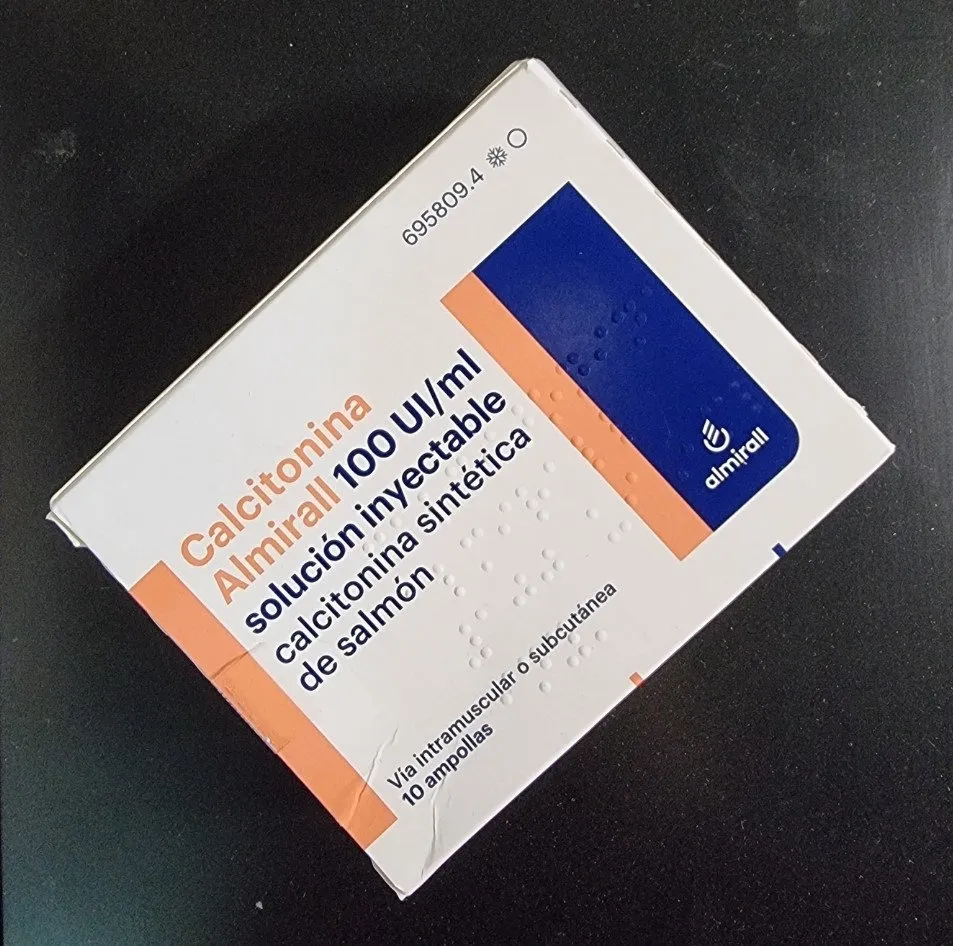
Table of Contents
- Package leaflet: Information for the user
- Introduction
- 1. What Calcitonina Almirall is and what it is used for
- 2. What you need to know before using Calcitonina Almirall
- 3. How to use Calcitonina Almirall
- 4. Possible adverse effects
- 5. Storage of Calcitonin Almirall
- 6. Contents of the container and other information
Package leaflet: Information for the user
Introduction
Package leaflet: information for the user
Calcitonin Almirall 100 IU/ml solution for injection
Synthetic salmon calcitonin
Read the entire leaflet carefully before you start using this medicine, because it contains important information for you.
- Keep this leaflet, as you may need to read it again.
If you have any questions, ask your doctor or pharmacist.
- This medicine has been prescribed for you only, and you should not give it to other people, even if they have the same symptoms as you, because it could harm them.
- If you experience any adverse reactions, consult your doctor or pharmacist, even if they are adverse reactions not listed in this leaflet. See section 4.
Leaflet contents
- What Calcitonin Almirall is and what it is used for
- What you need to know before using Calcitonin Almirall
- How to use Calcitonin Almirall
- Possible adverse effects
- How to store Calcitonin Almirall
- Contents of the pack and other information
1. What Calcitonina Almirall is and what it is used for
Calcitonina Almirall may be administered in the following cases:
-
Prevention of bone loss in situations of sudden immobilization. For example, patients who must remain in bed due to a fracture.
-
Paget's disease of the bone in individuals who cannot receive other treatments for this condition, such as patients with severe kidney problems. Paget's disease is a slowly progressing disorder that can cause changes in the size and shape of certain bones.
-
Treatment of high levels of calcium in the blood (hypercalcemia) caused by cancer.
2. What you need to know before using Calcitonina Almirall
Do not use Calcitonina Almirall:
- if you are allergic to calcitonin or to any of the other ingredients of this medicine (listed in section 6).
- if you have hypocalcemia (low calcium levels in the blood).
Warnings and precautions
Talk to your doctor or pharmacist before starting to use Calcitonina Almirall.
Allergic-type reactions may occur during treatment with Calcitonina Almirall, including cases of severe allergic reactions (anaphylactic shock). However, generalized or localized redness is a common reaction to calcitonin and is not an allergic reaction.
If an allergy to calcitonin is suspected, your doctor may decide to perform a sensitivity test before starting treatment.
Consult your doctor if you have been diagnosed with cancer. In clinical trials, patients treated with calcitonin for osteoporosis and osteoarthritis showed an increased risk of developing cancer with long-term treatment. Your doctor will decide whether calcitonin is an appropriate treatment for you and for how long it should be continued.
Use in children and adolescents
The use of Calcitonina Almirall is not recommended in patients under 18 years of age.
Use of Calcitonina Almirall with other medicines
Tell your doctor or pharmacist if you are taking, have recently taken, or might need to take any other medicines, including those obtained without a prescription.
Certain medicines may interact with Calcitonina Almirall; in such cases, it may be necessary to adjust the dose or discontinue treatment with one of them.
It is important that you inform your doctor if you are taking or have recently taken any of the following medicines:
- Cardiac glycosides and calcium channel blockers (medicines used to treat heart problems or high blood pressure).
- Bisphosphonates (for the treatment of various bone-related diseases or calcium metabolism disorders).
Pregnancy, breastfeeding, and fertility
If you are pregnant or breastfeeding, think you may be pregnant, or are planning to become pregnant, consult your doctor or pharmacist before using this medicine.
Pregnancy
It is unknown whether the use of Calcitonina Almirall is safe in pregnant women. Therefore, Calcitonina Almirall should only be used during pregnancy when, in the opinion of your doctor, the expected therapeutic benefits justify its use.
Breastfeeding
Do not use Calcitonina Almirall if you are breastfeeding.
Driving and use of machines
Calcitonina Almirall may cause transient dizziness. If you experience this adverse reaction, you should not drive or operate machinery.
Warnings about excipients
This medicine contains less than 1 mmol (23 mg) of sodium per ampoule and is therefore considered essentially "sodium-free".
3. How to use Calcitonina Almirall
Follow exactly the administration instructions for this medicine given by your doctor or pharmacist. If in doubt, consult your doctor or pharmacist again.
Remember to use your medicine.
Your doctor will decide the correct dose and how long you should continue treatment with calcitonin.
Dosage
Use in adults over 18 years of age
- For prevention of bone loss:
A dose of 100 IU once daily or 50 IU twice daily for 2 to 4 weeks is recommended.
- In Paget's disease:
A dose of 100 IU once daily is recommended, normally for a maximum of 3 months. In certain cases, the doctor may decide to extend the duration of treatment up to 6 months.
- For treatment of high calcium levels:
A dose of 100 IU every 6 to 8 hours is recommended.
Method of administration
Calcitonina Almirall can be administered subcutaneously or intramuscularly.
It may be administered before going to bed to reduce nausea or vomiting that may occur, especially at the beginning of treatment.
If you use more Calcitonina Almirall than you should
Contact your doctor or pharmacist immediately. Reactions expected in case of overdose include nausea, vomiting, flushing, and dizziness.
In case of overdose or accidental ingestion, you may also contact the Toxicology Information Service. Telephone 915 620 420.
4. Possible adverse effects
Like all medicines, this medicine may cause adverse effects, although not everyone will experience them.
The most frequently observed adverse reactions (in more than 1 in 10 patients) with Calcitonin Almirall are nausea (with or without vomiting), which occurs in 10% of patients and tends to decrease or disappear over the course of treatment or by reducing the dose.
Redness of the skin (in the face or upper part of the body) may also occur. This is not an allergic reaction but is due to the effect of the medicine and usually appears 10–20 minutes after administration.
Frequent adverse reactions (may affect up to 1 in 10 patients): cancer (after long-term treatments).
Uncommon adverse reactions (may affect up to 1 in 100 patients): diarrhoea, inflammatory reactions at the site of subcutaneous or intramuscular injection, skin rash, metallic taste in the mouth, dizziness, and increased urine production.
Rare adverse reactions (may affect up to 1 in 1,000 patients): transient decrease in blood calcium levels 4–6 hours after administration (in patients with Paget's disease and younger patients), and development of neutralizing antibodies against calcitonin.
Very rare (may affect up to 1 in 10,000 patients): severe allergic reactions such as bronchospasm (spasm of the bronchi), swelling of the tongue and throat, and in isolated cases, anaphylaxis (a severe generalized allergic reaction).
Reporting of adverse effects
If you experience any type of adverse effect, consult your doctor or pharmacist, even if it is a possible adverse effect not listed in this leaflet. You can also report them directly via the Spanish Pharmacovigilance System for Human Medicinal Products: www.notificaRAM.es. By reporting adverse effects, you can help provide more information on the safety of this medicine.
5. Storage of Calcitonin Almirall
Keep this medicine out of the sight and reach of children.
Store in a refrigerator (between 2°C and 8°C). Do not freeze.
Do not use this medicine after the expiry date stated on the packaging and outer carton after EXP. The expiry date refers to the last day of the month indicated.
Medicines should not be disposed of via wastewater or household waste. Dispose of containers and unused medicines at the SIGRE collection point at your pharmacy. If you are unsure, ask your pharmacist how to dispose of containers and medicines you no longer need. This will help protect the environment.
6. Contents of the container and other information
Composition of Calcitonin Almirall
- The active substance is synthetic salmon calcitonin. One vial (1 ml) contains 100 IU of synthetic salmon calcitonin.
- The other components are: sodium acetate trihydrate (E-262i), glacial acetic acid (E-260), sodium chloride, and water for injections.
Appearance of the product and contents of the container
Calcitonin Almirall is presented as a transparent, colorless injectable solution. Each pack contains 10 colorless glass vials of 100 IU.
Marketing Authorization Holder and Manufacturer
Marketing Authorization Holder
Almirall, S.A. General Mitre, nº 151 08022 – Barcelona (Spain).
Manufacturer
Famar Health Care Services Madrid, S.A.U. Avda. Leganés, 62 28925 Alcorcón – Madrid (Spain).
Date of the most recent review of this leaflet: March 2013
Detailed and up-to-date information on this medicinal product is available on the website of the Spanish Agency of Medicines and Medical Devices (AEMPS) http://www.aemps.gob.es/