Bucomax with lidocaine lozenges for sucking, peppermint flavour
Spain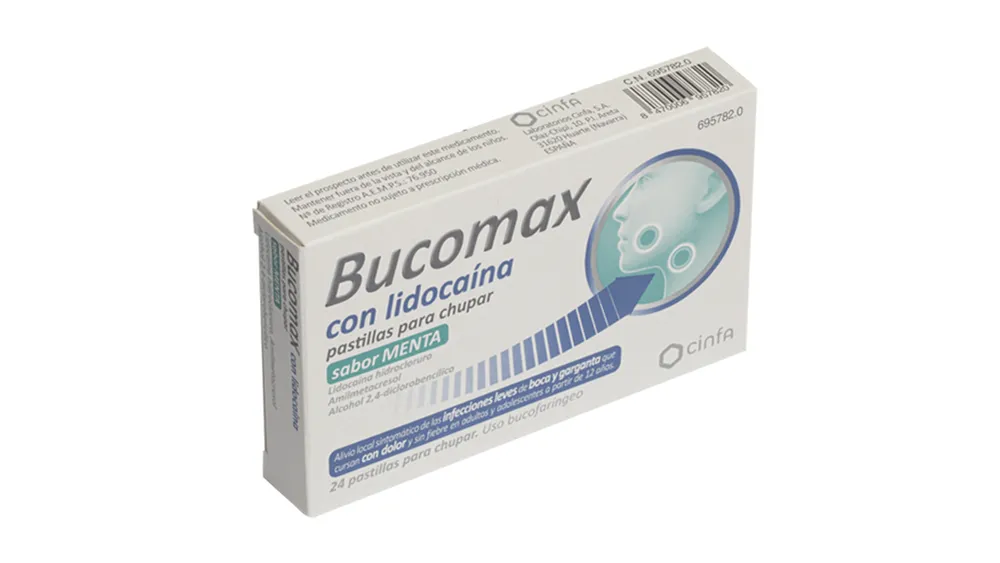
Table of Contents
- Package leaflet: Information for the user
- Introduction
- 1. What bucomax with lidocaine is and what it is used for
- 2. What you need to know before taking bucomax with lidocaine
- **Bucomax with lidocaine contains sodium**
- 3. How to take bucomax with lidocaine
- 4. Possible adverse effects
- 5. Storage of bucomax with lidocaine
- 6. Contents of the pack and other information
Package leaflet: Information for the user
Introduction
Package leaflet: information for the user
bucomax with lidocaine lozenges, mint flavour
lidocaine hydrochloride / amylmetacresol / 2,4-dichlorobenzyl alcohol
Read the entire leaflet carefully before you start taking this medicine because it contains important information for you.
Follow exactly the instructions for use provided in this leaflet or those indicated by your doctor, pharmacist or nurse.
- Keep this leaflet, as you may need to read it again.
- If you need advice or more information, consult your pharmacist.
- If you experience any adverse effects, consult your doctor, pharmacist or nurse, even if they are adverse effects not listed in this leaflet. See section 4.
- You should consult a doctor if your condition worsens or if you do not improve after 2 days of treatment.
Contents of the leaflet
- What bucomax with lidocaine is and what it is used for.
- What you need to know before taking bucomax with lidocaine.
- How to take bucomax with lidocaine.
- Possible side effects.
- How to store bucomax with lidocaine.
- Contents of the pack and other information.
1. What bucomax with lidocaine is and what it is used for
Bucomax with lidocaine belongs to a group of medicines called antiseptics.
Bucomax with lidocaine is a combination of two antiseptics, 2,4-dichlorobenzyl alcohol and amylmetacresol, and a local anesthetic for the throat, lidocaine hydrochloride.
It is used for the local symptomatic relief of mild mouth and throat infections associated with pain and without fever in adults and adolescents aged 12 years and older.
You should consult a doctor if your condition worsens or does not improve after 2 days.
2. What you need to know before taking bucomax with lidocaine
Do not take bucomax with lidocaine:
- If you are allergic to 2,4-dichlorobenzyl alcohol, amylmetacresol, lidocaine hydrochloride, or any of the other ingredients of this medicine (listed in section 6).
- If you are under 12 years of age.
- If you have had an allergic reaction to local anaesthetics.
- If you have suffered from or are suspected of having methaemoglobinaemia.
- If you have experienced asthma attacks or bronchospasm.
Warnings and precautions
Consult your doctor or pharmacist before taking bucomax with lidocaine:
- If you suffer from asthma.
- The anaesthesia caused by this medicine in the throat area may increase the risk of aspiration (coughing while eating, with a sensation of choking) when swallowing food or drink. This medicine should not be used before meals or before drinking.
- Prolonged use of this medicine for more than 5 days is not recommended, as it may alter the natural microbial balance of the throat.
- Do not exceed the maximum recommended dose. If taken in large amounts or repeatedly, this medicine may enter the bloodstream and affect the heart and nervous system, potentially causing seizures.
- Elderly, ill, or weakened individuals should consult their doctor before taking this medicine, as they may be more sensitive to possible adverse effects.
If your symptoms do not improve, worsen after 2 days of treatment, or if you develop high fever, headache, nausea, or vomiting, you should consult your doctor.
Do not exceed the maximum recommended dose.
Children and adolescents
This medicine is contraindicated in children under 12 years of age. bucomax with lidocaine is intended for adults and adolescents aged 12 years and older.
Taking bucomax with lidocaine with other medicines
Inform your doctor or pharmacist if you are taking, have recently taken, or might need to take any other medicines.
In particular, inform them if you are taking any of the following medicines, as dosage adjustments may be necessary:
- Beta-blockers (used to treat heart conditions or arterial diseases) and medicines such as cimetidine (used to treat stomach ulcers).
- Other local anaesthetics of the amide type.
- Medicines used for cardiac rhythm disorders, such as mexiletine or procainamide.
- Medicines such as fluvoxamine (used to treat depression).
- Antibiotics such as erythromycin and itraconazol.
You should not take other oropharyngeal antiseptics (medicines for mild throat infections like bucomax with lidocaine) while using this medicine, although interactions are not expected.
Taking bucomax with lidocaine with food, drinks, and alcohol
This medicine should not be used before meals or before drinking.
During treatment with this medicine, consumption of alcoholic beverages should be avoided.
Pregnancy, breastfeeding, and fertility
If you are pregnant or breastfeeding, think you may be pregnant, or are planning to become pregnant, consult your doctor or pharmacist before using this medicine.
Pregnancy:
Consult your doctor or pharmacist before using any medicine.
The use of this medicine during pregnancy is not recommended.
Breastfeeding:
Consult your doctor or pharmacist before using any medicine.
Fertility:
There are no available data on fertility.
Driving and using machines
Be aware of how this medicine affects you. At the recommended doses, drowsiness or reduced reaction capacity is not expected. However, if such effects occur, do not drive or operate dangerous machinery.
bucomax with lidocaine contains isomalt and maltitol
This medicine contains isomalt (E-953) and maltitol (E-965). If your doctor has diagnosed you with an intolerance to certain sugars, consult him or her before taking this medicine.
Bucomax with lidocaine contains sodium
This medicine contains less than 23 mg of sodium (1 mmol) per lozenge, which means it is essentially "sodium-free".
This medicine contains terpenes provided by levomenthol, which may cause seizures in young children (under 6 years of age) if administered in excessive doses. However, at the doses and by the route of administration used in this medicine, absorption and activity of the terpenes are very low.
3. How to take bucomax with lidocaine
Follow exactly the instructions for use provided in this leaflet or those given by your doctor or pharmacist. If in doubt, consult your doctor or pharmacist.
The recommended dose is:
Adults and adolescents aged 12 years and older: 1 tablet every 2 or 3 hours, as needed, up to a maximum of 8 tablets in 24 hours.
Use in children
This medicine is contraindicated in children under 12 years of age.
How to take bucomax with lidocaine:
Oropharyngeal use, to be dissolved in the mouth.
Slowly let one lozenge dissolve in the mouth. Do not swallow, chew, or bite it.
If symptoms do not improve, worsen after 2 days of treatment, or if you develop high fever, headache, nausea, or vomiting, you must consult your doctor.
If you take more bucomax with lidocaine than you should
An increased or altered normal heart rhythm, increased blood pressure, sedation, breathing disturbances during sleep, unconsciousness, cardiovascular collapse, insomnia, hallucinations, tremors, and epileptic seizures (symptoms of central nervous system depression or stimulation) may occur. Drowsiness may be a sign of overdose. In children, agitation may occur.
In case of accidental ingestion of large amounts, gastrointestinal discomfort, blurred vision, tinnitus (ringing in the ears), and drowsiness may be experienced.
In case of overdose or accidental ingestion, consult your doctor or pharmacist immediately or call the Toxicology Information Service at telephone number 91 562 04 20, indicating the medicine and the amount ingested.
Prolonged use of this medicine for more than 5 days is not recommended, as it may alter the natural microbial balance of the throat.
The use of high doses over long periods in children may cause seizures.
If you have any further questions about the use of this medicine, ask your doctor or pharmacist.
4. Possible adverse effects
Like all medicines, this medicine can cause adverse effects, although not everyone will experience them.
Very rare adverse effects (may affect up to 1 in 10,000 people): allergic reactions (hypersensitivity) such as redness, itching, or skin swelling (rash), or burning, stinging, or swelling of the mouth or throat.
Adverse effects with unknown frequency (cannot be estimated from available data): abdominal pain, nausea, or oral discomfort.
If you experience any adverse effects, consult your doctor or pharmacist, even if they are adverse effects not listed in this leaflet.
Reporting of adverse effects
If you experience any type of adverse effect, consult your doctor or pharmacist, even if they are possible adverse effects not listed in this leaflet. You may also report them directly through the Spanish Pharmacovigilance System for Human Medicinal Products: https://www.notificaram.es. By reporting adverse effects, you can help provide more information on the safety of this medicine.
5. Storage of bucomax with lidocaine
Keep this medicine out of sight and reach of children.
This medicine does not require special storage conditions.
Do not use this medicine after the expiry date stated on the packaging after EXP. The expiry date refers to the last day of the month indicated.
Medicines must not be disposed of via wastewater drains or household waste. Dispose of unused containers and medicines at the SIGRE collection point at your pharmacy. If in doubt, ask your pharmacist how to properly dispose of unused containers and medicines. This will help protect the environment.
6. Contents of the pack and other information
Composition of bucomax with lidocaine
Each pastille for sucking contains the following active substances:
Lidocaine hydrochloride 2.00 mg.
Amylmetacresol 0.60 mg.
2,4-dichlorobenzyl alcohol 1.20 mg.
The other components (excipients) are: peppermint essential oil, levomenthol, indigo carmine colour (E-132), quinoline yellow (E-104), sodium saccharin (E-954), tartaric acid (E-334), isomalt (E-953) and maltitol (E-965).
Appearance of the product and contents of the pack
bucomax with lidocaine is presented as cylindrical, biconvex pastilles, green in colour and with a mint flavour.
Each pack contains 8 or 24 pastilles.
Marketing Authorisation Holder and Manufacturer:
Marketing Authorisation Holder
Laboratorios Cinfa, S.A.
Carretera Olaz-Chipi, 10. Polígono Industrial Areta
31620 Huarte (Navarra) - Spain
Manufacturer
LOZY’S PHARMACEUTICALS, S.L.
Campus Empresarial s/n
31795 Lekaroz (Navarra)
SPAIN
or
Laboratorios Cinfa, S.A.
Carretera Olaz-Chipi, 10. Polígono Industrial Areta
31620 Huarte (Navarra) - Spain
Date of the most recent revision of this package leaflet: December 2019
Detailed and up-to-date information on this medicinal product is available on the website of the Spanish Agency for Medicines and Health Products (AEMPS) http://www.aemps.gob.es/