Brimica Genuair 340/12 micrograms powder for inhalation
Spain
Table of Contents
Package leaflet: Information for the user
Introduction
Package leaflet: information for the patient
Brimica Genuair 340 micrograms/12 micrograms powder for inhalation
aclidinium/formoterol fumarate dihydrate
Read the entire leaflet carefully before you start using this medicine, because it contains important information for you.
- Keep this leaflet. You may need to read it again.
- If you have any questions, ask your doctor, pharmacist, or nurse.
- This medicine has been prescribed for you only, and you must not give it to other people, even if they have the same symptoms as you, because it could harm them.
- If you experience any adverse reactions, consult your doctor, pharmacist, or nurse, even if they are adverse reactions not listed in this leaflet. See section 4.
Leaflet contents
- What Brimica Genuair is and what it is used for
- What you need to know before using Brimica Genuair
- How to use Brimica Genuair
- Possible side effects
- How to store Brimica Genuair
- Contents of the pack and other information
Instructions for use
1. What Brimica Genuair is and what it is used for
What Brimica Genuair is
This medicine contains two active substances called aclidinium and formoterol fumarate dihydrate. Both belong to a group of medicines known as bronchodilators. Bronchodilators work by relaxing the muscle in your airways, allowing the airways to open up more, which helps you breathe more easily. The Genuair inhaler delivers the active substances directly into the lungs when you inhale.
What Brimica Genuair is used for
Brimica Genuair is used in adult patients who have difficulty breathing due to a lung disease called chronic obstructive pulmonary disease (COPD), in which the airways and alveoli in the lungs are damaged or become blocked. By opening the airways, the medicine helps relieve symptoms such as breathlessness. Regular use of Brimica Genuair will reduce the impact of COPD on your daily life.
2. What you need to know before using Brimica Genuair
Do not use Brimica Genuair:
- if you are allergic to aclidinium, formoterol fumarate dihydrate, or any of the other ingredients of this medicine (listed in section 6).
Warnings and precautions
Consult your doctor, pharmacist, or nurse before starting to use Brimica Genuair if you have any of the following symptoms/conditions:
- If you have asthma. This medicine should not be used for the treatment of asthma.
- If you have heart problems.
- If you have epilepsy.
- If you have thyroid disorders (thyrotoxicosis).
- If you have a tumor in an adrenal gland (pheochromocytoma).
- If you have difficulty urinating or have problems due to an enlarged prostate.
- If you have a condition of the eye called narrow-angle glaucoma, which causes increased pressure in the eye.
Stop using Brimica Genuair and seek immediate medical help if you experience any of the following symptoms:
- If you experience sudden chest tightness, cough, wheezing, or difficulty breathing immediately after using the medicine. See section 4.
Brimica Genuair is used as a maintenance (long-term) treatment for COPD. This medicine should not be used to treat a sudden attack of breathing difficulty or wheezing.
If your usual COPD symptoms (shortness of breath, wheezing, or cough) do not improve or worsen during treatment with Brimica Genuair, you should continue using the medicine but must see your doctor as soon as possible so that they can determine whether you need additional medication.
If you see halos around lights or colored images, or have eye pain or discomfort, or experience temporary blurred vision, contact your doctor immediately.
Dry mouth has been observed with medicines such as Brimica Genuair. Long-term dry mouth may lead to dental caries, so it is important to maintain good oral hygiene.
Children and adolescents
Brimica Genuair must not be used in children or adolescents under 18 years of age.
Use of Brimica Genuair with other medicines
Inform your doctor or pharmacist if you are taking, have recently taken, or might need to take any other medicines. If you use Brimica Genuair with other medicines, the effect of Brimica Genuair or the other medicines may be altered.
Inform your doctor or pharmacist if you are taking:
-
Any medicine that may be similar to Brimica Genuair for the treatment of breathing difficulty.
-
Medicines that reduce potassium levels in the blood. These include:
-
oral corticosteroids (such as prednisolone),
-
diuretics (such as furosemide or hydrochlorothiazide),
-
certain medicines used to treat respiratory diseases (such as theophylline).
-
Medicines called beta-blockers, which may be used to treat high blood pressure and other heart conditions (such as atenolol or propranolol), or to treat glaucoma (such as timolol).
-
Medicines that may cause a type of change in the heart's electrical activity known as "QT interval prolongation" (seen on an electrocardiogram). These include medicines used to treat:
-
depression (such as monoamine oxidase inhibitors or tricyclic antidepressants),
-
bacterial infections (such as erythromycin, clarithromycin, or telithromycin),
-
allergic reactions (antihistamines).
Pregnancy and breastfeeding
If you are pregnant or breastfeeding, think you may be pregnant, or plan to become pregnant, consult your doctor, pharmacist, or nurse before using this medicine. You should not use Brimica Genuair during pregnancy or while breastfeeding unless your doctor has advised you to do so.
Driving and using machines
It is unlikely that Brimica Genuair will affect your ability to drive or use machines. However, in some patients, this medicine may cause blurred vision or dizziness. If you experience any of these adverse effects, do not drive or operate machinery until the dizziness has resolved and your vision has returned to normal.
Brimica Genuair contains lactose
This medicine contains lactose. If your doctor has told you that you have an intolerance to certain sugars, consult with them before taking this medicine.
3. How to use Brimica Genuair
Follow exactly the instructions for administering this medicine as given by your doctor or pharmacist. If in doubt, consult your doctor or pharmacist again.
- The recommended dose is one inhalation in the morning and one inhalation at night.
- You may use Brimica Genuair at any time, before or after eating or drinking.
- The effects of Brimica Genuair last for 12 hours; therefore, you should try to use Brimica Genuair at the same time every morning and evening, as this will ensure that there is always enough medicine in your body to help you breathe more easily throughout the day and night. In addition, taking it at the same time every day will help you remember to use it.
- The recommended dose can be used in elderly patients and in patients with kidney or liver problems. Dose adjustment is not necessary in these patients.
- Brimica Genuair is for inhalation use only.
- Instructions for use: refer to the Instructions for Use at the end of this leaflet to learn how to use the Genuair inhaler. If you have any doubts about how to use Brimica Genuair, consult your doctor or pharmacist.
COPD is a long-term condition and therefore Brimica Genuair is for long-term use. The medicine should be used every day, twice daily, not only when you have breathing difficulties or other COPD symptoms.
If you use more Brimica Genuair than you should
If you think you have used more Brimica Genuair than you should, you are more likely to experience some of its adverse effects, such as blurred vision, dry mouth, nausea, tremor, headache, palpitations, or increased blood pressure. In this case, contact your doctor immediately or go to the nearest emergency unit. Take the Brimica Genuair packaging with you. You may require medical assistance.
If you forget to use Brimica Genuair
If you forget a dose of Brimica Genuair, take it as soon as possible, and then take the next dose at the usual time. Do not take a double dose to make up for forgotten doses.
If you stop using Brimica Genuair
This medicine is for long-term treatment. If you wish to stop treatment, consult your doctor first, as your symptoms may worsen.
If you have any further questions about the use of this medicine, ask your doctor, pharmacist, or nurse.
4. Possible adverse effects
Like all medicines, this medicine can cause adverse effects, although not everyone experiences them.
Stop using the medicine and contact your doctor immediately if you:
-
experience swelling of the face, throat, lips or tongue (with or without difficulty breathing or swallowing), hives and severe skin itching (urticaria), as these may be symptoms of an allergic reaction. Based on available data, the frequency of this reaction cannot be estimated.
-
experience chest tightness, cough, wheezing or difficulty breathing immediately after using the medicine. These may be signs of a condition called “paradoxical bronchospasm”, which is a severe and prolonged contraction of the muscles in the airways occurring immediately after treatment with a bronchodilator. This reaction may occur rarely (affects 1 in 1,000 people).
Some adverse effects may be serious: if you experience any of these, inform your doctor immediately.
Uncommon: may affect up to 1 in 100 patients
- Muscle weakness or muscle spasms and/or abnormal heart rhythm, as these may be signs of low potassium levels in the blood
- Tiredness, increased thirst and/or increased need to urinate more frequently than usual, as these may be signs of high blood sugar levels
- Palpitations, as these may be a sign of an unusually fast heartbeat or abnormal heart rhythm
Rare (may affect up to 1 in 1,000 patients)
- Sudden difficulty breathing or swallowing, swelling of the tongue, throat, lips or face, skin rash and/or itching; these may be signs of an allergic reaction
Other adverse effects that may occur during use of Brimica Genuair:
Frequent: may affect up to 1 in 10 patients
- Combination of sore throat and increased mucus; may be signs of nasopharyngitis
- Headache
- Pain when urinating and/or frequent urination; may be signs of a urinary tract infection
- Cough
- Diarrhea
- Stuffy or congested nose, increased mucus and/or pain or pressure sensation in the cheeks or forehead; may be symptoms of sinusitis
- Dizziness
- Muscle cramps
- Nausea (feeling unwell)
- Difficulty falling asleep
- Dry mouth
- Muscle pain
- Dental gum abscess (infection)
- Elevated blood levels of a protein found in muscle tissue called creatine phosphokinase
- Tremors
- Anxiety
Uncommon
- Fast heartbeat (tachycardia)
- Abnormal or irregular heartbeat (cardiac arrhythmias)
- Chest pain or tightness (angina pectoris)
- Blurred vision
- Changes in voice tone (dysphonia)
- Difficulty urinating or sensation that the bladder does not empty completely (urinary retention)
- Abnormal electrocardiogram (prolongation of the QT interval) which may lead to an abnormal heart rhythm
- Altered sense of taste (dysgeusia)
- Throat irritation
- Inflammation of the mouth (stomatitis)
- Increased blood pressure
- Nervousness
- Rash
- Itching of the skin
Reporting of adverse effects
If you experience any type of adverse effect, talk to your doctor, pharmacist or nurse, even if it is a possible adverse effect not listed in this leaflet. You can also report them directly through the national reporting system included in Appendix V. By reporting adverse effects, you can help provide more information on the safety of this medicine.
5. Storage of Brimica Genuair
Keep this medicine out of the sight and reach of children.
Do not use this medicine after the expiry date stated on the label of the inhaler, the pack, and the inhaler bag after "EXP". The expiry date refers to the last day of the month indicated.
This medicine does not require any special storage conditions.
Keep the Genuair inhaler protected inside the sealed bag until treatment is started.
Use within 60 days after opening the bag.
Do not use Brimica Genuair if you notice that the packaging is damaged or shows signs of tampering.
Once the last dose has been used, the inhaler should be discarded. Medicines must not be disposed of via household waste. Ask your pharmacist how to dispose of medicines and packaging you no longer need. This will help protect the environment.
6. Contents of the pack and other information
Composition of Brimica Genuair
The active substances are aclidinium and formoterol fumarate dihydrate. Each delivered dose (the dose emitted from the mouthpiece) contains 396 micrograms of aclidinium bromide equivalent to 340 micrograms of aclidinium and 11.8 micrograms of formoterol fumarate dihydrate.
The other component is lactose monohydrate (see the end of section 2 under the heading “Brimica Genuair contains lactosa” for more information).
Nature of the product and contents of the pack
Brimica Genuair is a white or almost white inhalation powder.
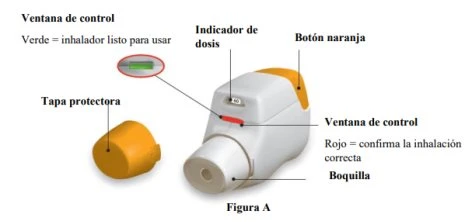
The Genuair inhaler is a white device with an integrated dose indicator and an orange dosing button. The mouthpiece is covered by a removable orange protective cap. It is supplied in a sealed aluminium protective pouch containing a desiccant sachet. After removing the inhaler from the pouch, the pouch and desiccant should be disposed of in the waste.
Pack sizes supplied:
Pack containing 1 inhaler with 30 doses.
Pack containing 1 inhaler with 60 doses.
Pack containing 3 inhalers with 60 doses each.
Only some pack sizes may be marketed.
Marketing Authorization Holder
Covis Pharma Europe B.V.
Gustav Mahlerplein 2
1082MA Amsterdam
The Netherlands
Manufacturer:
Industrias Farmacéuticas Almirall, S.A.
Ctra. de Martorell 41-61
08740 Sant Andreu de la Barca, Barcelona
Spain
More information about this medicine is available upon request by contacting the local representative of the Marketing Authorization Holder:
Belgium/Belgium/Belgium Covis Pharma Europe B.V. Tel/Tel: 80013067 | Lithuania UAB “BERLIN-CHEMIE MENARINI BALTIC” Tel: +370 52 691 947 |
| Luxembourg/Luxembourg Covis Pharma Europe B.V. Tel/Tel: 80024119 |
Czech Republic Berlin-Chemie/A.Menarini Czech Republic s.r.o. Tel: +420 267 199 333 | Hungary Berlin-Chemie/A. Menarini Kft. Tel.: +36 1799 7320 |
Denmark Covis Pharma Europe B.V. Tlf: 80711260 | Malta Covis Pharma Europe B.V. Tel: 80065149 |
Germany Berlin-Chemie AG Tel: +49 (0) 30 67070 Covis Pharma Europe B.V. Tel: +49 (0) 3031196978 | Netherlands Covis Pharma Europe B.V. Tel: 08000270008 |
Estonia OÜ Berlin-Chemie Menarini Eesti Tel: +372 667 5001 | Norway Covis Pharma Europe B.V. Tlf: 80031492 |
Greece MENARINI HELLAS AE Tel: +30 210 8316111-13 | Austria
Tel: +43 1 879 95 85-0 |
Spain Laboratorios Menarini S.A. Tel: +34-93 462 88 00 | Poland Covis Pharma Europe B.V. Tel.: 0800919353 |
France MENARINI France Tél: +33 (0)1 45 60 77 20 | Portugal
Tel: +351 210 935 500 |
Croatia Berlin-Chemie Menarini Hrvatska d.o.o. Tel: + 385 1 4821 361 | Romania Berlin-Chemie A.Menarini S.R.L. Tel: +40 21 232 34 32 |
Ireland Menarini Pharmaceuticals Ireland Ltd Tel: +353 1 284 6744 | Slovenia Berlin-Chemie / A. Menarini Distribution Tel: +386 01 300 2160 |
Iceland Covis Pharma Europe B.V. Sími: 8007279 | Slovakia Berlin-Chemie / A Menarini Distribution Tel: +421 2 544 30 730 |
Italy Laboratori Guidotti S.p.A. Tel: +39- 050 971011 | Finland/Finland Covis Pharma Europe B.V. Puh/Tel: 0800413687 |
Cyprus Covis Pharma Europe B.V. Tel: 80091079 | Sweden Covis Pharma Europe B.V. Tel: 0200898678 |
Latvia SIA Berlin-Chemie/Menarini Baltic Tel: +371 67103210 | United Kingdom (Northern Ireland) Covis Pharma Europe B.V. Tel: 08004334029 |
Date of the most recent review of this leaflet:
Detailed information on this medicine is available on the European Medicines Agency website: http://www.ema.europa.eu/.
Instructions for use
This section contains information on how to use the Genuair inhaler. It is important that you read this information, as Genuair may work differently from inhalers you have used before. We also provide a demonstration video on the use of the Genuair inhaler, available at www.genuair.com and by using the code shown below. If you have any doubts about how to use the inhaler, please consult your doctor, pharmacist, or nurse.
The instructions for use are divided into the following sections:
- How to get started
- Step 1: Prepare your dose
- Step 2: Inhale your medicine
- Additional information
How to get started
Read these instructions for use before starting to use the medicine
Become familiar with the parts of your Genuair inhaler
Disposal of unused medicine and of all materials that have been in contact with it must be carried out in accordance with local regulations.
Instructions for use
How to get started:
Read these instructions for use before starting to use the medicine
Become familiar with the parts of your Genuair inhaler
Before use:
- Before first use, open the sealed bag and remove the inhaler. Discard the bag and the desiccant.
- Do not press the orange button until you are ready to inhale a dose.
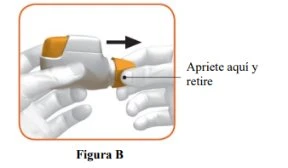
- Remove the cap by gently pressing the arrows on each side (Figure B).
STEP 1: Prepare your dose
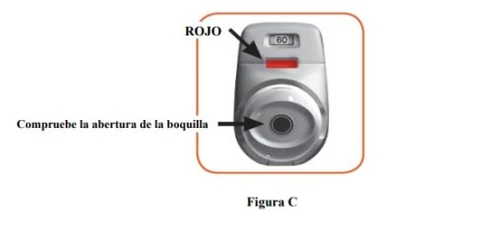
- Check the mouthpiece opening and make sure nothing is blocking it (Figure C).
- Check the control window (it should be red, Figure C).
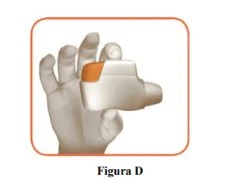
- Hold the inhaler horizontally with the mouthpiece facing towards you and the orange button on top (Figure D).
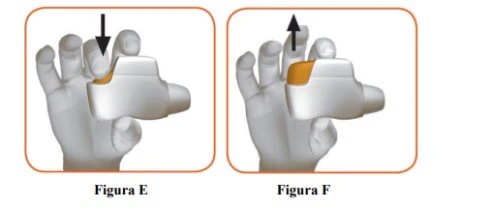
- Press the orange button fully downwards to load your dose (Figure E).
When you press the orange button fully down, the control window will change from red to green.
Make sure the orange button is on top. Do not tilt it. |
- Release the orange button (Figure F).
Make sure to release the button so that the inhaler can function properly. |
Stop and check:
- Make sure the control window is now green (Figure G).
Your medicine is ready to be inhaled.
Go to “STEP 2: Inhale your medicine”.
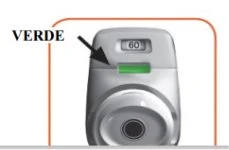
Figure G
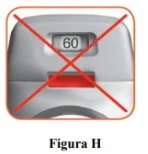
What to do if the control window remains red after pressing the button (Figure H).
The dose is not ready. Go back to “STEP 1 Prepare your dose” and repeat steps 1.1 to 1.6. |
STEP 2: Inhale your medication
Read steps 2.1 to 2.7 completely before use. Do not tilt. |
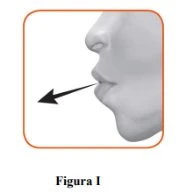
2.1 Keep the inhaler away from the mouth and breathe out fully. Never exhale into the inhaler (Figure I).
2.2 Keep the head upright, place the mouthpiece between the lips, and close the lips firmly around the mouthpiece (Figure J).
Do not hold the orange button down while inhaling. |
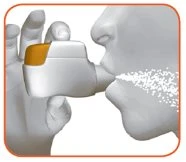
Figure J
2.3 Take a strong, deep breath in through the mouth. Continue inhaling for as long as possible.
A “click” will let you know that you have inhaled correctly. Continue inhaling for as long as possible after hearing the “click”. Some patients may not hear the “click”. Use the viewing window to ensure that you have inhaled correctly. |
2.4 Remove the inhaler from your mouth.
2.5 Hold your breath for as long as possible.
2.6 Slowly breathe out away from the inhaler.
Some patients may experience a sandy sensation in the mouth, or a slightly sweet or bitter taste. Do not inhale an extra dose if you do not taste or feel anything after inhaling. |
Stop and check:
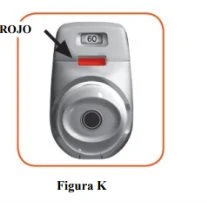
2.7 Make sure the control window is now red (Figure K). This means you have inhaled your medication correctly.
What to do if the control window remains green after performing the inhalation (Figure L).
Figure L This means you have not inhaled your medicine correctly. Go back to “STEP 2 Inhale your medicine” and repeat steps 2.1 to 2.7. If the control window still does not turn red, you may have forgotten to release the orange button before inhaling, or you may not have inhaled strongly enough. If this happens, try again. Make sure you have released the orange button and that you have breathed out fully. Then take a strong, deep breath in through the mouthpiece. Please contact your doctor if the control window remains green after several attempts. |
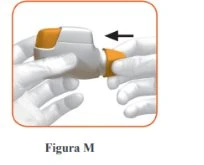
Replace the protective cap on the mouthpiece after each use (Figure M) to prevent contamination of the inhaler with dust or other materials. You must discard your inhaler if you lose the cap.
Additional information:
What should you do if you accidentally load a dose?
Store your inhaler with the protective cap in place until it is time to inhale your medication, then remove the cap and start at step 1.6.
How does the dose indicator work?
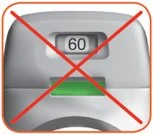
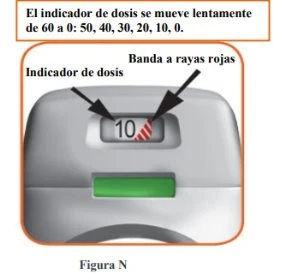
- The dose indicator shows the total number of doses remaining in the inhaler (Figure N).
- At first use, each inhaler contains at least 60 or 30 doses, depending on the package size.
- Each time a dose is loaded by pressing the orange button, the dose indicator moves slightly toward the next number (50, 40, 30, 20, 10, or 0).
When should you get a new inhaler?
You should get a new inhaler:
- If your inhaler appears to be damaged or if you lose the cap, or
- When a red striped band appears in the dose indicator, meaning you are approaching the last dose (Figure N), or
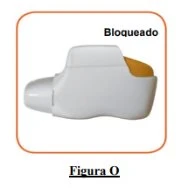
- If your inhaler is empty (Figure O).
How can you tell if your inhaler is empty?
When the orange button does not fully return to its upper position and remains stuck in a middle position, you have reached the last dose (Figure O). Even when the orange button is stuck, you can still inhale the last dose. After that, the inhaler can no longer be used and you must start using a new inhaler.
How should you clean the inhaler?
NEVER use water to clean the inhaler, as it could damage your medication.
If you wish to clean your inhaler, simply wipe the outside of the mouthpiece with a dry cloth or paper towel.