Bilina 0.5 mg/ml eye drops in suspension
Spain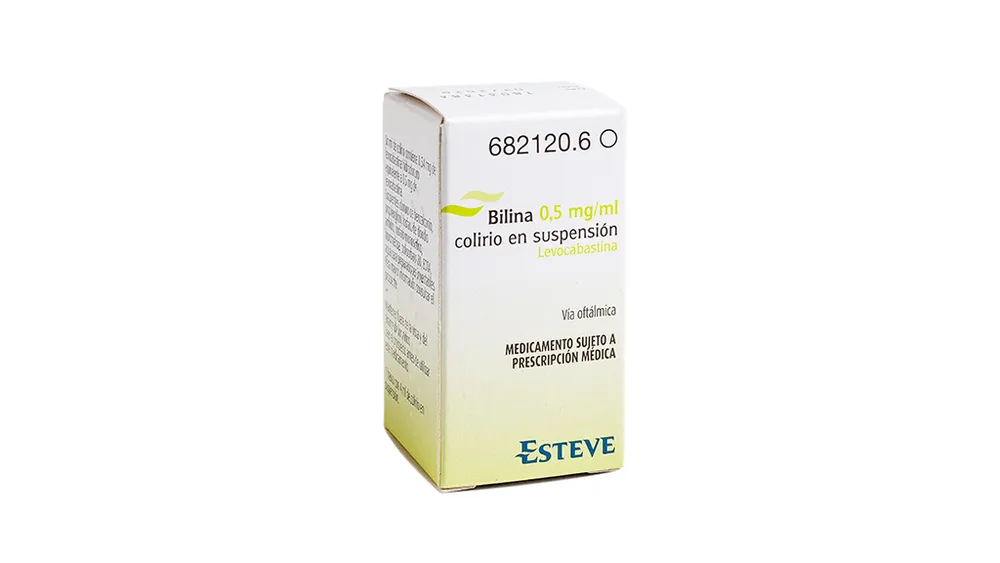
Instructions for Use
Package leaflet: Information for the user
Introduction
Package leaflet: information for the user
Bilina 0.5 mg/ml eye drops, suspension
Levocabastine
Read the entire leaflet carefully before you start using this medicine, because it contains important information for you.
- Keep this leaflet, as you may need to read it again.
- If you have any questions, consult your doctor or pharmacist.
- This medicine has been prescribed for you only, and you should not give it to others, even if they have the same symptoms as you, because it may harm them.
- If you experience any adverse reactions, consult your doctor or pharmacist, even if they are adverse reactions not listed in this leaflet. See section 4.
Leaflet contents
- What Bilina is and what it is used for
- What you need to know before using Bilina
- How to use Bilina
- Possible side effects
- How to store Bilina
- Contents of the pack and other information
1. What Bilina is and what it is used for
Bilina 0.5 mg/ml eye drops suspension contains levocabastine, an antihistamine used for the symptomatic treatment of allergic conjunctivitis in adults and in children and adolescents aged 4 to less than 18 years.
Levocabastine is a highly selective histamine H1 receptor antagonist. After application to the eyes, it provides rapid relief, lasting for hours, of the symptoms of allergic conjunctivitis (itching, redness, eyelid swelling, tearing).
2. What you need to know before using Bilina
Do not use Bilina
- If you are allergic (hypersensitive) to levocabastine or to any of the other components of this medicine (listed in section 6).
Warnings and precautions
Talk to your doctor or pharmacist before starting to use Bilina.
Children and adolescents
- The safety and efficacy of this medicine have not been established in children under 4 years of age.
- Bilina should only be used to treat children and adolescents aged 4 to less than 18 years.
Use of Bilina with other medicines
No interactions have been reported.
Tell your doctor or pharmacist if you are taking, have recently taken, or might need to take any other medicines.
Pregnancy, breast-feeding and fertility
If you are pregnant or breastfeeding, think you may be pregnant or are planning to become pregnant, you should not use Bilina, as safety studies have not been conducted in pregnant women and Bilina passes into breast milk. Consult your doctor or pharmacist before using this medicine.
Driving and using machines
Bilina does not cause sedation or interfere with psychomotor activity. Adverse reactions with Bilina eye drops such as eye irritation, pain, swelling, itching, redness, burning sensation, watery eyes, and blurred vision have been reported, which may affect vision. Therefore, caution is advised when driving or operating machinery after application of Bilina eye drops.
Bilina eye drops contain benzalkonium chloride
This medicine contains 15 mg of benzalkonium chloride per ml.
Benzalkonium chloride may be absorbed by soft contact lenses, altering their colour. Remove contact lenses before using this medicine and wait 15 minutes before reinserting them.
Benzalkonium chloride may cause eye irritation, especially if you have dry eye or other corneal conditions (the transparent layer at the front of the eye). Consult your doctor if you experience a foreign body sensation, stinging or pain in the eye after using this medicine.
This medicine contains 14.04 mg of phosphates per ml.
If you have severe damage to the cornea (the transparent layer at the front of the eye), treatment with phosphates may, in very rare cases, lead to blurred vision due to calcium accumulation.
3. How to use Bilina
- Dosage
Follow exactly the instructions for administration of this medicinal product as given by your doctor. If in doubt, consult your doctor or pharmacist again.
Adults and children and adolescents aged 4 to under 18 years
The recommended dose is 1 drop of Bilina in each eye, twice daily. The dose may be increased up to 1 drop in each eye, 3 or 4 times daily. Treatment should be continued until symptoms have resolved.
Use in children under 4 years of age
The safety and efficacy of this medicinal product have not been established. No data are available.
Elderly
Data on the use of levocabastine in elderly patients are not available.
- Instructions for use
Before first use of Bilina, remove the seal from the container and record the date of opening on the box.
Follow the steps below:
- Shake the container well before removing the cap.
- Tilt your head back as far as possible.
- Press the bottle and carefully instill 1 drop into the inner corner of the eye. Pull the lower eyelid down while keeping the head tilted back so that the drops can reach the space underneath the eye and eyelid. Blink several times to spread the drops across the entire eye surface.
 Repeat step 3 for the other eye.
Do not let the bottle touch the eye to avoid contamination of the remaining solution. Do not use the drops for more than 1 month after first opening the bottle.
Treatment should be continued until symptoms improve.
If you use more Bilina than you should
If you accidentally ingest the contents of a container, you may feel drowsy. In this case, drink plenty of non-alcoholic fluids to accelerate elimination of the medicinal product through the kidneys, and contact your doctor immediately.
In case of overdose or accidental ingestion, contact your doctor or pharmacist immediately or call the Toxicology Information Service at 91 562 04 20, indicating the medicinal product and the amount ingested.
If you forget to use Bilina
Do not apply an additional drop to make up for a missed dose.
If you have any further questions about the use of this product, ask your doctor or pharmacist.
4. Possible adverse effects
Like all medicines, Bilina may cause adverse effects, although not everyone experiences them.
The frequency of the possible adverse effects listed below is defined using the following convention:
Very common (may affect more than 1 in 10 people)
Common (may affect up to 1 in 10 people)
Uncommon (may affect up to 1 in 100 people)
Rare (may affect up to 1 in 1,000 people)
Very rare (may affect up to 1 in 10,000 people)
Frequency not known (cannot be estimated from the available data)
Adverse effects observed with Bilina include:
Common adverse effects (may affect between 1 and 10 out of every 100 patients) may include:
- Reaction at the site of administration such as burning/itching in the eyes, eye irritation
Very rare adverse effects (affect less than 1 in 10,000 patients) may include:
- A particular type of allergic reaction characterized by swelling of the lips, tongue, eyelids (angioneurotic edema), or other allergic reactions (anaphylaxis, hypersensitivity), such as urticaria and difficulty breathing
- Eye pain
- Conjunctivitis
- Swelling of the eyelids
- Swelling of the eyes
- Inflammation of the eyelids
- Eye congestion
- Reaction at the site of administration such as redness, eye itching
- Skin irritation in the area in contact with the medicine
- Urticaria
- Headache
- Palpitations
If you experience any adverse effects, consult your doctor or pharmacist, even if they are adverse effects not listed in this leaflet.
Reporting of adverse effects:
If you experience any type of adverse effect, consult your doctor or pharmacist, even if they are possible adverse effects not listed in this leaflet. You may also report them directly through the Spanish Pharmacovigilance System for Human Medicines: https://www.notificaram.es. By reporting adverse effects, you can help provide more information on the safety of this medicine.
5. Storage of Bilina
Keep out of the sight and reach of children.
Do not use this medicine after the expiry date stated on the packaging after EXP. The expiry date is the last day of the month indicated.
Discard 28 days after first opening the container.
Do not store above 25°C.
Medicines should not be disposed of via wastewater or household waste. Dispose of unused medicines and their containers at the SIGRE point at your pharmacy. If you have any doubts, ask your pharmacist how to dispose of medicines and containers you no longer need. This will help protect the environment.
6. Contents of the pack and other information
Composition of Bilina
- The active substance is levocabastine. Each millilitre of Bilina contains 0.5 milligrams of levocabastine.
- The other components (excipients) are benzalkonium chloride, propylene glycol, anhydrous disodium phosphate, monosodium phosphate, hypromellose, polysorbate 80, disodium edetate and water for injections.
Appearance of the product and contents of the container
Bilina is available as a sterile white suspension eye drop solution in a 4 ml plastic dropper bottle.
Marketing Authorisation Holder and Manufacturer
Marketing Authorisation Holder
Esteve Pharmaceuticals, S.A.
Passeig de la Zona Franca, 109
08038 Barcelona
Spain
Manufacturer
Famar, S.A.
Agiou Dimitriou 63
Alimos Attiki
17456 Greece
Date of the most recent review of this leaflet: September 2020
Detailed and up-to-date information on this medicine is available on the website of the Spanish Agency of Medicines and Medical Devices (AEMPS) http://www.aemps.gob.es/.
Similar Medications
-
Reactine levocabastine 0.5 mg/ml eye drops suspension
Form: suspension, ophthalmic
Active substance Dosage LEVOCABASTINE 0,54 mg Manufacturer: Jntl Consumer Health (Spain) S.L.
This page has been machine-translated and may contain inaccuracies. The original data is available in the manufacturing country's language.
Last data check: May 18, 2026 · Data source: CIMA — AEMPS