Betahistine CINFA 16 mg tablets EFG
Spain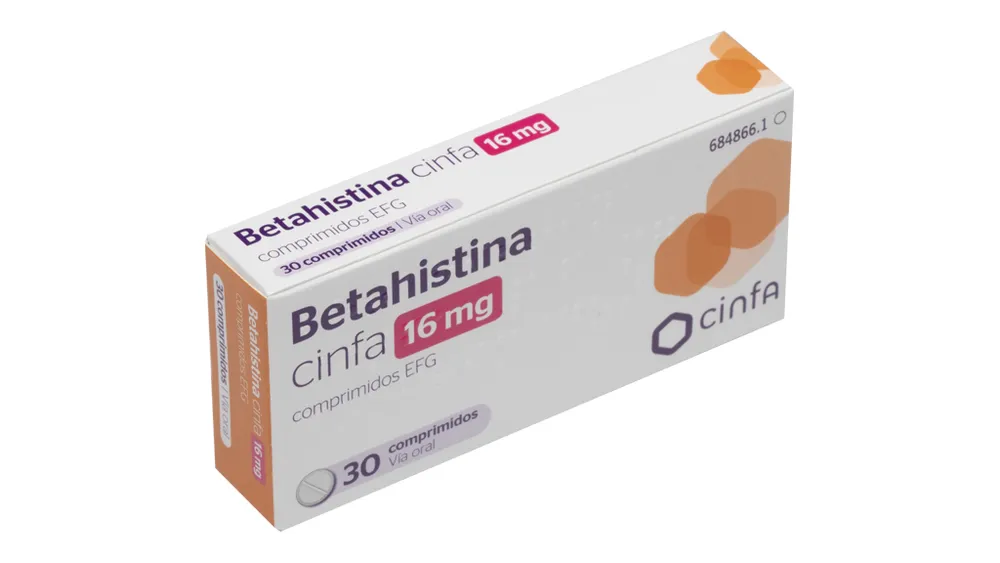
Table of Contents
Patient Information Leaflet
Introduction
Patient Information Leaflet
betahistina cinfa 16 mg tablets EFG
Betahistine dihydrochloride
Read the entire leaflet carefully before you start taking this medicine, because it contains important information for you.
- Keep this leaflet, as you may need to read it again.
- If you have any questions, ask your doctor or pharmacist.
- This medicine has been prescribed for you only, and you should not give it to other people, even if they have the same symptoms as you, because it may harm them.
- If you experience any adverse effects, consult your doctor or pharmacist, even if they are adverse effects not listed in this leaflet. See section 4.
Leaflet Contents
- What betahistina cinfa is and what it is used for
- What you need to know before taking betahistina cinfa
- How to take betahistina cinfa
- Possible adverse effects
- How to store betahistina cinfa
- Contents of the pack and other information
1. What betahistina cinfa is and what it is used for
Betahistina cinfa belongs to a group of medicines known as anti-vertigo medications, and its active substance is betahistine dihydrochloride.
Betahistina is used for the treatment of Ménière's syndrome, a disorder characterized by the following symptoms:
- vertigo (with nausea and vomiting),
- hearing loss, and
- sensation of ringing in the ear (tinnitus).
The active substance in this medicine is a histamine analogue that acts by improving circulation in the inner ear, thereby reducing pressure. The inner ear is one of the organs responsible for the sense of balance.
2. What you need to know before starting to take betahistine cinfa
Do not take betahistine cinfa
- If you are allergic to betahistine dihydrochloride or to any of the other ingredients of this medicine (listed in section 6).
- If your doctor has told you that you have a certain type of adrenal gland cancer called phaeochromocytoma.
Warnings and precautions
Consult your doctor or pharmacist before starting to take betahistine cinfa
- If you have bronchial asthma.
- If you have or have had a stomach ulcer.
- If you suffer from skin hives and intense itching (urticaria), skin rash (exanthema), or hay fever.
Children and adolescents
Betahistine is not recommended for use in children and adolescents under 18 years of age due to lack of experience in these age groups.
Taking betahistine cinfa with other medicines
Inform your doctor or pharmacist if you are taking, have recently taken, or might need to take any other medicines, including those obtained without a prescription.
Concomitant administration of betahistine with antiallergic medicines such as antihistamines (especially H1 antagonists) may reduce the effectiveness of both medicines.
Concomitant administration of betahistine with monoamine oxidase inhibitors (MAOIs) (used in the treatment of Parkinson's disease) may increase the effect of betahistine.
Taking betahistine cinfa with food, drinks and alcohol
It is recommended to take betahistine during or after meals to avoid gastric discomfort.
Pregnancy and breastfeeding
If you are pregnant or breastfeeding, think you may be pregnant, or are planning to become pregnant, consult your doctor or pharmacist before using this medicine.
It is unknown whether this medicine affects the fetus; therefore, betahistine should not be taken during pregnancy unless considered necessary by your doctor.
It is unknown whether this medicine passes into breast milk; therefore, if you are taking betahistine, you should not breastfeed your child.
Driving and using machines
Betahistine is indicated for Ménière's syndrome. This condition may negatively affect your ability to drive or operate machinery. In specific clinical trials designed to investigate the ability to drive or use machines, betahistine had no effects or effects were negligible.
betahistine cinfa contains lactose
This medicine contains lactose. If your doctor has informed you that you have an intolerance to certain sugars, consult with him before taking this medicine.
3. How to take betahistina cinfa
Follow exactly the instructions for administering this medicine as given by your doctor or pharmacist. If in doubt, consult your doctor or pharmacist again.
Your doctor will adjust the dose according to your response to treatment, starting from an initial dose of half a 16 mg tablet three times daily up to one 16 mg tablet three times daily (maximum dose). The maintenance dose will be adjusted according to your response, with the minimum effective dose being half a 16 mg tablet three times daily.
The tablets should be taken with water.
The 16 mg tablets are scored so they can be divided into two equal halves, facilitating administration of a half dose (8 mg) when necessary.
The tablet may be split into equal doses.
In some cases, improvement may not become evident until two weeks after starting treatment. Optimal results are obtained after several months of treatment.
The tablets may be taken with or without food. However, if taken on an empty stomach, they may cause mild stomach problems (listed in section 4). Taking the tablets with food may help reduce stomach-related issues.
Use in children and adolescents
Betahistina is not recommended for use in children and adolescents under 18 years of age due to limited data on safety and efficacy.
If you take more betahistina cinfa than you should
In case of overdose or accidental ingestion, contact your doctor or pharmacist immediately or call the Toxicology Information Service at telephone number: 91 562 04 20, indicating the medicine and the amount ingested.
You may experience the following symptoms due to an overdose: nausea, drowsiness, abdominal pain. You may also develop rapid heartbeat (tachycardia), low blood pressure (hypotension), difficulty breathing with a sensation of suffocation (bronchospasm), and fluid accumulation in tissues (edema).
Seizures may occur after taking very high doses.
Symptomatic treatment is recommended, as there is no specific antidote.
If you forget to take betahistina cinfa
Do not take a double dose to make up for forgotten doses. If you miss a dose, wait until the next scheduled dose and continue your regular treatment schedule.
If you stop taking betahistina cinfa
You should take betahistina for as long as your doctor recommends. Do not stop treatment prematurely, as the expected results will not be achieved.
If you have any further questions about the use of this medicine, ask your doctor or pharmacist.
4. Possible adverse effects
Like all medicines, this medicine may cause adverse effects, although not everyone will experience them.
The frequency classification is as follows:
Very common: may affect more than 1 in 10 patients.
Common: may affect up to 1 in 10 patients.
Uncommon: may affect up to 1 in 100 patients.
Rare: may affect up to 1 in 1,000 patients.
Very rare: may affect up to 1 in 10,000 patients.
Frequency not known: cannot be estimated from the available data.
In clinical trials, the following adverse effects were observed:
Gastrointestinal disorders
Common: nausea and dyspepsia (discomfort in the upper abdomen with a feeling of bloating).
Central nervous system disorders
Common: headache.
After marketing and in the scientific literature, the following adverse effects have been reported with a frequency not known:
Immune system disorders
Hypersensitivity reactions, for example anaphylaxis.
Gastrointestinal disorders
Mild gastric discomfort (for example vomiting, gastrointestinal pain, abdominal distension and bloating). These effects can usually be managed by taking the medicine during meals or by reducing the dose.
Skin and subcutaneous tissue disorders
Cutaneous and subcutaneous hypersensitivity reactions, particularly angioneurotic edema (swelling of the skin and mucous membranes, especially of the face, mouth, tongue and hands), urticaria, skin rash and itching (pruritus).
Reporting of adverse effects
If you experience any type of adverse effect, consult your doctor or pharmacist, even if it is a possible adverse effect not listed in this leaflet. You may also report them directly via the Spanish Pharmacovigilance System for Human Medicinal Products: https://www.notificaram.es By reporting adverse effects, you can help provide more information on the safety of this medicine.
5. Storage of betahistine cinfa
Keep this medicine out of the sight and reach of children.
Do not store above 30°C.
Do not use this medicine after the expiry date stated on the packaging after EXP. The expiry date refers to the last day of the month indicated.
Medicines must not be disposed of via wastewater drains or household waste. Dispose of unused medicines and their containers at the SIGRE Point located at the pharmacy. If in doubt, ask your pharmacist how to properly dispose of unused medicines and their packaging. This will help protect the environment.
6. Contents of the pack and other information
Composition of betahistina cinfa
- The active substance is betahistine dihydrochloride. Each tablet contains 16 mg of betahistine dihydrochloride.
- The other components are: monohydrate lactose, microcrystalline cellulose (E-460i), povidone K-90 (E-1201), colloidal anhydrous silica, crospovidone, stearic acid and talc.
Appearance of the product and contents of the pack
Cylindrical white tablets, with a score line on one side and marked with the code "B16" on the other.
The tablets are presented in PVC/PVDC blister packs containing 30 tablets.
Marketing Authorization Holder and Manufacturer
Marketing Authorization Holder
Laboratorios Cinfa, S.A.
Carretera Olaz-Chipi, 10. Polígono Industrial Areta
31620 Huarte (Navarra) – Spain
Manufacturer
Laboratorios Cinfa, S.A.
Carretera Olaz-Chipi, 10. Polígono Industrial Areta
31620 Huarte (Navarra) – Spain
or
KERN PHARMA, S.L.
Venus, 72. Poligono Industrial Colon II.
08228 Terrassa, Spain
Date of the most recent revision of this leaflet: July 2020
Detailed information on this medicine is available on the website of the Spanish Agency of Medicines and Health Products (AEMPS) http://www.aemps.gob.es
You can access detailed and up-to-date information about this medicine by scanning with your mobile phone (smartphone) the QR code included in the package leaflet and carton. You may also access this information at the following internet address: https://cima.aemps.es/cima/dochtml/p/74833/P_74833.html
QR code to: https://cima.aemps.es/cima/dochtml/p/74833/P_74833.html