Benzetacil 2.400.000 UI powder and solvent for injectable suspension
Spain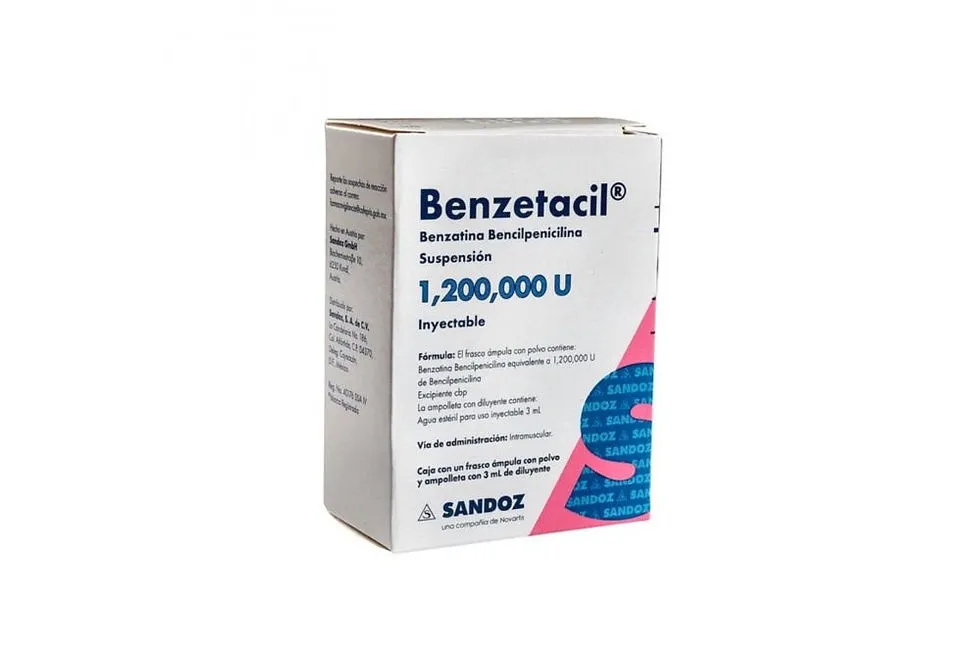
Table of Contents
- Patient Information Leaflet
- Introduction
- 1. What BENZETACIL 2,400,000 IU is and what it is used for
- 2. What you need to know before using BENZETACIL 2,400,000 IU
- 3. How to use BENZETACIL 2,400,000 IU
- 4. Possible adverse effects
- 5. Storage of BENZETACIL 2,400,000 IU
- 6. Contents of the container and additional information
Patient Information Leaflet
Introduction
Patient Information Leaflet
BENZETACIL 2,400,000 IU powder and solvent for injectable suspension
Benzathine benzylpenicillin
Read the entire leaflet carefully before you start using this medicine, as it contains important information for you.
|
Package leaflet contents:
- What BENZETACIL 2,400,000 IU is and what it is used for
- What you need to know before using BENZETACIL 2,400,000 IU
- How to use BENZETACIL 2,400,000 IU
- Possible side effects
- How to store BENZETACIL 2,400,000 IU
- Contents of the pack and other information
1. What BENZETACIL 2,400,000 IU is and what it is used for
BENZETACIL 2,400,000 IU contains benzylpenicillin benzathine, an antibiotic belonging to the penicillin family.
Antibiotics are used to treat bacterial infections and are not effective against viral infections such as influenza or the common cold. It is important to follow your doctor's instructions regarding dosage, dosing interval, and duration of treatment. Do not store or reuse this medicine. If you have any antibiotic left after completing the treatment, return it to the pharmacy for proper disposal. Medicines must not be disposed of via wastewater or household waste. |
Benzathine benzylpenicillin is indicated for the treatment of infections caused by susceptible organisms such as:
- Pharyngitis and tonsillitis.
- Syphilis: primary and secondary.
- Latent syphilis (except neurosyphilis).
- Erysipelas (skin infection).
- Tropical infectious skin diseases caused by bacteria of the Treponema species, such as yaws or pinta.
Benzathine benzylpenicillin is also indicated for the prevention of the following diseases:
- Rheumatic fever.
- Post-streptococcal glomerulonephritis (a specific form of kidney inflammation).
- Erysipelas (skin infection).
BENZETACIL 2,400,000 IU is mainly used in the treatment of syphilis, which requires high doses of benzathine benzylpenicillin.
2. What you need to know before using BENZETACIL 2,400,000 IU
Do not use BENZETACIL 2,400,000 IU
If you are allergic to the active substance or to any of the other components of this medicine (listed in section 6).
If you are allergic (hypersensitive) to penicillins, cephalosporins, or soy.
If you have ever had an allergic reaction while taking an antibiotic or other medicines. This may include a skin rash or swelling of the face or neck.
Warnings and precautions
Talk to your doctor or pharmacist before starting to use BENZETACIL 2,400,000 IU.
- if you have ever had an allergic reaction to other antibiotics such as penicillin or other beta-lactam antibiotics,
- if you have kidney problems (your doctor may need to adjust the dose of this medicine),
- if you have liver problems,
- if you are on a low-sodium diet.
BENZETACIL 2,400,000 IU should not be used in tissues with poor blood flow.
If you experience allergic symptoms (e.g., skin rash, itching, shortness of breath), consult your doctor immediately.
A hypersensitivity test should be performed, if possible, prior to treatment. If an allergic reaction occurs, your doctor will discontinue treatment and, if necessary, initiate appropriate treatment.
If you are allergic to cephalosporins. In patients hypersensitive to cephalosporins, cross-allergic reactions should be considered possible.
If you have asthma or are allergic to hay fever, inform your doctor. Severe immediate allergic reactions may occur when treatment is administered for the first time. In some cases, you may need to remain under observation for at least 30 minutes after administration of the medicine in case of an acute allergic reaction. In case of allergy, your doctor will take appropriate measures. Treatment with BENZETACIL 2,400,000 IU must be stopped immediately.
When treating syphilis, a reaction of the body to bacterial toxins may occur, lasting up to several days (Jarisch-Herxheimer reaction, see section 4). Symptoms include sudden fever (sometimes with chills), pallor, followed by skin redness, headache, muscle and joint pain, or fatigue. Your doctor will initiate appropriate treatment to suppress or reduce a Jarisch-Herxheimer reaction.
If you have renal insufficiency and/or severe hepatic insufficiency, as the dose will need to be adjusted. For long-term treatment (more than 5 days), your doctor may schedule blood count checks and tests to assess kidney function.
Like other antibiotics, treatment with BENZETACIL 2,400,000 IU may lead to the overgrowth of organisms not sensitive to the antibiotic. Contact your doctor if you develop a fungal infection.
If you have ulcerative colitis, Crohn's disease, or pseudomembranous colitis (persistent and/or severe diarrhea during or after administration of this medicine), you should be under strict clinical monitoring, including periodic laboratory tests.
During treatment with antibiotics, including BENZETACIL 2,400,000 IU, diarrhea may occur even several weeks after treatment has ended. If you experience severe or persistent diarrhea, or notice blood or mucus in your stools, inform your doctor immediately so that treatment can be stopped. Do not take medications intended to block or delay intestinal transit.
Other medicines and BENZETACIL 2,400,000 IU
Tell your doctor or pharmacist if you are taking, have recently taken, or might need to take any other medicines.
Consult your doctor if you are taking any of the following medicines:
- Allopurinol and Probenecid (medicines for gout or gouty arthritis)
- Methotrexate (a medicine used in chemotherapy)
- Other antibiotics
- Anticoagulants (medicines to thin the blood)
Inform your doctor or pharmacist if you are taking, have recently taken, or might need to take any other medicines.
Use of BENZETACIL 2,400,000 IU with food and drinks
Treatment with BENZETACIL is not affected when administered together with food.
Pregnancy, breast-feeding and fertility
If you are pregnant, breast-feeding, think you may be pregnant, or plan to become pregnant, consult your doctor or pharmacist before using this medicine.
BENZETACIL 2,400,000 IU should not be used during pregnancy unless the woman's clinical condition requires treatment with benzylpenicillin benzathine.
Small amounts of benzylpenicillin pass into breast milk. Although no adverse effects have been reported in infants so far, the possibility of sensitization or interference with intestinal flora should be considered. If diarrhea, candidiasis, or skin rash occurs in the infant, consult your doctor immediately. Breast-feeding may be resumed 24 hours after the end of treatment.
Driving and using machines
There is no evidence of effects on the ability to drive or operate machinery.
BENZETACIL 2,400,000 IU contains Sodium
This medicine contains 43.78 mg of sodium per vial, equivalent to 2% of the maximum daily intake of 2 g of sodium recommended by the WHO for an adult.
BENZETACIL 2,400,000 IU contains Soy Lecithin
This medicine contains 20.15 mg of soy lecithin per vial. It should not be used in case of allergy to peanuts or soy.
3. How to use BENZETACIL 2,400,000 IU
Follow exactly the administration instructions for this medicine as indicated by your doctor.
If in doubt, please consult your doctor or pharmacist again.
In general, BENZETACIL 2,400,000 IU is administered by a healthcare professional.
The recommended dose is:
General treatment:
Adults and adolescents: 1,200,000 IU once weekly.
Children weighing > 30 kg: 1,200,000 IU once weekly.
Children weighing < 30 kg: 600,000 IU once weekly.
Duration of treatment: a single dose.
Treatment of Syphilis:
BENZETACIL 2,400,000 IU is primarily used in the treatment of syphilis:
- Primary and secondary syphilis:
Adults and adolescents: 2,400,000 IU administered as a single dose.
Children: 50,000 IU/kg body weight, not exceeding 2,400,000 IU.
If clinical symptoms recur or laboratory results remain positive, treatment should be repeated.
Duration of treatment: a single dose.
- Latent syphilis:
Adults and adolescents: 2,400,000 IU once weekly.
Children: 50,000 IU/kg body weight, not exceeding 2,400,000 IU.
Duration of treatment: 3 weeks.
- Congenital syphilis: without neurological involvement.
Newborns and infants: 1 x 50,000 IU/kg body weight.
Duration of treatment: a single dose.
Treatment of tropical infectious skin diseases (yaws, pinta):
Adults and adolescents: 1,200,000 IU as a single dose.
Children weighing > 30 kg: 1,200,000 IU as a single dose.
Children weighing < 30 kg: 600,000 IU as a single dose.
Duration of treatment: a single dose.
Prophylaxis of rheumatic fever, post-streptococcal glomerulonephritis, and erysipelas:
Adults and adolescents: 1,200,000 IU every 3–4 weeks.
Children weighing > 30 kg: 1,200,000 IU every 3–4 weeks.
Children weighing < 30 kg: 600,000 IU every 3–4 weeks.
Duration of treatment:
- Without cardiac involvement: at least 5 years, or until 21 years of age.
- Temporary heart involvement: at least 10 years, or until 21 years of age.
- Persistent cardiac involvement: at least 10 years or until 40 years of age; sometimes lifelong treatment is required.
Children
For use in children and for other indications treated with lower doses of benzathine benzylpenicillin, BENZETACIL 1,200,000 IU and BENZETACIL 600,000 IU are available.
Patients with renal and/or hepatic impairment
The dose and dosing interval will be determined by your doctor. Depending on the degree of kidney and/or liver function, your doctor may consider adjusting the dose.
Method of administration
BENZETACIL 2,400,000 IU is administered exclusively by deep intramuscular injection.
The injection must not be administered into tissues with poor blood supply.
In case of repeated intramuscular injections, the injection site should be rotated.
Severe local reactions may occur during intramuscular administration, especially in young children. For this reason, alternative treatments, such as a different penicillin formulation, may be considered whenever possible.
For instructions on reconstitution of the medicine prior to administration, see the section “Preparation instructions” at the end of the package leaflet.
If you use more BENZETACIL 2,400,000 IU than you should
At extremely high doses, penicillins may cause neuromuscular excitability or seizures.
In case of overdose or accidental ingestion, consult your doctor or pharmacist immediately, or call the Toxicology Information Service at telephone number 91 562 04 20, indicating the medicine and the amount used.
If you forget to use BENZETACIL 2,400,000 IU
Do not use a double dose to make up for forgotten doses. Take the missed dose as soon as possible, then continue with your regular schedule.
If you stop treatment with BENZETACIL 2,400,000 IU
If you have any further questions about the use of this medicine, ask your doctor or pharmacist.
4. Possible adverse effects
Like all medicines, this medicine can cause adverse effects, although not everyone will experience them.
The adverse effects of this medicine are generally transient and mild. In most cases, adverse effects are of allergic origin and manifest dermatologically. The toxicological profile of this drug is similar to that of other penicillins, although allergic manifestations are somewhat more frequent, especially with parenteral administration.
Severe allergic reactions (anaphylactic reactions or angioedema) may occur, such as:
- skin rash or itching
- difficulty breathing or tightness in the chest
- swelling of the eyelids, face, or lips
- swelling or redness of the tongue
- fever
- joint pain
- swollen lymph nodes
In case of an allergic reaction, administration should be discontinued and treatment initiated with antihistamines (antiallergic agents) and/or corticosteroids (anti-inflammatory agents).
The adverse effects listed below are classified according to frequency and by organ system. Frequency categories are defined by the following convention:
Very common (affects more than 1 in 10 patients);
Common (affects up to 1 in 100 patients);
Uncommon (affects up to 1 in 1,000 patients);
Rare (affects between 1 and 10 in 10,000 patients);
Very rare (affects fewer than 1 in 10,000 patients);
Frequency not known (cannot be estimated from available data).
Infections and infestations:
Common: fungal infection (candidiasis).
Blood and lymphatic system disorders:
Very rare: blood cell abnormalities (eosinophilia, neutropenia, leucopenia, agranulocytosis, granulocytopenia, pancytopenia) and coagulation disorders.
Frequency not known: Prolongation of bleeding time and prothrombin time. Hemolytic anemia (reduced red blood cell levels), thrombocytopenia (reduced platelet levels).
Gastrointestinal disorders:
Common: nausea.
Uncommon: inflammation of the oral mucosa (stomatitis) and inflammation of the tongue (glossitis), vomiting.
Rare: pseudomembranous colitis (inflammation of the colon), diarrhea.
Immune system disorders:
Rare: allergic reactions: skin rash similar to that caused by nettles (urticaria), angioedema (swelling), skin reactions (erythema multiforme, exfoliative dermatitis), fever, painful joints, anaphylactic shock with collapse, and anaphylactoid reactions (asthma, hemorrhagic skin lesions known as purpura, gastrointestinal discomfort).
Frequency not known: serum sickness. When treating syphilis, a reaction known as the Jarisch-Herxheimer reaction may occur due to the destruction of bacteria, characterized by fever, chills, general and focal symptoms. Para-allergic reactions may occur in patients with cutaneous mycosis (skin fungus). Angioedema (swelling of the skin, mucosa, and subcutaneous tissue, usually localized in the face, mouth, or tongue).
Nervous system disorders:
Rare: neuropathy (nerve damage).
Frequency not known:
Encephalopathy with insomnia, confusion, hallucinations, seizures, and epileptic state; myoclonus (muscle contractions); and, more rarely, aseptic meningitis and benign intracranial hypertension.
Metabolic encephalopathy (neurological disorders with seizures and loss of consciousness).
Hepatic disorders:
Frequency not known: inflammation of the liver (hepatitis), bile flow disorder (cholestasis).
Skin and connective tissue disorders:
Common: rashes, exanthems (reddish skin eruptions), pruritus (itching).
Frequency not known: AGEP - Acute Generalized Exanthematous Pustulosis, with symptoms such as severe drug-induced skin reactions with or without skin redness, fever, pustules, maculopapular rash (flat, red area on the skin), morbilliform rash (rash resembling measles), itching, erythema (inflammatory redness of the skin).
Renal and urinary disorders:
Rare: kidney disease (nephropathy), kidney inflammation (interstitial nephritis), albuminuria, cylindruria (excretion of proteins in urine), and hematuria (blood in urine). Oliguria (reduced urine output) and anuria (no urine excretion) may occur at high doses and generally resolve within 48 hours after treatment ends.
General disorders and administration site conditions:
Common: pain and/or infiltration at the injection site.
Investigations:
Common: changes in certain laboratory tests and investigations such as:
- Positive direct Coombs test.
- False positives in urine protein determination using precipitation techniques (Folin-Ciocalteu-Lowry and biuret methods).
- False positives in amino acid determination tests.
- Simulated albuminemia in albumin determination by electrophoretic methods.
- Non-enzymatic tests detecting false positive urine glucose and urobilinogen.
- Elevated levels when measuring urinary keto-steroids (Zimmermann reaction).
Reporting suspected adverse reactions:
It is important to report suspected adverse reactions to the medicine after its authorization. This enables continued monitoring of the benefit-risk balance of the medicine. Healthcare professionals are encouraged to report suspected adverse reactions via the Spanish Pharmacovigilance System for Human Medicines: https://www.notificaram.es
5. Storage of BENZETACIL 2,400,000 IU
Keep this medicine out of sight and reach of children.
The powder for injectable suspension (vial) must be stored in a dry place.
Reconstituted vial: The reconstituted product should be used immediately for intramuscular administration.
Do not use this medicine after the expiry date stated on the packaging after “EXP”. The expiry date refers to the last day of the month indicated.
Medicines must not be disposed of via wastewater or household waste. Dispose of unused medicines and their containers at the Sigre Point located at the pharmacy.
If you have any doubts, ask your pharmacist how to properly dispose of medicines and containers you no longer need. This will help protect the environment.
6. Contents of the container and additional information
Composition of BENZETACIL 2.400.000 IU
Vial:
- The active substance is Benzathine benzylpenicillin (benzylpenicillin G benzathine). Each vial contains 2,400,000 IU of benzylpenicillin benzathine.
- The other components (excipients) are: Tween 80, lecithin, sodium citrate (E-331).
Ampoule: Water for injections.
After reconstitution of the vial with 6 ml of water, the final volume is 7.9 ml, containing 2,400,000 IU of benzylpenicillin benzathine.
There are 400,000 IU of benzylpenicillin benzathine in 1.31 ml of suspension.
Appearance of the product and contents of the pack
BENZETACIL 2.400.000 IU is available in single packs: 1 vial and 1 ampoule, and in clinical packs: 100 vials and 100 ampoules.
Marketing Authorization Holder and Manufacturer:
Marketing Authorization Holder:
Laboratorio Reig Jofré, S.A.
Gran Capitán, 10
08970 San Joan Despí (Barcelona)
Manufacturer:
Laboratorio Reig Jofré, S.A.
Jarama, 111 - Industrial Estate
45007 Toledo
Date of the most recent revision of this leaflet: October 2021.
Detailed and up-to-date information on this medicine is available on the website of the Spanish Agency of Medicines and Health Products (AEMPS): http://www.aemps.es/
This information is intended exclusively for healthcare professionals:
Medicine: BENZETACIL 2.400.000 IU powder and solvent for injectable suspension
Method of administration:
BENZETACIL 2.400.000 IU is administered exclusively by deep intramuscular injection into the upper outer quadrant of the gluteus or into the ventro-gluteal site according to the Hochstetter method, with the needle directed toward the iliac crest or as per the Hochstetter technique. The puncture should be as perpendicular as possible to the skin surface, and the injection should be administered as far as possible from major blood vessels. For repeated doses, the injection site should be changed.
In children, the recommended injection site is the mid-lateral muscle of the thigh (quadriceps femoris). Injection into the deltoid muscle is only recommended if the muscle mass is adequate. In such cases, care must be taken to avoid the radial nerve.
In infants and young children, the peripheral area of the upper outer quadrant of the gluteal region should only be used as an injection site in exceptional circumstances, to avoid injury to the sciatic nerve.
Before injection, intravascular administration must be ruled out by aspiration. For repeated doses, change the injection site.
For depot preparations, although a maximum of 5 ml per injection site is recommended as a tolerance limit, the entire contents of the vial may be administered at a single site. If excessive pain occurs, the volume may be divided between two injection sites.
The injection should be administered as slowly as possible and only under low pressure.
Avoid pressing and/or rubbing the injection site after administration.
Preparation instructions:
For the injection of BENZETACIL, a long needle of gauge 0.9 mm should be used. Aseptically prepare the suspension by injecting the 6 ml of water for injections from the ampoule provided in the package into the vial.
Shake until a homogeneous suspension is obtained. Draw up the contents of the vial into the syringe.
1.31 ml of the reconstituted injectable suspension of BENZETACIL 2.400.000 IU contains 400,000 IU of benzylpenicillin benzathine after reconstitution with the 6 ml of water from the ampoule.
To inject, insert the needle deeply into the gluteal muscle, place the syringe, and aspirate by pulling back on the plunger to ensure no blood appears, confirming that the needle is not within the lumen of a blood vessel. Administer the injection as soon as possible to prevent crystallization within the needle, which may cause increased pain for the patient.
For single use only. Discard any unused suspension.