Bentifen 0.25 mg/ml eye drops solution
Spain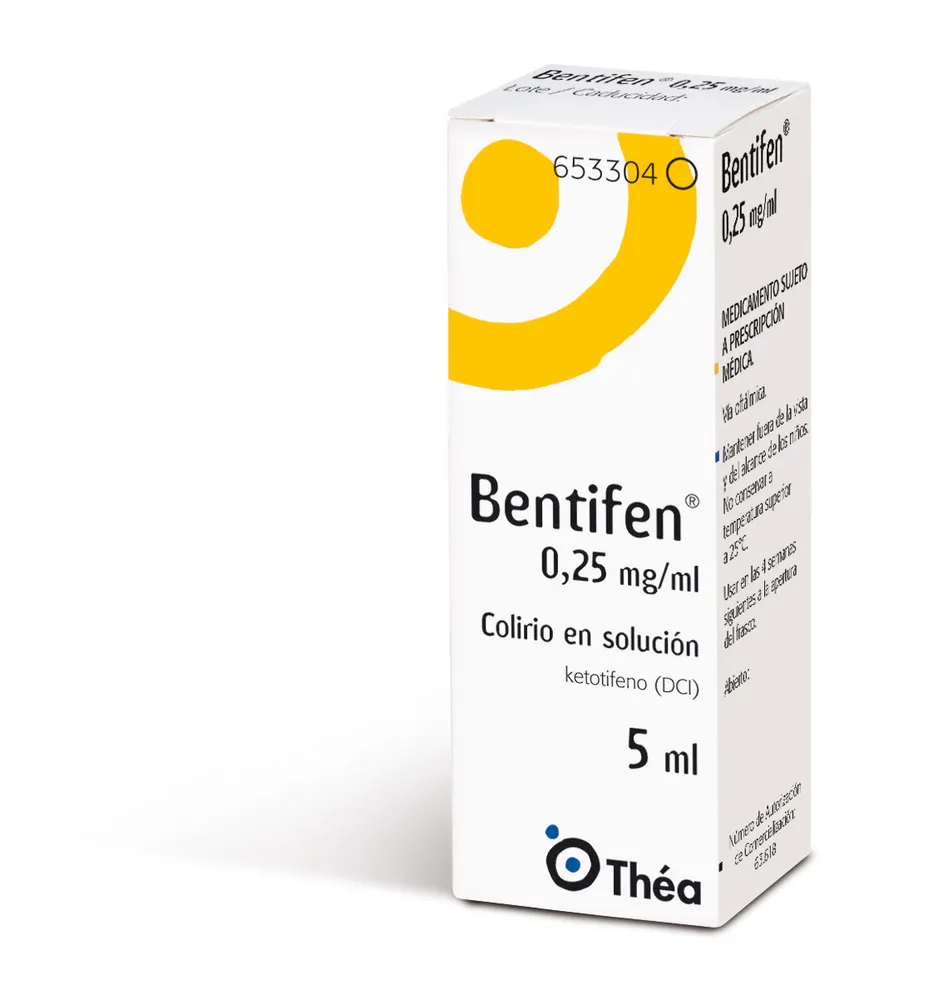
Table of Contents
Package leaflet: Information for the user
Introduction
Package leaflet: information for the user
Bentifen 0.25 mg/ml eye drops, solution
Ketotifen
Read the entire leaflet carefully before you start using this medicine, because it contains important information for you.
- Keep this leaflet, as you may need to read it again. If you have any questions, consult your doctor, pharmacist or nurse.
- This medicine has been prescribed for you only, and you should not give it to other people, even if they have the same symptoms as you, because it may harm them.
- If you experience any adverse effects, consult your doctor, pharmacist or nurse, even if these adverse effects are not listed in this leaflet. See section 4.
Leaflet contents
- What Bentifen is and what it is used for
- What you need to know before using Bentifen
- How to use Bentifen
- Possible side effects
- How to store Bentifen
- Contents of the pack and other information
1. What Bentifen is and what it is used for
Bentifen contains the active substance ketotifen, which is an antiallergic agent. Bentifen is used to treat ocular symptoms of seasonal allergic conjunctivitis.
You should consult a doctor if your condition worsens or does not improve.
2. What you need to know before using Bentifen
Do not use Bentifen
If you are allergic (hypersensitive) to ketotifen or to any of the other components of this medicine (listed in section 6).
Warnings and precautions
Talk to your doctor, pharmacist, or nurse before starting to use Bentifen.
Using Bentifen with other medicines
If you need to apply any other eye medication in addition to Bentifen, wait at least 5 minutes between applying each product.
Inform your doctor or pharmacist if you are taking, have recently taken, or might need to take any other medicines. This is especially important for medicines used to treat:
- Depression, anxiety, and sleep disorders
- Allergies (e.g. antihistamines)
Using Bentifen with food, drinks, and alcohol
Bentifen may increase the effects of alcohol.
Pregnancy and breastfeeding
If you are pregnant or breastfeeding, think you may be pregnant, or are planning to become pregnant, consult your doctor or pharmacist before using this medicine.
Bentifen may be used during breastfeeding.
Driving and using machines
Bentifen may cause blurred vision, drowsiness, or dizziness. Do not drive or operate machinery until these effects have subsided.
Bentifen contains benzalkonium chloride
This medicine contains 2.6 micrograms of benzalkonium chloride per drop.
Benzalkonium chloride may be absorbed by soft contact lenses and may discolor them. Remove contact lenses before using this medicine and wait 15 minutes before reinserting them.
Benzalkonium chloride may cause eye irritation, especially if you have dry eye or other corneal conditions (the transparent layer at the front of the eye). Consult your doctor if you experience a foreign body sensation, stinging, or eye pain after using this medicine.
3. How to use Bentifen
Follow exactly the instructions for administering this medicine as given by your doctor or pharmacist. If in doubt, consult your doctor or pharmacist.
Follow exactly the instructions for using this medicine provided in this leaflet or as directed by your doctor, pharmacist, or nurse. If in doubt, consult your doctor, pharmacist, or nurse.
The recommended dose for adults, elderly patients, and children (3 years of age and older) is one drop into the affected eye(s) twice daily (morning and night).
Instructions for use
- Wash your hands.
- Open the bottle. Do not touch the dropper tip after opening the bottle.
- Tilt your head backwards (Fig. 1).
- Pull the lower eyelid downwards with your finger and hold the bottle with the other hand. Squeeze the bottle so that one drop falls into the eye (Fig. 2).
- Close your eyes and press with the fingertip against the inner corner of the eye for about 1-2 minutes. This prevents the drop from draining through the tear duct into the throat and ensures that most of the drop remains in the eye (Fig. 3). If necessary, repeat steps 3 to 5 for the other eye.
- Close the bottle after use.
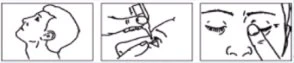
Fig. 1 Fig. 2 Fig. 3
If you have any further questions about the use of this medicine, consult your doctor, pharmacist, or nurse.
If you use more Bentifen than you should
There is no danger if Bentifen is accidentally swallowed, or if more than one drop accidentally enters your eye. If in doubt, consult your doctor. In addition, in case of overdose or accidental ingestion, you may contact the Toxicology Information Service at Tel.: 91 562 04 20.
If you forget to use Bentifen
If you forget to use Bentifen, apply the dose as soon as you remember. Then continue with your usual treatment schedule.
Do not use a double dose to make up for a missed dose.
4. Possible adverse effects
Like all medicines, this medicine can cause adverse effects, although not everyone experiences them.
The following adverse effects have been reported.
Frequent: may affect up to 1 in 10 patients
- eye irritation or pain
- eye inflammation
Uncommon: may affect up to 1 in 100 patients
- blurred vision when drops are applied to the eye
- dry eye
- eyelid disorder
- conjunctivitis
- increased sensitivity of the eyes to light
- visible bleeding in the white part of the eye
- headache
- somnolence
- rash (which may also cause itching)
- eczema (itching, redness, rash with stinging)
- dry mouth
- allergic reaction (including swelling of the face and eyelids) and worsening of the severity of an existing allergic condition such as asthma and eczema
Frequency unknown: frequency cannot be estimated from available data
- dizziness
Reporting of adverse effects
If you experience any type of adverse effect, talk to your doctor, pharmacist, or nurse, even if it is a possible adverse effect not listed in this leaflet. You can also report them directly via the Spanish Pharmacovigilance System for Human Medicinal Products: www.notificaRAM.es. By reporting adverse effects, you can help provide more information on the safety of this medicine.
5. Storage of Bentifen
Keep this medicine out of the sight and reach of children.
Do not store above 25°C.
The bottle itself is not sterile, but its contents are sterile until the bottle is opened.
After the first opening of the bottle, the eye drops can only be kept for 4 weeks.
Do not use this medicine after the expiry date stated on the packaging after EXP. The expiry date refers to the last day of the month indicated.
Medicines must not be disposed of via wastewater or household waste. Dispose of empty containers and unused medicines at the SIGRE collection point at your pharmacy. If in doubt, ask your pharmacist how to dispose of containers and unused medicines. This will help protect the environment.
6. Contents of the package and other information
Composition of Bentifen
The active substance is ketotifen (as fumarate). Each ml contains 0,345 mg of ketotifen fumarate, equivalent to 0,25 mg of ketotifen.
The other components are glycerol (E422), sodium hydroxide (E524), water for injections, and benzalkonium chloride.
Appearance of the product and contents of the container
Bentifen is a clear, colourless to pale yellow solution. The solution is supplied in a container holding a 5 ml bottle.
Marketing Authorization Holder
Holder:
Laboratoires THEA - 12, rue Louis Blériot - 63017 Clermont-Ferrand Cedex 2 - France
Local representative:
Laboratorios THEA S.A. - Enric Granados St., nº 86-88, 2nd floor - 08008 Barcelona, Spain
Manufacturer:
Excelvision,
27 rue de la Lombardière,
07100 Annonay, France
This medicinal product is authorized in the European Economic Area member states under the following names:
Spain | Bentifen 0.25 mg/ml eye drops solution |
Sweden | Bentifen 0.25 mg/ml, eye drops, solution |
Date of the most recent review of this leaflet: 09/2025
Detailed information about this medicine is available on the website of the Spanish Agency for Medicines and Health Products (AEMPS): http://www.aemps.es