Azydrop 15 mg/g, eye drops in single-dose container
Spain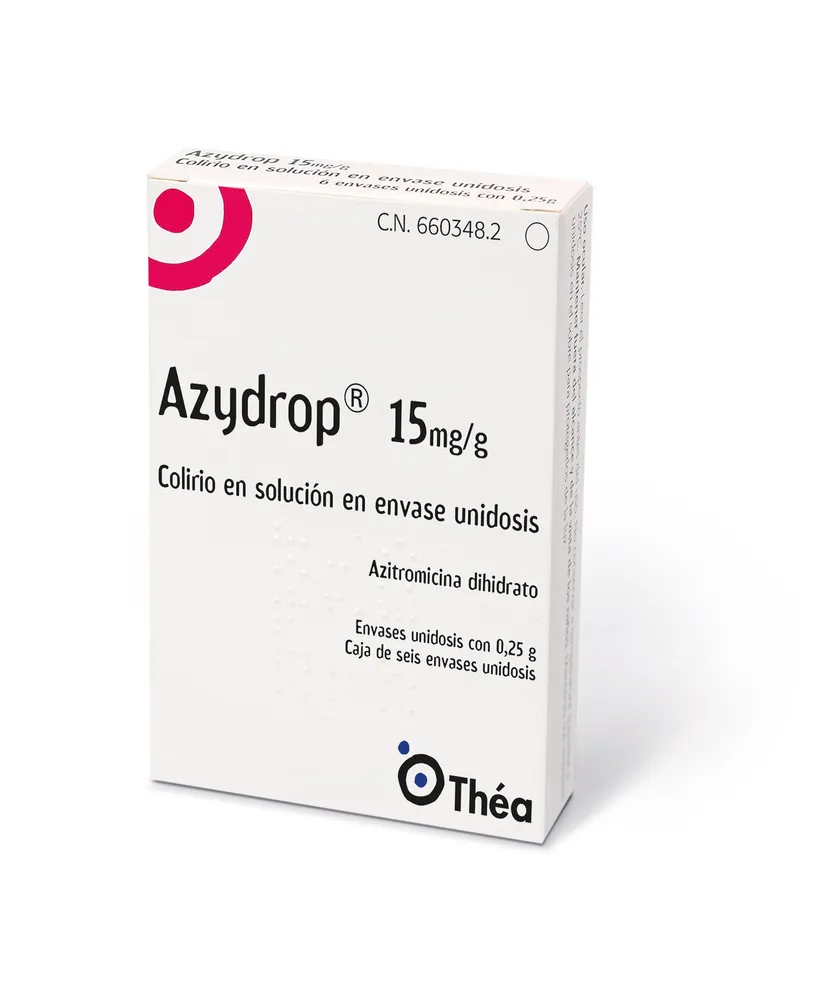
Table of Contents
- Patient Information Leaflet
- Introduction
- 1. What AZYDROP is and what it is used for
- 2. What you need to know before using AZYDROP
- **Warnings and precautions**
- **Use of AZYDROP with other medicines**
- 3. How to use AZYDROP
- 4. Possible adverse effects
- 5. Storage of AZYDROP
- 6. Contents of the pack and other information
Patient Information Leaflet
Introduction
Package leaflet: Information for the patient
AZYDROP 15 mg/g, eye drops solution in single-dose container
Azithromycin dihydrate
Read the entire leaflet carefully before you start using this medicine, as it contains important information for you.
- Keep this leaflet, as you may need to read it again. If you have any questions, consult your doctor, your child's doctor, pharmacist, or nurse.
- This medicine has been prescribed for you or your child only and must not be given to others, even if they have the same symptoms as you, as it may harm them.
- If you experience any adverse effects, consult your doctor, pharmacist, or nurse, even if they are adverse effects not listed in this leaflet. See section 4.
Leaflet Contents
- What AZYDROP is and what it is used for
- What you need to know before using AZYDROP
- How to use AZYDROP
- Possible side effects
- How to store AZYDROP
- Contents of the pack and other information
1. What AZYDROP is and what it is used for
AZYDROP contains azithromycin, an antibiotic belonging to the macrolide class.
AZYDROP is used for local treatment of certain bacterial ocular infections in adults (including elderly patients) and in children from birth up to 17 years of age.
- purulent bacterial conjunctivitis,
- trachomatous conjunctivitis (particularly infections due to the bacterium called Chlamydia trachomatis, present or emerging in developing countries).
2. What you need to know before using AZYDROP
DO NOT use AZYDROP
- If you are allergic to azithromycin, to any other type of antibiotic in the macrolide class, or to medium-chain triglycerides.
Warnings and precautions
Consult your doctor or the doctor treating your child, or your pharmacist or nurse before starting to use AZYDROP.
- If an allergic reaction occurs, you must discontinue treatment and consult your doctor.
- If you do not see improvement after three days of starting treatment, or if abnormal signs occur, you must consult your doctor.
- Due to your eye infection, the use of contact lenses is not recommended.
This medicine is for ocular use only.
Do not inject or ingest.
Use of AZYDROP with other medicines
If you are using any other eye medication, you should:
? apply the other eye medicine first,
? wait 15 minutes,
? then apply Azydrop last.
Inform your doctor, the doctor treating your child, or your pharmacist if you are using, have recently used, or might have used any other medicines.
Pregnancy
AZYDROP may be used during pregnancy.
Your doctor may prescribe this medicine during pregnancy if considered necessary.
Breast-feeding
Some data indicate that azithromycin passes into breast milk. This medicine may be used during breast-feeding.
If you are pregnant or breast-feeding, think you may be pregnant, or plan to become pregnant, consult your doctor or pharmacist before using this medicine.
Driving and use of machines
You may experience transient blurred vision after ocular administration of this product. Wait until your vision returns to normal before driving a vehicle or operating machinery.
3. How to use AZYDROP
This medicine is intended for use in the eye (ocular use).
Always use this medicine exactly as your doctor or the doctor treating your child has told you. If in doubt, please consult your doctor or the doctor treating your child, or your pharmacist.
Dosage
The recommended dose for adults (including elderly patients) and children from birth up to 17 years of age is one drop in the affected eye(s) twice daily: one drop in the morning and one drop in the afternoon.
The duration of treatment is three days.
Due to the prolonged action of the product, it is unnecessary to extend treatment beyond three days, even if you still have residual signs of bacterial infection.
Method of administration
For proper administration of Azydrop:
- wash your hands thoroughly before and after using the product,
- instill one drop into the eye to be treated while looking upward and gently pulling down the lower eyelid,
- avoid touching the eye or eyelids with the tip of the single-dose container dropper,
- discard the single-dose container after use. Do not save it for later use.
DO NOT INJECT, DO NOT INGEST
If you forget to use AZYDROP
Do not use a double dose to make up for the missed dose.
If you interrupt treatment with AZYDROP
Always consult your doctor if you are considering interrupting treatment.
If you have any questions about the use of this product, ask your doctor, pharmacist, or nurse.
4. Possible adverse effects
Like all medicines, Azydrop can cause adverse effects, although not everyone experiences them.
Immediately inform your doctor if you experience any of the symptoms listed below after taking this medicine, as they may be serious.
Uncommon: may affect 1 in 100 people:
- Severe allergic reaction causing swelling of the face or throat (angioedema).
Not known: frequency cannot be estimated from available data
- Severe cutaneous adverse reactions: rash, skin eruption, blisters on the skin, mouth, eyes and genitals (Stevens-Johnson Syndrome (SJS) or Toxic Epidermal Necrolysis (TEN)), rash accompanied by other symptoms such as fever, swollen glands and increased eosinophils (a type of white blood cells), rash characterized by small red spots associated with itching (Drug Reaction with Eosinophilia and Systemic Symptoms (DRESS)), generalized erythema with widespread skin peeling (exfoliative dermatitis), skin eruption characterized by the rapid appearance of red skin areas dotted with small pustules (small blisters filled with white/yellow fluid) (Acute Generalized Exanthematous Pustulosis (AGEP)).
Stop taking azithromycin if you develop these symptoms and contact your doctor or seek immediate medical attention.
The following adverse effects have been observed after administration of the product:
Very common: may affect more than 1 in 10 people:
- Transient eye discomfort (itching, burning, stinging).
Common: may affect up to 1 in 10 people:
- Blurred vision,
- Sticky sensation in the eye,
- Foreign body sensation.
Uncommon: may affect 1 in 100 people:
- Allergic reaction (hypersensitivity),
- Inflammation of the conjunctiva (may be due to infection or allergy) (conjunctivitis),
- Allergic inflammation of the conjunctiva (allergic conjunctivitis),
- Inflammation of the cornea (keratitis),
- Itching of the eyelids (eyelid eczema),
- Dry skin, redness, swelling of the eyelids (eyelid edema),
- Eye allergy,
- Tearing,
- Redness of the eyelids (eyelid erythema),
- Redness of the conjunctiva (conjunctival hyperemia).
Reporting of adverse effects
If you experience any type of adverse effect, consult your doctor or your child's doctor, pharmacist, or nurse, even if these are possible adverse effects not listed in this leaflet. You may also report them directly via the Spanish Pharmacovigilance System for Human Medicines: https://www.notificaram.es. By reporting adverse effects, you can help provide more information on the safety of this medicine.
5. Storage of AZYDROP
Keep this medicine out of the sight and reach of children.
Do not use this medicine after the expiry date stated on the carton and on the single-dose container. The expiry date refers to the last day of the month indicated.
-
Do not store above 25ºC.
-
Keep the single-dose containers in the sachet to protect them from light.
Discard the single-dose container with any remaining solution immediately after first use. Do not keep it for later use.
Medicines should not be disposed of via wastewater or household waste. Dispose of containers and unused medicines at the SIGRE collection point at your pharmacy. If you are unsure, ask your pharmacist how to dispose of containers and medicines you no longer need. This will help protect the environment.
6. Contents of the pack and other information
Composition of Azydrop
-
The active substance is azithromycin dihydrate. Each gram of solution contains 15 mg of azithromycin dihydrate, equivalent to 14.3 mg of azithromycin. A single-dose container with 250 mg of solution contains 3.75 mg of azithromycin dihydrate.
-
The other component is medium-chain triglycerides.
Appearance of the product and contents of the pack
Azydrop is a solution for ocular use (eye drops in solution) supplied in single-dose containers containing 0.25 g of product. It is an oily, transparent, colourless or slightly yellow liquid.
The pack contains six single-dose containers in a sachet, sufficient for one course of treatment.
Marketing Authorisation Holder
Laboratoires Théa
12, rue Louis Blériot
F-63017 Clermont-Ferrand Cedex 2
France
Manufacturer
Laboratoire UNITHER
1 rue de l’Arquerie 50200
Coutances
France
Or
Laboratoires Théa
12, rue Louis Blériot
F-63017 Clermont-Ferrand Cedex 2
France
Local Representative
Laboratorios Thea, S.A.
C/ Enric Granados, nº 86-88, 2ª planta
08008 Barcelona
Spain
This medicinal product is authorised in the following European Economic Area member states under the following names:
Germany, Austria, Bulgaria, Czech Republic, Cyprus, Denmark, Slovenia, Finland, France, Greece, Netherlands, Ireland, Iceland, Italy, Luxembourg, Norway, Poland, Portugal, United Kingdom, Romania and Sweden: AZYTER
Spain: AZYDROP
Date of revision of this leaflet: October 2018
Detailed and up-to-date information on this medicinal product is available on the website of the Spanish Agency of Medicines and Medical Devices (AEMPS) http://www.aemps.es/.