Ansatipin 150 mg hard capsules
Spain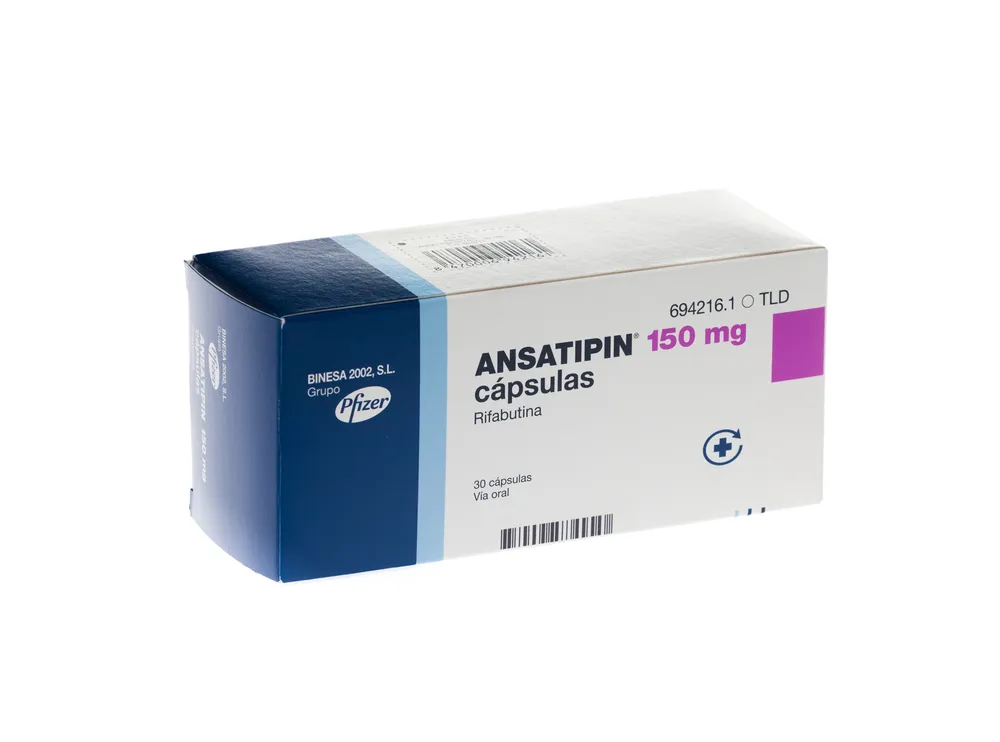
Table of Contents
Package leaflet: Information for the user
Introduction
Package leaflet: information for the patient
Ansatipin 150mg hard capsules
rifabutin
Read the entire leaflet carefully before you start taking this medicine, as it contains important information for you.
- Keep this leaflet, as you may need to read it again.
- If you have any questions, ask your doctor or pharmacist.
- This medicine has been prescribed for you only, and you should not give it to other people, even if they have the same symptoms as you, since it may harm them.
- If you experience any adverse effects, consult your doctor or pharmacist, even if they are adverse effects not listed in this leaflet. See section 4.
Leaflet contents
- What Ansatipin 150 mg is and what it is used for
- What you need to know before taking Ansatipin 150 mg
- How to take Ansatipin 150 mg
- Possible side effects
- How to store Ansatipin 150 mg
- Contents of the pack and other information
1. What Ansatipin 150 mg is and what it is used for
Ansatipin 150 mg is an antibiotic belonging to the rifamycin group.
Antibiotics are used to treat bacterial infections and are not effective against viral infections such as flu or the common cold.
It is important that you follow your doctor's instructions regarding dosage, dosing interval, and duration of treatment.
Do not store or reuse this medicine. If you have any antibiotic left after completing your treatment, return it to the pharmacy for proper disposal. Do not dispose of medicines via wastewater or household waste.
It is used in adults for the prevention of infections caused by Mycobacterium avium-intracellulare (MAC) in patients with HIV (Human Immunodeficiency Virus) infection, when clinically indicated.
Ansatipin is also used in adults to treat the following infections when other treatments are not suitable:
-
Treatment of localized or disseminated symptomatic infection caused by atypical mycobacteria (such as Mycobacterium avium and other species) in patients with HIV infection
-
Treatment of pulmonary tuberculosis (Mycobacterium tuberculosis) when treatment with rifampicin is not appropriate due to risk of drug interactions or in cases of rifampicin resistance and confirmed susceptibility to rifabutin.
For the treatment of atypical mycobacteria and pulmonary tuberculosis, Ansatipin must always be administered in combination with other drugs active against mycobacteria.
Consult your doctor if you have any questions about how Ansatipin works or why this medicine has been prescribed for you.
2. What you need to know before taking Ansatipin 150 mg
Do not take Ansatipin 150 mg
- if you are allergic to rifabutin or to other medicines in the same family (rifamycins), such as rifampicin, or to any of the other ingredients of this medicine (listed in section 6).
- if you are receiving treatment with medicines containing rilpivirine administered as a long-acting injectable suspension.
Warnings and precautions
Talk to your doctor or pharmacist before starting treatment if:
- You have severe kidney or liver disease, as your doctor may need to adjust the dose of Ansatipin.
- You are taking medicines to treat HIV, as they may interact with Ansatipin (see section Other medicines and Ansatipin 150 mg).
- You are taking oral contraceptives, as Ansatipin may reduce their contraceptive effectiveness.
Talk to your doctor or pharmacist if, during treatment:
- You experience severe skin reactions such as skin and mucous membrane inflammation, which may be very serious (Stevens-Johnson syndrome), skin inflammation with blistering (toxic epidermal necrolysis), or drug rash with eosinophilia and systemic symptoms (DRESS, including skin rash, swollen lymph nodes, elevated eosinophils [a type of white blood cells], and internal organ inflammation [liver, lungs, heart, kidneys, and large intestine]). In such cases, you must consult your doctor immediately, who will decide whether rifabutin administration should be discontinued.
- You are diagnosed with active tuberculosis, as you will require anti-tuberculosis drugs.
- You develop eye inflammation (uveitis). You should consult your ophthalmologist and your doctor, as it may be necessary to reduce the dose or discontinue treatment with Ansatipin.
- You develop diarrhoea, abdominal pain, or fever during or after treatment, as these may be symptoms of a serious intestinal disorder. Inform your doctor, who will decide whether treatment with Ansatipin should be discontinued or other appropriate therapeutic measures taken.
Ansatipin may cause a red-orange discoloration of the urine, as well as of the skin or other body secretions. Soft contact lenses may become permanently stained.
This medicine is not recommended for children and adolescents under 18 years of age due to lack of data on safety and efficacy.
Other medicines and Ansatipin 150 mg
Inform your doctor or pharmacist if you are taking, have recently taken, or might need to take any other medicines.
Treatment with Ansatipin may require dose adjustments of other medicines either used in combination or taken regularly by the patient, due to potential interactions (increased or decreased effects of the medicines).
Therefore, if you start treatment with Ansatipin, close monitoring by your doctor and/or dose adjustments of certain medicines you are taking may be necessary, such as:
- medicines to prevent blood clotting (warfarin)
- painkillers (opioid analgesics such as codeine and morphine)
- anti-inflammatory medicines (corticosteroids)
- immunosuppressants used to prevent transplant rejection (cyclosporine, tacrolimus)
- medicines to treat heart conditions (digoxin, quinidine, verapamil, beta-adrenergic blockers such as disopyramide or mexiletine)
- medicines to treat diabetes (oral hypoglycaemics)
- antiepileptics (phenytoin and other anticonvulsants)
- anxiolytics or sedatives (diazepam and barbiturates)
- medicines to lower blood triglycerides (clofibrate)
- antibiotics to treat bacterial infections (dapsone, sulfamethoxazole-trimethoprim, clarithromycin and chloramphenicol)
- antifungals, to treat fungal infections (ketoconazole, fluconazole, voriconazole, posaconazole and itraconazole)
- antiretrovirals, to treat HIV (delavirdine, didanosine, dolutegravir, doravirine, elvitegravir/cobicistat, etravirine, indinavir, saquinavir, rilpivirine [for oral use, e.g., tablets], ritonavir, zidovudine, nelfinavir, amprenavir, bictegravir, combinations of atazanavir, darunavir, fosamprenavir, tipranavir and lopinavir with ritonavir)
- medicines to treat hepatitis C (sofosbuvir)
- antituberculosis medicines (bedaquiline, ethambutol, isoniazid, rifampicin and p-aminosalicylic acid). If rifabutin and p-aminosalicylic acid are administered together, the doses should be spaced 12 hours apart, as the latter may interfere with the absorption of Ansatipin.
- antacids. If taken, they should be taken at least 3 hours after Ansatipin
- oral contraceptives, as rifabutin may reduce their contraceptive effectiveness (ethinylestradiol / norethisterone)
Pregnancy, breastfeeding and fertility
Consult your doctor or pharmacist before using any medicine.
If you are pregnant or breastfeeding, think you may be pregnant, or are planning to become pregnant, consult your doctor before using this medicine.
Do not use Ansatipin during pregnancy unless your doctor considers it necessary.
Consult your doctor if you are using oral contraceptives, as Ansatipin may reduce their contraceptive effectiveness.
It is unknown whether rifabutin is excreted in human breast milk. If you are breastfeeding, consult your doctor to determine whether breastfeeding or treatment with Ansatipin should be discontinued.
Driving and using machines
The effect of this medicine on the ability to drive or use machines is negligible or none.
Ansatipin 150 mg hard capsules contain sodium
This medicine contains less than 1 mmol of sodium (23 mg) per capsule; i.e., essentially “sodium-free”.
3. How to take Ansatipin 150 mg
Follow exactly the instructions for use of this medicine given by your doctor. If in doubt, consult your doctor again.
The recommended dose of Ansatipin is taken once daily at any time of day, regardless of meals. In patients with nausea, vomiting, or other gastrointestinal problems, administration with food is recommended.
Adults
- If you are taking Ansatipin as the sole treatment:
Indication | Dosage |
Prevention of Mycobacterium avium-intracellulare (MAC) infection in patients with HIV infection | 300 mg (2 capsules) daily. |
- If you take Ansatipin with other treatments:
Indication | Dosage |
Infections caused by atypical mycobacteria: | 450–600 mg (3 to 4 capsules) daily. |
Pulmonary tuberculosis | 150–450 mg (1 to 3 capsules) daily. |
Your doctor will decide the duration of treatment based on the response obtained.
In patients with liver or kidney disease, your doctor will assess whether the dose of Ansatipin needs to be adjusted.
If you take more Ansatipin 150mg than you should
In case of overdose or accidental ingestion, contact your doctor or pharmacist immediately, or call the Toxicology Information Service at 91 562 04 20, indicating the medication and the amount ingested.
If you forget to take Ansatipin
Do not take a double dose to make up for missed doses.
If you stop taking Ansatipin
Do not stop treatment with Ansatipin before the time indicated by your doctor, as symptoms may worsen or reappear.
If you have any further questions about the use of this medicine, ask your doctor or pharmacist.
4. Possible adverse effects
Like all medicines, this medicine can cause adverse effects, although not everyone will experience them.
Consult your doctor immediately if you experience any of the following adverse effects:
- Severe allergic reactions (anaphylactic shock) (frequency not known)
- Severe skin adverse reactions (see Warnings and precautions) (frequency not known)
The following are additional adverse effects that may occur:
Very common adverse effects (affecting at least 1 in 10 patients) are:
- Decrease in white blood cells (leukopenia).
Common adverse effects (affecting at least 1 in 100 patients) are:
- Decrease in the number of red blood cells in the blood (anemia).
- Rash.
- Nausea.
- Muscle pain (myalgia).
- Fever.
Uncommon adverse effects (affecting at least 1 in 1,000 patients) are:
- Decrease in all blood cells (pancytopenia).
- Decrease in granulocytes, a type of blood cell (granulocytopenia or agranulocytosis).
- Decrease in neutrophils, a type of blood cell (neutropenia).
- Decrease in lymphocytes, a type of blood cell (lymphopenia).
- Decrease in platelets (thrombocytopenia).
- Increase in eosinophils, a type of blood cell (eosinophilia).
- Allergic reactions (hypersensitivity).
- Narrowing of the airways making it difficult for air to pass to the lungs (bronchospasm).
- Inflammation of the eye (uveitis).
- Eye disorders (deposits in the cornea).
- Vomiting.
- Yellowing of the skin and mucous membranes (jaundice).
- Increase in liver enzymes.
- Change in skin color.
- Joint pain (arthralgia).
Adverse effects with frequency not known are:
- Skin adverse reactions: drug reaction with eosinophilia and systemic symptoms (DRESS), toxic epidermal necrolysis (TEN), Stevens-Johnson syndrome (SJS), acute generalized exanthematous pustulosis (AGEP), erythema multiforme, exfoliative dermatitis, bullous dermatitis.
- Clostridiodes difficile colitis, a serious intestinal disease.
- Change in urine color.
Reporting of adverse effects
If you experience any type of adverse effect, consult your doctor, pharmacist, or nurse, even if it is an adverse effect not listed in this leaflet. You may also report them directly via the Spanish Pharmacovigilance System for Human Medicines: www.notificaRAM.es. By reporting adverse effects, you can help provide more information on the safety of this medicine.
5. Storage of Ansatipin
Store below 25°C.
Keep this medicine out of the sight and reach of children.
Do not use this medicine after the expiry date stated on the carton after EXP. The expiry date refers to the last day of the month indicated.
Do not use this medicine if you notice that the carton is damaged or has been opened.
Medicines must not be disposed of via wastewater or household waste. Dispose of empty containers and unused medicines at the SIGRE collection point at your pharmacy. If you are unsure, ask your pharmacist how to properly dispose of unused medicines and their packaging. This will help protect the environment.
6. Contents of the pack and other information
Composition of Ansatipin
- The active substance is rifabutin.
- The other components (excipients) are: microcrystalline cellulose (E460i), sodium lauryl sulfate (E487), magnesium stearate (E470b), and colloidal silicon dioxide. The capsule components are: gelatin, red iron oxide (E172), and titanium dioxide (E171).
Appearance of the product and contents of the pack
Ansatipin is presented as opaque, reddish-brown hard gelatin capsules, packed in transparent PVC/aluminum blisters. Each pack contains 30 hard capsules.
Marketing Authorization Holder and Manufacturer
Marketing Authorization Holder
Binesa 2002, S.L.
Avda. de Europa, 20-B
Parque Empresarial La Moraleja
28108 Alcobendas (Madrid), Spain
Local representative
Pfizer, S.L.
Avda. de Europa, 20-B
Parque Empresarial La Moraleja
28108 Alcobendas (Madrid), Spain
Manufacturer
Pfizer Italia S.r.L.
Via del Commercio
63046, Marino del Tronto, Ascoli-Piceno, Italy.
Date of the most recent revision of this leaflet: March 2026
Detailed and up-to-date information on this medicinal product is available on the website of the Spanish Agency for Medicines and Health Products (AEMPS) (http://www.aemps.gob.es/)