Ampres 10 mg/ml solution for injection
Spain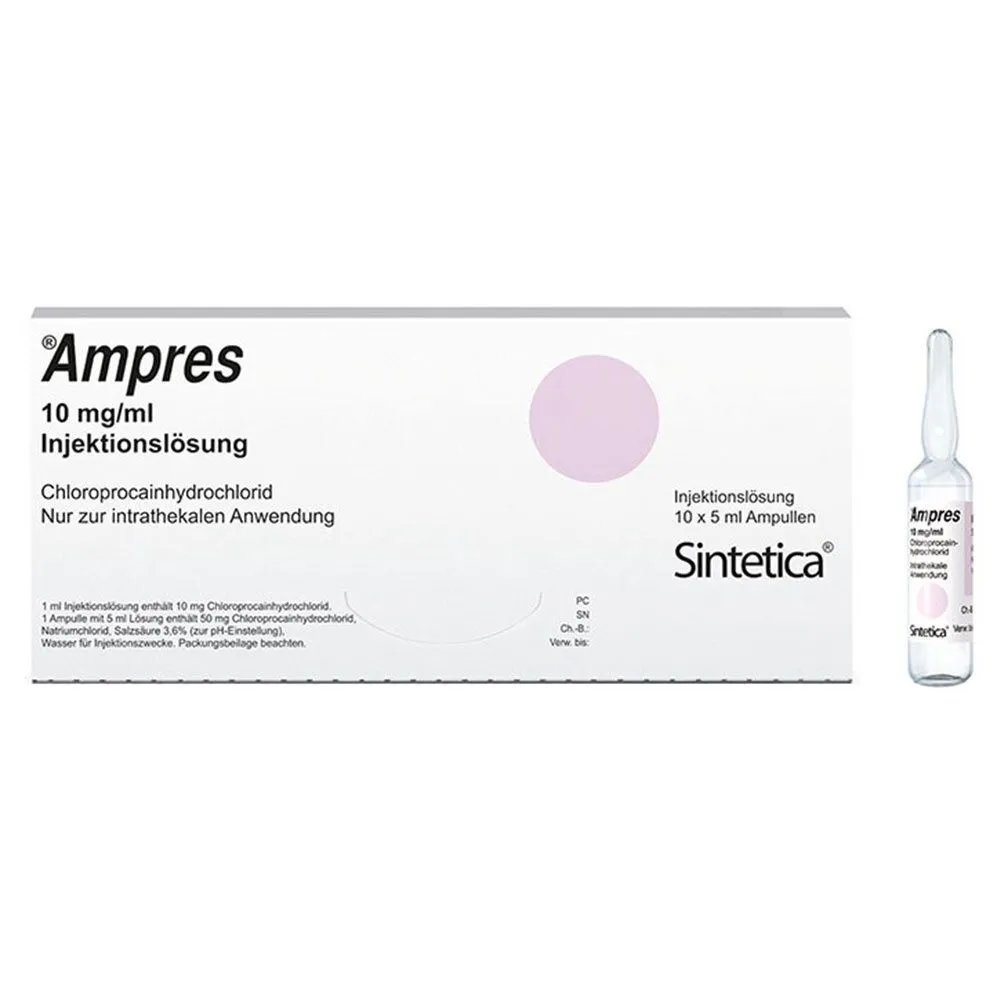
Table of Contents
Package leaflet: Information for the user
Introduction
Package leaflet: Information for the user
Ampres 10 mg/ml injectable solution
Chloroprocaine hydrochloride
Read the entire leaflet carefully before you start using this medicine, because it contains important information for you.
- Keep this leaflet, as you may need to read it again.
- If you have any questions, ask your doctor, pharmacist or nurse.
If you experience any adverse reactions, consult your doctor, pharmacist or nurse, even if they are adverse reactions not listed in this leaflet. See section 4.
Leaflet contents:
- What Ampres is and what it is used for
- What you need to know before using Ampres
- How to use Ampres
- Possible side effects
- How to store Ampres
- Contents of the pack and other information
1. What Ampres is and what it is used for
Ampres contains the active substance chloroprocaine hydrochloride. It is a type of medicine called a local anaesthetic, belonging to the ester class, and is an injectable solution. Ampres is used to anaesthetize (numb) specific parts of the body and prevent pain during surgery.
Ampres is indicated only in adults.
2. What you need to know before using Ampres
Do not use Ampres
- if you are allergic to hydrochloride chloroprocaine, to medicines in the PABA ester group (para-aminobenzoic acid), to other local anaesthetics of the ester type, or to any of the other components of this medicine (listed in section 6),
- if you have serious heart conduction disorders,
- if you suffer from severe anaemia,
- if you have general or specific contraindications for the administration method.
Warnings and precautions
If any of the following situations apply to you, you must discuss them with your doctor before this medicine is administered.
- if you have ever experienced an adverse reaction to an anaesthetic in the past,
- if you have signs of skin infection or inflammation at or near the proposed injection site,
- if you suffer from any of the following disorders:
- central nervous system diseases such as meningitis, polio, or spinal cord problems due to anaemia,
- severe headache,
- brain, spinal, or other tumours,
- spinal tuberculosis,
- recent spinal trauma,
- very low blood pressure or low blood volume,
- blood coagulation disorders,
- acute porphyria,
- fluid in the lungs,
- sepsis (blood poisoning),
- if you have heart disease,
- if you suffer from neurological disorders such as multiple sclerosis, hemiplegia, paraplegia, or muscular disorders.
Other medicines and Ampres
Inform your doctor, pharmacist, or nurse if you are taking, have recently taken, or might need to take any other medicines. This is especially important if you are taking medicines for irregular heart rhythm (class III antiarrhythmics), for treating low blood pressure (vasopressors), or for pain relief.
Pregnancy, breastfeeding, and fertility
If you are pregnant or breastfeeding, think you might be pregnant, or are planning to have a baby, consult your doctor before receiving this medicine. Ampres is not recommended as a local or regional anaesthetic during pregnancy and should only be administered during pregnancy if absolutely necessary. This does not preclude the use of Ampres during childbirth.
It is not known whether chloroprocaine is excreted in breast milk. If you are breastfeeding, inform your doctor, who will decide whether or not Ampres should be used.
Driving and using machines
Ampres has a major influence on the ability to drive and use machines.
Your doctor is responsible for deciding in each case whether you may drive or use machines.
Ampres contains sodium
This medicine contains less than 1 mmol of sodium (23 mg) per dose (maximum dose equal to 5 ml of Ampres injectable solution) and is therefore considered "sodium-free".
3. How to use Ampres
This medicine will be administered by your doctor.
Regional anesthesia should only be administered by a physician with the necessary knowledge and experience. The responsible physician is accountable for taking the necessary precautions to avoid intravascular injection and for recognizing and managing any adverse effects.
Equipment, medications, and personnel capable of managing an emergency must be immediately available.
Your doctor will determine the correct dose for you. It will normally be 4–5 ml (40–50 mg of chloroprocaine hydrochloride).
A reduced dose is indicated in patients with impaired general condition (e.g., vascular occlusion, arteriosclerosis, diabetic polyneuropathy).
Use in children and adolescents
The safety and efficacy of Ampres in children and adolescents have not been established. No data are available.
Ampres is administered by intrathecal (spinal) injection when the planned surgical procedure is not expected to exceed 40 minutes.
If you have any further questions about the use of this product, ask your doctor, pharmacist, or nurse.
4. Possible adverse effects
Like all medicines, Ampres may have adverse effects, although not everyone experiences them.
Important side effects to be aware of:
Sudden life-threatening allergic reactions (such as anaphylaxis) are rare and affect up to 1 in 1,000 users.
Possible symptoms include sudden onset of itching, erythema (skin redness), edema (swelling), sneezing, vomiting, dizziness, excessive sweating, elevated temperature; and shortness of breath, wheezing, or difficulty breathing. If you think Ampres is causing you an allergic reaction, inform your doctor immediately.
In addition, if you experience persistent motor, sensory and/or autonomic (bladder and bowel control) deficits in some lower segments of the spinal column, inform your doctor immediately to avoid permanent neurological damage.
Other possible adverse effects:
Very common: affects more than 1 in 10 patients
Decreased blood pressure, feeling of discomfort (nausea)
Common: affects up to 1 in 10 patients
Anxiety, restlessness, paresthesia, dizziness, vomiting, difficulty urinating.
Uncommon: affects up to 1 in 100 patients
Drop in blood pressure (with high doses), slow heartbeat, tremors, seizures, numbness of the tongue, hearing problems, visual disturbances, speech difficulties, loss of consciousness.
Rare: affects up to 1 in 1,000 patients
Neuropathy, drowsiness progressing to unconsciousness and respiratory arrest, spinal block (including total spinal block), decreased blood pressure due to spinal block, loss of bladder and bowel control, loss of perineal sensation and sexual function, arachnoiditis, cauda equina syndrome, and permanent neurological injury.
Double vision, irregular heartbeat (arrhythmias).
Myocardial depression, cardiac arrest (risk increases with high doses or accidental intravascular injection).
Respiratory depression.
Reporting of adverse effects:
If you experience any type of adverse effect, consult your doctor, pharmacist, or nurse, even if it is a possible adverse effect not listed in this leaflet. You may also report them directly through the Spanish Pharmacovigilance System for Human Medicines: https://www.notificaRAM.es . By reporting adverse effects, you can help provide more information on the safety of this medicine.
5. Storage of Ampres
Keep this medicine out of the sight and reach of children.
Do not use this medicine after the expiry date stated on the ampoule label and on the outer carton. The expiry date refers to the last day of the month indicated.
Do not store above 25°C. Do not refrigerate or freeze. Store in the original packaging to protect from light.
The medicine should be used immediately after first opening. For single use only.
Do not use Ampres if you notice that the solution does not appear clear and free from particles.
As this medicine is restricted to hospital use, disposal is carried out directly by the hospital. Medicines should not be disposed of via wastewater. These measures will help protect the environment.
6. Contents of the pack and other information
Composition of Ampres
The active substance is chloroprocaine hydrochloride.
1 ml of injectable solution contains 10 mg of chloroprocaine hydrochloride.
1 vial containing 5 ml of solution contains 50 mg of chloroprocaine hydrochloride.
The other components are hydrochloric acid 3.7% (for pH adjustment), sodium chloride, and water for injections.
Appearance of the medicine and contents of the pack
This medicine is presented as an injectable solution. The solution is clear and colourless.
It is supplied in clear colourless glass type I vials.
Pack of 10 vials. Each vial contains 5 ml of injectable solution.
Marketing Authorisation Holder and Manufacturer
Marketing Authorisation Holder
B.Braun Medical, S.A.
Ctra. de Terrassa, 121
08191 (Rubí) Barcelona Spain
Manufacturer
Sirton Pharmaceuticals SpA
Piazza XX Settembre, 2
22079 Villa Guardia (CO)
Italy
Or
Sintetica GmbH
Albersloher Weg 11
48155 Münster
Germany
More information about this medicine is available upon request by contacting the local representative of the Marketing Authorisation Holder:
Member State | Medicinal product name |
Austria | Ampres 10mg/ml Injection solution |
Belgium | Ampres 10mg/ml Solution for injection - |
France | Clorotekal 10mg/ml solution for injection |
Germany | Ampres 10mg/ml Injektionslösung |
Ireland | Ampres 10mg/ml solution for injection |
Italy | Decelex |
Poland | Ampres |
Spain | Ampres 10mg/ml injectable solution |
United Kingdom (Northern Ireland) | Ampres 10mg/ml solution for injection |
Date of the most recent review of this leaflet: January 2022
Other sources of information
Detailed information on this medicinal product is available on the website of the Spanish Agency of Medicines and Medical Devices: http://www.aemps.gob.es.
This information is intended exclusively for healthcare professionals:
The Summary of Product Characteristics (SmPC) is attached at the end of the printed leaflet as a separate section.