Aminoplasmal hepa solution for infusion
Spain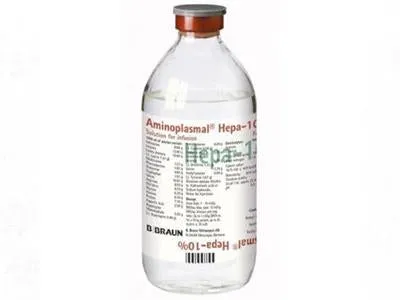
Table of Contents
- Package leaflet: Information for the user
- Introduction
- 1. What Aminoplasmal HEPA is and what it is used for
- 2. What you need to know before using Aminoplasmal HEPA
- 3. How to use Aminoplasmal HEPA
- 4. Possible adverse effects
- 5. Storage of Aminoplasmal HEPA
- 6. Contents of the pack and other information
Package leaflet: Information for the user
Introduction
Package leaflet: information for the user
Aminoplasmal HEPA solution for infusion
Amino acids
Read all of this leaflet carefully before you start using this medicine because it contains important information for you.
- Keep this leaflet; you may need to read it again.
- If you have any questions, ask your doctor or pharmacist.
- If you get any side effects, talk to your doctor or pharmacist, even if it is not one of the side effects listed in this leaflet. See section 4.
Contents of the leaflet
- What Aminoplasmal HEPA is and what it is used for
- What you need to know before you use Aminoplasmal HEPA
- How to use Aminoplasmal HEPA
- Possible side effects
- How to store Aminoplasmal HEPA
- Contents of the pack and other information
1. What Aminoplasmal HEPA is and what it is used for
Aminoplasmal HEPA is a solution administered through a small tube (catheter) inserted into a vein (intravenous infusion).
The solution contains amino acids essential for growth or recovery of the body.
You will receive this medicine when your liver function is severely impaired. It may help prevent or reverse a decline in brain function associated with severe liver disease.
Under these conditions, you may be unable to perform complex tasks. You might also feel drowsy, or become nearly or completely unconscious.
You will receive this medicine if you are unable to eat normally and cannot be fed through a tube inserted into your stomach. This solution can be administered to adults, adolescents, and children over 2 years of age.
2. What you need to know before using Aminoplasmal HEPA
Do not use Aminoplasmal HEPA
- if you are allergic to the active substances or to any of the other components of this medicine (listed in section 6);
- if you have a congenital disorder in protein and amino acid metabolism;
- if you have severe (i.e., potentially life-threatening) circulatory disorders (cardiovascular shock);
- if you have insufficient oxygen supply (hypoxia);
- if you have an accumulation of acid substances in your blood (metabolic acidosis);
- if you have severe renal dysfunction (severe renal failure) not adequately treated with hemodialysis or similar treatments;
- if you have poorly controlled heart failure with significant deterioration in blood circulation (decompensated heart failure);
- if you have fluid accumulation in the lungs (acute pulmonary edema);
- if you have disturbances in the balance of salts (electrolytes) and water in your body.
Newborns, infants, and children under two years of age
This solution must not be administered to newborns, infants, or children under 2 years of age, as the composition of the solution does not adequately meet the specific nutritional requirements of this age group.
Children and adolescents
The safety and efficacy of Aminoplasmal HEPA in children have not yet been established.
Warnings and precautions
Consult your doctor or pharmacist before starting to use Aminoplasmal HEPA:
- if your kidneys are not functioning properly, your doctor will assess whether this solution is suitable for you. Your daily dose will be carefully adjusted according to the severity of renal failure;
- if you have any impairment of heart function;
- if you have abnormally high blood serum concentration (high serum osmolarity).
If you have disturbances in salt and water balance, this condition must be corrected before you receive this medicine. Examples of such conditions include lack of both water and salts simultaneously (hypotonic dehydration), or lack of sodium (hyponatremia) or potassium (hypokalemia).
Before and during treatment with this medicine, your blood electrolyte levels, blood sugar levels, fluid balance, acid-base balance, blood proteins, and kidney function should be monitored. For this purpose, blood and urine samples will be taken and analyzed.
Established liver treatment will be continued. It will not be replaced by amino acid infusions.
Aminoplasmal HEPA is generally administered as part of a parenteral nutrition regimen that also includes non-protein energy supplements (carbohydrate solutions, fat emulsions), essential fatty acids, electrolytes, vitamins, fluids, and trace elements.
Use of Aminoplasmal HEPA with other medicines
Inform your doctor or pharmacist if you are taking, have recently taken, or might need to take any other medicines.
Pregnancy and breastfeeding
If you are pregnant or breastfeeding, think you may be pregnant, or plan to become pregnant, consult your doctor or pharmacist before using this medicine.
Pregnancy
You will be given this medicine during pregnancy only if your doctor considers it necessary for your recovery. There are no available data on the use of this medicine in pregnant women.
Breastfeeding
At therapeutic doses of Aminoplasmal HEPA, no effect on the newborn/infant is expected. However, breastfeeding is not recommended if women require intravenous feeding at the same time.
Driving and use of machines
This medicine is normally administered to immobile patients in a controlled setting (emergency treatment, acute treatment in a hospital, or in a day-care unit). This excludes driving and operating machinery.
Aminoplasmal HEPA contains Sodium
This medicine contains 3.4 to 26.45 mg of sodium (main component of table salt) per 500 ml. This corresponds to 0.15% - 1.3% of the maximum daily recommended sodium intake for adults.
3. How to use Aminoplasmal HEPA
Follow exactly the instructions for administration of this medicine given by your doctor or pharmacist. If in doubt, consult your doctor or pharmacist again.
Dosage
Adults
Your doctor will determine the amount you need daily.
Generally, it will be 8 to 15 ml/kg body weight per day. The solution should be infused at a rate not exceeding 1 ml per kg body weight per hour.
Children and adolescents
The doses for the age group indicated below are average guideline values. The exact dose must be individually adjusted according to age, stage of development, underlying disease, and severity of the condition.
The initial dose will be 5 ml/kg body weight/day, gradually increasing up to 15 ml/kg body weight/day during treatment, depending on recovery of liver function.
The solution should be infused at a rate not exceeding 1 ml per kg body weight per hour.
Treatment duration
This medicine may be used for as long as you require intravenous nutrition and as long as there is a risk of worsening brain function.
If you receive more Aminoplasmal HEPA than you should
This is unlikely to happen, as your doctor will determine your daily doses.
However, if you receive an overdose or the solution is administered too rapidly, you may experience nausea, vomiting, chills, or headache.
In addition, your blood may contain too many acidic substances (metabolic acidosis) or too much ammonia (hyperammonemia), and you may lose amino acids in the urine.
You may also have too much fluid in your body (overhydration), your electrolyte balance may be disturbed (electrolyte imbalance), or you may develop fluid in the lungs (pulmonary edema).
If this occurs, the infusion can be interrupted and restarted at a slower rate after a certain period.
If you have used more Aminoplasmal HEPA than you should, contact your doctor or pharmacist immediately or call the Toxicology Information Service (telephone 91-562 04 20), indicating the medicine and the amount used.
If you have any further questions about the use of this product, ask your doctor or pharmacist.
4. Possible adverse effects
Like all medicines, this medicine may cause adverse effects, although not everybody gets them.
These adverse effects are not necessarily related to Aminoplasmal HEPA, but may occur with any type of intravenous nutrition, especially at the beginning.
The following adverse effects can be serious. If you experience any of the following, inform your doctor immediately. Your doctor will stop administering this medicine:
Frequency not known (cannot be estimated from available data)
- Allergic reactions
Other adverse effects
Uncommon (may affect up to 1 in 100 people)
- Vomiting, nausea
Reporting of adverse effects:
If you experience any type of adverse effect, consult your doctor, even if it is a possible adverse effect not listed in this leaflet. You can also report them directly through the Spanish Pharmacovigilance System for Human Medicinal Products: https://www.notificaram.es. By reporting adverse effects, you can help provide more information on the safety of this medicine.
5. Storage of Aminoplasmal HEPA
Keep this medicine out of the sight and reach of children.
Do not use this medicine after the expiry date stated on the labels of the vial and carton, following EXP. The expiry date refers to the last day of the month indicated.
No special storage temperature is required. Store the vial in the outer packaging to protect it from light.
Do not freeze.
The remaining solution must never be kept for later use once the infusion has been completed.
6. Contents of the pack and other information
Composition of Aminoplasmal HEPA
The active substances are amino acids.
This medicine contains:
In 1 ml | In 500 ml | |||
Isoleucine | 8.80 mg | 4.40 g | ||
Leucine | 13.60 mg | 6.80 g | ||
Lysine acetate | 10.60 mg | 5.30 g | ||
(equivalent to lysine) | (7.51 mg) | 3.75 g | ||
Methionine | 1.20 mg | 0.60 g | ||
Phenylalanine | 1.60 mg | 0.80 g | ||
Threonine | 4.60 mg | 2.30 g | ||
Tryptophan | 1.50 mg | 0.75 g | ||
Valine | 10.60 mg | 5.30 g | ||
Arginine | 8.80 mg | 4.40 g | ||
Histidine | 4.70 mg | 2.35 g | ||
Glycine | 6.30 mg | 3.15 g | ||
Alanine | 8.30 mg | 4.15 g | ||
Proline | 7.10 mg | 3.55 g | ||
Aspartic acid | 2.50 mg | 1.25 g | ||
Asparagine monohydrate | 0.55 mg | 0.27 g | ||
(equivalent to asparagine) | (0.48 mg) | 0.24 g | ||
Acetylcysteine | 0.80 mg | 0.40 g | ||
(equivalent to cysteine) | (0.59 mg) | 0.29 g | ||
Glutamic acid | 5.70 mg | 2.85 g | ||
Ornithine hydrochloride | 1.66 mg | 0.83 g | ||
(equivalent to ornithine) | (1.30 mg) | 0.65 g | ||
Serine | 3.70 mg | 1.85 g | ||
Acetyltyrosine | 0.86 mg | 0.43 g | ||
(equivalent to tyrosine) | 0.70 mg | 0.35 g |
The other components are: sodium hydroxide or hydrochloric acid (for pH adjustment), disodium edetate, and water for injections.
Electrolyte concentrations | |
Acetate | 51 mmol/l |
Chloride | 10 mmol/l |
Amino acid content | 100 g/l |
Nitrogen content | 15.3 g/l |
Energy | 1675 kJ/l ? 400 kcal/l |
Theoretical osmolarity | 875 mOsm/l |
pH | 5.5–6.5 |
Product appearance and contents of the pack
Aminoplasmal HEPA is a clear, colorless or slightly straw-colored aqueous solution.
The product is supplied in 500 ml transparent glass bottles closed with elastomeric stoppers.
The 500 ml bottles are available in packs of 10 units.
Only certain pack sizes may be marketed.
Marketing Authorization Holder and Manufacturer
Marketing Authorization Holder:
- Braun Medical, S.A.
Ctra. de Terrassa, 121
08191-Rubí (Barcelona)
Spain
Manufacturer:
- Braun Melsungen AG
Carl-Braun Strasse, 2
D-34212 Melsungen
Germany
Date of the most recent review of this leaflet: July 2021.
Other sources of information
Detailed information on this medicinal product is available on the website of the Spanish Agency for Medicines and Health Products (http://www.aemps.gob.es/).
This information is intended for healthcare professionals only:
Handling instructions
No special conditions for disposal are required.
Single-use containers. Discard the container and any unused contents after use.
Only use if the solution is clear, colorless or slightly straw-colored, and if the bottle and its closure are undamaged.
Use sterile administration equipment for the infusion of Aminoplasmal HEPA.
If during total parenteral nutrition it is necessary to add other nutrients such as carbohydrates, lipids, vitamins, electrolytes, and trace elements to this medicinal product, the mixture must be prepared under strictly aseptic conditions. Mix thoroughly after adding any additive. Aminoplasmal HEPA may only be mixed with other nutrients whose compatibility has been documented. Compatibility data for various additives and the corresponding shelf life of such mixtures are available from the manufacturer upon request.
Special storage precautions
Do not use the product if the solution is not clear and colorless to slightly straw-colored, or if the bottle or its closure is damaged.
The containers are for single use only. Discard the container and any unused contents after use.
Shelf life
Unopened container
3 years
After first opening of the container
The medicine should be used immediately.
After mixing with additives
From a microbiological standpoint, admixtures should be administered immediately after preparation. If not administered immediately, storage times and conditions prior to use are the responsibility of the user and should normally not exceed 24 hours at 2°C–8°C, unless the admixture has been prepared under controlled and validated aseptic conditions.
For complete information on this medicinal product, consult the Summary of Product Characteristics.