Amenur 1 mg film-coated tablets EFG
Spain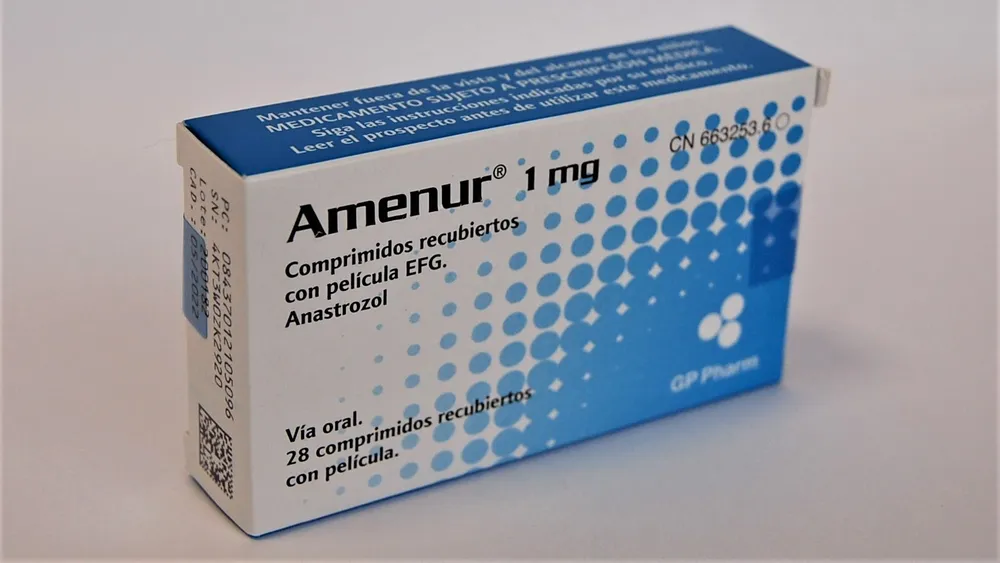
Table of Contents
Package leaflet: Information for the user
Introduction
PACKAGE LEAFLET: INFORMATION FOR THE USERAMENUR 1 mg film-coated tablets EFG
Anastrozol
Read the entire leaflet carefully before you start taking this medicine, because it contains important information for you.
- Keep this leaflet as you may need to read it again.
- If you have any questions, ask your doctor or pharmacist.
- This medicine has been prescribed for you only, and you should not give it to others, even if they have the same symptoms as you, because it could harm them.
- If you experience any adverse reactions, consult your doctor or pharmacist, even if they are adverse reactions not listed in this leaflet. See section 4.
Leaflet contents:
- What Amenur is and what it is used for
- What you need to know before taking Amenur
- How to take Amenur
- Possible side effects
- How to store Amenur
- Contents of the pack and other information
1. What Amenur is and what it is used for
Amenur contains a substance called anastrozole and belongs to a group of medicines known as "aromatase inhibitors". Anastrozole is used to treat breast cancer in women who have undergone menopause.
Anastrozole works by reducing the amount of hormones called estrogens produced by your body, through blocking a natural body substance (an enzyme) called "aromatase".
2. What you need to know before starting to take Amenur
Do not take Amenur
- If you are allergic (hypersensitive) to anastrozole or to any of the other components of this medicine (listed in section 6).
- If you are pregnant or breastfeeding (see the section titled “Pregnancy and breastfeeding”).
Do not take anastrozole if you are in any of the situations described above. If you are unsure, consult your doctor or pharmacist before taking anastrozole.
Take special care with Amenur
Before taking Amenur, check with your doctor or pharmacist
- If you still have menstrual periods and have not yet reached menopause.
- If you are taking a medicine containing tamoxifen or medicines containing estrogen (see the section titled “Other medicines and Amenur”).
- If you have ever had a condition affecting bone strength (osteoporosis).
- If you have any liver or kidney problems.
If you are unsure whether any of these apply to you, consult your doctor or pharmacist before taking anastrozole.
If you are admitted to hospital, inform the healthcare staff that you are taking anastrozole.
Other medicines and Amenur
Tell your doctor or pharmacist if you are using, have recently used, or might need to use any other medicines, including those obtained without a prescription and herbal remedies. This is because anastrozole may affect the action of other medicines, and some medicines may affect anastrozole.
Do not take anastrozol if you are already being treated with any of the following medicines:
- Certain medicines used to treat breast cancer (selective estrogen receptor modulators), for example, medicines containing tamoxifen. This is because these medicines may prevent anastrozole from working properly.
- Medicines containing estrogens, such as hormone replacement therapy (HRT).
If you are in any of these situations, seek advice from your doctor or pharmacist.
Consult your doctor or pharmacist if you are taking the following:
- A medicine known as an “LHRH analogue”. This includes gonadorelin, buserelin, goserelin, leuprorelin, and triptorelin. These medicines are used to treat breast cancer, certain female (gynecological) health conditions, and infertility.
Pregnancy and breastfeeding
Do not take anastrozole if you are pregnant or breastfeeding. Stop treatment with anastrozole if you become pregnant and consult your doctor.
Consult your doctor or pharmacist before using any medicine.
Driving and use of machines
It is unlikely that anastrozole will affect your ability to drive or use tools or machinery. However, occasionally some patients may experience weakness or drowsiness while taking anastrozole. If this happens to you, seek advice from your doctor or pharmacist.
Important information about some of the components of Amenur
Amenur contains lactose
This medicine contains lactose. If your doctor has told you that you have an intolerance to certain sugars, consult with him before taking this medicine.
Amenur contains sodium
This medicine contains less than 23 mg of sodium (1 mmol) per tablet; that is, essentially “sodium-free”.
3. How to take Amenur
Follow exactly the instructions given by your doctor for taking this medicine. If in doubt, consult your doctor or pharmacist again.
- The recommended dose is one tablet daily.
- Try to take the tablet at the same time each day.
- Swallow the tablet whole with water.
- You may take anastrozol before, during, or after meals.
Continue taking anastrozol for as long as your doctor tells you to. This is a long-term treatment and you may need to take it for several years.
Use in children and adolescents
Anastrozol must not be given to children and adolescents.
If you take more Amenur than you should
If you take more anastrozol than you should, contact your doctor immediately.
In case of overdose or accidental ingestion, contact your doctor or pharmacist immediately or call the Toxicology Information Service at 91 562 04 20, stating the medicine and the amount taken.
If you forget to take Amenur
If you forget to take a dose, simply take the next dose at the usual time.
Do not take a double dose (two doses at the same time) to make up for a missed dose.
If you stop taking Amenur
Do not stop taking your tablets unless instructed by your doctor.
If you have any further questions about the use of this medicine, ask your doctor or pharmacist.
4. Possible adverse effects
Like all medicines, this medicine can cause adverse effects, although not everyone will experience them.
Stop taking Amenur and seek urgent medical treatment if you experience any of the following very rare but serious side effects:
- A very severe skin reaction with skin ulcers or blisters. This is known as “Stevens-Johnson syndrome”.
- Allergic reactions (hypersensitivity) with swelling of the throat that may cause difficulty swallowing or breathing. This is known as “angioedema”.
Very common adverse effects (may affect more than 1 in 10 people)
- Headache.
- Hot flushes.
- Dizziness (nausea).
- Skin rash.
- Joint pain or stiffness.
- Joint inflammation (arthritis).
- Weakness.
- Bone loss (osteoporosis).
- Depression.
Common adverse effects (may affect up to 1 in 10 people)
- Loss of appetite.
- Increased or high levels of a fatty substance in the blood known as cholesterol, which would be detected in a blood test.
- Drowsiness.
- Carpal tunnel syndrome (tingling, pain, cold sensation, weakness in areas of the hand).
- Tingling, numbness, or skin pins and needles, loss/lack of taste.
- Diarrhea.
- Vomiting.
- Changes in blood tests showing how well your liver is functioning.
- Hair thinning (hair loss).
- Allergic reactions (hypersensitivity) including face, lips, or tongue swelling.
- Bone pain.
- Vaginal dryness.
- Vaginal bleeding (usually during the first weeks of treatment – if bleeding continues, speak with your doctor).
- Muscle pain.
Uncommon adverse effects (may affect up to 1 in 100 people)
- Changes in special blood tests showing how your liver is functioning (gamma-GT and bilirubin).
- Inflammation of the liver (hepatitis).
- Hives or welts.
- Trigger finger (a condition in which one of the fingers of the hand remains bent).
- Increase in the amount of calcium in the blood. If you experience nausea, vomiting, and thirst, inform your doctor, pharmacist, or nurse, as you may need a blood test.
Rare adverse effects (may affect up to 1 in 1,000 people)
- Rare skin inflammation which may include red spots or blisters.
- Hypersensitivity-induced skin rash (this may be due to an allergic or anaphylactoid reaction).
- Inflammation of small blood vessels causing red or purple skin discoloration.
- Very rarely, symptoms of joint, stomach, and kidney pain may occur; this is known as “Henoch-Schönlein purpura”.
Adverse effects with unknown frequency (frequency cannot be estimated from available data)
- Dry eye.
- Lichenoid eruption (small red or purple itchy bumps on the skin).
- Inflammation of a tendon or tendinitis (connective tissues joining muscles to bones).
- Tendon rupture (connective tissues joining muscles to bones).
- Memory impairment.
Effects on your bones
Anastrozol reduces the levels of hormones called estrogens in your body. This may reduce the mineral content of your bones. They may become weaker and increase the likelihood of fractures. Your doctor will monitor these risks according to treatment guidelines for bone status in postmenopausal women. You should discuss risks and treatment options with your doctor.
Reporting of adverse effects
If you experience any adverse effect, talk to your doctor, pharmacist, or nurse, even if it is a possible adverse effect not listed in this leaflet. You can also report them directly via the Spanish Pharmacovigilance System for Human Medicines, www.notificaram.es. By reporting adverse effects, you can help provide more information on the safety of this medicine.
5. Storage of Amenur
Keep this medicine out of the sight and reach of children. Store the tablets in a safe place where children cannot see or reach them. These tablets could harm them.
Do not use this medicine after the expiry date stated on the packaging after EXP. The expiry date is the last day of the month indicated.
No special storage conditions are required.
Store in the outer packaging.
Medicines must not be disposed of via wastewater or household waste. Dispose of unused medicines and their containers at a SIGRE collection point at your pharmacy. If you are in doubt, ask your pharmacist how to dispose of medicines and containers you no longer need. This will help protect the environment.
6. Contents of the pack and other information
Composition of Amenur
The active substance is anastrozole. Each film-coated tablet contains 1 mg of anastrozole.
The other components (excipients) of the core are: lactose monohydrate (lactose), povidone (E1201), sodium starch glycolate from potato (potato starch), magnesium stearate (E572); the components (excipients) of the coating are: hypromellose (E464), macrogol 6000, titanium dioxide (E171) and talc.
Appearance of the product and contents of the pack
Round, biconvex, white or almost white film-coated tablet.
Amenur is presented in blisters, in packs containing 28 tablets.
Marketing Authorization Holder and Manufacturer
Marketing Authorization Holder
GP-Pharm, S.A.
Pol. Ind. Els Vinyets – Els Fogars C244, Km 22
08777 Sant Quintí de Mediona (Barcelona)
SPAIN
Manufacturer
Genepharm S.A.
18 Km Marathon Avenue
15351 Pallini
Greece
Date of the most recent revision of the package leaflet: May 2025
Detailed and up-to-date information on this medicinal product is available on the website of the Spanish Agency of Medicines and Medical Devices (AEMPS) http://www.aemps.gob.es/