Amchafibrin 500 mg film-coated tablets
Spain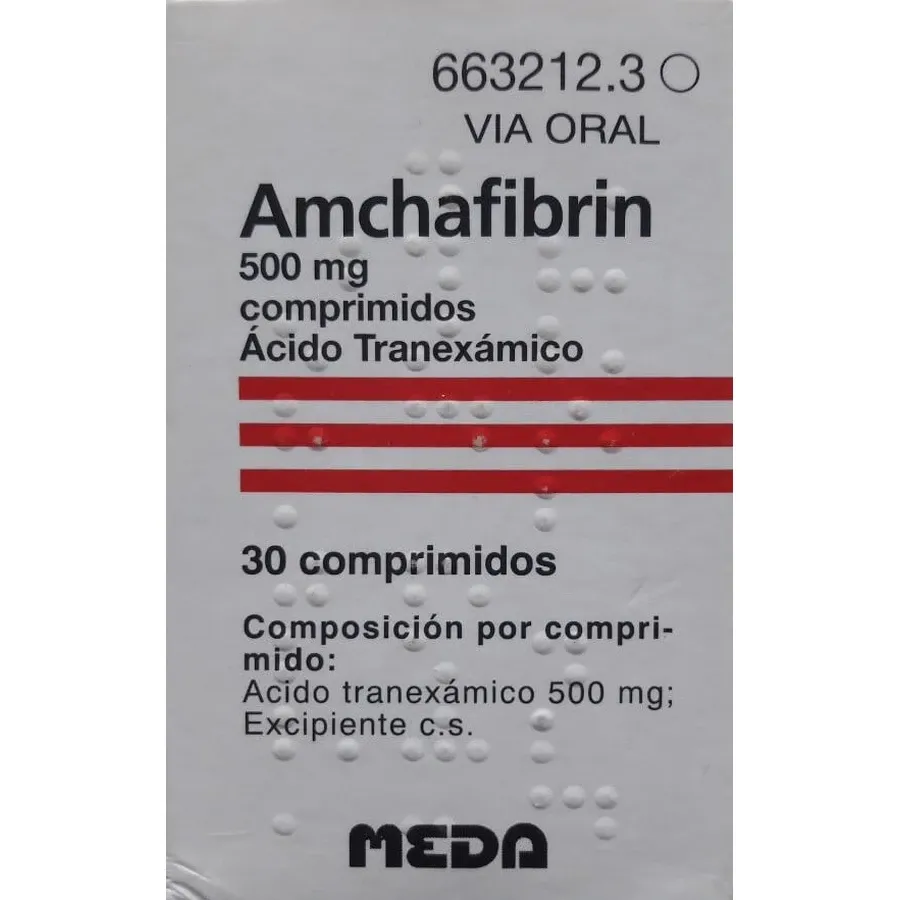
Table of Contents
Package leaflet: Information for the user
Introduction
Package leaflet: information for the user
Amchafibrin 500 mg film-coated tablets
tranexamic acid
Read the entire leaflet carefully before you start taking this medicine, because it contains important information for you.
-
Keep this leaflet, as you may need to read it again. If you have any questions, consult your doctor or pharmacist.
-
This medicine has been prescribed for you only, and you should not give it to other people, even if they have the same symptoms as you, because it may harm them.
- If you experience any adverse effects, consult your doctor or pharmacist, even if they are adverse effects not listed in this leaflet. See section 4.
Contents of the leaflet
-
What Amchafibrin is and what it is used for
-
What you need to know before taking Amchafibrin
-
How to take Amchafibrin
-
Possible side effects
-
Storage of Amchafibrin
-
Contents of the pack and other information
1. What Amchafibrin is and what it is used for
Amchafibrin contains the active substance tranexamic acid, which belongs to a group of medicines known as antifibrinolytics.
This medicine is indicated for the treatment and prevention of blood loss associated with abnormal excessive bleeding, such as:
- any type of surgery on the prostate or urinary bladder,
- abnormally heavy and prolonged menstrual periods,
- patients with a tendency to bleed abnormally (haemophiliacs) undergoing dental surgery (extractions),
- localized swelling affecting the mouth and upper respiratory tract (hereditary angioneurotic oedema).
2. What you need to know before taking Amchafibrin
Do not take Amchafibrin:
- If you are allergic to the active substance or to any of the other components of this medicine (listed in section 6).
- If you have a tendency to form thrombi (blood clots).
- If you are at risk of excessive bleeding due to a coagulation disorder called consumption coagulopathy.
- If you have severe kidney problems (severe renal insufficiency).
- If you have a history of seizures.
If in doubt, consult your doctor or pharmacist.
Warnings and precautions
Consult your doctor or pharmacist before starting to take Amchafibrin:
- If you have impaired kidney function.
- If you have hematuria (blood in the urine) of renal origin, as a clot may form in the urethra and obstruct urine outflow.
- If you are taking oral contraceptives, due to an increased risk of thrombosis.
Other medicines and Amchafibrin
Inform your doctor or pharmacist if you are taking, have recently taken, or might need to take any other medicines.
It is important to inform your doctor if you are taking any of the following drugs:
- Fibrinolytic medications (used to help break down blood clots). This is because tranexamic acid would counteract the effect of these medicines.
- Oral contraceptives.
If in doubt, consult your doctor or pharmacist.
Pregnancy and breastfeeding
If you are pregnant or breastfeeding, think you may be pregnant, or plan to become pregnant, consult your doctor or pharmacist before using this medicine.
Tranexamic acid is excreted in breast milk, although in minimal amounts. If you are breastfeeding, consult your doctor or pharmacist before taking this medicine.
Children
The main use of tranexamic acid in children is for dental extractions. Use with caution. The dose of this medicine in children and adolescents should be calculated based on body weight.
Driving and use of machines
No studies have been conducted on the effects on the ability to drive and operate machinery. If you experience dizziness or somnolence, driving vehicles or operating machinery is not recommended.
3. How to take Amchafibrin
Follow exactly the instructions given by your doctor or pharmacist for taking this medicine. If in doubt, consult your doctor or pharmacist again.
Adults:
Usual dose
Take 2 to 3 tablets, 2–3 times a day.
The exact dose for you depends on the reason why this medicine has been prescribed. Follow your doctor's instructions regarding how many tablets you should take, when to take them, and how long the treatment should last.
Doses in certain special cases:
- Total or partial removal of the prostate (prostatectomy): during the first 3 days after surgery, take 2 tablets, 3 to 4 times a day, until there is no blood in the urine.
- Abnormally heavy and prolonged menstruation (metrorrhagia): take 2 tablets, 3 times a day, for 3 or 4 days. The total daily dose should not exceed 4 g (8 tablets). Treatment with Amchafibrin should not be started until menstrual bleeding has begun.
Use in the elderly
Dose reductions are not necessary unless renal impairment is present.
Renal impairment
This medicine may accumulate in patients with renal impairment; therefore, the dose should be reduced in such cases.
Use in children and adolescents
Your doctor will tell you the exact dose to give to the child. The dose will be calculated by your doctor based on the child's weight.
If in doubt, ask your doctor or pharmacist.
If you take more Amchafibrin than you should
If you take more Amchafibrin than you should, you may experience nausea, vomiting, postural symptoms and/or hypotension. In such cases, vomiting should be induced, gastric lavage performed, and treatment with activated charcoal initiated. Maintain a high fluid intake to promote renal elimination.
In case of overdose, consult your doctor or pharmacist immediately, or call the Toxicology Information Service. Telephone number: 91 562 04 20. Take this leaflet with you.
If you forget to take Amchafibrin
Do not take a double dose to make up for forgotten doses; instead, continue taking this medicine as usual.
If you stop taking Amchafibrin
Do not stop treatment with this medicine without consulting your doctor.
If you have any further questions about the use of this medicine, ask your doctor or pharmacist.
4. Possible adverse effects
Like all medicines, this medicine can cause adverse effects, although not everyone will experience them.
Immediately inform your doctor if you experience any of the following:
- If you develop a rash or an allergic reaction such as itching, swelling of lips/tongue, or wheezing/shortness of breath. In such a case, stop taking the tablets immediately and contact your doctor right away.
- If you develop blood clots in the veins (a rare adverse effect that may affect up to 1 in 1,000 people), especially in the legs (symptoms include swelling, pain, and redness in the legs), which may travel through blood vessels to the lungs and cause chest pain and difficulty breathing. If you experience any of these symptoms, seek immediate medical attention.
Rare (affects 1 to 10 out of 1,000 patients)
- Visual disturbances, especially in color vision.
- Formation of a blood clot in an eye. This may cause bleeding in the eye or loss of vision.
- Itching, redness, or swelling of the skin.
Very rare (affects fewer than 1 in 10,000 patients)
- Formation of a blood clot in blood vessels (i.e., thrombosis).
- Allergic reactions that may cause difficulty breathing or dizziness.
- Nausea.
- Vomiting.
- Diarrhea.
- Seizures or convulsions.
- General feeling of being unwell (malaise) and low blood pressure (hypotension), with or without loss of consciousness.
Nausea, vomiting, and diarrhea are usually mild and disappear very quickly; however, if they persist, inform your doctor or pharmacist.
Reporting of adverse effects
If you experience any type of adverse effect, consult your doctor or pharmacist, even if it is a possible adverse effect not listed in this leaflet. You may also report them directly via the Spanish System for Pharmacovigilance of Human Medicines: www.notificaRAM.es. By reporting adverse effects, you can help provide more information on the safety of this medicine.
5. Storage of Amchafibrin
Keep this medicine out of the sight and reach of children.
Do not store above 30 ºC.
Do not use this medicine after the expiry date stated on the packaging after “CAD” or “EXP”. The expiry date refers to the last day of the month indicated.
Medicines must not be disposed of via wastewater or household waste. Dispose of empty containers and unused medicines at the SIGRE collection point at your pharmacy. If you have any doubts, ask your pharmacist how to properly dispose of containers and unused medicines. This will help protect the environment.
6. Contents of the pack and other information
Composition of Amchafibrin
- The active substance is tranexamic acid. Each film-coated tablet contains 500 mg of tranexamic acid.
- The other components are: microcrystalline cellulose, low-substituted hydroxypropylcellulose, talc, magnesium stearate, povidone, anhydrous colloidal silica, butyl methacrylate copolymer, titanium dioxide (E 171), macrogol, and vanillin.
Appearance of the product and contents of the pack
Film-coated white oval tablets, with a score line on one side.
The tablets are presented in PVC/PVDC-aluminum blisters. The available pack size is 30 tablets.
Marketing Authorization Holder and Manufacturer
Marketing Authorization Holder
Viatris Healthcare Limited
Damastown Industrial Park
Mulhuddart, Dublin 15
Dublin
Ireland
Manufacturer
Madaus GmbH
Lütticher Str. 5
53842 Troisdorf,
Germany
For further information about this medicinal product, please contact the local representative of the Marketing Authorization Holder:
Viatris Pharmaceuticals, S.L.
C/General Aranaz, 86
28027 Madrid
Spain
Date of the most recent review of this leaflet: November 2022
Detailed and up-to-date information on this medicinal product is available on the website of the Spanish Agency of Medicines and Health Products (AEMPS): https://www.aemps.gob.es/