Alutard SQ Apis mellifera 100,000 SQ-U/ml injectable suspension
Spain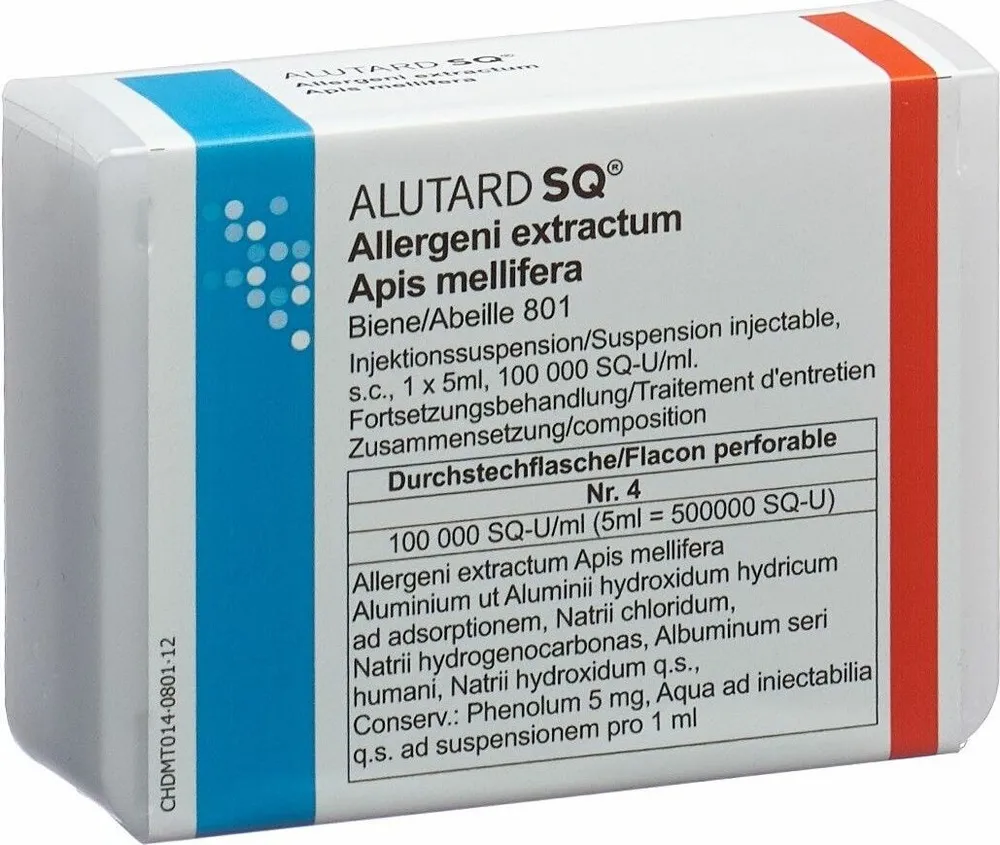
Table of Contents
- Patient Information Leaflet
- Introduction
- 1. What Alutard SQ Apis mellifera is and what it is used for
- 2. What you need to know before using Alutard SQ Apis mellifera
- 3. How to use Alutard SQ Apis mellifera
- 4. Possible adverse effects
- 5. Storage of Alutard SQ Apis mellifera
- 6. Contents of the pack and other information
Patient Information Leaflet
Introduction
Patient Information Leaflet
Alutard SQ Apis mellifera starter pack (100 SQ-U/ml, 1 000 SQ-U/ml, 10 000 SQ-U/ml and
100 000 SQ-U/ml), injectable suspension
Alutard SQ Apis mellifera 100 000 SQ-U/ml injectable suspension
Bee venom allergen (Apis mellifera)
Read the entire leaflet carefully before you start using this medicine, as it contains important information for you.
- Keep this leaflet as you may need to read it again.
- If you have any questions, ask your doctor or nurse.
- This medicine has been prescribed for you only, and you should not give it to other people, even if they have the same symptoms as you, because it may harm them.
- If you experience any adverse reactions, consult your doctor or nurse, even if they are adverse reactions not listed in this leaflet. See section 4.
Leaflet Contents
- What Alutard SQ Apis mellifera is and what it is used for
- What you need to know before using Alutard SQ Apis mellifera
- How to use Alutard SQ Apis mellifera
- Possible side effects
- How to store Alutard SQ Apis mellifera
- Contents of the pack and other information
1. What Alutard SQ Apis mellifera is and what it is used for
Alutard SQ Apis mellifera contains the allergen (the substance that causes the allergic reaction) from bee venom. It is used as preventive treatment for allergy to bee stings.
This treatment is intended for patients with a history of severe allergic reactions to bee stings. The aim of the treatment is to address the underlying cause of the allergy. It works by gradually increasing immunological tolerance to bee venom.
2. What you need to know before using Alutard SQ Apis mellifera
Do not use Alutard SQ Apis mellifera
- if you are allergic to any of the other components of this medicine (listed in section 6).
- if you have a disease affecting the immune system.
- if you have recently experienced an asthma attack and/or your asthma symptoms have worsened, for example, increased daytime symptoms, nighttime awakenings, increased need for medication, and/or activity limitations.
- if you have severe heart or vascular disease.
Warnings and precautions
Talk to your doctor before starting Alutard SQ Apis mellifera if:
- you have experienced any adverse reaction after the last administration of Alutard SQ Apis mellifera
- you have chronic heart disease
- you know that your kidney function is reduced, as there may be a risk of aluminium accumulation in your body
- you have an autoimmune disease
- you have cancer
- you have a fever or show any other signs of infection
- within the last 3 to 4 days you have experienced allergic symptoms such as allergic rhinitis
- you have eczema that has worsened
- you know you have elevated levels of the protein tryptase in your blood
- you know you have mastocytosis or any other condition causing an increased number of mast cells in your body
- you have asthma
If you have any of the above conditions, it is important to inform your doctor to reduce the risk of allergic reactions related to treatment with Alutard SQ Apis mellifera (see section 4 “Possible side effects”).
Children and adolescents
Children aged 5 years and older: Information on the effect of treatment in children is limited. Safety data have not shown a higher risk in children compared to adults. It is recommended that the doctor evaluate the risks and benefits for each child.
Children under 5 years of age: The doctor should carefully evaluate the risks and benefits of treatment for each child.
Using Alutard SQ Apis mellifera with other medicines
Tell your doctor or pharmacist if you are taking, have recently taken, or might need to take any other medicines.
Specifically inform your doctor or nurse if:
- you are taking any other medication for your allergy, such as antihistamines or corticosteroids, as these may increase your tolerance to this treatment. Your doctor may need to adjust the dose
- you are taking medicines containing large amounts of aluminium, such as certain antacids (used for heartburn). Since Alutard SQ Apis mellifera also contains aluminium, there may be a risk of aluminium accumulation in your body
- you have recently been vaccinated, for example against tetanus. At least one week should pass between the injection of Alutard SQ Apis mellifera and the other vaccine
- you are taking beta-blockers or ACE inhibitors for high blood pressure or heart disease, tricyclic antidepressants or monoamine oxidase inhibitors (MAOIs) for depression, or COMT inhibitors for Parkinson’s disease. These medicines may increase the risk of, or affect the treatment of, any allergic reaction occurring while using Alutard SQ Apis mellifera
Use of Alutard SQ Apis mellifera with alcohol
You should avoid alcohol on the day of the injection, as it may increase the risk of experiencing a severe allergic reaction (anaphylaxis).
Pregnancy and breastfeeding
If you are pregnant or breastfeeding, think you may be pregnant, or are planning to become pregnant, consult your doctor or pharmacist before using this medicine.
Initiating treatment with Alutard SQ Apis mellifera should not be started during pregnancy. If you become pregnant during maintenance treatment, discuss with your doctor the risks of continuing maintenance therapy.
It is unknown whether Alutard SQ Apis mellifera is excreted in breast milk. You should consult your doctor before starting treatment if you are breastfeeding.
Driving and using machines
Alutard SQ Apis mellifera may affect driving and the use of machines in some cases, as you may experience dizziness after receiving the treatment.
Alutard SQ Apis mellifera contains sodium
This medicine contains less than 1 mmol of sodium (23 mg) per dose; hence, it is essentially “sodium-free”.
3. How to use Alutard SQ Apis mellifera
Alutard SQ Apis mellifera treatment is administered via an injection. The injections are usually given in your arm, under the skin. Your doctor or nurse will always administer the injections.
You must remain at the clinic for at least 30 minutes after the injection so that any potential allergic reaction can be detected and treated.
On the day of the injection, you should avoid: strenuous physical exercise, hot baths, and alcohol.
The treatment consists of two phases: the initial phase and the maintenance phase.
Initial phase:
Treatment will begin according to the schedule established by your doctor. During the initial phase, injections are typically administered once a week. This phase usually lasts between 7 and 25 weeks.
The goal is to gradually increase the dose until reaching the maximum dose you can tolerate or the recommended maximum maintenance dose. If a reaction occurs at the injection site and lasts longer than 6 hours after the injection, your doctor may adjust the dose based on the extent of your skin reaction. Your doctor may prescribe antihistamines before the injection.
Maintenance phase:
Once the maintenance dose is reached, the interval between injections will gradually be extended, until injections are given every 6–8 weeks for a period of 3–5 years.
Treatment with more than one allergen at the same time:
If you are treated with more than one allergen simultaneously, at least 30 minutes must elapse between injections.
If you use more Alutard SQ Apis mellifera than you should
A doctor will administer your treatment with Alutard SQ Apis mellifera. In the event of an overdose, you will be monitored and treated by a doctor.
If you forget to use Alutard SQ Apis mellifera
Contact your doctor if you think a dose has been missed. If the time interval between two injections has been too long, your doctor may reduce the dose to prevent you from experiencing an allergic reaction.
If you stop treatment with Alutard SQ Apis mellifera
To achieve the best outcome from your treatment, you need to receive the injections for 3 to 5 years.
If you have any further questions about using this medicine, ask your doctor.
4. Possible adverse effects
Like all medicines, this medicine may cause adverse effects, although not everyone will experience them.
Adverse effects may be an allergic reaction to the allergen being treated. Local reactions such as itching, redness, and swelling may occur at the injection site after each injection. Adverse effects usually occur within 30 minutes following the injection. However, delayed reactions may occur up to 24 hours after the injection.
Seek immediate medical attention if your asthma worsens suddenly or if you experience any of the following symptoms, which may be signs of an anaphylactic reaction (frequency cannot be estimated from available data):
- Rapid swelling of the face or throat
- Difficulty swallowing
- Difficulty breathing
- Hives
- Flushing
- Worsening of existing asthma
- Nausea, abdominal pain, vomiting, and diarrhea
- Severe malaise
Other possible adverse effects (frequency cannot be estimated from available data):
- Injection site reactions: swelling, nodules, pain, itching, redness, increased hair growth
- Headache
- Dizziness
- Skin itching sensation
- Swelling of the eyelids
- Eye inflammation or itching
- Rapid heart rate
- Sensation of fast, strong, or irregular heartbeats
- Low blood pressure
- Pallor
- Nasal congestion
- Tightness or irritation sensation in the throat
- Wheezing
- Asthma symptoms, shortness of breath, or cough
- Rash
- Joint pain or swelling
- Feeling of warmth
- Sensation of something stuck in the throat
- Swelling of tissues (usually in the lower limbs)
- Chest discomfort
- Fatigue
- Feeling of malaise
If any allergic reaction occurs, you must contact your doctor immediately to receive appropriate treatment.
Reporting of adverse effects
If you experience any type of adverse effect, consult your doctor or nurse, even if they are possible adverse effects not listed in this leaflet. You may also report them directly via the Spanish Pharmacovigilance System for Human Medicines: www.notificaRAM.es. By reporting adverse effects, you can help provide more information on the safety of this medicine.
5. Storage of Alutard SQ Apis mellifera
Keep this medicine out of the sight and reach of children.
Do not use this medicine after the expiry date stated on the label after EXP. The expiry date refers to the last day of the month indicated. The vial should be used within 6 months after first opening, when used for a specific patient and stored in the refrigerator (between 2°C and 8°C).
Store in the refrigerator (between 2°C and 8°C). Do not freeze. Keep in the original packaging to protect from light.
Medicines must not be disposed of via wastewater or household waste. Unused containers and medicines should be taken to the SIGRE collection point at the pharmacy. If you are in doubt, please ask your pharmacist how to dispose of unused containers and medicines. This will help protect the environment.
6. Contents of the pack and other information
Composition of Alutard SQ Apis mellifera
- The active substance is bee venom allergen (Apis mellif ica).
- The other components are aluminium hydroxide (hydrated), sodium chloride, sodium hydrogen carbonate, phenol, sodium hydroxide, human albumin solution, and water for injections.
Appearance of the product and contents of the pack
Alutard SQ Apis mellifera is an injectable suspension. The suspension is white to slightly brown or green in colour.
The product is available in two presentations: a starter pack with four concentrations and a maintenance pack with the concentration of 100,000 SQ-U/ml. The vial labels are of different colours to distinguish the different concentrations. Not all pack sizes may be marketed.
The activity is expressed in SQ-U/ml.
The activity in 1 ml of injectable suspension is:
Vial/ Color | Vial 1 Gray | Vial 2 Green | Vial 3 Orange | Vial 4 Red |
Concentration | 100 SQ-U | 1,000 SQ-U | 10,000 SQ-U | 100,000 SQ-U |
Aluminum content in the adjuvant | 0.00113 mg/ml | 0.0113 mg/ml | 0.113 mg/ml | 1.13 mg/ml |
Marketing Authorization Holder and Manufacturing Responsible Person
Marketing Authorization Holder
ALK-Abelló A/S
Bøge Allé 6-8
2970 Hørsholm
Denmark
Manufacturing Responsible Person
ALK-Abelló S.A.
Miguel Fleta 19
28037 Madrid
Spain
For further information on this medicinal product, please contact the local representative of the Marketing Authorization Holder:
ALK-Abelló S.A.
C/ Miguel Fleta, 19
28037 – Madrid
This medicinal product is authorized in the Member States of the European Economic Area and the United Kingdom (Northern Ireland) under the following names:
Belgium, Ireland, Luxembourg, United Kingdom (Northern Ireland) | ALUTARD SQ? Bee |
Norway, Sweden | Alutard SQ? Bigift |
Portugal, Spain | Alutard SQ? Apis mellifera |
Austria | Alutard SQ? Bienengift |
France | ALUTARD? VENIN D’ABEILLE APIS MELLIFERA |
Hungary | Alutard SQ? Méh |
Italy | Alutard? Apis mellifera |
Romania | Alutard SQ? venin de albina |
Slovenia | Cebelji strup Alutard SQ? |
Date of the most recent review of this leaflet: 07/2025
Detailed and up-to-date information on this medicine is available on the website of the Spanish Agency of Medicines and Medical Devices (AEMPS) http://www.aemps.gob.es/.
This information is intended exclusively for healthcare professionals:
Treatment with Alutard SQ Apis mellifera must be carried out under the supervision of a physician experienced in specific immunotherapy. After each injection, the patient must remain under observation for at least 30 minutes.
During storage, a precipitate and a transparent liquid may be observed. This is normal for a suspension and does not indicate deterioration in product quality. The precipitate may range in color from white to slightly brown or green. Vials should be inverted slowly up and down 10–20 times to form a homogeneous suspension before use. Visually inspect the suspension for fine particles prior to administration. Discard the product if visible particles are present.
Alutard SQ Apis mellifera is administered by subcutaneous route. The injection should be given either laterally in the distal part of the upper arm, or dorsally in the proximal part of the forearm.
Avoid intravascular injection by carefully aspirating before injection. Aspiration should be repeated every 0.2 ml during injection, and the injection should be administered slowly. An emergency anaphylaxis kit must be available during treatment with Alutard SQ Apis mellifera.
Due to the absence of compatibility studies, this medicinal product must not be mixed with other medicinal products.