Almotriptan Combix 12.5 mg film-coated tablets EFG
Spain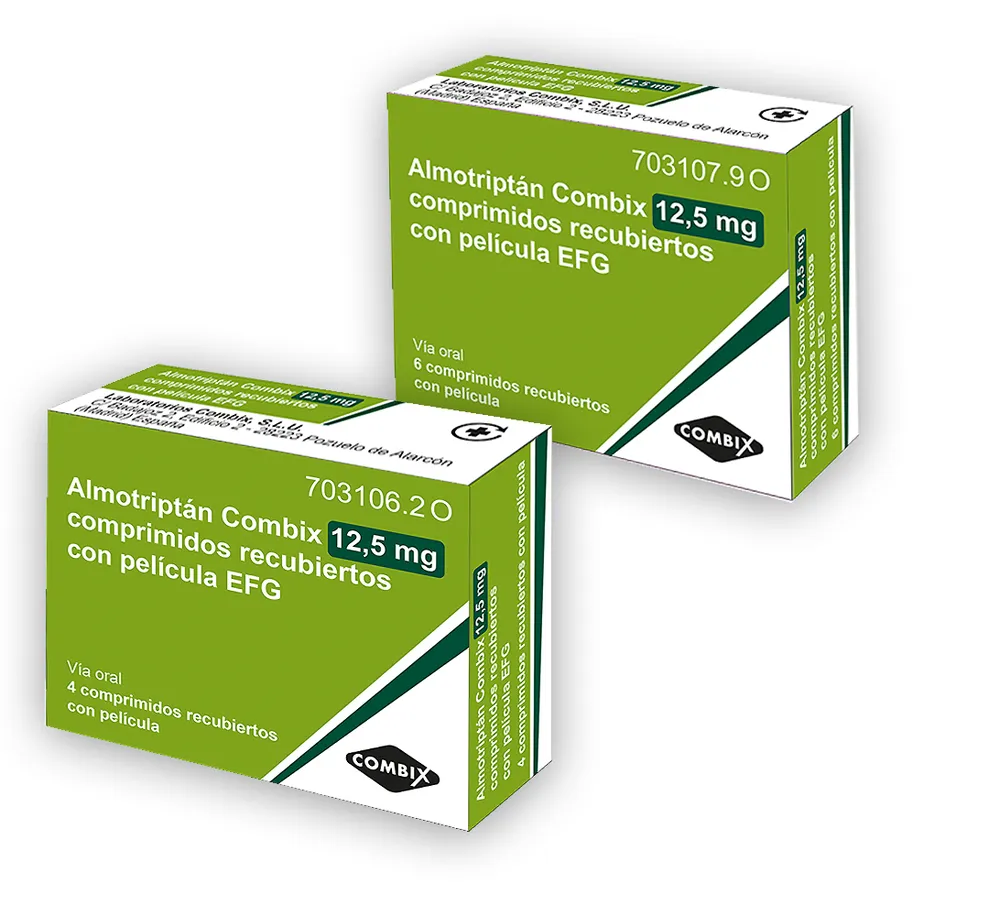
Table of Contents
- Package leaflet: Information for the user
- Introduction
- 1. What Almotriptán Combix is and what it is used for
- 2. What you need to know before taking Almotriptán Combix
- 3. How to take Almotriptán Combix
- 4. Possible adverse effects
- 5. Storage of Almotriptan Combix
- 6. Package contents and additional information
Package leaflet: Information for the user
Introduction
Package leaflet: information for the user
Almotriptán Combix 12.5 mg film-coated tablets EFG
Read the entire leaflet carefully before you start taking this medicine, because it contains important information for you.
- Keep this leaflet, as you may need to read it again.
- If you have any questions, ask your doctor, pharmacist, or nurse.
- This medicine has been prescribed for you only, and you should not give it to other people, even if they have the same symptoms as you, because it could harm them.
- If you experience any adverse effects, consult your doctor, pharmacist, or nurse, even if they are adverse effects not listed in this leaflet. See section 4.
Leaflet contents:
- What Almotriptán Combix is and what it is used for
- What you need to know before taking Almotriptán Combix
- How to take Almotriptán Combix
- Possible adverse effects
- How to store Almotriptán Combix
- Contents of the pack and other information
1. What Almotriptán Combix is and what it is used for
Almotriptán Combix is an antimigraine medication that belongs to a class of compounds known as selective serotonin receptor agonists. Almotriptán Combix is believed to reduce the inflammatory response associated with migraines by binding to serotonin receptors on cerebral (cranial) blood vessels, causing vasoconstriction.
Almotriptán Combix is used to relieve headache pain associated with migraine attacks, with or without aura.
2. What you need to know before taking Almotriptán Combix
Do not take Almotriptán Combix
-
If you are allergic to almotriptan or to any of the other components of this medicine (listed in section 6).
-
If you have or have ever had any condition that restricts blood flow to the heart, such as:
- Myocardial infarction,
- Chest pain or discomfort occurring typically during physical activity or stress,
- Silent cardiac problems,
- Chest pain occurring at rest,
- Severe hypertension (very high blood pressure),
- Uncontrolled mild or moderate hypertension,
-
If you have had a stroke or reduced cerebral blood flow,
-
If you have had obstruction of the large arteries in the arms or legs (peripheral vascular disease),
-
If you are taking other migraine medications, including ergotamine, dihydroergotamine, methysergide, or another selective serotonin agonist (e.g., sumatriptan),
-
If you have severe hepatic disease.
Warnings and precautions
Consult your doctor, pharmacist, or nurse before taking Almotriptán Combix:
- If your type of migraine has not been diagnosed,
- If you have an allergy (hypersensitivity) to antibacterial medicines used to treat urinary tract infections (sulfonamides),
- If your headache symptoms differ from your usual migraine attacks, for example, if you experience noise in your ears or vertigo, brief paralysis of part of your body, or paralysis of the muscles controlling eye movement, or any other new symptom,
- If you are at risk of heart disease, including uncontrolled high blood pressure, high cholesterol, obesity, diabetes, if you smoke, have a family history of heart disease, are a postmenopausal woman, or a man over 40 years of age,
- If you have mild or moderate liver disease,
- If you have severe renal disease,
- If you are over 65 years of age, as you may be more likely to experience increases in blood pressure,
- If you are taking SSRIs (selective serotonin reuptake inhibitors) or SNRIs (serotonin-noradrenaline reuptake inhibitors). See also below “Taking Almotriptán Combix with other medicines”.
It has been suggested that excessive use of migraine medications may lead to chronic headache.
Children and adolescents
Children under 18 years of age should not take Almotriptán Combix.
Patients over 65 years of age
If you are over 65 years of age, you should consult your doctor before taking this medicine.
Taking Almotriptán Combix with other medicines
Inform your doctor or pharmacist if you are using, have recently used, or might need to use any other medicines.
Please inform your doctor:
- If you are taking any medication for depression, such as monoamine oxidase inhibitors (e.g., moclobemide), selective serotonin reuptake inhibitors (e.g., fluoxetine), or serotonin-noradrenaline reuptake inhibitors (e.g., venlafaxine), as these medicines may cause serotonin syndrome, a potentially serious reaction. Symptoms of serotonin syndrome include: confusion, agitation, fever, sweating, uncoordinated movements of limbs or eyes, involuntary muscle contractions, or diarrhea,
- If you are taking herbal preparations containing St. John’s wort (Hypericum perforatum), as this may increase the likelihood of adverse effects.
Almotriptan should not be taken at the same time as other medicines containing ergotamine, which are also used to treat migraine. However, both medicines may be taken sequentially, provided a minimum interval has elapsed between doses:
- After taking almotriptan, it is recommended to wait at least 6 hours before taking ergotamine,
- After taking ergotamine, it is recommended to wait at least 24 hours before taking almotriptan.
Taking Almotriptán Combix with food and drink
Almotriptán Combix can be taken regardless of meals.
Pregnancy and breastfeeding
If you are pregnant, breastfeeding, think you may be pregnant, or are planning to become pregnant, consult your doctor or pharmacist before using this medicine.
There is only very limited information available on the use of almotriptan during pregnancy. Almotriptán Combix should only be used during pregnancy if prescribed by your doctor and only after careful consideration of the benefit-risk balance.
Caution should be exercised when using this medicine during breastfeeding. You should avoid breastfeeding for 24 hours after treatment.
Driving and using machines
This medicine, like migraine itself, may cause drowsiness. If you experience these effects, avoid driving or operating machinery, as it could be dangerous.
3. How to take Almotriptán Combix
Follow exactly the instructions for use of this medicine as given by your doctor. If in doubt, consult your doctor or pharmacist again.
Almotriptán Combix should only be used to treat a migraine attack that has already started, and not to prevent migraine attacks or headaches.
Adults (18-65 years of age)
The recommended dose is one Almotriptán Combix tablet (12.5 mg of almotriptan), which should be taken as soon as possible after the onset of a migraine attack. If the attack does not subside, do not take more than one tablet.
If you experience a second attack within the following 24 hours, a second 12.5 mg tablet may be taken, provided that at least 2 hours have elapsed between the first and second tablet.
The maximum daily dose is two 12.5 mg tablets within 24 hours.
The tablets may be taken with liquid (for example, water) and may be taken with or without food.
Almotriptán Combix should be taken as soon as possible after the onset of a migraine attack, although it is also effective if taken somewhat later.
Severe renal impairment
If you have severe renal disease, do not take more than one 12.5 mg tablet in 24 hours.
If you take more Almotriptán Combix than you should
If you accidentally take too many Almotriptán Combix tablets, or if someone else or a child takes this medicine, consult your doctor or pharmacist immediately.
In case of overdose or accidental ingestion, contact the Toxicology Information Service at telephone number 91 562 04 20, indicating the medicine and the amount ingested.
If you forget to take Almotriptán Combix
Try to take Almotriptán Combix as prescribed. Do not take a double dose to make up for missed doses.
If you have any further questions about the use of this medicine, ask your doctor, pharmacist, or nurse.
4. Possible adverse effects
Like all medicines, this medicine can cause adverse effects, although not everyone will experience them.
Frequent (may affect up to 1 in 10 people)
- dizziness,
- somnolence,
- nausea,
- vomiting,
- fatigue
Uncommon (may affect up to 1 in 100 people)
- tingling, itching, or numbness of the skin (paraesthesia),
- headache,
- ringing, noises, or clicking in the ears (tinnitus),
- strong heartbeat (palpitations),
- throat tightness,
- diarrhoea,
- discomfort during digestion (dyspepsia),
- dry mouth,
- muscle pain (myalgia),
- bone pain,
- chest pain,
- feeling of weakness (asthenia).
Very rare (may affect up to 1 in 10,000 people)
- spasm of the blood vessels in the heart (coronary vasospasm),
- heart attack (myocardial infarction),
- increased heart rate (tachycardia).
Frequency not known (cannot be estimated from the available data)
- allergic reactions (hypersensitivity reactions), including swelling of the mouth, neck, or hands (angioedema),
- severe allergic reactions (anaphylactic reactions),
- seizures,
- visual disturbances, blurred vision (visual disorders may also occur during a migraine attack itself).
During treatment with Almotriptán Combix, inform your doctor immediately:
- If you experience chest pain, tightness in the chest or throat, or any other symptom suggesting a heart attack. Please report this immediately to your doctor and do not take any further Almotriptán Combix tablets.
Reporting of adverse effects:
If you experience any type of adverse effect, consult your doctor, pharmacist, or nurse, even if it is a possible adverse effect not listed in this leaflet. You may also report them directly via the Spanish Pharmacovigilance System for Human Medicines: https://www.notificaram.es. By reporting adverse effects, you can help provide more information on the safety of this medicine.
5. Storage of Almotriptan Combix
Keep this medicine out of the sight and reach of children.
No special storage conditions are required.
Do not use this medicine after the expiry date stated on the packaging after EXP. The expiry date refers to the last day of the month indicated.
Medicines must not be disposed of via wastewater or household waste. Unused medicines and containers should be returned to the SIGRE collection point at your pharmacy. If you have any doubts, ask your pharmacist how to dispose of medicines and packaging you no longer need. This will help protect the environment.
6. Package contents and additional information
Composition of AlmotriptánCombix
- The active substance is almotriptan.
Each coated tablet contains 12.5 mg of almotriptan (as almotriptan maleate).
- The other components are:
Tablet core: mannitol (E421), microcrystalline cellulose (E460i), potato starch, povidone K30, sodium stearyl fumarate (E470a), and magnesium stearate (E470b).
Tablet coating: Opadry White 03F580010 (hypromellose (E464), titanium dioxide (E171), macrogol 4000 (E1521), and talc (E553b)).
Appearance of the medicinal product and contents of the pack
Film-coated tablets, white or almost white, round, biconvex, smooth on both sides.
PVC/PVDC-Aluminum blisters and OPA/Al/PVC-Aluminum blisters, standard or unit dose.
Almotriptán Combix is available in packs containing 4 and 6 tablets. Only certain pack sizes may be commercially available.
Marketing Authorization Holder and Manufacturer
Marketing Authorization Holder
Laboratorios Combix, S.L.U.
C/ Badajoz, 2. Edificio 2
28223 Pozuelo de Alarcón (Madrid)
Spain
Manufacturer
Zydus France
ZAC Les Hautes Patures
Parc d'activités des Peupliers
25 Rue des Peupliers
92000 Nanterre
France
Or
Pharmex Advanced Laboratories S.L.
Ctra. A-431 Km. 19
14720 Almodóvar del Río (Córdoba)
Spain
Date of the most recent revision of this leaflet: October 2014.
Detailed and up-to-date information on this medicinal product is available on the website of the Spanish Agency of Medicines and Health Products (AEMPS) http://www.aemps.gob.es/.