Alhemo 300 mg/3 ml solution for injection in pre-filled pen
Spain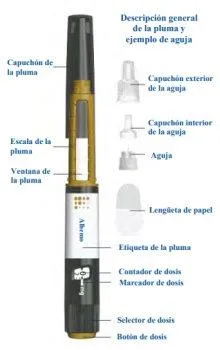
Table of Contents
Package Leaflet: Information for the User
Introduction
Package Leaflet: Information for the User
Alhemo 300mg/3ml solution for injection in a pre-filled pen
concizumab
This medicinal product is subject to additional monitoring, which will allow for rapid detection of new safety information. You can help by reporting any adverse reactions you may experience. Section 4, at the end, includes information on how to report adverse reactions.
Read all of this leaflet carefully before you start using this medicine, because it contains important information for you.
- Keep this leaflet, as you may need to read it again.
- If you have any questions, ask your doctor, pharmacist, or nurse.
- This medicine has been prescribed for you only, and you should not give it to others, even if they have the same symptoms as you, because it may harm them.
- If you experience any adverse reactions, consult your doctor, pharmacist, or nurse, even if they are adverse reactions not listed in this leaflet. See section 4.
Contents of the leaflet
- What Alhemo is and what it is used for
- What you need to know before using Alhemo
- How to use Alhemo
- Possible side effects
- How to store Alhemo
- Contents of the pack and other information
1. What Alhemo is and what it is used for
What Alhemo is
Alhemo contains the active substance concizumab, which belongs to a group of medicines called "monoclonal antibodies". Concizumab is a protein that recognizes a target in the blood involved in the blood clotting process and binds to it.
What Alhemo is used for
Alhemo is used to prevent or reduce the frequency of bleeding episodes in adults and adolescents aged 12 years and older with:
- haemophilia A with inhibitors.
- severe haemophilia A (when blood factor VIII levels are less than 1%) without inhibitors.
- haemophilia B with inhibitors.
- moderate/severe haemophilia B (when blood factor IX levels are less than or equal to 2%) without inhibitors.
Haemophilia A is a congenital deficiency of blood clotting factor VIII, and haemophilia B is a congenital deficiency of blood clotting factor IX.
How Alhemo works
Concizumab blocks a natural blood factor that prevents blood from clotting. This factor is called tissue factor pathway inhibitor. By blocking this inhibitor, concizumab makes blood clotting more effective and thus helps prevent or reduce bleeding in individuals who lack a clotting factor.
Alhemo acts independently of factor VIII and factor IX, and independently of inhibitors against these factors.
2. What you need to know before using Alhemo
Do not use Alhemo
- if you are allergic to cinzetumab or any of the other ingredients of this medicine (listed in section 6).
Warnings and precautions
Allergic reactions
There is a risk that you may experience an allergic reaction. Stop treatment and contact your doctor immediately if you develop symptoms of allergic reactions such as rash, redness, hives, or itching. You may also experience symptoms of severe allergic reactions, including:
- Itching over large areas of the skin
- Redness and/or swelling of the lips, tongue, face, or hands
- Difficulty swallowing
- Shortness of breath
- Wheezing
- Chest tightness
- Pale and cold skin
- Palpitations
- Dizziness due to low blood pressure
Stop using Alhemo and seek immediate emergency help if you experience symptoms of severe allergic reactions.
Blood clots
Blood clots can form anywhere in the body.
Stop using Alhemo and contact your doctor immediately if you experience symptoms of blood clots such as:
- Swelling, warmth, pain, or redness of the skin: these could be signs of a blood clot in the arms or legs.
- Shortness of breath, severe chest pain: these could be signs of blood clots in the heart or lungs.
- Headache, confusion, problems with speech or movement, numbness in the face, eye pain or swelling, or vision problems: these could be signs of a blood clot in the brain or eyes.
- Sudden pain in the stomach or lower back: these could be signs of blood clots in the intestines or kidneys.
Children and adolescents
Alhemo is not recommended for children under 12 years of age. The safety and benefits of this medicine have not yet been established in this population.
Other medicines and Alhemo
Tell your doctor if you are taking, have recently taken, or might need to take any other medicines.
Pregnancy and breastfeeding
Use a highly effective method of contraception during treatment with Alhemo and for 7 weeks after your last injection. Consult your doctor about the type of contraception you should use.
If you are pregnant or breastfeeding, think you may be pregnant, or are planning to become pregnant, consult your doctor before using this medicine.
Driving and using machines
It is unlikely that Alhemo will affect your ability to drive or operate machinery.
Alhemo contains sodium and polysorbates
This medicine contains less than 1 mmol of sodium (23 mg) per dose; this is essentially “sodium-free”.
This medicine contains 0.25 mg of polysorbate 80 per ml. Polysorbates may cause allergic reactions. Inform your doctor if you have any known allergies.
3. How to use Alhemo
Refer to the Instructions for use detailed on the reverse side of this leaflet before using the Alhemo pre-filled pen. Ask your doctor if you need to use alternative injection techniques; for example, thin patients and adolescents may need to inject into a skin fold to avoid injecting too deeply (into the muscle).
Always follow exactly the administration instructions given by your doctor for this medicine. If in doubt, consult your doctor, pharmacist, or nurse.
Treatment of breakthrough bleeding
You may need to use factor VIII, factor IX, or bypassing agents to treat breakthrough bleeding episodes while using Alhemo. Carefully follow your healthcare provider's instructions on when and how to use these factor VIII or factor IX products or bypassing agents.
Recommended dose for adults and adolescents
- Initial dose on Day 1: 1 mg per kg of body weight.
- From Day 2 until the maintenance dose is established: 0.20 mg per kg of body weight once daily.
- Individual maintenance dose as determined by the physician: 0.15, 0.20, or 0.25 mg per kg of body weight once daily.
Alhemo is injected under the skin of the abdomen or thigh and can be used at any time of day.
If you use more Alhemo than you should
Contact your doctor immediately.
If you forget to use Alhemo
Alhemo can be used at any time of day.
Missing one or more doses of Alhemo may affect the effectiveness of the medicine. It is important to administer Alhemo every day.
If you miss your daily dose of Alhemo:
If you miss a dose during the first 4 weeks of treatment, contact your doctor to determine how to resume treatment.
If you miss a dose after the maintenance dose has been established:
- If you missed 1 daily dose, resume your daily dose.
- If you missed 2 to 6 daily doses, administer your daily dose twice (in two separate injections, each corresponding to one daily dose), then continue with your daily dose the following day.
- If you missed 7 or more daily doses, contact your doctor immediately, as you will need a new loading dose before continuing with your daily dose the following day.
If you have any doubts, contact your doctor.
If you stop using Alhemo
You may no longer be protected against bleeding. Do not stop treatment with Alhemo without consulting your doctor.
If you have any further questions about the use of this medicine, ask your doctor, pharmacist, or nurse.
4. Possible adverse effects
Like all medicines, this medicine can cause adverse effects, although not everyone gets them.
Stop using Alhemo and contact your doctor immediately if you experience symptoms of serious allergic reactions or symptoms of blood clots. See “Warnings and precautions” in section 2.
Other adverse effects
Very common: may affect more than 1 in 10 people
- Reactions at the injection site such as redness, bleeding, itching, hives, swelling, pain, numbness.
Common: may affect up to 1 in 10 people
- Allergic reaction
Uncommon: may affect up to 1 in 100 people
- Blood clots
Reporting of adverse effects
If you experience any type of adverse effect, talk to your doctor, pharmacist, or nurse, even if it is a possible adverse effect not listed in this leaflet. You can also report them directly through the national reporting system included in Appendix V. By reporting adverse effects, you can help provide more information on the safety of this medicine.
5. Storage of Alhemo
Keep this medicine out of the sight and reach of children.
Do not use this medicine after the expiry date stated on the pen label and on the outer packaging following EXP. The expiry date refers to the last day of the month indicated.
Do not use this medicine if you notice any change in the solution's colour.
Before use
- Store unused Alhemo pens in a refrigerator at between 2 °C and 8 °C.
- Keep the new, unused pen with the cap on.
- When storing in the refrigerator, do not place the pen directly next to the cooling element.
- Do not use Alhemo if it has been frozen or stored at temperatures above 30 °C.
After first use
-
Store the Alhemo pen currently in use without the needle attached for up to 28 days (4 weeks), either:
-
In a refrigerator at between 2 °C and 8 °C.
Do not place the pen directly next to the cooling element. Do not use Alhemo if it has been frozen.
or
- At room temperature below 30 °C.
Discard the pen if it has been stored at temperatures above 30 °C. Do not store the pen in direct sunlight.
- Keep the Alhemo pen in use with the cap on.
Medicines must not be disposed of via wastewater or household waste. Ask your pharmacist how to dispose of medicines and packaging that you no longer need. This helps protect the environment.
6. Contents of the pack and other information
Composition of Alhemo
- The active substance is concizumab.
One millilitre of Alhemo 300 mg/3 ml contains 100 mg of concizumab.
- The other components are L-arginine hydrochloride, L-histidine, sodium chloride, sucrose, polysorbate 80, phenol, hydrochloric acid/sodium hydroxide (for pH adjustment), and water for injections. See also section 2 “Alhemo contains sodium and polysorbates”.
Appearance of the product and contents of the pack
Alhemo is an injectable solution ranging from transparent to slightly turbid and from colourless to slightly yellow in a disposable pre-filled pen. Translucent to white protein particles are acceptable.
Alhemo 300 mg/3 ml is available as a single pack containing 1 pre-filled pen.
Needles for injection are not included.
Marketing Authorisation Holder and Manufacturer
Novo Nordisk A/S
Novo Alle 1
DK-2880 Bagsvaerd
Denmark
Date of the most recent revision of this leaflet:
Other sources of information
Detailed information on this medicine is available on the European Medicines Agency website: http://www.ema.europa.eu.
Instructions for use
Alhemo 300 mg/3 ml solution for injection in pre-filled pen
concizumab
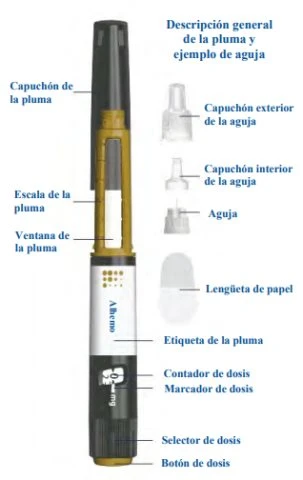
What is in this pack?
- 1 pre-filled Alhemo pen
- Package leaflet
Needles are not included.
Read the instructions and ensure you have received training from your doctor or nurse before using the pen.
Follow your doctor’s or nurse’s instructions on how to use Alhemo and how often Alhemo should be injected.
The pen is pre-filled with 300 mg of Alhemo for subcutaneous use only (injection under the skin). The pen contains multiple doses of Alhemo.
The pen can deliver up to 80 mg in one injection. The dose counter increments in 1 mg steps. If you require more than 80 mg, multiple injections are required.
Safety information
The pen is for single-patient use only and must not be shared. Sharing the pen or needles may lead to infections and transmission of diseases.
Always use a new needle for each injection. Do not reuse needles, as this may cause needle blockage, infections, and incorrect dosing.
The needle is covered by two caps. Both caps must be removed. If you forget to remove both caps, no solution will be injected.
Where should I inject the dose on my body?
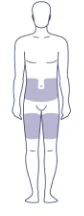
You can inject under the skin of:
- the stomach (abdomen) OR
- the thigh.
Inject at a 90º angle. The grey areas in the image on the right show the injection sites. For each injection, select a new injection site at least 5 centimetres away from the previous injection site.
Check the pen 1
Check the pen label
Look at the name and colour to ensure you have the correct medicine.
Inspect the medicine
Remove the pen cap and check through the viewing window that Alhemo is a solution ranging from transparent to slightly turbid and from colourless to slightly yellow. Translucent to white protein particles are acceptable. If Alhemo appears discoloured, do not use the pen.
Check the expiry date
Check the expiry date on the pen label to ensure it has not passed. Do not use the pen after the expiry date.
If the pen is cold
Alhemo can be injected directly from the refrigerator or after allowing it to reach room temperature. You may warm the pen with the palms of your hands. Do not use any other heat source.
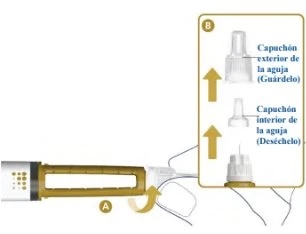
Attach a new needle 2
Take a new needle and remove the paper tab.
- Place the needle straight onto the pen. Screw it on until tight. See A.
- Remove the outer needle cap and keep it. See B.
- Remove the inner needle cap and discard it. See B.
Never use a bent or damaged needle.
Use only needles recommended by your doctor or nurse. This pen is designed to be used with NovoFine Plus 32G x 4 mm or NovoFine 32G x 4 mm injection needles. If you use needles longer than 4 mm, consult your doctor or nurse on how to perform the injection.
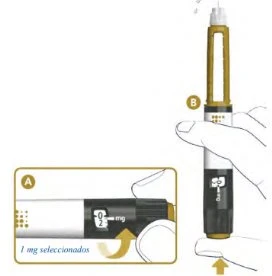
Check the flow 3
A drop of Alhemo may appear at the needle tip, but you must still check the flow of Alhemo before each injection to avoid underdosing:
-
Turn the dose selector one mark to select 1 mg. See A in the next figure. Hold the pen with the needle pointing upwards.
-
Press the dose button. See B.
-
Observe whether liquid Alhemo comes out of the needle tip. See B.
If no liquid appears, go to Troubleshooting if no liquid appears when checking flow.
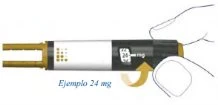
Select the dose 4
Turn the dose selector to select the prescribed dose.
Confirm that you have selected the correct dose.
You can adjust the dose by turning the dose selector in either direction.
If you require a dose higher than can be set, you must inject yourself multiple times to receive your full dose. For more information, see step 6.
The pen contains 300 mg of Alhemo.
The pen can deliver up to 80 mg in one injection.
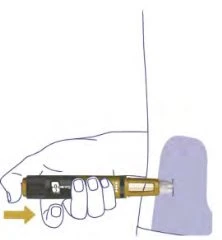
Inject the dose 5
Read steps a. to e. before starting your injection.
This ensures you receive the full dose.
-
Select the injection site. See “Where should I inject the dose on my body?”
-
Insert the needle directly into the stomach (abdomen) or thigh at a 90º angle.
-
Press and hold the dose button until the dose counter returns to <0>.
-
With the needle still under the skin, count slowly to 6 after the dose counter returns to <0>.
-
Remove the needle from the skin.
The pen clicks during dose delivery and you may also hear or feel a click when the dose counter returns to <0>.
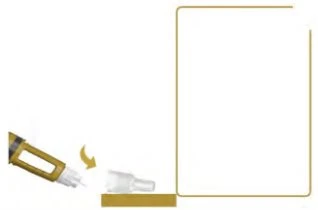
Remove the needle 6
Remove the needle from the pen after each injection by inserting the needle tip into the outer needle cap without touching the needle or cap.
When the needle is covered, press the outer needle cap gently to the end. Unscrew the needle. Do not touch the back end of the needle.
Dispose of the needle as instructed by your doctor, nurse, pharmacist, or local authorities.
Do you need a dose higher than can be set?
If you need a dose higher than can be set, you must inject yourself more than once to receive your full dose. Repeat steps 1 to 6 until you have received your full dose. When you have received your full dose, go to step 7.
- Always use a new needle for each injection.
- Check the flow of Alhemo before each injection.
- Accurately calculate the amount to be injected in each injection to receive the full dose.
After the dose 7
Replace the cap on the pen to protect Alhemo from light.
Your pen is now ready to be stored until next use.
After first use, do not use the pen for more than 28 days.
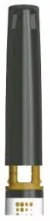
How much Alhemo is left in the pen?
The scale on the pen shows the approximate amount of Alhemo remaining in the pen.
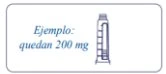
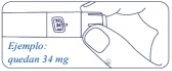
To see more precisely how much Alhemo is left in the pen, turn the dose selector until it stops. The dose marker will align with the number of milligrams remaining in the pen. The number shown in the dose counter is the number of milligrams left in the pen.
If the dose counter shows 80, there are 80 mg or more left in the pen. The following example shows 34 mg of Alhemo remaining in the pen.
Troubleshooting if no liquid appears when checking flow (step 3)
- If no liquid appears, repeat step 3 up to six times until liquid is seen.
- If still no liquid appears, attach a new needle (step 2) and check again (step 3).
- If no liquid appears even with a new needle, do not use the pen. Use a new pen.
Storage
Refer to section 5 “Storage of Alhemo” on the reverse of this leaflet.
Take care of your pen
Handle the pen carefully. Rough handling or misuse may lead to inaccurate dosing. If this occurs, you may not achieve the intended effect of this medicine.
Do not expose the pen to dust, dirt, or liquids.
Do not wash, wet, or lubricate the pen. If necessary, clean it with a damp cloth using a mild detergent.
Keep the pen out of sight and reach of others, especially children.
Disposal of pens, needles, and Alhemo packaging materials
When the pen is empty, dispose of it according to local regulations.
The pen cannot be refilled.
To reduce the risk of needlestick injuries, dispose of used needles immediately as instructed by your doctor, nurse, pharmacist, or local authorities.
[Text for the cover of the folded leaflet]
Package leaflet and instructions for use