Adisocol 150 mg tablets EFG
Spain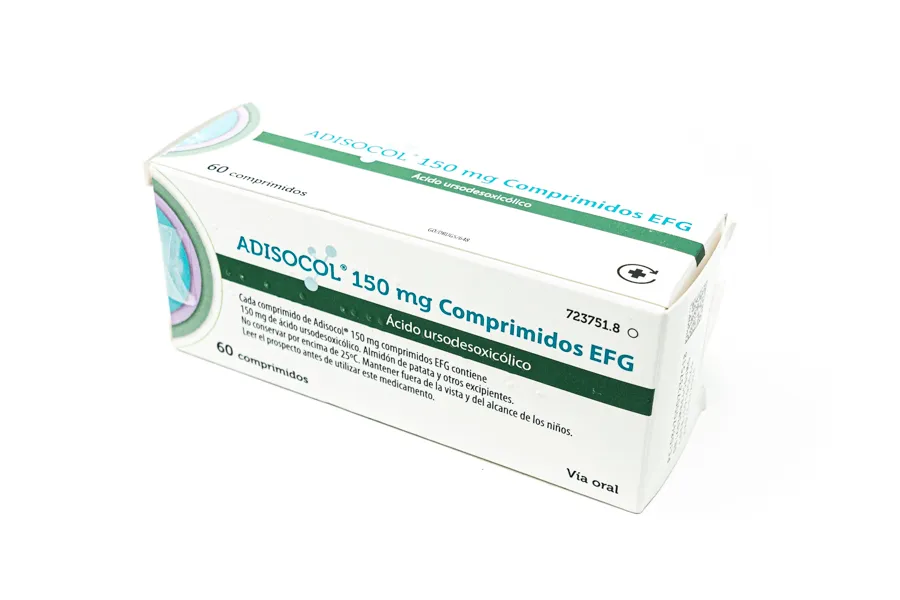
Table of Contents
Patient Information Leaflet
Introduction
Package leaflet: Information for the patient
Adisocol 150 mg tablets EFG
ursodeoxycholic acid
Read the entire leaflet carefully before you start taking this medicine, as it contains important information for you.
- Keep this leaflet, as you may need to read it again.
- If you have any questions, consult your doctor or pharmacist.
- This medicine has been prescribed for you only, and you should not give it to other people, even if they have the same symptoms as you, because it may harm them.
- If you experience any adverse effects, consult your doctor or pharmacist, even if they are adverse effects not listed in this leaflet. See section 4.
Contents of the leaflet
- What Adisocol is and what it is used for
- What you need to know before taking Adisocol
- How to take Adisocol
- Possible side effects
- How to store Adisocol
- Contents of the pack and other information
1. What Adisocol is and what it is used for
Ursodeoxycholic acid influences the composition of bile, thereby dissolving cholesterol gallstones. The effect of ursodeoxycholic acid in primary biliary cholangitis and cystic fibrosis can be explained by several mechanisms, such as a protective effect on liver cells and an effect on the immune system.
- Ursodeoxycholic acid is used in patients:
- with small gallstones,
- who do not wish to undergo surgery or are not eligible for gallstone surgery,
- in whom excess cholesterol in the bile has been detected.
-
Ursodeoxycholic acid is used in patients with primary biliary cholangitis. Primary biliary cholangitis is a disease in which liver tissue is damaged due to defective bile drainage.
-
Ursodeoxycholic acid is used in children between 6 and 18 years of age with liver and biliary problems caused by cystic fibrosis. Cystic fibrosis, also known as mucoviscidosis, is a hereditary disease in which mucous membranes are particularly thick and rigid throughout the body. This can lead, among other conditions, to obstruction and inflammation of the liver and bile ducts.
2. What you need to know before starting Adisocol
Do not take Adisocol:
- If you have acute inflammation of the gallbladder or bile ducts.
- If you have obstruction or blockage of the biliary tract.
- If you frequently suffer painful cramps in the upper abdomen (biliary colic).
- If you have radiopaque (X-ray visible) calcified gallstones.
- If you have a gallbladder that can no longer contract properly.
- If you are allergic to bile acids or to any of the other components of this medicine (listed in section 6).
- If you have active gastric or duodenal ulcer.
Children
In children with interrupted biliary drainage due to fibrous tissue formation in the bile duct (biliary atresia), in whom bile flow has not been restored either spontaneously or via a surgical biliary bypass (portoenterostomy).
Warnings and precautions
This medicine must be taken under medical supervision.
Your doctor should examine your liver every 4 weeks during the first three months of treatment, and then every 3 months thereafter. Besides helping to identify responders versus non-responders among patients being treated for primary biliary cholangitis, this monitoring should also allow early detection of potential liver deterioration, especially in patients with advanced primary biliary cholangitis.
When used to dissolve gallstones:
To assess the therapeutic progress of gallstone dissolution and to detect possible gallstone calcification in a timely manner, the gallbladder should be imaged 6 to 10 months after starting treatment (oral cholecystography), including full imaging with occlusion views and in both upright and supine positions (ultrasound monitoring), depending on stone size.
If the gallbladder cannot be visualized by X-ray, or in cases where gallstones are calcified, gallbladder contractility is impaired, or there are frequent episodes of biliary colic, treatment with ursodeoxycholic acid should be discontinued.
When used for the treatment of advanced primary biliary cholangitis:
In very rare cases, hepatic cirrhosis may decompensate, which may partially improve after discontinuation of treatment.
Women taking Adisocol to dissolve gallstones should stop taking oral contraceptives and other hormonal methods of birth control, because hormones in oral contraceptives may trigger gallstone formation.
In the final stage of primary biliary cholangitis, liver function may be severely impaired in very rare cases. Liver function may partially recover after treatment is stopped.
If you experience diarrhea, your doctor may reduce your dose. If diarrhea persists, your doctor may decide to discontinue treatment.
Consult your doctor or pharmacist before starting this medicine.
Other medicines and Adisocol
Inform your doctor or pharmacist if you are taking, have recently taken, or might need to take any other medicines. This also applies to medicines not requiring a prescription.
The effects of the following medicines may be affected (interactions):
A reduced effect of the following medicines may occur:
- Medicines that bind stomach acid, such as aluminium hydroxide, and substances that bind bile acids (cholestyramine, colestipol), which may bind to ursodeoxycholic acid and prevent its absorption.
Therefore, these medicines should not be taken at the same time as ursodeoxycholic acid, but only at least two hours before or after.
- Ursodeoxycholic acid may reduce intestinal absorption of ciprofloxacin, dapsone (antibiotics), and nitrendipine (an antihypertensive agent). When any of these medicines are used concurrently with Adisocol, your doctor should monitor you closely.
An increased effect of the following medicines may occur when using ursodeoxycholic acid:
- Ursodeoxycholic acid may increase intestinal absorption of cyclosporine. If necessary, blood levels should be monitored and the cyclosporine dose adjusted accordingly.
Estrogens, oral contraceptives ("the pill"), and cholesterol-lowering agents (such as clofibrates) may promote gallstone formation and may counteract the effect of gallstone treatment with ursodeoxycholic acid.
Inform your doctor or pharmacist if you are taking or have taken other medicines. This also applies to medicines not requiring a prescription.
Pregnancy and breastfeeding
If you are pregnant or breastfeeding, think you may be pregnant, or plan to become pregnant, consult your doctor or pharmacist before using this medicine.
Pregnancy
You should not take this medicine during pregnancy unless your doctor considers it absolutely necessary.
Women of childbearing potential
Even if you are not pregnant, you should discuss this possibility with your doctor, as women of childbearing age should only be treated if using a reliable method of contraception. Non-hormonal contraceptives or low-estrogen-dose hormonal contraception are recommended. However, if you are using this medicine to treat gallstones, only non-hormonal contraception should be used, because hormonal contraception may trigger gallstone formation.
Breastfeeding
Inform your doctor if you are breastfeeding or planning to breastfeed. According to a few documented cases in breastfeeding women, levels of ursodeoxycholic acid in breast milk are very low, and adverse effects in infants are unlikely.
Driving and using machines
The influence of ursodeoxycholic acid on the ability to drive and use machines is none or negligible.
3. How to take Adisocol
Follow exactly the instructions for use of this medicine provided by your doctor or pharmacist. If in doubt, consult your doctor or pharmacist again.
Your doctor will determine the dose based on your body weight.
Take the tablets after a meal with a glass of milk or a snack. Take the prescribed number of tablets divided throughout the day.
- Dissolution of gallstones:
Four to six 150 mg tablets, two to three 300 mg tablets, or two 450 mg tablets per day (600–900 mg of ursodeoxycholic acid per day).
Always take two tablets after dinner.
When taking the dose two or three times a day: for example, one tablet after lunch and two tablets after dinner.
When taking a twice-daily dose of two tablets: take both tablets preferably two hours after dinner and one hour before going to bed.
- Primary biliary cholangitis (liver tissue damage due to impaired bile flow):
- Stage I–III:
Four to eight 150 mg tablets, two to four 300 mg tablets, or two 450 mg tablets per day (600–1200 mg of ursodeoxycholic acid per day).
Take the prescribed dose in two or three divided doses after meals.
- Stage IV:
Based on liver function tests, your doctor will decide whether you should receive the full dose as in stages I–III, or half of this dose.
Children aged 6 to 18 years with cystic fibrosis
- Liver and biliary tract diseases caused by cystic fibrosis (mucoviscidosis):
Four to ten 150 mg tablets, two to five 300 mg tablets, or two to three 450 mg tablets per day (600–1500 mg of ursodeoxycholic acid per day).
Take the tablets with a glass of milk or a snack. Take the prescribed dose in two or three divided doses after meals.
Scored tablets may be divided if you have difficulty swallowing due to tablet size, so that half a tablet is taken sequentially in two doses.
If you notice that this medicine is too strong or, conversely, too weak, consult your doctor or pharmacist.
If you take more Adisocol than you should
Inform your doctor if you have taken more ursodeoxycholic acid than you should. It is unlikely that you will experience any problems, but you may develop diarrhea.
If you forget to take Adisocol
Take the prescribed dose at your next scheduled dose.
Do not take a double dose to make up for missed doses.
How long should you take Adisocol?
The duration of treatment depends on the size of the gallstone, but is usually no less than 3 to 4 months. Treatment should not be stopped prematurely, even if symptoms have disappeared. Only an X-ray scan or ultrasound can show whether the gallstones have completely dissolved. After complete disappearance of gallstones has been confirmed by ultrasound, treatment should still be continued for another three to four months.
Treatment with Adisocol for primary biliary cholangitis and for liver and biliary system disorders due to cystic fibrosis will be continued to maintain the protective effect of Adisocol.
If you have any further questions about the use of this medicine, ask your doctor or pharmacist.
4. Possible adverse effects
Like all medicines, this medicine may cause adverse effects, although not everybody gets them.
Frequent adverse effects (occur in less than 1 in 10 patients but in more than 1 in 100 patients)
- soft stools or diarrhoea
Rare adverse effects (may affect up to 1 in 10,000 patients)
- in the treatment of primary biliary cholangitis: severe pain in the upper right part of the abdomen, serious worsening (decompensation) of hepatic cirrhosis which partially improves after stopping treatment;
- calcification of gallstones;
- urticaria (rash).
Reporting of adverse effects
If you experience any type of adverse effect, consult your doctor or pharmacist, even if it is a possible adverse effect not listed in this leaflet. You can also report them directly through the Spanish Pharmacovigilance System for Human Medicinal Products: https://www.notificaram.es. By reporting adverse effects, you can help provide more information on the safety of this medicine.
5. Storage of Adisocol
Keep this medicine out of the sight and reach of children.
Do not use this medicine after the expiry date stated on the packaging after (EXP). The expiry date refers to the last day of the month indicated.
Do not store above 25°C.
Medicines should not be disposed of via wastewater or household waste. Dispose of unused medicines and their containers at the Sigre Point located at the pharmacy. Ask your pharmacist how to dispose of medicines and containers you no longer need. This will help protect the environment.
6. Contents of the pack and other information
Composition of Adisocol
- The active substance is ursodeoxycholic acid.
- The other excipients are microcrystalline cellulose (Microcel 101) (E460), polyvinylpyrrolidone (Plasdona K-90) (E1201), magnesium stearate (E572), sodium carboxymethyl starch Type A (Primojel).
Appearance of the product and contents of the pack
Adisocol 150 mg are film-coated tablets, white to almost white, round, approximately 9.5 mm in size, with a score line and engraved "G" "442" on one side and smooth on the other.
Marketing Authorization Holder and Manufacturer
Marketing Authorization Holder:
Glenmark Arzneimittel GmbH
Industriestr. 31
82194 Gröbenzell
Germany
Manufacturer:
Glenmark Pharmaceuticals s.r.o.
Fibichova 143
566 17 Vysoke Myto
Czech Republic
For further information about this medicinal product, please contact the local representative of the Marketing Authorization Holder:
Glenmark Farmacéutica, S.L.U.
C/ Retama 7, 7th floor
28045 Madrid
Spain
This medicinal product is authorized in the European Economic Area member states under the following names:
Country | Medicinal product name |
Netherlands | Ursodeoxycholzuur Glenmark 150 mg tabletten |
Spain | Adisocol 150 mg tablets EFG |
Date of the most recent review of this leaflet: April 2018
Detailed information about this medicine is available on the website of the Spanish Agency of Medicines and Medical Devices (AEMPs) (http://www.aemps.gob.es/).