Adenocor 6 mg/2 ml solution for injection
Spain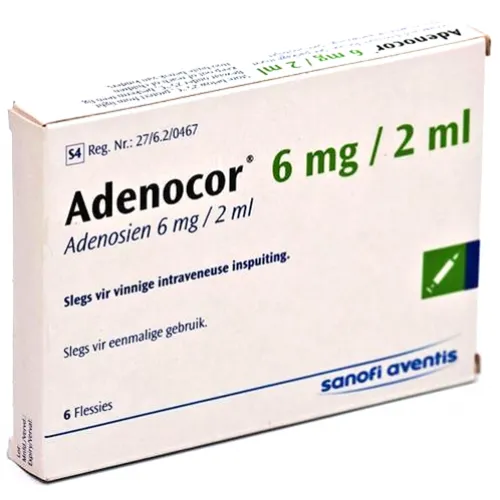
Table of Contents
Package leaflet: Information for the user
Introduction
Package leaflet: information for the patient
Adenocor 6 mg/2 ml solution for injection
Adenosine
Read the entire leaflet carefully before you start using this medicine, because it contains important information for you.
-
Keep this leaflet, as you may need to read it again.
-
If you have any questions, consult your doctor, pharmacist or nurse.
-
This medicine has been prescribed for you only and must not be given to other people, even if they have the same symptoms as you, because it could harm them.
-
If you experience any adverse effects, consult your doctor, pharmacist or nurse, even if they are adverse effects not listed in this leaflet. See section 4.
Leaflet contents:
- What Adenocor is and what it is used for
- What you need to know before using Adenocor
- How to use Adenocor
- Possible adverse effects
- Storage of Adenocor
- Contents of the pack and other information
1. What Adenocor is and what it is used for
Adenocor is a coronary vasodilator that increases blood flow to the heart muscle.
This medicine is used for the diagnosis and treatment of certain cardiac rhythm disorders.
In children, Adenocor is used:
To restore your child’s heartbeat to a normal rhythm if your child has a heart rhythm problem called paroxysmal supraventricular tachycardia (PSVT).
2. What you need to know before using Adenocor
Do not use Adenocor
- If you are allergic to adenosine or to any of the other ingredients of this medicine (listed in section 6).
- If you have certain heart conditions such as sinus disease, certain atrioventricular blocks (except in patients with a functioning artificial pacemaker); or heart failure.
- If you have long QT syndrome, a disorder of the heart's electrical system that may cause an abnormal heart rhythm (arrhythmia), fainting or loss of consciousness (syncope), and even sudden death.
- If you have severe hypotension, a condition in which a person's blood pressure is much lower than normal, which may cause symptoms such as dizziness or lightheadedness.
- If you have bronchial asthma or certain respiratory problems such as chronic obstructive pulmonary disease (COPD) with bronchospasm (closure of the bronchi).
Warnings and precautions
Consult your doctor before using Adenocor:
- If you have certain heart problems, including severe heart failure, slow heart rate, or have recently had a myocardial infarction.
- In case of minor atrioventricular conduction disturbances, as these may worsen during infusion.
- If you are prone to seizures, as adenosine may trigger them.
- If you have atrial fibrillation or atrial flutter—a heart rhythm disorder (arrhythmia) usually involving a rapid heart rate in which the upper chambers of the heart (atria) are stimulated to contract in a disorganized and abnormal manner—and have an accessory conduction pathway, as this may lead to increased conduction through the abnormal pathway.
- In case of left main coronary artery stenosis (narrowing), valvular stenosis, uncorrected hypovolemia (decreased circulating blood volume), pericarditis (inflammation of the membrane surrounding the heart, the pericardium), pericardial effusion, autonomic dysfunction, or carotid artery stenosis with cerebrovascular insufficiency.
- If you are taking dipyridamole (a medicine used to treat blood clotting disorders).
Increased cardiac sensitivity to adenosine has been observed in patients who have recently undergone heart transplantation (within less than 1 year).
If you are under 18 years of age
In children with a heart rhythm disorder called "Wolff-Parkinson-White (WPW) syndrome", Adenocor may unexpectedly cause an abnormal heart rhythm.
Use of Adenocor with other medicines
Inform your doctor or pharmacist if you are taking, have recently taken, or might need to take any other medicines.
The administration of adenosine together with other drugs may alter their effects. Inform your doctor or pharmacist if you are taking:
- dipyridamole (a medicine used to treat blood clotting disorders).
- aminophylline, theophylline, or other xanthines (medicines used to treat asthma or bronchitis). These medicines should not be taken within 24 hours before administration of this medicine.
Use of Adenocor with food and drinks
Taking this medicine with food or drinks may alter its effects.
You should not drink tea, cola, coffee, or cocoa, or eat chocolate during the 12 hours before administration of this medicine.
Pregnancy and breastfeeding
If you are pregnant or breastfeeding, think you may be pregnant, or plan to become pregnant, consult your doctor or pharmacist before using this medicine.
This medicine should not be administered during pregnancy unless your doctor considers that the benefit outweighs the risk.
This medicine should not be used during breastfeeding, as it is unknown whether it passes into breast milk. If your doctor considers adenosine treatment essential, alternative feeding methods for the infant should be considered.
Adenocor contains sodium
This medicine contains less than 23 mg of sodium (1 mmol) per 2 ml of injectable solution; hence, it is essentially "sodium-free".
3. How to use Adenocor
This medicine is intended for hospital use only.
Continuous monitoring of heart function (electrocardiogram) is required during adenosine administration, as life-threatening arrhythmias may occur. Heart rate and blood pressure must be continuously monitored.
It must be administered by rapid intravenous injection.
Infants and children
Adenocor is a medicine for use in hospitals equipped with resuscitation equipment.
Your doctor will decide whether this medicine is needed, the dose to be administered based on your child's weight, and whether repeated injections are necessary.
- Your child will be closely monitored, including recording of the heart's electrical activity by electrocardiogram (ECG).
- A doctor or nurse will administer it as an injection into your child's vein.
If you use more Adenocor than you should
Cases of overdose have not been reported. The plasma half-life of adenosine is very short, and any side effects of this medicine (if they occur) would resolve very rapidly upon discontinuation of administration.
In the event of overdose or accidental ingestion, consult your doctor or pharmacist immediately or call the Toxicology Information Service at telephone number: 91 5620420, indicating the medicine and the amount ingested.
4. Possible adverse effects
Like all medicines, this medicine can produce adverse effects, although not everyone experiences them.
These effects are related to the characteristics of adenosine and disappear within seconds or minutes after administration.
The adverse effects observed, according to their frequency of occurrence: very common (may affect more than 1 in 10 patients); common (may affect up to 1 in 10 patients); uncommon (may affect up to 1 in 100 patients); rare (may affect up to 1 in 1,000 patients); very rare (may affect up to 1 in 10,000 patients); frequency not known (cannot be estimated from available data), are as follows:
Cardiac disorders:
Very common: facial flushing, bradycardia (slow heart rate), sinus pause, dropped beats, atrial extrasystoles, atrioventricular block, ventricular excitability disturbances such as ventricular extrasystoles, non-sustained ventricular tachycardia.
Common: palpitations and sinus tachycardia.
Uncommon: blurred vision.
Rare: atrial fibrillation, severe bradycardia, ventricular fibrillation, and "torsades de pointes" (a type of arrhythmia; when this occurs, the heart cannot pump enough oxygen-rich blood to the rest of the body, especially the brain).
Frequency not known: asystole/cardiac arrest (sometimes fatal), myocardial infarction/elevation of the ST segment. Spasm of the coronary artery which may lead to a heart attack.
Nervous system disorders:
Common: headache, dizziness, vertigo.
Uncommon: increased intracranial pressure.
Very rare: temporary and reversible worsening of intracranial hypertension.
Frequency not known: fainting, syncope, and seizures.
Eye disorders:
Uncommon: blurred vision.
Respiratory, thoracic and mediastinal disorders:
Very common: sensation of shortness of breath.
Uncommon: hyperventilation.
Very rare: bronchospasm (contraction of bronchial muscles), which may in some cases be fatal.
Frequency not known: respiratory failure (feeling of suffocation, usually in patients with asthma or chronic obstructive pulmonary disease - COPD), apnea/respiratory arrest, which may in some cases be fatal.
Gastrointestinal disorders:
Common: nausea.
Uncommon: metallic taste.
Frequency not known: vomiting.
Vascular disorders:
Very common: hot flushes.
Frequency not known: hypotension (abnormal condition in which a person's blood pressure is much lower than usual, which may cause symptoms such as dizziness or lightheadedness), sometimes severe. Cerebrovascular accident/transient ischemic attack. (See section Warnings and precautions.)
General disorders and administration site conditions:
Very common: chest pressure/pain, sensation of chest tightness.
Common: burning sensation.
Uncommon: sweating, general malaise/weakness/pain.
Very rare: injection site reactions.
Immune system disorders:
Frequency not known: anaphylactic reaction (including angioedema and skin reactions such as urticaria and rash).
Psychiatric disorders:
Common: apprehension (anxiety).
Reporting of adverse effects:
If you experience any type of adverse effect, consult your doctor, pharmacist, or nurse, even if it is a possible adverse effect not listed in this leaflet. You may also report them directly via the Spanish Pharmacovigilance System for Human Medicines: https://www.notificaram.es. By reporting adverse effects, you can help provide more information on the safety of this medicine.
5. Storage of Adenocor
Keep this medicine out of the sight and reach of children.
Do not use this medicine after the expiry date stated on the packaging after EXP. The expiry date is the last day of the month indicated.
Do not refrigerate. Discard the contents of any partially used vial.
Do not use this medicine if particles or discoloration are observed.
Medicines must not be disposed of via wastewater or household waste. Ask your pharmacist how to dispose of medicines and packaging you no longer need. This will help protect the environment.
6. Contents of the container and other information
Composition of Adenocor
- The active substance is adenosine, at a concentration of 3 mg/mL of solution.
- The other components are sodium chloride (equivalent to 7.1 mg of sodium (0.3 mmol) per vial) and water for injections.
Appearance of the product and contents of the container
Clear, colourless injectable solution.
Each vial contains 6 mg of adenosine diluted in 2 mL of solution.
Marketing Authorization Holder and Manufacturer
Marketing Authorization Holder:
Sanofi-aventis, S.A.
C/ Rosselló i Porcel, 21
08016 Barcelona
Spain
Manufacturer:
FAMAR HEALTH CARE SERVICES MADRID, S.A.U.
Avenida de Leganés, 62
28925 Alcorcón (Madrid)
or
CENEXI HSC Hérouville-Saint-Clair
2, rue Louis Pasteur
14200 Hérouville-Saint-Clair (France)
Date of the most recent revision of this leaflet: August 2023
Detailed and up-to-date information on this medicinal product is available on the website of the Spanish Agency of Medicines and Medical Devices (AEMPS) http://www.aemps.gob.es/.
The following information is intended for healthcare professionals only:
Dosage and administration
This medicinal product should only be used in a hospital setting where electrocardiographic monitoring is available and cardiopulmonary resuscitation can be performed if necessary.
Patients who develop a high-grade atrioventricular block after a certain dose should not receive additional doses.
Dosage
- Therapeutic dose
-Adults:
- Initial dose: 3 mg administered as an intravenous bolus (2-second injection)
- Second dose: If the first dose does not terminate supraventricular tachycardia within 1 to 2 minutes, administer 6 mg as an intravenous bolus
- Third dose: If the second dose does not terminate supraventricular tachycardia within 1 to 2 minutes, administer 12 mg under the same conditions.
Higher or additional doses are not recommended.
-Paediatric population:
A cardiorespiratory resuscitation team and equipment must be immediately available during adenosine administration.
Adenosine must be administered with continuous electrocardiographic monitoring and recording.
The recommended dose in the paediatric population for the treatment of paroxysmal supraventricular tachycardia is:
- Initial bolus: 0.1 mg/kg body weight (maximum dose 6 mg)
- Increments of 0.1 mg/kg body weight as needed until supraventricular tachycardia is terminated (maximum dose 12 mg).
-Patients over 65 years:
See recommended adult dosage.
- Diagnostic dose
The ascending dosage regimen described above may be administered to obtain sufficient diagnostic information.
Route of administration
Adenosine must be administered rapidly by intravenous (IV) bolus, either directly into a vein or via an intravenous catheter. If administered via an intravenous catheter, the injection should be given as proximally as possible, followed immediately by a rapid saline flush. If administered via a peripheral vein, a large-bore cannula should be used.
Precautions to be taken before handling or administering the medicinal product
The solution should be inspected visually for discoloration and the presence of particles prior to administration.
Overdose
Overdose may cause severe hypotension, bradycardia, or asystole. The half-life of adenosine in blood is very short (less than 10 seconds), and adverse effects are generally self-limiting rapidly.
Treatment of any prolonged adverse effect should be individualized and directed at the specific symptom.
Methylxanthines, such as caffeine and theophylline, and aminophylline are competitive antagonists of adenosine.
Administration of aminophylline or theophylline may be necessary.