Aciclovir Stada 200 mg tablets EFG
Spain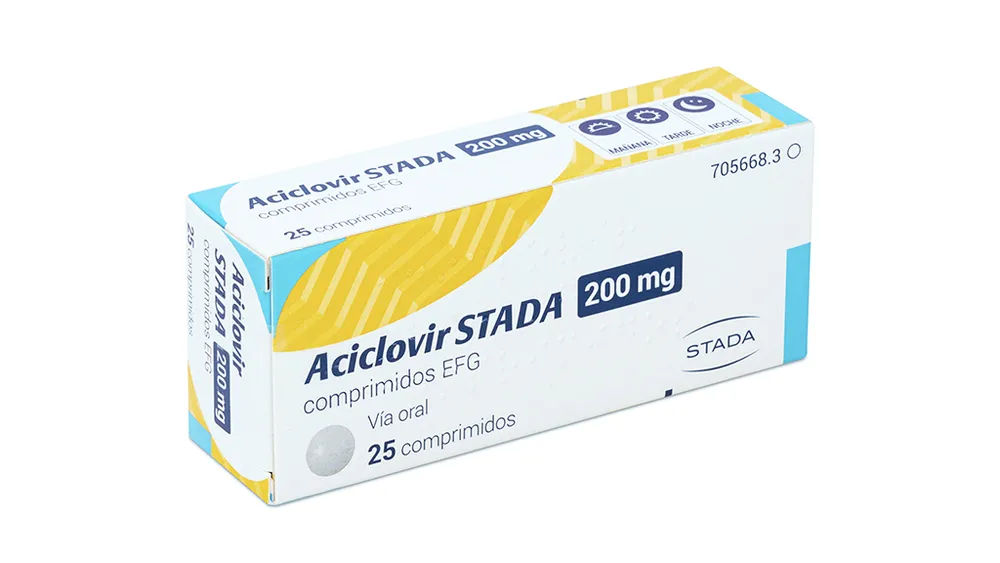
Table of Contents
Package leaflet: Information for the user
Introduction
Package leaflet: Information for the user
Aciclovir Stada 200 mg tablets EFG
Read the entire leaflet carefully before you start taking this medicine because it contains important information for you.
- Keep this leaflet as you may need to read it again.
- If you have any questions, ask your doctor or pharmacist.
- This medicine has been prescribed for you only, and you should not give it to other people, even if they have the same symptoms as you, because it may harm them.
- If you experience any adverse effects, consult your doctor or pharmacist, even if such effects are not listed in this leaflet. See section 4.
Leaflet contents
- What Aciclovir Stada is and what it is used for
- What you need to know before taking Aciclovir Stada
- How to take Aciclovir Stada
- Possible side effects
- How to store Aciclovir Stada
- Contents of the pack and other information
1. What Aciclovir Stada is and what it is used for
Aciclovir Stada belongs to a class of drugs effective against viral infections (antivirals).
Aciclovir Stada is used
- for the treatment of immunocompetent patients with skin and mucous membrane infections caused by the herpes simplex virus, especially when a severe course is likely, as occurs in cases of primary genital herpes (excluding herpes simplex virus infections in newborns and herpes simplex virus infections in children with impaired immune function (their body is less able to fight infections)).
- for the prevention of severe recurrent genital herpes infections in immunocompetent patients.
- for the prevention of herpes simplex infections following bone marrow or organ transplantation and during remission periods after treatment of acute leukemia.
2. What you need to know before starting Aciclovir Stada
Do not take Aciclovir Stada
- If you are allergic to aciclovir, valaciclovir, or to any of the other ingredients of this medicine (listed in section 6).
Warnings and precautions
Talk to your doctor or pharmacist before taking Aciclovir Stada.
- If you have impaired kidney function or are elderly. The dose should then be adjusted, and you should also drink an adequate amount of fluid during treatment (see also section 3 “How to take Aciclovir Stada”).
- If you have a neurological disorder.
If you are being treated for genital herpes infection and lesions or blisters are visible on the genitals, it is recommended to avoid sexual contact in order to prevent possible transmission to your partner.
Taking Aciclovir Stada with other medicines
Inform your doctor or pharmacist if you are taking, have recently taken, or might need to take any other medicines.
In particular, inform your doctor if you are taking any of the following medicines:
- Interferon (a medicine used in the treatment of multiple sclerosis), which may increase the effects of both medicines.
- Zidovudine (a medicine used in the treatment of AIDS), which may cause disorders of the nervous system (neuropathies), seizures, and lethargy.
- Theophylline (used for asthma and other respiratory problems).
- Cimetidine (used to treat peptic ulcers) and probenecid (used to treat gout), as they increase aciclovir concentration.
- Mycophenolate mofetil (a medicine used in transplant patients). Caution is advised if you are taking high doses of aciclovir, as blood levels of both medicines may increase.
Pregnancy and breastfeeding
If you are pregnant or breastfeeding, think you may be pregnant, or are planning to become pregnant, consult your doctor or pharmacist before using this medicine.
Pregnancy
There is still insufficient information available on the consequences of using aciclovir during pregnancy. You should consult your doctor or pharmacist if you are pregnant.
Breastfeeding
Aciclovir is excreted in breast milk. Likewise, there is insufficient knowledge about its consequences. Therefore, consult your doctor or pharmacist if you are breastfeeding.
Driving and using machines
It is currently unknown whether aciclovir affects the ability to drive or operate machinery. Although the properties of aciclovir make such an effect unlikely, fatigue, headache, and effects on the nervous system have occasionally been reported. You should bear this in mind if you intend to drive or use machines while being treated with aciclovir.
Aciclovir Stada contains sodium
This medicine contains less than 1 mmol of sodium (23 mg) per tablet, i.e., essentially “sodium-free”.
3. How to take Aciclovir Stada
The dose will be determined by your doctor individually for each patient.
Always take this medicine exactly as your doctor has instructed you. In some cases, the dose may differ from the recommended dose. Consult your doctor if you are unsure.
The recommended dose is:
- Treatment of herpes simplex virus infections in immunocompetent patients:
One aciclovir tablet 5 times daily, every 4 hours for 5 days. No dose will be taken during the night. If the infection is severe, your doctor may decide to treat you for a longer period. The first dose should be taken as soon as symptoms appear.
- Prophylaxis of frequently recurring genital herpes virus infections in immunocompetent patients:
Two aciclovir tablets twice daily, every 12 hours.
- Prophylaxis of herpes simplex infections following bone marrow or organ transplantation and during remission periods after treatment of acute leukemia:
One aciclovir tablet 4 times daily, every 6 hours.
In patients with severely impaired immune systems, the dose may be increased to 2 aciclovir tablets, 4 times daily.
Prophylactic therapy with aciclovir should begin simultaneously with the start of the risk period, i.e., when the immune system is suppressed.
Use in children
For children over 2 years of age, the same dose as for adults should be used. These tablets are not designed for use in younger children (i.e., under 2 years of age).
Patients with reduced renal function
Caution is recommended if renal function is impaired.
Herpes simplex virus infections:
In patients with severe renal impairment (creatinine clearance less than 10 ml/min), a dose adjustment is recommended to 200 mg of aciclovir twice daily, at approximately 12-hour intervals.
Elderly patients
In principle, dose adjustment is not required in elderly patients. Only in cases of renal impairment might the doctor decide to adjust the dose.
Method of administration
Take the tablets with half a glass of water or another liquid.
Patients with renal impairment or elderly patients should ensure they drink plenty of fluids during treatment with aciclovir. It is also important for patients receiving high doses of aciclovir to take sufficient fluids.
If you take more Aciclovir Stada than you should
Contact your doctor or pharmacist immediately or call the Toxicology Information Service at telephone: 915 62 04 20, indicating the medicine and the amount ingested.
Symptoms of overdose include gastrointestinal effects such as nausea or vomiting, and effects on the central nervous system such as headache and confusion.
If you forget to take Aciclovir Stada
If you have only just remembered that you missed a dose, you may still take it. However, if a considerable time has passed since the missed dose was due, you should skip that dose. Wait until the time for your next dose and continue with your prescribed dosing schedule. Do not take a double dose of aciclovir to make up for a missed dose.
If you stop taking Aciclovir Stada
Your doctor has advised you on how long you should continue taking aciclovir. Do not stop treatment earlier than instructed without first consulting your doctor.
If you have any further questions about the use of this medicine, ask your doctor or pharmacist.
4. Possible adverse effects
Like all medicines, this medicine may cause adverse effects, although not everyone experiences them. These adverse effects usually disappear once treatment has ended. Below is a list of the possible adverse effects.
Frequent: may affect up to 1 in 10 people
- Confusion
- Hallucinations
- Headache, dizziness, drowsiness
The generally reversible adverse effects listed above usually occurred in patients with renal function disorders and in cases of overdose, as well as with other predisposing factors, but cannot be entirely attributed to these characteristics.
- Nausea • Vomiting • Diarrhea • Abdominal pain
- Itching • Skin rash (including photosensitivity)
- Tiredness • Fever • Fatigue
Uncommon: may affect up to 1 in 100 people
- Sleeplessness
- Hives • Diffuse hair loss (relationship with treatment not clearly established)
Rare: may affect up to 1 in 1,000 people
- Severe allergic reaction (anaphylaxis)
- Difficulty breathing (dyspnea)
- Reversible increases in bilirubin and liver enzymes
- Angioedema • Increased blood urea and creatinine
Very rare: may affect between 1 in 10,000 people
- Changes in blood counts (anemia, leukopenia, thrombocytopenia)
- Feelings of depersonalization (reversible after discontinuation of treatment), agitation, psychotic symptoms • Tremor, ataxia, dysarthria, seizures, encephalopathy, disturbances of consciousness up to coma
The generally reversible adverse effects listed above usually occurred in patients with renal function disorders or other predisposing factors, but cannot be entirely attributed to these characteristics.
- Hepatitis, jaundice
- Acute renal failure, kidney pain
Reporting of adverse effects
If you experience any type of adverse effect, consult your doctor or pharmacist, even if they are possible adverse effects not listed in this leaflet. You may also report them through the Spanish Pharmacovigilance System for Human Medicines: https://www.notificaram.es. By reporting adverse effects, you can help provide more information on the safety of this medicine.
5. Storage of Aciclovir Stada
Keep this medicine out of sight and reach of children.
Do not use this medicine after the expiry date stated on the packaging, following "Do not use after" or "EXP".
Do not store above 25°C.
Medicines must not be disposed of via wastewater or household waste. Dispose of unused medicines and their packaging at a SIGRE collection point at your pharmacy. If you have any doubts, ask your pharmacist how to dispose of medicines and packaging you no longer need. This will help protect the environment.
6. Contents of the pack and other information
- The active substance in Aciclovir Stada is aciclovir. Each tablet contains 200 mg of aciclovir.
- The other components are: microcrystalline cellulose, sodium carboxymethylstarch (type A) (derived from potato starch), copovidone, magnesium stearate and colloidal anhydrous silica.
What Aciclovir Stada looks like and contents of the pack
Aciclovir Stada 200 mg tablets are white, round, flat tablets.
Each pack of Aciclovir Stada 200 mg tablets contains 25, 50, 100 or 500 tablets or 25x1 tablets (unit dose) in blisters containing 5 tablets.
Only certain pack sizes may be marketed.
Marketing Authorization Holder and Manufacturer
Marketing Authorization Holder
Laboratorio STADA, S.L.
Frederic Mompou, 5
08960 Sant Just Desvern (Barcelona)
Spain
[email protected]
Manufacturer
STADA Arzneimittel AG,
Stadastrasse 2-18
61118 Bad Vilbel (Germany)
or
LAMP San Prospero S.p.A
Via della Pace 25/A
41030 San Prospero, Modena
(Italy)
or
Centrafarm Services, B.V
Van de Reijtstraat 31-E
4814 NE Breda
(Netherlands)
or
Sanico NV
Veedijk 59
2300 Turnhout
Belgium
This medicinal product is authorized in the Member States of the European Economic Area under the following names:
Belgium: Aciclovir EG 200 mg tabletten
Denmark: Aciclodan 200 mg
Spain: Aciclovir Stada 200 mg comprimidos EFG
Finland: Acyclostad 200 mg tabletti
Netherlands: Aciclovir CF 200 mg, tabletten
Portugal: Aciclovir Ciclum 200 mg comprimidos
Sweden: Aciklovir STADA 200 mg
Date of the most recent review of this leaflet: August 2023
Detailed information on this medicinal product is available on the website of the Spanish Agency of Medicines and Health Products (AEMPS): http://www.aemps.gob.es/