Aciclovir Noridem 500 mg powder for solution for infusion EFG
Spain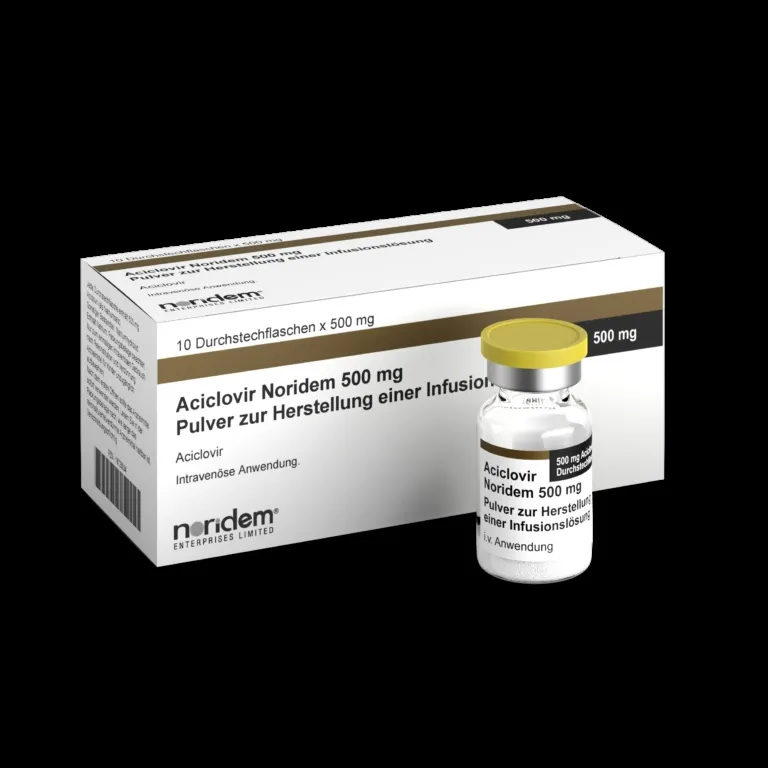
Table of Contents
- Package Leaflet: Information for the User
- Introduction
- 1. What Aciclovir Noridem is and what it is used for
- 2. What you need to know before starting to take Aciclovir Noridem
- 3. How Aciclovir Noridem is administered
- 4. Possible adverse effects
- 5. Storage of Aciclovir Noridem
- 6. Contents of the pack and other information
Package Leaflet: Information for the User
Introduction
Package Leaflet: Information for the Patient
Aciclovir Noridem 500 mg powder for solution for infusion EFG
Read the entire leaflet carefully before you start taking this medicine, because it contains important information for you.
-
Keep this leaflet; you may need to read it again.
-
If you have any questions, ask your doctor or nurse.
-
If you experience any adverse reactions, consult your doctor or nurse, even if they are adverse reactions not listed in this leaflet. See section 4.
Leaflet Contents
-
What Aciclovir Noridem is and what it is used for
-
What you need to know before receiving Aciclovir Noridem
-
How Aciclovir Noridem is administered
-
Possible side effects
-
How to store Aciclovir Noridem
-
Contents of the pack and other information
1. What Aciclovir Noridem is and what it is used for
Aciclovir Noridem contains the active substance aciclovir. This medicine is a direct-acting antiviral agent (destroys or stops the growth of viruses that cause herpes zoster or herpes).
It is used to treat certain infections caused by the herpes virus and certain forms of chickenpox and shingles (a viral disease characterized by a painful rash, for example, in the eye).
2. What you need to know before starting to take Aciclovir Noridem
Do not take Aciclovir Noridem
- if you are allergic to aciclovir or to any of the other ingredients of this medicine (listed in section 6).
Warnings and precautions
Talk to your doctor, pharmacist, or nurse before using this medicine.
- if you have kidney problems (renal impairment)
- if you experience back pain in the kidney area, this could be a sign of kidney problems (renal impairment); discontinuation of treatment may be considered
- if you are receiving intravenous aciclovir or taking high oral doses of aciclovir, you should also maintain regular hydration.
Other medicines and Aciclovir Noridem
Inform your doctor or pharmacist if you are taking, have recently taken, or might need to take any other medicines, including those obtained without a prescription.
- using this medicine together with other medicines that are toxic to the kidneys may increase the risk of kidney problems. Caution is required when administering aciclovir intravenously together with nephrotoxic medicines.
- avoid combined intravenous administration (injecting several medicines simultaneously into the same tubing set, or similarly mixing them in the same infusion). This medicine may crystallize when combined with certain medicines.
- if you are receiving lithium (a medicine used to regulate mood) at the same time as high-dose intravenous aciclovir, blood levels of lithium should be closely monitored due to the risk of lithium toxicity.
- if aciclovir is administered at the same time as theophylline (a medicine used to treat asthma and certain respiratory conditions), your doctor may request tests to measure theophylline blood levels.
Pregnancy, breastfeeding, and fertility
If you are pregnant or breastfeeding, think you may be pregnant, or are planning to become pregnant, consult your doctor or pharmacist before using this medicine.
You must not take this medicine during pregnancy unless specifically instructed by your doctor.
If you find out you are pregnant during treatment, inform your doctor, as only they can determine whether you should continue treatment.
Avoid breastfeeding during treatment with aciclovir, as it may be excreted in breast milk.
Driving and use of machines
Your doctor will assess your ability to drive vehicles and operate machinery based on your medical condition and certain possible adverse effects, especially those affecting the nervous system, which may occur during treatment (see Section 4: Possible side effects).
Aciclovir Noridem contains sodium
This medicine contains 52.2 mg of sodium (the main component of table/cooking salt) per vial. This corresponds to 2.6% of the maximum daily recommended sodium intake for an adult.
3. How Aciclovir Noridem is administered
You must never administer this medicine yourself. It will always be given by a suitably qualified person.
Dosage
The dosage is determined according to the condition being treated and the patient's age and body weight.
- In adults: 5–10 mg/kg every 8 hours,
- In children over 3 months of age: the dose should be calculated according to body weight, 10 to 20 mg/kg every 8 hours, with a maximum dose of 400 mg to 800 mg every 8 hours, respectively,
- In newborn infants: 20 mg/kg every 8 hours.
Use in patients with renal impairment
Caution is recommended when administering aciclovir by infusion to patients with renal impairment.
- If you have kidney problems, your doctor will need to adjust your dose of this medicine.
- If you are elderly, your doctor will adjust the dose, as renal function may be reduced in elderly patients.
- In overweight patients, and particularly in those with renal impairment and elderly patients, the dose should be adjusted.
- In infants and children with renal impairment, the dose must be appropriately adjusted depending on the extent of the renal impairment.
- In any case, it is important to maintain adequate hydration during treatment to reduce the risk of renal function deterioration.
Method of administration
This medicine will be administered by a healthcare professional, who will inject it into a vein (strictly intravenous (IV) use only).
Duration of treatment
The usual duration of treatment is 5 to 10 days. The duration should be adjusted according to the patient's condition and response to treatment. In the case of neonatal herpes, and depending on the indication, the treatment duration may be 14 or 21 days.
If you are given more Aciclovir Noridem than you should
Contact your doctor immediately.
In certain situations (for example, if you have kidney problems), neurological disorders may occur (see section 4: Possible side effects).
In case of overdose or accidental ingestion, contact your doctor or pharmacist immediately or call the Toxicology Information Service at telephone number 91 562 04 20, indicating the medicine and the amount ingested.
If you have any further questions about the use of this medicine, ask your doctor, pharmacist, or nurse.
4. Possible adverse effects
Like all medicines, this medicine can cause adverse effects, although not everyone will experience them.
These adverse effects are classified from the most frequent to those observed less frequently.
Frequent: (may affect up to 1 in 10 people)
-
Gastrointestinal problems:
-
nausea,
-
vomiting,
-
diarrhoea,
-
abdominal pain.
-
Hepatic problems: increases in serum bilirubin and liver enzymes (substances produced by the liver).
These effects usually disappear when treatment is discontinued.
- Skin reactions:
- pruritus (itching)
- skin rash
- urticaria (rash similar to that caused by stinging nettle stings).
- Renal problems: increased blood urea and creatinine (signs of impaired kidney function).
- General problems: inflammatory skin lesions or phlebitis (formation of a blood clot in a vein) at the injection site, which may exceptionally lead to necrosis (destruction of cells) in cases of extravasation (when the medicine leaks out of the injected vein) or insufficient dilution of the solution. These inflammatory lesions are related to the alkaline pH of this medicine.
Frequency not known: (frequency cannot be estimated from the available data)
-
Blood disorders:
-
thrombocytopenia (reduced platelet count; platelets are cells that enable blood clotting)
-
leucopenia (reduced white blood cell count).
-
Neuropsychiatric problems:
-
Headache, dizziness.
-
Balance disorders, ataxia (difficulty walking and lack of coordination), and dysarthria (slurred speech and articulation difficulties), which may occur together or in isolation and are indicative of cerebellar syndrome (a set of signs and symptoms characteristic of significant damage to the cerebellum, a part of the brain responsible for balance).
-
Neurological problems, sometimes severe, which may indicate encephalopathy (brain disease) and include confusion, agitation, tremors, myoclonus (involuntary muscle contractions), seizures, hallucinations, psychosis (personality disturbances), somnolence, and coma. These neurological signs are usually observed in patients with kidney problems who have received doses higher than recommended, or in elderly patients (see “Warnings and precautions”). These effects usually resolve when treatment is discontinued. The presence of these symptoms may be due to overdose; consult your doctor about this as soon as possible.
-
Hepatic problems: acute liver injury.
-
Respiratory problems: dyspnoea (difficulty breathing).
-
Immune system disorders: anaphylactic reactions (generalized allergic reaction).
-
Skin reactions: angioedema (sudden swelling of the face and neck).
-
Renal problems: acute renal failure, especially in elderly individuals or those with kidney problems if the dose is exceeded, and back pain around the kidney area, which may be associated with kidney problems (see also “Warnings and precautions”).
The risk of acute renal failure is caused by overdose and/or dehydration, or by combination with medicines that are nephrotoxic (toxic to the kidneys).
These risk factors should be controlled regardless of the patient's age. The risk of kidney problems can be avoided by adhering to the recommended dosage, observing usage precautions (especially maintaining adequate hydration), and administering the medicine slowly.
Other adverse effects
Frequency not known: (frequency cannot be estimated from the available data)
- fatigue,
- fever.
Reporting of adverse effects
If you experience any type of adverse effect, consult your doctor, pharmacist, or nurse, even if they are possible adverse effects not listed in this leaflet. You may also report them directly via the Spanish Pharmacovigilance System for Human Medicines, www.notificaRAM.es. By reporting adverse effects, you can help provide more information on the safety of this medicine.
5. Storage of Aciclovir Noridem
Keep this medicine out of the sight and reach of children.
Do not use this medicine after the expiry date stated on the vial and the carton after EXP. The expiry date refers to the last day of the month indicated.
This medicine does not require special storage temperature conditions.
After reconstitution:
Chemical and physical in-use stability has been demonstrated for 24 hours at between 23 °C and 27 °C under artificial light and between 2 °C and 8 °C when dissolved in 20 ml of water for injections or in an injectable sodium chloride solution at 9 mg/ml (0.9 %).
After dilution:
Chemical and physical in-use stability has been demonstrated for 12 hours at between 23 °C and 27 °C at an Aciclovir concentration of 5.0 mg/ml following dilution with the compatible solutions mentioned in the section Information for healthcare professionals, Preparation and handling.
From a microbiological standpoint, the product should be used immediately. If not used immediately, the storage times and conditions prior to use are the responsibility of the user and normally should not exceed 24 hours at between 2 °C and 8 °C or the previously stated times for chemical and physical in-use stability, whichever is shorter, unless the opening/reconstitution/dilution has taken place under controlled and validated aseptic conditions.
Medicines must not be disposed of via wastewater or household waste. Ask your pharmacist how to dispose of medicines and containers you no longer need. This will help protect the environment.
6. Contents of the pack and other information
Composition of Aciclovir Noridem
- The active substance is aciclovir. Each 500 mg of powder for solution for infusion contains 500 mg of aciclovir (as the sodium salt).
- The other excipient is sodium hydroxide.
Appearance of Aciclovir Noridem and contents of the pack
Aciclovir Noridem powder for solution for infusion is presented in colourless glass vials of type I, with a capacity of 20 ml, containing a white or almost white powder, closed with a 20 mm bromobutyl rubber stopper and sealed with a 20 mm aluminium seal, with coloured plastic flip-off caps (yellow).
Pack sizes: 1, 5 or 10 vials.
Only certain pack sizes may be marketed.
Marketing Authorisation Holder and Manufacturer
Marketing Authorisation Holder
Noridem Enterprises Ltd.
Evagorou & Makariou
Mitsi Building 3, Office 115
1065 Nicosia, Cyprus
Manufacturer
DEMO S.A. PHARMACEUTICAL INDUSTRY
21st Km National Road Athens-Lamia.
14568 Greece
T: +30 210 8161802, F: +30 2108161587.
This medicinal product is authorised in the Member States of the European Economic Area under the following names:
Germany | Aciclovir Noridem 500 mg Powder for the preparation of an infusion solution |
Romania | Aciclovir Noridem 500 mg Powder for perfusion solution |
Czech Republic | Aciclovir Noridem |
Croatia | Aciclovir Noridem 500 mg Powder for infusion solution |
Austria | Aciclovir Noridem 500 mg Powder for the preparation of an infusion solution |
Italy | Aciclovir Noridem |
Poland | Aciclovir Noridem |
Slovakia France Spain Portugal Netherlands Hungary Slovenia | Aciclovir Noridem 500 mg Powder for infusion solution Aciclovir Noridem 500 mg Powder for solution for infusion Aciclovir Noridem 500 mg Powder for solution for perfusion Aciclovir Noridem Aciclovir Noridem 500 mg Powder for solution for infusion Aciclovir Noridem 500 mg Powder for infusion solution Aciclovir Noridem 500 mg Powder for solution for infusion |
Date of the most recent review of this summary: November 2022
The following information is intended for healthcare professionals only:
Preparation and handling
Must be prepared immediately before use. Unused solution must be discarded.
Reconstitution:
Aciclovir Noridem should be reconstituted using the following volumes of water for injections or 9 mg/ml (0.9%) sodium chloride injectable solution to obtain a solution containing 25 mg of aciclovir per ml:
Volume of reconstitution liquid for liquid formulation
500 mg vial: 20 ml
Based on the calculated dose, the appropriate number and concentration of vials to be used must be determined.
To reconstitute each vial, add the recommended volume of perfusion fluid and gently shake until the contents of the vial are completely dissolved.
Administration
The required dose of Aciclovir Noridem must be administered by slow intravenous infusion over a period of one hour.
After reconstitution, Aciclovir Noridem may be administered using a controlled-rate infusion pump. Alternatively, the reconstituted solution may be further diluted to give an aciclovir concentration of no more than 5 mg/ml (0.5% w/v) for infusion administration.
The required volume of reconstituted solution should be added to the chosen infusion solution as recommended below, and mixed well to ensure adequate mixing.
For children and neonates, where it is recommended to keep the volume of infusion fluid to a minimum, dilution is recommended based on 4 ml of reconstituted solution (100 mg aciclovir) added to 20 ml of infusion fluid.
For adults, infusion bags containing 100 ml of infusion fluid are recommended, even when this results in an aciclovir concentration substantially lower than 0.5% w/v. Therefore, a 100 ml infusion bag may be used for any dose between 250 mg and 500 mg of aciclovir (10 and 20 ml of reconstituted solution), but a second bag should be used for doses between 500 mg and 1000 mg.
When diluted according to the recommended schemes, Aciclovir Noridem is known to be compatible with the following infusion fluids:
- Sodium chloride 9 mg/ml (0.9%) injectable solution
- Intravenous infusion of sodium chloride (0.45% w/v)
- Intravenous infusion of sodium chloride (0.18% w/v) and glucose (4% w/v)
- Intravenous infusion of sodium chloride (0.45% w/v) and glucose (2.5% w/v)
- Compound sodium lactate intravenous infusion (Hartmann's solution)
When diluted according to the above scheme, Aciclovir Noridem provides an aciclovir concentration not exceeding 0.5% w/v.
As no antimicrobial preservative is included, reconstitution and dilution must be carried out under completely aseptic conditions, immediately before use, and any unused solution must be discarded.
Reconstituted or diluted solutions must not be refrigerated.
If visible turbidity or crystallization occurs in the solution before or during infusion, the preparation must be discarded.
Disposal of unused medicine and all materials that have come into contact with it must be carried out in accordance with local regulations.
Incompatibilities
This medicinal product must not be mixed with other medicinal products except those mentioned in the Administration section.
Dosage and method of administration
Dosage
The dose for patients with normal renal function is indicated below. In patients with abnormal renal function, dosage must be adjusted according to the degree of renal impairment (see section Patients with Renal Impairment).
For recommendations on treatment duration, see section Duration of Treatment.
Dosage in patients with normal renal function
Adults and adolescents (>12 years)
- Varicella zoster virus (VZV) infections: 10 mg/kg every 8 hours; 10–15 mg/kg every 8 hours in pregnant women
- Herpes simplex virus (HSV) infections (except meningoencephalitis): 5 mg/kg every 8 hours
- Herpes meningoencephalitis: 10 mg/kg every 8 hours
For obese patients, the recommended adult dose should be based on ideal body weight rather than actual body weight.
Paediatric population
In children older than 3 months of age
In children aged between 3 months and 12 years, the dose should be calculated according to body weight.
- HSV infection (except meningoencephalitis) or VZV infections: 10 mg/kg every 8 hours, with a maximum dose of 400 mg every 8 hours
- HSV meningoencephalitis or VZV infection in immunocompromised children: 20 mg/kg every 8 hours, with a maximum dose of 800 mg every 8 hours
Neonates
In neonates and infants up to 3 months of age, the dose is calculated based on body weight.
- Known or suspected neonatal herpes: the recommended regimen is 20 mg/kg body weight intravenously every 8 hours for 21 days for disseminated disease and CNS disease, or for 14 days for disease limited to skin and mucous membranes.
Dosage in patients with renal impairment
The interval between doses and dosage must be adjusted according to creatinine clearance in ml/min for adults and adolescents and in ml/min/1.73 m² for infants and children under 13 years of age. Caution is recommended when administering aciclovir by infusion to patients with renal impairment. In such patients, particular care should be taken to ensure adequate fluid intake.
The following dosage adjustments are recommended.
Recommended dose adjustment in adults and adolescents >12 years with renal impairment:
Creatinine clearance | Recommended dose unit and dosing frequency according to indication | |
VZV or HSV infections (except herpetic meningoencephalitis) | VZV infections in immunocompromised children or herpetic meningoencephalitis | |
25-50 ml/min | 5 mg/kg body weight every 12 hours | 10 mg/kg body weight every 12 hours |
10-25 ml/min | 5 mg/kg body weight every 24 hours | 10 mg/kg body weight every 24 hours |
0 (anuria) to 10 ml/min | 2.5 mg/kg body weight every 24 hours | 5 mg/kg body weight every 24 hours |
Patients on hemodialysis | 2.5 mg/kg body weight every 24 hours and after hemodialysis | 5 mg/kg body weight every 24 hours and after hemodialysis |
Dose adjustment in children ≤ 12 years, infants and neonates with renal impairment:
Creatinine clearance (mL/min/1.73 m²) | Recommended dose unit and dosing frequency according to indication | |
In infants and children aged 3 months or older | ||
VHSV or VZV infection (except herpes encephalitis) VZV infection | VZV infections in immunocompromised patients or with herpes encephalitis | |
25–50 mL/min/1.73 m² | 10 mg/kg body weight twice daily | 20 mg/kg body weight twice daily |
10–25 mL/min/1.73 m² | 5 mg/kg body weight twice daily | 10 mg/kg body weight twice daily |
0 (anuria) to 10 mL/min/1.73 m² | 2.5 mg/kg body weight twice daily | 5 mg/kg body weight twice daily |
Patients on hemodialysis | 2.5 mg/kg body weight twice daily after hemodialysis | 5 mg/kg body weight twice daily after hemodialysis |
Advanced age
Renal impairment should be considered in elderly patients, and dosage should be adjusted according to creatinine clearance (see section “Dosage in patients with renal impairment”).
Adequate fluid intake should be ensured.
Duration of treatment
The usual duration of treatment is 5 days, but may be adjusted according to the patient's condition and response to therapy. The recommended duration is:
- 8–10 days for varicella zoster virus infections
- 10 days for the treatment of herpetic meningoencephalitis; duration should be adjusted based on the patient's condition and response to treatment
- 5–10 days for other herpes simplex virus infections
- 14 days for neonatal herpes treatment in cases of mucocutaneous (skin/eye/mouth) infection
- 21 days for neonatal herpes treatment in cases of disseminated disease or central nervous system involvement.
The duration of prophylactic treatment with Aciclovir Noridem is determined by the length of the risk period.
Method of administration
Strictly intravenous route:
Each dose must be administered slowly by intravenous infusion (via infusion pump or drip) over at least one hour.
For instructions on reconstitution of the medicinal product prior to administration, see the section on Preparation and handling.
Overdose
Symptoms and signs
Intravenous aciclovir overdose has led to increased serum creatinine, elevated blood urea, and subsequent renal failure. Neurological effects such as confusion, hallucinations, agitation, seizures, and coma have been reported in association with overdose.
Treatment
Patients should be closely monitored for any signs of toxicity.
Haemodialysis significantly increases aciclovir elimination from the bloodstream and may therefore be considered as a treatment option in cases of symptomatic overdose.