Aciclovir CINFA 200 mg tablets EFG
Spain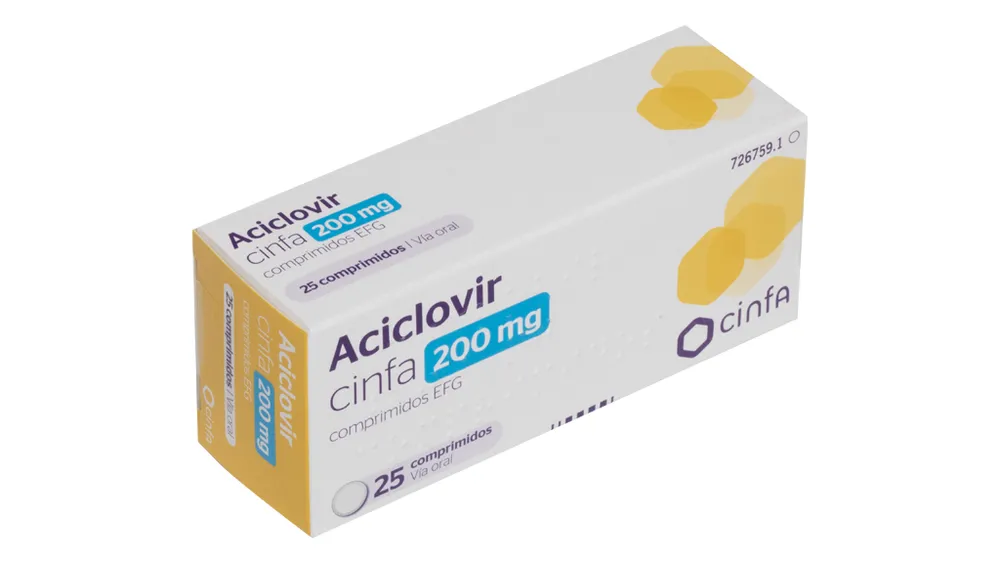
Table of Contents
- Package leaflet: Information for the user
- Introduction
- 1. What Aciclovir cinfa is and what it is used for
- 2. What you need to know before starting to take Aciclovir cinfa
- 3. How to take Aciclovir cinfa
- 4. Possible adverse effects
- 5. Storage of Aciclovir cinfa
- 6. Contents of the pack and other information
Package leaflet: Information for the user
Introduction
Package leaflet: information for the user
Aciclovir cinfa 200 mg tablets EFG
Read all of this leaflet carefully before you start taking this medicine, because it contains important information for you.
- Keep this leaflet, as you may need to read it again.
- If you have any questions, ask your doctor or pharmacist.
- This medicine has been prescribed for you only, and you should not give it to other people, even if they have the same symptoms as you, because it could harm them.
- If you experience any adverse effects, consult your doctor or pharmacist, even if they are adverse effects not listed in this leaflet. See section 4.
Leaflet contents
- What Aciclovir cinfa is and what it is used for
- What you need to know before taking Aciclovir cinfa
- How to take Aciclovir cinfa
- Possible side effects
- How to store Aciclovir cinfa
- Contents of the pack and other information
1. What Aciclovir cinfa is and what it is used for
Aciclovir belongs to a group of medicines known as antivirals.
It is used to treat and prevent infections caused by the herpes simplex virus, genital herpes, herpes zoster, and the varicella virus.
2. What you need to know before starting to take Aciclovir cinfa
Do not take Aciclovir cinfa
- If you are allergic to aciclovir, valaciclovir, or any of the other ingredients of this medicine (listed in section 6).
Warnings and precautions
Talk to your doctor or pharmacist before starting aciclovir.
-
If you have any kidney disease or are elderly. Your doctor may need to reduce your dose. You should also drink sufficient fluids during treatment to maintain adequate hydration.
-
If you have genital herpes infection, it is recommended to take precautions during sexual intercourse even after starting antiviral treatment.
Use of Aciclovir cinfa with other medicines
Tell your doctor or pharmacist if you are taking, have recently taken, or might need to take any other medicines.
INFORM YOUR DOCTOR IF YOU HAVE RECENTLY TAKEN PROBENECID, CIMETIDINE, OR MYCOPHENOLATE MOFETIL (A MEDICINE USED IN TRANSPLANT PATIENTS).
Pregnancy, breast-feeding, and fertility
If you are pregnant or breast-feeding, think you may be pregnant, or are planning to become pregnant, consult your doctor or pharmacist before using this medicine.
Aciclovir passes into breast milk. Contact your doctor or pharmacist if you are breast-feeding.
Driving and using machines
Some adverse effects such as drowsiness or somnolence may affect your ability to concentrate and react. Do not drive or operate machinery if you feel your ability is impaired.
Aciclovir cinfa contains sodium
This medicine contains less than 23 mg of sodium (1 mmol) per tablet; therefore, it is essentially "sodium-free".
3. How to take Aciclovir cinfa
Follow exactly the instructions given by your doctor for taking this medicine. If in doubt, consult your doctor or pharmacist again.
Your doctor will decide the correct dose, frequency, and duration of treatment.
Remember to take your medicine.
Your doctor will tell you how long your treatment with aciclovir should last. Do not stop treatment early.
The usual doses for adults are:
- for treatment of herpes simplex infections: one 200 mg tablet five times a day every four hours, omitting the nighttime dose
- for suppression of recurrences caused by herpes simplex virus: one 200 mg tablet four times a day every six hours, or two 200 mg tablets twice a day every twelve hours
- for prevention of herpes simplex infections in immunocompromised patients: one 200 mg tablet four times a day every six hours
- for treatment of chickenpox and herpes zoster infections: four 200 mg tablets five times a day every four hours, omitting the nighttime dose.
The usual doses for children are:
- for treatment of herpes simplex infections and prevention of herpes simplex infections in immunocompromised children:
- children and adolescents (2 to 18 years): the dose is the same as for adults
- infants (28 days to 23 months): half the adult dose should be administered.
Other formulations are available that are more suitable for children under 6 years of age.
-
for treatment of chickenpox:
-
children (over 6 years) and adolescents: four 200 mg tablets four times a day
-
children between 2 and 6 years: two 200 mg tablets four times a day.
It is recommended that you drink plenty of fluids while on this treatment.
If you think that the effect of aciclovir is too strong or too weak, inform your doctor or pharmacist.
If you take more Aciclovir cinfa than you should
In case of overdose or accidental ingestion, contact your doctor or pharmacist immediately or call the Toxicology Information Service, telephone: 915 62 04 20, indicating the medication and amount ingested.
If you forget to take Aciclovir cinfa
Do not take a double dose to make up for missed doses; simply wait for the next scheduled dose.
4. Possible adverse effects
Like all medicines, this medicine can cause adverse effects, although not everyone will experience them.
Frequent adverse effects (may affect up to 1 in 10 people)
- Headache, dizziness, feeling tired, fever.
- Nausea, vomiting, diarrhoea, stomach pain.
- Itching, skin rashes (sometimes caused by sensitivity to sunlight).
Uncommon adverse effects (may affect up to 1 in 100 people)
- Hair loss.
- Urticaria (hives).
Rare adverse effects (may affect up to 1 in 1,000 people)
- Changes in blood tests (reversible increases in bilirubin and liver enzymes, increases in blood urea and creatinine).
- Difficulty breathing.
- Angioedema (swelling of the lips, eyes, and tongue).
- Sudden and severe allergic reaction (anaphylactic reaction).
Very rare adverse effects (may affect up to 1 in 10,000 people)
- Anaemia (reduced number of red blood cells) or leucopenia (reduced number of white blood cells), bruising (due to reduced number of platelets).
- Agitation, confusion, tremors, difficulty with movement, difficulty speaking, confusion or imagining things (hallucinations), changes in personality and behaviour, seizures, drowsiness, encephalopathy (brain dysfunction), coma. These effects are generally reversible and usually occurred in patients with kidney disorders or predisposing factors.
- Hepatitis (inflammation of the liver), jaundice (yellowing of the skin and eyes), acute kidney failure, kidney pain (may be associated with kidney failure).
Tell your doctor immediately if you experience any of the following symptoms of allergy: sudden wheezing, palpitations or tightness in the chest, collapse, swelling of the eyelids, face, lips or other parts of the body, skin rash or bruising. These symptoms may mean that you are allergic to aciclovir. Do not take any more tablets unless your doctor tells you to.
Reporting of adverse effects
If you experience any type of adverse effect, consult your doctor or pharmacist, even if
the possible adverse effects are not listed in this leaflet. You can also
report them directly via the Spanish Pharmacovigilance System for
Human Medicines: https://www.notificaRAM.es. By reporting adverse effects,
you can help provide more information on the safety of
this medicine.
5. Storage of Aciclovir cinfa
Keep this medicine out of the sight and reach of children.
Do not use this medicine after the expiry date which is stated on the packaging after EXP. The expiry date refers to the last day of the month indicated.
Do not store above 30 °C.
Medicines should not be disposed of via wastewater or household waste. Return unused medicines and their containers to your pharmacy's SIGRE point. If you are unsure, ask your pharmacist how to dispose of medicines and containers you no longer need. This helps protect the environment.
6. Contents of the pack and other information
Composition of Aciclovir cinfa
- The active substance is aciclovir. Each tablet contains 200 mg of aciclovir.
- The other components are: microcrystalline cellulose, povidone K-30, sodium carboxymethyl starch (type A) (derived from potato starch), and magnesium stearate.
Appearance of the product and contents of the pack
Aciclovir cinfa is presented in tablet form. The tablets are white, round, and biconvex.
The tablets are packaged in Al/PVC blisters.
Carton box containing 25 tablets.
Marketing Authorisation Holder and Manufacturer
Marketing Authorisation Holder
Laboratorios Cinfa, S.A.
Carretera Olaz-Chipi, 10. Polígono Industrial Areta
31620 Huarte (Navarra) – Spain
Manufacturer
Pharmaceutical Works Polpharma SA Pelplinska 19
83-200 Starogard Gdanski
Poland
or
Laboratorios Cinfa, S.A.
Carretera Olaz-Chipi, 10. Polígono Industrial Areta
31620 Huarte (Navarra) - Spain
Date of the most recent revision of this leaflet: September 2019
Detailed and up-to-date information on this medicinal product is available on the website of the Spanish Agency of Medicines and Medical Devices (AEMPS) http://www.aemps.gob.es/
You can access detailed and up-to-date information about this medicine by scanning with your mobile phone (smartphone) the QR code included in the package leaflet and outer packaging. You can also access this information at the following internet address: https://cima.aemps.es/cima/dochtml/p/84468/P_84468.html
QR code link: https://cima.aemps.es/cima/dochtml/p/84468/P_84468.html