Acalka 1080 mg prolonged-release tablets
Spain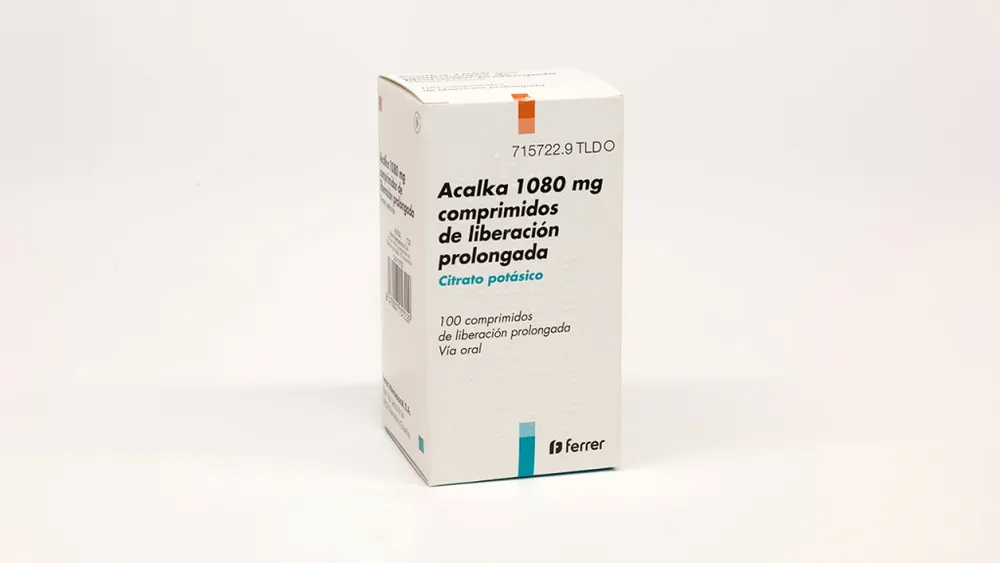
Table of Contents
Package leaflet: Information for the user
Introduction
Package leaflet: information for the user
Acalka 1080 mg
prolonged-release tablets
Potassium citrate
Contents of the leaflet
- What Acalka is and what it is used for
- What you need to know before taking Acalka
- How to take Acalka
- Possible side effects
- How to store Acalka
- Contents of the pack and other information
1. What Acalka is and what it is used for
Acalka belongs to a group of medicines known as urinary stone solvents, which are used to dissolve urinary tract stones (calculi).
Acalka reduces the formation of calcium oxalate crystals and the precipitation of uric acid. It increases the urinary pH, helping to restore normal pH levels without causing any disturbance in the body.
It is indicated for the prevention and treatment of renal lithiasis (formation of kidney stones) due to calcium oxalate and/or calcium phosphate, uric acid alone or associated with calcium lithiasis, and hypocitraturia (low citrate levels in urine).
2. What you need to know before starting to take Acalka
Do not take Acalka
- If you are allergic (hypersensitive) to potassium citrate or to any of the other components of this medicine (listed in section 6).
- If you have renal insufficiency (kidney disease), as the use of Acalka could lead to hyperkalaemia (increased blood potassium levels).
- If you have a persistent alkaline urinary tract infection.
- If you have urinary tract obstruction (partial or complete blockage of the urinary system causing interruption in the passage of urine).
- If you have hyperkalaemia (increased blood potassium levels).
- If you have adrenal insufficiency (a disorder of the adrenal glands leading to hormonal deficiency).
- If you have respiratory alkalosis (decreased levels of carbon dioxide in the blood) or metabolic alkalosis (increased levels of bicarbonate in the blood).
- If you have active peptic ulcer (stomach or duodenal ulcer).
- If you have intestinal obstruction (partial or complete blockage of the intestine causing interruption in the passage of intestinal contents).
- If you have delayed gastric emptying (slow emptying of the stomach).
- If you are taking anticholinergic medicines.
Warnings and precautions
Consult your doctor or pharmacist before starting to take Acalka.
- If you have hepatic insufficiency (liver disease) or reduced potassium excretion (decreased elimination of potassium by the body), as the use of Acalka could lead to hyperkalaemia (increased blood potassium levels).
- Potassium citrate is formulated in wax-matrix tablets that allow slow release of potassium citrate. After the wax matrix is emptied, it may pass intact through the gastrointestinal tract and may still be visible in the faeces.
Use of Acalka with other medicines
Inform your doctor or pharmacist if you are currently taking, have recently taken, or might need to take any other medicines.
Acalka must not be taken together with potassium-sparing diuretics (medicines used to increase urine output without increasing potassium loss), such as triamterene, spironolactone, or amiloride.
Use of Acalka with food and drink
While taking Acalka, a salt-free diet is recommended, and daily fluid intake should be significantly increased.
Pregnancy and breastfeeding
If you are pregnant or breastfeeding, think you may be pregnant, or are planning to become pregnant, consult your doctor or pharmacist before using this medicine.
If you are pregnant, take Acalka only if prescribed by your doctor.
Do not take Acalka during breastfeeding unless specifically instructed by your doctor.
Driving and using machines
Acalka has no influence on the ability to drive or operate machinery.
3. How to take Acalka
Follow exactly the instructions for use of this medicine as given by your doctor. If in doubt, consult your doctor or pharmacist again.
The recommended dose is:
Mild or moderate hypocitraturia (low citrate levels in urine):
The usual dose of Acalka is 1 tablet (10 mEq of potassium citrate) three times a day, 30 minutes after the three main meals.
Severe hypocitraturia (low citrate levels in urine):
The usual dose of Acalka is 2 tablets (20 mEq of potassium citrate) three times a day, 30 minutes after the three main meals.
Do not exceed 10 tablets per day, even in very severe cases of hypocitraturia.
Acalka tablets are for oral use.
Swallow the tablets whole with sufficient liquid, without chewing, breaking, or dissolving them in liquid, 30 minutes after the three main meals to prevent the occurrence of mild gastrointestinal disorders (of the stomach and intestine).
If you take more Acalka than you should
If you have taken more Acalka than you should, consult your doctor or pharmacist immediately. In case of overdose or accidental ingestion, contact the Toxicology Information Service at telephone (91) 562.04.20.
In the event of hyperkalemia (elevated potassium levels in blood), treatment consists of administering an intravenous solution of 10% dextrose with 10–12 U of insulin per 1000 ml. If acidosis is also present, treatment includes intravenous sodium bicarbonate and hemodialysis or peritoneal dialysis.
If you forget to take Acalka
Do not take a double dose to make up for missed doses.
If you have any further questions about the use of this medicine, ask your doctor or pharmacist.
4. Possible adverse effects
Like all medicines, Acalka may have adverse effects, although not everyone will experience them.
Acalka may cause mild gastrointestinal disorders (of the stomach and intestine), which decrease if taken with food.
If you experience any adverse effects, consult your doctor or pharmacist, even if they are adverse effects not listed in this leaflet.
5. Storage of Acalka
Keep this medicine out of the sight and reach of children.
Keep the bottle tightly closed to protect it from light and moisture.
Do not use this medicine after the expiry date stated on the packaging and label following EXP. The expiry date refers to the last day of the month indicated.
Medicines should not be disposed of via wastewater or household waste. Dispose of unused medicines and their containers at the SIGRE Point at your pharmacy. If you are unsure, ask your pharmacist how to properly dispose of unused medicines and their packaging. This way, you will help protect the environment.
6. Contents of the pack and other information
Composition of Acalka
- The active substance is potassium citrate. Each tablet contains 1080 mg of potassium citrate (10 milliequivalents), corresponding to 390 mg of potassium.
- The other components (excipients) are: Carnauba wax (E-903) and magnesium stearate.
Appearance of the medicinal product and contents of the pack
Acalka is prolonged-release tablets. It is available in packs of 100 tablets.
Marketing Authorization Holder and Manufacturer
Marketing Authorization Holder:
Ferrer Internacional, S.A.
Gran Vía Carlos III, 94
08028-Barcelona
Manufacturer:
Ferrer Internacional, S.A.
Joan Buscallà, 1-9
08173 Sant Cugat del Vallès (Barcelona)
Date of the most recent review of this leaflet: January 2026
"Detailed and up-to-date information on this medicinal product is available on the website of the Spanish Agency of Medicines and Medical Devices (AEMPS) http://www.aemps.gob.es/"