Yogurt
Ukraine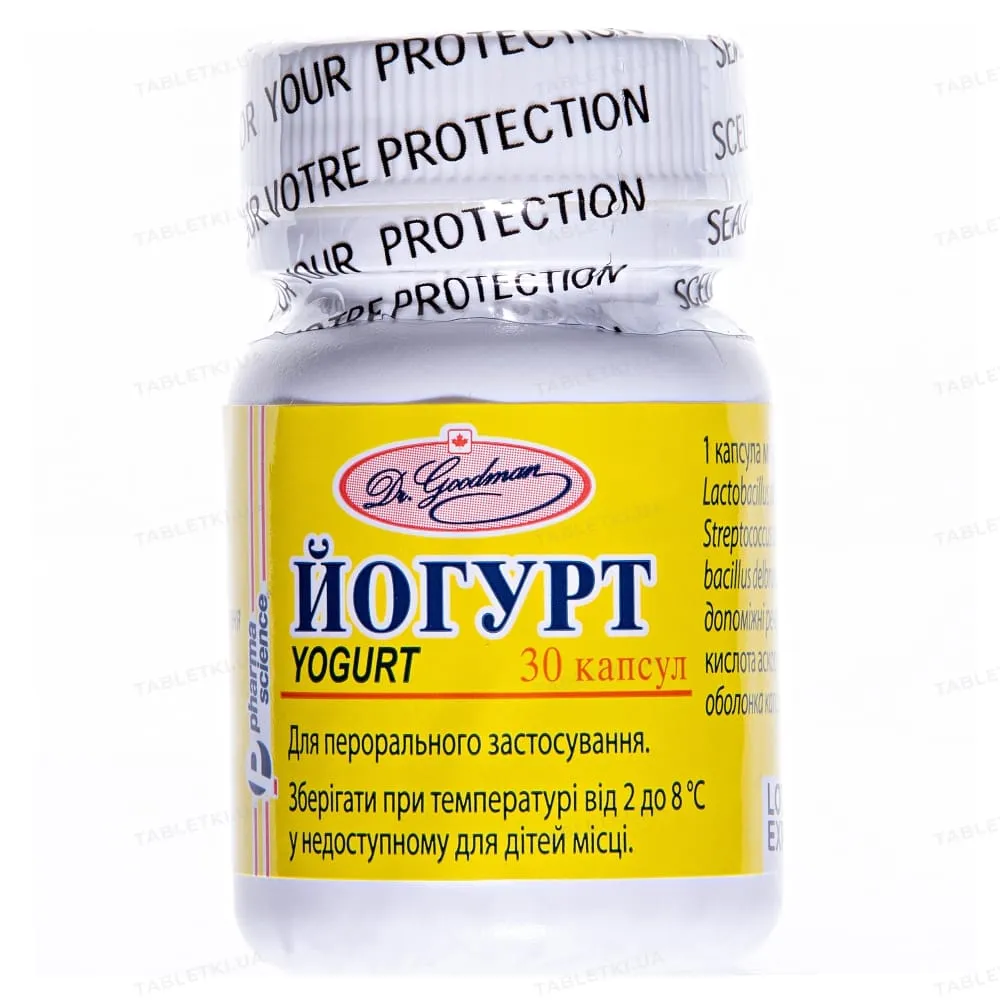
Table of Contents
INSTRUCTIONS FOR MEDICAL USE OF THE MEDICINAL PRODUCT YOGURT (YOGURT)
Composition:
Active substances:
Lactobacillus acidophilus, Lactobacillus rhamnosus, Streptococcus salivarius subsp. thermophilus, Lactobacillus delbrueckii subsp. bulgaricus;
1 capsule contains 2 billion or 4 billion active cells [colony-forming units (CFU)] of Lactobacillus acidophilus, Lactobacillus rhamnosus, Streptococcus salivarius subsp. thermophilus, Lactobacillus delbrueckii subsp. bulgaricus;
Excipients: lactose, magnesium stearate, ascorbic acid;
capsule shell: gelatin.
Pharmaceutical form. Capsules.
Main physicochemical properties: gelatin capsules of creamy color; the capsule content is a fine white powder with a yellowish tint (variations to ivory color and the presence of individual darker granules are possible).
Pharmacotherapeutic group. Antidiarrheal microorganisms. Combination of lactobacteria.
ATC code A07FA51.
Pharmacological Properties
Pharmacodynamics
Lactic acid bacteria in the medicinal product Yogurt are part of the normal intestinal flora in humans and play an important role in providing colonization resistance, immunostimulation, vitamin synthesis, detoxification, and digestive functions of the body. The antimicrobial activity of lactic acid bacteria is directed against staphylococci, Proteus, enteropathogenic Escherichia coli, and Candida species, and is associated with their ability to produce lactic acid and lactocins, as well as their immunomodulating properties, such as enhancing cytokine activity and stimulating phagocytosis by lymphocytes and macrophages in the intestine.
Lactobacilli in the medicinal product Yogurt influence intestinal peristalsis, participate in protein digestion, and in the breakdown of lactose into glucose and galactose, and promote the production of lactic acid.
Lactic acid bacteria lower the pH of intestinal contents, thereby inhibiting the growth and proliferation of pathogenic and conditionally pathogenic microflora. Lactobacilli act as a barrier preventing sensitizing substances (endotoxins, bacterial and food allergens) from passing from the intestine into the bloodstream. The viability of bacteria contained in the medicinal product Yogurt remains unaffected during passage through the esophagus, stomach, and duodenum. When incubated in gastric juice solution at 37°C and pH 3 for three hours, these bacteria remained fully viable. Moreover, they continued to grow in a nutrient medium containing 1% bile. All these properties ensure stable delivery of the bacteria contained in the medicinal product Yogurt to their site of action—the small and large intestine.
The colonization capacity of the bacterial strain in the medicinal product Yogurt is enhanced due to its combination with Streptococcus thermophilus.
Lactobacillus delbrueckii subsp. bulgaricus and Streptococcus thermophilus contain high levels of β-galactosidase. Patients with β-galactosidase deficiency in intestinal epithelial cells are able to absorb lactose in the presence of Lactobacillus delbrueckii subsp. bulgaricus and Streptococcus thermophilus.
Pharmacokinetics
The active substances of the medicinal product Yogurt are not absorbed from the gastrointestinal tract; therefore, there are no available study data on pharmacokinetics.
Clinical characteristics.
Indications.
- Prevention and treatment of acute gastroenteritis in children and adults.
- Prevention and treatment of antibiotic-associated diarrhea in adults and children.
- As part of complex therapy for allergic diseases (atopic dermatitis, food allergy).
Contraindications.
Yogurt is contraindicated in patients with hypersensitivity to the active or excipient ingredients of the medicinal product or to gelatin, milk, or soy.
Yogurt should not be administered to patients with immunodeficient conditions such as AIDS, lymphoma, or to patients with autoimmune diseases receiving injectable immunosuppressive agents or corticosteroids (in doses exceeding 0.5 mg/kg body weight per day, calculated as prednisolone).
Yogurt should not be used in patients with short bowel syndrome due to the risk of developing D-lactic acidosis.
Interaction with other medicinal products and other forms of interactions.
Not studied.
Special precautions for use
Discontinue use of Yogurt and consult a physician if symptoms of gastrointestinal disturbances (e.g. diarrhea) occur, worsen, or persist for more than 3 days.
Yogurt should not be used without prior medical advice if the following symptoms are present: fever, vomiting, bloody diarrhea, or severe abdominal pain.
In certain patient groups, microbial preparations, including probiotics, may rarely cause systemic infections. Although such cases have not been observed with the use of Yogurt, these patient groups should use the product only under medical supervision, with careful assessment of risks versus benefits. These groups include:
- Critically ill, severely debilitated patients, typically in intensive care units.
- Patients with central venous catheters, patients with myocarditis or endocarditis, or those who have undergone cardiac surgery; patients after gastrointestinal or oral surgery (including tooth extraction), as open wounds may serve as entry points for infection.
- Patients with blood in the stool, particularly children and elderly patients, since permeable intestinal barriers may allow microbes to enter the bloodstream.
- Patients with significantly weakened or suppressed immune systems, including those after stem cell or solid organ transplantation; patients receiving injectable immunosuppressive agents or corticosteroids for autoimmune diseases (in doses exceeding 0.5 mg/kg body weight per day, expressed as prednisolone); patients undergoing radiotherapy or chemotherapy; and patients with underdeveloped immune systems, such as premature infants.
Since Yogurt contains bacterial strains that produce D-lactate (D-lactic acid), patients with short bowel syndrome, in whom D-lactate acidosis may develop, should avoid using this medicinal product.
Excipients. Since the lactic acid bacteria Lactobacillus delbrueckii subsp. bulgaricus and Streptococcus thermophilus have high levels of β-galactosidase, patients with β-galactosidase deficiency in intestinal epithelial cells may be able to absorb lactose in the presence of these bacteria. Therefore, patients with intolerance to certain sugars may use Yogurt, taking into account the properties of these lactic acid bacteria contained in the medicinal product.
Use during pregnancy or breastfeeding.
Lactobacilli are naturally present in the intestine. Yogurt can be used during pregnancy and breastfeeding.
Effect on the ability to drive and operate machinery.
Yogurt does not affect the ability to drive or operate machinery.
Dosage and Administration.
The medicinal product is taken orally, during meals, preferably simultaneously with food.
For children or adults who cannot swallow the capsule, it is recommended to open the capsule and mix its contents with a small amount of food or liquid.
For a child, the capsule contents or, if necessary, approximately half of the contents, should be sprinkled and mixed with food or drink suitable for the child.
Dosage for children:
from 3 months to 1 year of age: 1–2 × 10⁹ CFU per day;
from 1 to 3 years of age: 2–4 × 10⁹ CFU per day;
from 3 to 12 years of age: 4–8 × 10⁹ CFU per day.
For adults and children aged 12 years and older: 6–12 × 109 CFU per day.
The duration of treatment is 25–30 days. If necessary, the course may be repeated.
Children. The yogurt is used for children aged 3 months and older.
Overdose.
There are no reports of overdose cases.
Side effects.
Side effects are very rare. Possible hypersensitivity reactions, rash, itching.
Reporting of adverse reactions after drug registration is of great importance. It allows continuous monitoring of the benefit-risk balance of the medicinal product. Medical and pharmaceutical professionals, as well as patients or their legal representatives, should report all suspected adverse reactions and lack of drug efficacy via the Automated Pharmacovigilance Information System at the following link: https://aisf.dec.gov.ua.
Shelf life.
3 years.
Storage conditions.
Store at a temperature of 2 to 8 °C, in a place inaccessible to children.
Transportation and temporary storage of the product at a temperature not exceeding 30 °C for up to 30 days is permitted.
Packaging.
2 billion CFU: 30 or 75 capsules in bottles; 15 capsules in blisters, 1 blister per cardboard box.
4 billion CFU: 30 capsules in bottles.
Availability. Over-the-counter.
Manufacturer. Pharmascience Inc.
Manufacturer's address.
6111 Royalmount Avenue, 100, Montreal, Quebec H4P 2T4, Canada.