Efrasia dz
UkraineTable of Contents
INSTRUCTIONS FOR MEDICAL USE OF THE MEDICINAL PRODUCT EFRAZIA D3
Composition:
Active substance: 1 ml of solution contains 1 g of Euphrasia officinalis D3;
Excipients: potassium nitrate, boric acid, disodium tetraborate.
Pharmaceutical form. Eye drops, solution.
Main physicochemical properties: clear sterile solution, colorless to slightly yellowish.
Pharmacotherapeutic group.
Ophthalmological agents.
ATC code S01X.
Pharmacological properties.
Pharmacodynamics.
Euphasia D3, eye drops, is a homeopathic medicinal product for anthroposophic therapy.
Pharmacokinetics.
Data not available.
Clinical characteristics.
Indications.
Efrasyu D3, eye drops, are indicated for symptomatic treatment of catarrhal conjunctivitis with signs of irritation or inflammation and lacrimation, accompanied by eyelid swelling due to fluid accumulation and associated with an allergic reaction.
Contraindications.
Efrasyu D3, eye drops, are not recommended for use in cases of hypersensitivity to the active substance or to any other component of the medicinal product.
Interaction with other medicinal products and other types of interactions.
No data available. Interactions with other medicinal products have not been studied.
Special precautions for use.
The patient is advised to seek immediate consultation with an ophthalmologist if:
- there is severe eye pain or sudden worsening of vision;
- there is pus in the eyes;
- symptoms persist or new symptoms develop.
Use during pregnancy or breastfeeding.
Data on the use of the medicinal product Efrasea D3 during pregnancy or breastfeeding are limited or unavailable. During pregnancy or breastfeeding, the product should be used only after consultation with a physician, when the benefit of treatment to the mother outweighs the potential risk to the fetus or infant.
Ability to influence reaction rate while driving or operating machinery.
Has no effect or has a negligible effect. However, it should be noted that after instillation of eye drops onto the ocular mucous membrane, temporary blurred vision may occur. Do not drive or operate machinery until normal vision is fully restored.
Method of Administration and Dosage
Adults and children aged 2 years and older:
- Immediate use (for acute conditions): instill 1 drop into the conjunctival sac of the affected eye every 2 hours, maximum for up to 2 days. If no effect is observed within 2 days, consult a physician;
- Regular use (for chronic conditions): 1 drop 3 times daily in each affected eye.
For children under 2 years of age, the use of the medicinal product Efrazia D3 must be prescribed by a physician only. There are no recommendations for the use of this medicinal product in this age group of patients.
|
|
|
|
|
|
Instructions for using the dispenser:
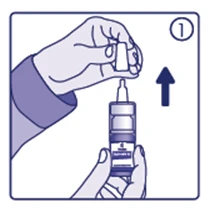
- Remove the small protective cap by gently pulling it off the bottle (Figure 1).
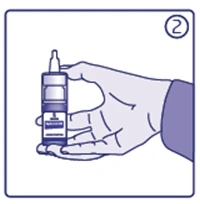
- Hold the bottle with your thumb positioned as shown in Figure 2.
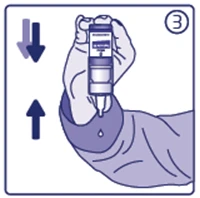
- Before first use, invert the bottle with the dropper tip pointing downwards and press the dispenser several times until the first drop appears. The bottle is now ready for use: a drop will be released with gentle pressure (Figure 3).
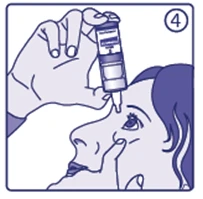
- Tilt your head backwards, hold the bottle over the eye, and gently press the rubber part of the dropper tip to instill the medication into the conjunctival sac (Figure 4). Distribute the solution by gently blinking the eyelids.
- Immediately after use, securely close the bottle with the protective cap.
Duration of treatment.
Treatment usually needs to be completed within 1 week. The duration of treatment should be determined by a physician if no improvement is observed within 2 days or if prolonged treatment is required. If a previous dose of Euphrasia D3 has been missed, do not use a double dose.
Instructions for patients wearing contact lenses.
Wearing contact lenses is not recommended during eye inflammation. Euphrasia D3 eye drops are compatible with contact lenses; however, the lens manufacturer's recommendations should be observed. Generally, it is recommended to remove lenses before applying the medication and to reinsert them 30 minutes after administration.
Children.
The use of Euphrasia D3 has not been studied in children under 2 years of age. There are no recommendations for use in this age group; therefore, the medication should be administered to children under 2 years only under medical supervision.
Overdose.
There are no reported cases of overdose.
Side effects
Efrazia DZ may cause side effects, although they do not occur in every patient.
After application of Efrazia D3, eye drops, onto the ocular mucous membrane, irritation may occur in the form of burning, itching, swelling, redness, or increased lacrimation (frequency unknown).
If any of the side effects worsen, or if any side effects not listed in this section occur, patients should consult a physician.
Reporting of suspected adverse reactions
After marketing authorization of the medicinal product, reporting of suspected adverse reactions is important as it allows continued monitoring of the benefit-risk balance of the medicinal product. Healthcare professionals should report any suspected adverse reactions via the national pharmacovigilance system.
Shelf life. 3 years.
After first opening: 12 weeks.
Storage conditions.
No special storage conditions required.
Keep out of reach and sight of children.
Packaging.
10 ml solution in a bottle, 1 bottle per cardboard box.
Supply classification.
Over-the-counter (without prescription).
Manufacturer.
Weleda AG, Germany.
Address of manufacturer and location of operations.
Möhlerstr. 3-5, 73525, Schwäbisch Gmünd, Germany.