Vitamin a
Ukraine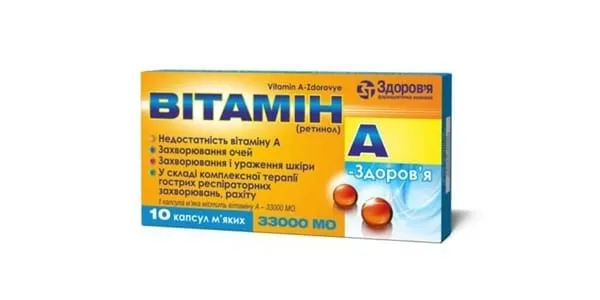
Table of Contents
INSTRUCTION FOR MEDICAL USE OF THE MEDICINAL PRODUCT VITAMIN A (VITAMINA)
Composition:
Active substance: retinol;
for the 33000 IU dose
1 capsule contains vitamin A 33000 IU;
Excipients: sunflower oil; capsule shell: gelatin, glycerin, carmoisine (E 122);
for the 100000 IU dose
1 capsule contains vitamin A 100000 IU;
Excipients: sunflower oil; capsule shell: gelatin, glycerin.
Pharmaceutical form. Soft capsules.
Main physicochemical properties:
for the 33000 IU dose – soft gelatin capsules of spherical or round shape with a seam, red in color, filled with oily liquid ranging from light yellow to dark yellow;
for the 100000 IU dose – soft gelatin capsules of spherical or round shape with a seam, from light yellow to dark yellow in color, filled with oily liquid ranging from light yellow to dark yellow.
Pharmacotherapeutic group. Simple vitamin A preparations. Retinol (vitamin A).
ATC code A11CA01.
Pharmacological Properties
Pharmacodynamics
Vitamin A has a general strengthening effect and normalizes tissue metabolism: it participates in redox processes (due to a large number of unsaturated bonds), in the synthesis of mucopolysaccharides, proteins, lipids, in mineral metabolism, and in cholesterol formation. It enhances the production of lipase and trypsin, stimulates myelopoiesis and cellular division processes. It exerts a positive effect on the function of lacrimal, sebaceous, and sweat glands; increases resistance of the mucous membranes of the respiratory tract and intestine to diseases; enhances the body's resistance to infections. It promotes proliferation of skin epithelial cells, rejuvenates the cell population, reduces the number of cells undergoing terminal differentiation, inhibits keratinization processes, enhances the synthesis of glycosaminoglycans, activates interactions between immunocompetent cells and epidermal cells, and stimulates skin regeneration. Retinol is an essential component for normal retinal function: it binds to opsin (the red pigment of the retina) to form visual purple—rhodopsin, which is necessary for visual adaptation in the dark.
Local action is mediated by the presence of specific retinol-binding receptors on the surface of epithelial cells.
Pharmacokinetics
Vitamin A is almost completely absorbed in the intestine (mainly in the duodenum and rectum). After administration, maximum plasma concentration of the drug is observed within 4 hours. Retinol is unevenly distributed throughout the body. The highest concentrations are found in the liver and adipose tissue; it is also detected in the kidneys, fat depots, adrenal glands, and other endocrine glands. Retinol metabolites are excreted by the kidneys. Elimination half-life is 9.1 hours. Retinol is not detectable in the urine of healthy individuals, as it is excreted in bile.
Clinical characteristics.
Indications.
A-avitaminosis and A-hypovitaminosis.
Eye diseases: pigmentary retinitis, xerophthalmia, hemeralopia, eczematous lesions of the eyelids, superficial keratitis, corneal lesions, conjunctivitis, pyoderma.
Skin diseases and skin lesions: frostbite, burns, wounds, ichthyosis, follicular keratosis, senile keratosis, cutaneous tuberculosis, psoriasis, certain forms of eczema.
Complex therapy of rickets, collagenoses, and hypotrophies.
As part of complex therapy for acute respiratory diseases occurring against a background of exudative diathesis, chronic bronchopulmonary diseases; inflammatory, erosive-ulcerative intestinal lesions, liver cirrhosis.
Contraindications.
Hypersensitivity to components of the drug, acute and chronic nephritis, cardiac insufficiency grade II–III, cholelithiasis, chronic pancreatitis, hypervitaminosis A, retinoid overdose, hyperlipidemia, obesity, chronic alcoholism, sarcoidosis (including in medical history).
Interaction with other medicinal products and other types of interactions.
Estrogens and oral contraceptives containing them enhance the absorption of retinol, which may lead to the development of hypervitaminosis A. Cholestyramine, colestipol, mineral oils, and neomycin reduce the absorption of vitamin A (an increased dose of vitamin A may be required). Nitrates impair retinol absorption.
During prolonged therapy with tetracyclines, vitamin A should not be administered in high doses (50,000 IU or higher) due to increased risk of developing intracranial hypertension. Retinol reduces the effect of Ca2+ preparations and increases the risk of developing hypercalcemia. Isotretinoin increases the risk of toxic effects.
Vitamin E reduces the toxicity, absorption, and hepatic storage of vitamin A; high doses of vitamin E may reduce vitamin A reserves in the body. Retinol reduces (mutually) the risk of hypervitaminosis D. Corticosteroids and alcohol consumption reduce the therapeutic effect of the drug. Concurrent use of vitamin A and anticoagulants increases the tendency to bleeding. Retinol reduces the anti-inflammatory effect of glucocorticoids.
Special precautions for use.
The medicinal product has the property of accumulating and remaining in the body for a prolonged period; therefore, it should not be taken concurrently with other medicinal products containing vitamin A. Prolonged daily use of the medicinal product, especially in high doses, may lead to the development of hypervitaminosis A.
Use with caution in diseases associated with impaired blood coagulation or tendency to bleeding, calcium loss from the body, severe liver damage, acute and chronic hepatitis. To monitor liver function, biochemical blood tests should be performed before and during treatment.
The medicinal product is not recommended during prolonged therapy with tetracyclines.
Retinol should be taken 1 hour before or 4–6 hours after cholestyramine administration.
The presence of fats in food is essential for normal absorption of vitamin A.
Alcohol and tobacco abuse impair the absorption of the medicinal product from the gastrointestinal tract.
Use during pregnancy or breastfeeding.
Due to the high dose of vitamin A, this medicinal product is contraindicated during pregnancy and breastfeeding.
Ability to influence reaction rate when driving or operating machinery.
There are no data indicating that retinol affects the speed of psychomotor reactions when driving a vehicle or operating precision machinery.
Method of Administration and Dosage
Retinol is indicated for therapeutic use in adults for mild to moderate vitamin A deficiency. The medicinal product should be taken orally, 10–15 minutes after eating.
Due to the ability of vitamin A to accumulate in the body, caution should be exercised regarding the dose of retinol palmitate (especially when using capsules containing 100000 IU).
The daily dose for adults should not exceed 100000 IU.
For therapeutic use in mild and moderate vitamin A deficiency, adults should be administered up to 33000 IU per day; in eye disorders – 33000–100000 IU per day. In skin disorders, adults should be administered 33000–100000 IU per day.
Dosage and duration of treatment with Vitamin A should be determined individually by a physician.
Children. The medicinal product is contraindicated in children.
Overdose.
Symptoms: severe headache, dizziness; drowsiness, confusion, visual disturbances, seizures, persistent vomiting, profuse diarrhea, severe dehydration, irritability; on the second day, widespread rash appears, followed by extensive desquamation, starting from the face; gingival bleeding, dryness and ulceration of the oral mucosa, chapped lips, painful palpation of long tubular bones due to subperiosteal hemorrhages, joint and muscle pain.
Treatment: symptomatic therapy; thyroxine should be administered as an antidote, as well as ascorbic acid.
Adverse Reactions.
Gastrointestinal system: loss of appetite, dryness of the oral mucosa, stomach pain, vomiting, nausea.
Hepatobiliary system: hepatotoxic effects, portal hypertension.
Skin and subcutaneous tissue: skin and lip fissures and dryness, yellow-orange discoloration on palms, soles, and in the nasolabial triangle area, subcutaneous edema; in isolated cases, pruritic maculopapular rashes may occur on the first day of treatment, requiring discontinuation of the medicinal product.
Nervous system: asthenia, excessive fatigue, drowsiness, discomfort, headache, irritability, increased intraocular pressure, visual disturbances, gait disturbances.
Endocrine system: oligomenorrhea.
Urinary system: pollakiuria, nocturia, polyuria.
Blood system: hemolytic anemia.
Musculoskeletal system: bone pain, bone X-ray abnormalities, seizures.
Other: hyperthermia, hair loss, photosensitivity, weight loss, hypercalcemia; hypersensitivity reactions may occur during treatment.
Adverse effects usually resolve spontaneously upon dose reduction or temporary discontinuation of the medicinal product.
In skin disorders, administration of high doses of the medicinal product may be accompanied, after 7–10 days of treatment, by exacerbation of local inflammatory response, which does not require additional treatment and subsequently diminishes. This effect is associated with the myelo- and immunostimulatory action of the medicinal product.
Shelf life. 2 years.
Storage conditions.
Store in the original packaging at a temperature not exceeding 25 °C.
Keep out of reach of children.
Packaging.
For the 33,000 IU dose.
10 capsules in a blister; 3 blisters per pack.
10 capsules in a blister; 5 blisters per pack.
20 capsules in a blister; 1 blister per pack.
20 capsules in a blister; 3 blisters per pack.
For the 100,000 IU dose.
10 capsules in a blister; 3 blisters per pack.
10 capsules in a blister; 5 blisters per pack.
20 capsules in a blister; 1 blister per pack.
20 capsules in a blister; 3 blisters per pack.
Supply category. Over-the-counter.
Manufacturer. JSC " KYIV VITAMIN PLANT ".
Manufacturer's address and location of business activity.
38 Kopilivska Street, Kyiv, 04073, Ukraine.
Web-site: www.vitamin.com.ua.