Ursonost
Ukraine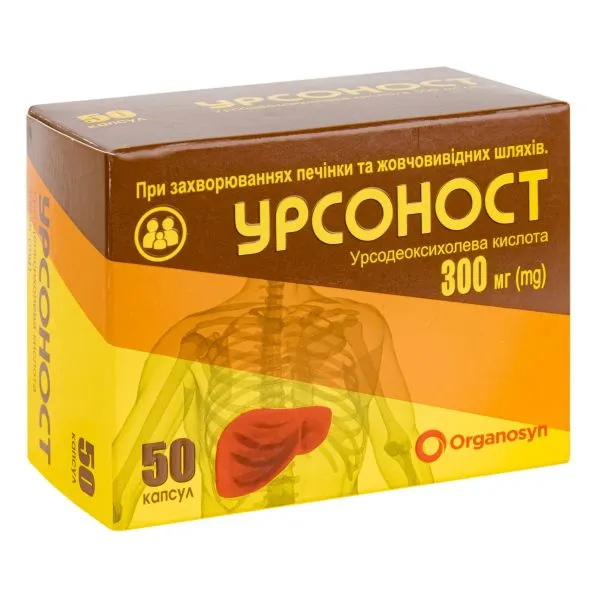
Table of Contents
INSTRUCTIONS FOR MEDICAL USE OF THE MEDICINAL PRODUCT URSONOST (ursonost)
Composition:
Active substance: ursodeoxycholic acid;
1 capsule contains 150 mg or 300 mg of ursodeoxycholic acid;
Excipients: maize starch, magnesium stearate, colloidal anhydrous silicon dioxide.
Pharmaceutical form. Capsules.
Main physicochemical characteristics: hard gelatin capsule of white or almost white color containing a fine granular powder of white or almost white color; presence of powder agglomerates which disintegrate upon pressure is permissible.
Pharmacotherapeutic group.
Agents used in the treatment of liver and biliary tract disorders.
ATC code A05AA02.
Pharmacological Properties
Pharmacodynamics
Ursodeoxycholic acid (UDCA) is a 7-epimer of chenodeoxycholic acid and is a bile acid physiologically present in human bile in low concentrations relative to the total amount of bile acids.
UDCA suppresses hepatic synthesis and secretion of cholesterol and also inhibits cholesterol absorption in the intestine. It likely exerts a weak inhibitory effect on the synthesis and secretion of endogenous bile acids into bile and does not affect phospholipid excretion into bile.
With continuous administration, the concentration of UDCA in bile reaches its maximum level after approximately 3 weeks. Despite its insolubility in aqueous environments, cholesterol can be solubilized by at least two different mechanisms in the presence of dihydroxy bile acids. In addition to solubilizing cholesterol in micelles, UDCA has a unique action promoting the dissolution of cholesterol into liquid crystals in aqueous environments. Thus, even though high doses (e.g., 15–18 mg/kg/day) do not result in UDCA concentrations exceeding 60% of the total bile acid pool, UDCA-enriched bile effectively dissolves cholesterol. The overall effect of UDCA is to increase bile concentration, thereby promoting cholesterol saturation.
The various mechanisms of action of UDCA are directed toward reducing the amount of cholesterol available for stone formation that is excreted into bile and toward solubilizing it, thus promoting the dissolution of cholesterol gallstones.
After discontinuation of UDCA, the concentration of the bile acid in bile decreases exponentially, falling to approximately 5–10% of its normal level within about one week.
Pharmacokinetics
Approximately 90% of the therapeutic dose of UDCA is absorbed in the small intestine following oral administration. After absorption, UDCA enters the liver via the portal vein and undergoes first-pass metabolism (i.e., significant first-pass effect), where it is conjugated with glycine or taurine and then secreted into the hepatic bile ducts. UDCA in bile is concentrated in the gallbladder and released into the duodenum via the common bile duct upon gallbladder contraction, a physiological response to food intake. Only trace amounts of UDCA appear in systemic circulation, and very small quantities are excreted in urine. The primary site of therapeutic action of the drug is the liver, bile, and intestinal lumen.
Besides conjugation, UDCA is not metabolized by the liver or intestinal mucosa. A small portion of the drug undergoes bacterial degradation during each cycle of enterohepatic circulation. UDCA may be either oxidized or reduced at the 7-carbon position, resulting in 7-ketolithocholic acid (7-KLCA) or lithocholic acid (LCA), respectively. Additionally, bacterial-catalyzed deconjugation of glyco- and tauro-ursodeoxycholic acids occurs in the small intestine. Free UDCA, 7-KLCA, and LCA are poorly soluble in aqueous environments, and large amounts of these compounds are excreted in feces from the distal intestine. Reabsorbed free UDCA is restored by the liver. Of the LCA formed in the small intestine, 80% is excreted in feces, while the 20% that is absorbed undergoes sulfation at the 3-hydroxyl group in the liver to form relatively insoluble lithocholyl conjugates, which are excreted in bile and eliminated in feces. Absorbed 7-KLCA is stereospecifically reduced in the liver to chenodiol.
LCA is formed via 7-dehydroxylation of dihydroxy bile acids (UDCA and chenodiol) in the intestinal lumen. The 7-dehydroxylation reaction is alpha-specific, meaning chenodiol undergoes 7-dehydroxylation more efficiently than UDCA. With equimolar doses of UDCA and chenodiol, the levels of LCA present in bile remain unchanged. Animal studies have shown that accumulation of LCA leads to liver damage due to insufficient sulfation activity. Humans possess the ability to sulfate LCA. During clinical studies, some patients showed signs of liver injury, but this was not associated with UDCA therapy. This may be explained by the fact that some individuals may have reduced sulfation capacity, although this phenomenon has not been fully studied.
Clinical characteristics.
Indications.
- Ursonost is indicated for patients with radiolucent, non-calcified gallstones <20 mm in maximum diameter, for whom elective cholecystectomy may be performed, including patients at high surgical risk due to systemic disease, elderly patients, individuals with intolerance to general anesthesia, or patients who refuse surgery.
- Ursonost is indicated for prevention of gallstone formation in obese patients who are planning rapid weight loss.
Contraindications.
- Patients with calcified cholesterol or radiopaque stones.
- Patients with urgent indications for cholecystectomy, including unremitting acute cholecystitis, cholangitis, biliary tract obstruction, gallstone pancreatitis, or patients with biliary-enteric fistulas.
- Hypersensitivity to bile acids.
Interaction with other medicinal products and other forms of interaction.
Bile acid sequestrants such as cholestyramine and colestipol may affect the action of UDCA by reducing its absorption. Aluminum-based antacids have been shown to adsorb bile acids in vitro, and thus may reduce UDCA absorption. Estrogens, oral contraceptives, and clofibrate (as well as other lipid-lowering agents) increase hepatic cholesterol secretion and may reduce the efficacy of UDCA.
Ursonost may enhance intestinal absorption of cyclosporines. Therefore, in patients receiving cyclosporines, blood levels of this substance should be monitored and the dose adjusted if necessary.
In individual cases, UDCA may reduce absorption of ciprofloxacin.
A decreased maximum plasma concentration (Cmax) and area under the curve (AUC) of the calcium antagonist nitrendipine has been observed when administered concomitantly with UDCA. When used with dapsone, a reduction in the therapeutic effect of UDCA has been noted.
These observations and in vitro study results suggest a potential for UDCA to induce cytochrome P450 3A-type enzymes. However, controlled clinical studies have shown that UDCA does not exert a significant inductive effect on cytochrome P450 3A enzymes.
Estrogenic hormones and cholesterol-lowering agents such as clofibrate may promote gallstone formation, producing an effect opposite to that of UDCA, which is used for dissolution of gallstones.
Special precautions for use
Dissolution of gallstones with Ursonost requires long-term therapy. Complete dissolution does not occur in all patients, and recurrence of stones within 5 years is observed in 50% of patients treated with UDCA. It is essential to strictly adhere to the conditions of UDCA therapy; alternative treatment methods should also be considered. The safety of Ursonost use for more than 24 months has not been established.
The ability to monitor bile composition to verify a reduction in cholesterol content in bile is an important factor for a favorable prognosis of treatment outcomes.
The drug should be used with caution in patients with frequent biliary colic, biliary tract infections, severe pancreatic disorders, or patients with intestinal diseases that may affect enterohepatic circulation of bile acids (e.g., ileojejunal resection or stoma, regional ileitis).
Patients receiving Ursonost for gallstone dissolution should undergo ultrasound examination or cholecystography every 6 months to monitor treatment efficacy. One of the indicators of progressive treatment may be monitoring bile composition to control the reduction in cholesterol content.
Women receiving the drug for gallstone dissolution should use an effective non-hormonal method of contraception, as hormonal contraceptives may increase the risk of gallstone formation.
Ultrasound examination or cholecystography is recommended to be repeated every 6 months in patients receiving Ursonost for gallstone dissolution.
During the first 3 months of treatment, liver function should be monitored by the physician every 4 weeks by measuring AST, ALT, and GGT levels, and then every 3 months during continued therapy. These control examinations allow assessment of the patient's response to treatment in primary biliary cirrhosis and enable early detection of potential deterioration in liver function.
Cholesterol gallstone dissolution
To properly assess the therapeutic effect and to timely detect calcified gallstones, their size and condition, gallbladder imaging (oral cholecystography) should be performed: overall imaging and occlusion in both upright and supine positions (ultrasound examination) 6–10 months after initiation of treatment, taking into account the size of the stones.
UDCA should not be used if the gallbladder cannot be visualized by X-ray due to calcified gallstones, impaired gallbladder contractility, or in cases of frequent biliary colic.
Use in elderly patients
In clinical studies, approximately 4% of patients were aged 65 years or older (about 3% were over 75 years). No age-related differences in safety and efficacy were observed. Other reported clinical studies have not revealed differences between elderly and younger patients. However, it cannot be excluded that some elderly individuals may show slightly reduced efficacy and increased sensitivity to Ursonost. Therefore, individual dose adjustment is recommended for patients in this age group.
Use during pregnancy or breastfeeding
There are insufficient data on the use of the drug during pregnancy, especially in the first trimester. Animal studies indicate teratogenic effects in early stages of pregnancy.
UDCA should not be used during pregnancy unless clearly necessary. Women of reproductive age may use Ursonost only if they are using proven contraceptive methods. Non-hormonal contraceptives or low-estrogen oral contraceptives are recommended. If patients are taking UDCA for gallstone dissolution, only effective non-hormonal contraceptives should be used, as hormonal contraceptives may promote gallstone formation. Pregnancy must be ruled out before initiating treatment.
There is no information on the passage of Ursonost into breast milk. Therefore, the drug should not be used during breastfeeding. If treatment with UDCA is essential, breastfeeding must be discontinued.
Ability to influence reaction speed when driving or operating machinery
No effects on the ability to drive a vehicle or operate machinery have been observed.
Method of Administration and Dosage
UDCA should be administered under medical supervision.
Capsules should be swallowed whole with liquid. Regularity of intake should be maintained.
For patients weighing less than 47 kg or who have difficulty swallowing capsules, an alternative dosage form (e.g., suspension) is recommended.
Solubilization of gallstones
The recommended dose of Ursofalk for treatment of radiopaque gallbladder stones is 8–10 mg/kg/day, administered in 2 or 3 divided doses.
Control ultrasound examinations of the gallbladder should be performed every 6 months during the first year of therapy. If gallstones are dissolving, treatment should be continued and ultrasound monitoring performed every 1–3 months. In most patients who eventually achieve complete stone dissolution, partial or complete dissolution is observed at the first evaluation. If no evidence of partial stone dissolution is observed after 12 months of Ursofalk therapy, the probability of success is significantly reduced.
Prevention of gallstone formation
The recommended dose of Ursofalk for prevention of gallstones in patients undergoing rapid weight reduction is 600 mg/day (300 mg twice daily).
Children
There is insufficient experience with the use of Ursofalk in children.
Overdose
Diarrhea may occur in case of overdose. Other symptoms of overdose are unlikely, as absorption of UDCA decreases with increasing dose; therefore, most of the administered amount is excreted in feces.
If diarrhea occurs, the dose should be reduced; if diarrhea persists, treatment should be discontinued.
Specific antidotes are not required. Treatment of diarrhea is symptomatic and aimed at restoring fluid and electrolyte balance.
Cases of UDCA overdose with doses up to 4 g per day have been reported, but such doses did not result in significant adverse consequences.
If a large dose of UDCA is accidentally ingested, standard measures for intoxication should be taken, or cholestyramine may be administered to bind bile acids.
Additional Information for Special Patient Populations
Long-term high-dose UDCA therapy (28–30 mg/kg/day) in patients with primary sclerosing cholangitis (off-label use) has been associated with a higher frequency of serious adverse events.
Adverse Reactions.
During clinical studies, the nature and frequency of adverse reactions were similar across all groups. The following adverse reactions and conditions are the most commonly observed:
General disorders:
flu-like symptoms, allergy.
Gastrointestinal disorders:
abdominal pain, dyspepsia, constipation, diarrhea, nausea, vomiting, cholecystitis.
Respiratory system disorders:
bronchitis, cough, pharyngitis, upper respiratory tract infections.
Musculoskeletal system disorders:
arthralgia, arthritis, back pain.
Nervous system disorders:
dizziness, headache.
Skin and appendages disorders:
hair loss.
Urinary system disorders:
urinary tract infections.
Hypersensitivity reactions:
very rarely, allergic reactions including rash and urticaria may occur.
Reporting of adverse reactions after drug registration is of great importance. It enables continuous monitoring of the benefit-risk balance of the medicinal product. Healthcare and pharmaceutical professionals, as well as patients or their legal representatives, are encouraged to report all suspected adverse reactions and lack of efficacy via the automated pharmacovigilance information system at the following link: https://aisf.dec.gov.ua
Shelf life. 5 years.
Do not use the medicinal product after the expiry date stated on the packaging.
Storage conditions.
Store at a temperature not exceeding 25°C.
Keep out of reach and sight of children.
Packaging.
10 capsules per blister; 2 or 5 blisters per cardboard box.
Prescription status. Prescription only.
Manufacturer.
LLC "Marifarm", Slovenia
Marifarm d.o.o., Slovenia
Evertogen Life Sciences Limited
Evertogen Life Sciences Limited
Manufacturer's address and location of its business activities.
8 Minarikova Street, Maribor, 2000, Slovenia.
8, Minarikova street, Maribor, 2000, Slovenia
Plot No: S-8, S-9, S-13/P & S-14/P TSIIC, Pharma SEZ, Green Industrial Park, Polepally (V), Jadcherla (M), Mahabubnagar, Telangana, IN-509 301, India
Plot No: S-8, S-9, S-13/P & S-14/P TSIIC, Pharma SEZ, Green Industrial Park, Polepally (V), Jadcherla (M), Mahabubnagar, Telangana, IN-509 301, India