Uronefron®
Ukraine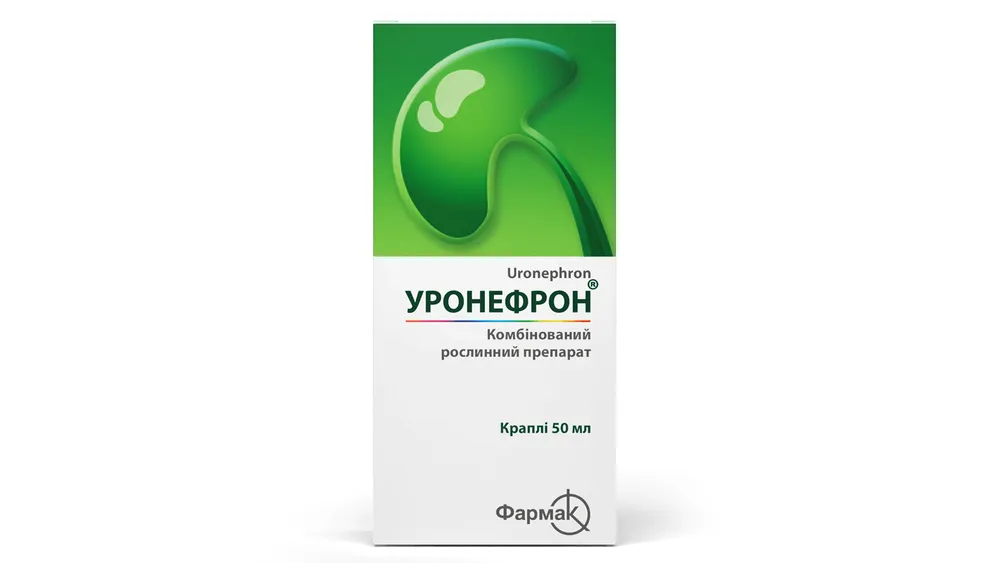
Table of Contents
INSTRUCTIONS FOR MEDICAL USE OF THE MEDICINAL PRODUCT URONEPHRON® (URONEPHRON)
Composition:
Active substances: 1 ml of solution contains liquid phytoextract (1:5.8) – 1 ml, from a mixture of herbal raw materials: onion peel (Allium cepa L.), couch grass rhizome (Rhizoma Agropyri), birch leaf (Betulae folium), fenugreek seed (Foenugraeci semen), parsley root (Radix Petroselini), goldenrod herb (Solidaginis herba), field horsetail herb (Equiseti herba), bird's-foot grass herb (Polygoni avicularis herba), lovage root (Radix Levistici) (extraction agent: 45% ethanol);
Excipients: ethyl parahydroxybenzoate (E 214).
27 drops are contained in 1 ml of the preparation.
Pharmaceutical form. Drops.
Main physicochemical characteristics: dark brown liquid with a yellowish or greenish tint, with a characteristic aromatic odor. Slight opalescence and fine precipitate are permissible.
Pharmacotherapeutic group. Agents promoting dissolution of urinary calculi.
ATC code G04BC.
Pharmacological Properties
Pharmacodynamics
Uronefрон® is a combined herbal medicinal product. It exerts anti-inflammatory, diuretic, spasmolytic, and antimicrobial effects. The diuretic action is due to flavone derivatives, inositol, saponins, and silicates. The latter also enhance the excretion of uric acid in cases of urinary urate deposits. The medicinal product prevents crystallization of mineral components in the urinary tract and favorably influences the maintenance of the balance between colloids and crystalloids in urine. Saponins reduce surface tension, form protective colloids, emulsify pathogenic components of urine, and prevent the formation of sand and kidney stones. It promotes the flushing out of sand and small concrements and prevents the growth of existing concrements or the formation of new ones.
Allii cepae squama (onion bulb scales) contains essential oil (up to 0.15%), vitamin C, riboflavin, thiamine, carotenoids, phytic, citric, and malic acids, sugars (glucose, fructose, sucrose), flavonoids, and compounds of potassium, iron, manganese, zinc, and cobalt. It exerts an anti-inflammatory effect.
Agropyri rhizoma (couch grass rhizome) contains polysaccharides, sugars, alcohols, glycosides, vitamins, essential and fatty oils, and organic acids. Its main actions are diuretic and regulation of metabolism.
Betulae folium (birch leaves) contains essential oils, saponins, tannins, resins, ascorbic acid, and nicotinic acid. Its main actions are diuretic, choleretic, spasmolytic, and anti-inflammatory.
Foenugraeci semen (fenugreek seeds) contains trigonelline, nicotinic acid, rutin, steroidal saponins and phytosterols, flavonoids, and essential oils. Its main actions are anti-inflammatory, tonic, and wound-healing.
Petroselini radix (parsley root) contains apiol, myristicin, and flavonoids. Its main actions are diuretic, anti-inflammatory, and litholytic.
Solidaginis herba (goldenrod herb) contains flavonoids: kaempferol, quercetin, and their glycosides—astragalin, rutin. Its main actions are diuretic, antibacterial, and anti-inflammatory.
Equiseti herba (field horsetail herb) contains flavonoids: derivatives of apigenin, luteolin, kaempferol, and quercetin, as well as phenolcarboxylic acids, tannins, and saponins. Its main actions are diuretic, anti-inflammatory, litholytic, and detoxifying.
Polygoni avicularis herba (birdweed herb) contains flavonoids, phenolic acids, carotene, ascorbic acid, and tannins. Its main actions are diuretic and hemostatic.
Levisticum (lovage). The aerial parts and roots of lovage contain essential oil (0.1–0.2% in fresh roots, 0.6–1% in dried roots), sugars, organic acids, mineral substances, resins, and starch. The essential oil includes terpineol, cineole, acetic, isovaleric, and benzoic acids. Its main actions are diuretic and anti-inflammatory.
The components contained in the herbal medicinal product Uronefрон® exhibit complex activity, manifested as anti-inflammatory effects and relief of urinary tract spasms, diuretic and vasodilatory effects, and also contribute to the antimicrobial efficacy of the drug.
Pharmacokinetics
Not studied.
Clinical characteristics.
Indications.
In complex therapy of infectious and inflammatory diseases of the urinary system:
- Acute and chronic cystitis;
- Acute and chronic pyelonephritis;
- Chronic urethritis;
- Chronic prostatitis.
Treatment and prevention of urolithiasis, including after surgical removal of urinary concrements.
Contraindications.
- Hypersensitivity to any component of the medicinal product or to plants of the genus Asteraceae (Compositae) (common goldenrod), Apiaceae (Umbelliferae), anethole (lovage root), birch pollen (birch leaves).
- Conditions where reduced fluid intake is recommended (e.g., renal failure, cardiac failure).
- Conditions associated with increased blood coagulation.
- Obstruction of urinary tract.
- Acute nephritis, nephroses, phosphate lithiasis.
Interaction with other medicinal products and other forms of interaction.
Due to the diuretic effect of the drug, accelerated excretion of other concurrently administered medicinal products should be considered.
The drug may enhance the effects of hypoglycemic agents, nonsteroidal anti-inflammatory drugs, lithium salts, monoamine oxidase inhibitors, anticoagulants; and prolong the action of pentobarbital, paracetamol, aminopyrine.
The drug may reduce intestinal absorption of medicinal products in the small intestine, particularly beta-carotene, alpha-tocopherol, as well as cholesterol.
Special precautions for use
When using the medicinal product, blood glucose monitoring is necessary in patients with diabetes due to the possible hypoglycemic effect of fenugreek.
If pain, difficulties with urination, presence of blood in urine, worsening of symptoms, or an increase in body temperature occur, immediate medical advice must be sought.
During treatment with this medicinal product, it is recommended to drink plenty of fluids.
The drug should not be used if edema caused by cardiac or renal insufficiency is present.
The product contains ethylparahydroxybenzoate (E 214), which may cause allergic reactions (possibly delayed).
The medicinal product contains a small amount of ethanol – less than 100 mg/dose.
Use during pregnancy or breastfeeding
Animal experimental studies have not shown any teratogenic effects of Uronefron® on the fetus. However, there is no clinical experience with its use in pregnant women. Therefore, as a precautionary measure, the use of the drug should be avoided during pregnancy and breastfeeding.
Ability to influence reaction rate when driving or operating machinery
If dizziness occurs during treatment with this medicinal product, patients should refrain from driving or operating machinery.
Dosage and Administration.
For oral use in adults.
Take 25–30 drops 3–4 times daily after meals, diluted in 100 mL (1/2 glass) of warm boiled water.
The duration of treatment is determined by a physician. Typically, treatment lasts from 2 to 6 weeks. If necessary, the course may be repeated.
Children.
There is no experience with the use of the medicinal product in children and adolescents under 18 years of age; therefore, it should not be prescribed to patients in this age group.
Overdose.
In case of overdose, the manifestations of adverse reactions may be intensified.
Treatment is symptomatic.
Side effects.
Immune system:
Allergic reactions, including rash, urticaria, itching, allergic rhinitis, facial swelling.
Nervous system:
Dizziness.
Gastrointestinal tract:
Nausea, vomiting, diarrhea, bloating.
Skin and subcutaneous tissue:
Increased sensitivity to ultraviolet radiation (photosensitization).
Urinary system:
Renal colic.
Shelf life. 2 years.
Do not use the medicinal product after the expiry date stated on the packaging.
Storage conditions.
Store in the original packaging at a temperature not exceeding 25 °C.
Keep out of reach of children.
Packaging. 25 ml or 50 ml in a vial. 1 vial per carton.
Supply category. Over-the-counter.
Manufacturer. JSC "Farmak".
Manufacturer's address and place of business.
74, Kyrylivska Street, Kyiv, 04080, Ukraine.