Tizin® xylo
Ukraine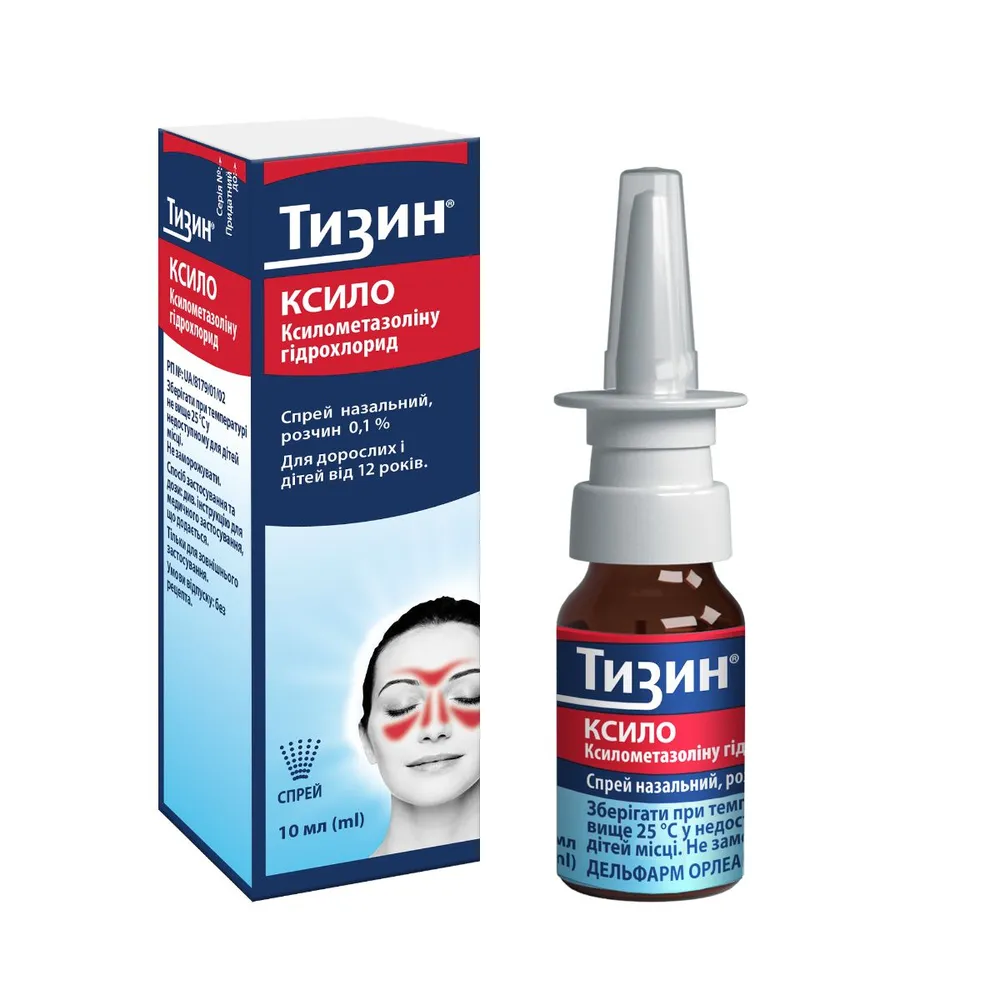
Table of Contents
INSTRUCTIONS FOR MEDICAL USE OF THE MEDICINAL PRODUCT TYZINE® XYLO (TYZINE® XYLO)
Composition:
Active substance: xylometazoline hydrochloride;
1 ml of solution contains 0.5 mg or 1 mg of xylometazoline hydrochloride;
Excipients: benzalkonium chloride solution; sorbitol solution, non-crystallizing (E 420); sodium chloride; sodium dihydrogen phosphate dihydrate; disodium hydrogen phosphate dihydrate; disodium edetate; purified water.
Pharmaceutical form. Nasal spray, solution.
Main physicochemical properties: clear, colourless, odourless solution or with a slight characteristic odour.
Pharmacotherapeutic group. Anti-edematous and other agents for local use in nasal disorders. Sympathomimetics, simple preparations.
ATC code R01A A07.
Pharmacological properties.
Xylometazoline hydrochloride, an imidazole derivative, is a sympathomimetic active substance with alpha-adrenergic action. The drug exerts vasoconstrictive effects, thereby reducing swelling of the mucous membrane. Onset of action usually occurs within 5–10 minutes and lasts up to 10 hours; the drug relieves nasal breathing by reducing mucosal swelling and improving secretion drainage.
When applied intranasally, the absorbed amount of the drug may occasionally be sufficient to cause systemic effects, particularly those affecting the central nervous system and cardiovascular system.
Clinical characteristics.
Indications.
For symptomatic relief of nasal congestion associated with acute rhinitis due to colds and influenza, sinusitis, allergic and non-allergic rhinitis.
Contraindications.
Tizin® Ksilo should not be used in the following cases:
- hypersensitivity to the active substance xylometazoline hydrochloride or to any of the excipients of the medicinal product;
- dry inflammation of the nasal mucosa with crust formation (dry rhinitis);
- atrophic or vasomotor rhinitis;
- concomitant treatment with monoamine oxidase inhibitors (MAOIs), treatment with monoamine oxidase inhibitors (MAOIs) within two weeks prior to starting Tizin® Ksilo nasal spray, or with other medicinal products capable of increasing blood pressure;
- after hypophysectomy or surgical intervention on the dura mater;
- closed-angle glaucoma;
- acute coronary diseases;
- coronary asthma;
- hyperthyroidism.
Due to the presence of benzalkonium chloride used as a preservative, Tizin® Ksilo must not be used in cases of established hypersensitivity to this compound.
Special precautions.
After local application, systemic absorption of xylometazoline hydrochloride is minimal; however, Tizin® Ksilo should be used only after careful benefit-risk assessment in patients:
- with severe cardiovascular diseases (e.g., ischemic heart disease, arterial hypertension);
- with pheochromocytoma;
- with metabolic disorders (e.g., in diabetes mellitus);
- with benign prostatic hyperplasia.
Prolonged use and overdose of sympathomimetic decongestants may lead to reactive hyperemia of the nasal mucosa. This reaction may cause airway obstruction, which in turn leads to repeated or even continuous use of the drug. This may result in chronic edema (medication-induced rhinitis), and eventually in atrophy of the nasal mucosa and ozena.
In milder cases, treatment with sympathomimetic agents may be discontinued first in one nostril, and after reduction of complications, treatment may continue by administering the drug into the other nostril, thus preserving partial nasal breathing.
Tizin® Ksilo contains benzalkonium chloride. This compound may cause irritation of the nasal mucosa.
Interaction with other medicinal products and other types of interactions.
Concomitant use of Tizin® Ksilo nasal spray with monoamine oxidase inhibitors of the tranilcipramine type or tricyclic antidepressants, as well as with medicinal products that increase blood pressure, may lead to arterial hypertension due to the effects of these agents on the cardiovascular system.
Due to the low systemic absorption of xylometazoline following intranasal administration, interaction with medicinal products administered by other routes is considered unlikely.
Special precautions for use.
The medicinal product should be prescribed with caution to patients who experience strong adverse reactions when using adrenergic agents, such as insomnia, dizziness, tremor, cardiac arrhythmia, or increased arterial blood pressure.
Use during pregnancy or breastfeeding.
Pregnancy
Xylometazoline hydrochloride should not be used during pregnancy, as there are no adequate studies on the effect of the medicinal product on the fetus.
Breastfeeding
The medicinal product Tizin® Ksilo should not be used during breastfeeding, as it is unknown whether the active substance passes into breast milk.
Ability to influence reaction rate when driving or operating machinery.
Tizin® Ksilo generally does not affect the ability to drive or operate complex machinery when used at recommended doses; however, the possibility of adverse reactions affecting the central nervous system and visual organs should be taken into account.
Method of Administration and Dosage
Doses
The dosage depends on individual patient sensitivity and clinical response.
Unless otherwise prescribed, children aged 4 to 6 years should receive 1–2 sprays of Tizin® Ksilo (0.05% metered spray) into each nostril up to 3 times daily. Children aged 6 to 12 years should receive 2–3 sprays of Tizin® Ksilo (0.05% metered spray) into each nostrir up to 3 times daily. Adults and children aged 12 years and older should receive 2–3 sprays of Tizin® Ksilo (0.1% metered spray) into each nostril up to 3 times daily.
Method of Administration
To use Tizin® Ksilo nasal spray, 0.05% and 0.1% solution, first remove the protective cap. Before the first use, press the pump several times until a uniform spray is produced. The spray is then ready for use. Insert the nozzle tip into each nostril and press once. During spraying, gently inhale through the nose.
Hold the nasal spray bottle upright. Do not spray upside down or at an angle. For hygiene reasons, wipe the spray nozzle after each use and replace the protective cap.
Treatment Duration
Tizin® Ksilo should not be used for more than 7 consecutive days, except when recommended by a physician.
Repeated use should only be initiated after a several-day break and following consultation with a physician. The treatment duration for children should be determined individually by a doctor.
In cases of chronic rhinitis, Tizin® Ksilo should only be used under medical supervision due to the risk of nasal mucosa atrophy.
Children
Tizin® Ksilo nasal spray, 0.05% solution, is indicated for the treatment of children aged 4 to 12 years. Tizin® Ksilo nasal spray, 0.05% solution, is not recommended for children under 4 years of age.
Tizin® Ksilo nasal spray, 0.1% solution, is indicated for the treatment of adults and children aged 12 years and older.
Overdose
Symptoms
Systemic effects after nasal administration are unlikely due to local vasoconstriction, which limits absorption. However, in the case of systemic absorption, xylometazoline, as an α2-adrenergic agonist, may produce effects similar to clonidine: transient increase in blood pressure followed by prolonged hypotension and sedation.
Symptoms of intoxication with imidazole derivatives may be clinically unclear, as periods of stimulation may alternate with periods of depression of the central nervous and cardiovascular systems.
Symptoms of central nervous system stimulation include anxiety, agitation, hallucinations, and seizures.
Symptoms of central nervous system depression include decreased body temperature, lethargy, somnolence, and coma.
Additional possible symptoms include miosis, mydriasis, sweating, nausea, cyanosis, fever, pallor, CNS paralysis, sedation, dry mouth, arrhythmia, tachycardia, bradycardia, cardiac arrest, hypertension, shock-like hypotension, pulmonary edema, respiratory disturbances, and apnea.
Overdose, especially in children, may significantly affect the central nervous system, causing spasms, coma, bradycardia, apnea, and hypertension, which may later shift to arterial hypotension.
Treatment
Severe overdose requires hospital treatment. Since xylometazoline hydrochloride is rapidly absorbed, activated charcoal (adsorbent), sodium sulfate (laxative), or gastric lavage (in cases of higher doses) should be administered immediately. Hypotension can be managed with non-selective alpha-blockers. Vasoconstrictors are contraindicated. If necessary, antipyretics, anticonvulsants, and artificial oxygen respiration should be used.
Adverse reactions.
Undesirable effects were classified into the following frequency categories:
very common: >1/10;
common: ≥1/100 to <1/10;
uncommon: ≥1/1000 to <1/100;
rare: ≥1/10,000 to <1/1000;
very rare: <1/10,000;
frequency not known: cannot be estimated from the available data.
Respiratory, thoracic and mediastinal disorders
Tizine® Xylo may cause temporary mild irritation symptoms (burning sensation or dryness of the nasal mucosa), especially in sensitive patients, as well as nasal and throat pain.
Common: reactive hyperemia.
Uncommon: nasal bleeding, sneezing, epistaxis.
Prolonged or frequent use of higher doses of xylometazoline hydrochloride may cause burning, stinging, itching, sensitivity, dryness or irritation of the nasal mucosa, as well as rebound congestion and drug-induced rhinitis. This effect may occur as early as 7 days after treatment initiation, and prolonged use may lead to irreversible damage of the nasal mucosa with crust formation (atrophic rhinitis).
Occasionally, nausea, headache, and transient visual disturbances may occur.
Rebound nasal congestion after discontinuation of treatment has been reported, particularly following prolonged use of xylometazoline.
Nervous system disorders
Rare: headache, dizziness, rebound effect, insomnia, increased fatigue.
Very rare: hallucinations, predominantly in children.
Cardiovascular disorders
Uncommon: systemic sympathomimetic effects (tachycardia, increased pulse rate, elevated blood pressure).
Very rare: arrhythmia.
Musculoskeletal and connective tissue disorders
Very rare: convulsions, particularly in children.
Immune system disorders
Uncommon: hypersensitivity reactions, including angioneurotic edema, rash, pruritus.
Post-marketing data
The following adverse effects have been reported spontaneously: burning sensation of the mucosa, nasal dryness; prolonged treatment may lead to rebound effect.
Shelf life. 3 years.
Shelf life of the product after first opening of the bottle – 24 weeks.
Storage conditions.
Store at a temperature not exceeding 25 °C, in a place inaccessible to children. Do not freeze.
Packaging.
Nasal spray, solution 0.05% and 0.1%, 10 ml in bottles; 1 bottle in a cardboard pack.
Availability. Over-the-counter.
Manufacturer. DELPHARM ORLEANS / DELPHARM ORLEANS.
Manufacturer's address and place of business
5 avenue de Concyr, ORLEANS CEDEX 2, 45071, France / 5 avenue de Concyr, ORLEANS CEDEX 2, 45071, France.
Marketing Authorization Holder.
McNeil Products Limited.
Address of the Marketing Authorization Holder.
50-100 Holmers Farm Way, High Wycombe, HP12 4EG, England.
Representative of the Marketing Authorization Holder. LLC "Johnson & Johnson Ukraine".
Address of the Representative.
32/2 Ostrizkykh Knyaziv St., Kyiv, 01010, Ukraine.
+38 (044) 498 0888
+38 (044) 498 7392