Tutukon
Ukraine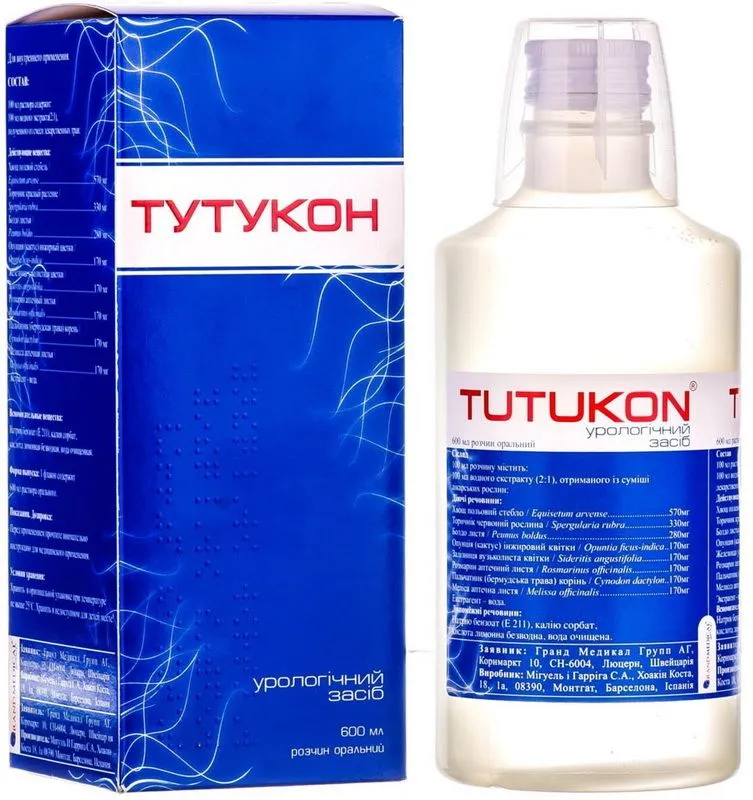
Table of Contents
INSTRUCTION FOR MEDICAL USE OF THE MEDICINAL PRODUCT TUTUKON (TUTUKON®)
Composition:
Active substances:
100 ml of solution contains 100 ml of aqueous extract (2:1) obtained from a mixture of medicinal plants: field horsetail stem (Equisetum arvense) 570 mg, red sandwort plant (Spergularia rubra) 330 mg, boldo leaves (Peumus boldus) 280 mg, prickly pear (cactus) flowers (Opuntia ficus-indica) 170 mg, narrow-leaved ironwort flowers (Sideritis angustifolia) 170 mg, rosemary leaves (Rosmarinus officinalis) 170 mg, Bermuda grass root (Cynodon dactylon) 170 mg, lemon balm leaves (Melissa officinalis) 170 mg; extraction solvent — water;
Excipients: sodium benzoate (E 211), potassium sorbate, anhydrous citric acid, purified water.
Pharmaceutical form. Oral solution.
Main physicochemical characteristics: a clear or slightly opalescent liquid, ranging from colorless to slightly yellowish, with a characteristic odor.
Pharmacotherapeutic group. Agents used in urology. Other urological agents. ATC code G04BX.
Pharmacological Properties
Pharmacodynamics
A combined herbal medicinal product. Has diuretic, spasmolytic, litholytic, anti-inflammatory, antibacterial, choleretic, and antioxidant effects. Promotes the elimination from the body of uric acid, toxins, and heavy metal salts.
Pharmacokinetics. Not applicable.
Clinical characteristics
Indications. In complex therapy: for urolithiasis (urates, oxalates, phosphates, carbonates), cystitis, urethritis, urinary tract spasms, irritable bowel syndrome; for prevention of urolithiasis after lithotripsy.
Contraindications
- Hypersensitivity to the components of the medicinal product.
- Conditions where reduced fluid intake is recommended (e.g., renal insufficiency, cardiac insufficiency).
- Gastritis.
- Prostatitis.
- Biliary tract obstruction, gallstones, liver dysfunction and/or other conditions requiring medical supervision.
Interaction with other medicinal products and other types of interactions. Unknown.
Special precautions for use
In inflammatory kidney diseases, medical advice must be sought. The medicinal product should be used with caution in patients with gastroenteritis, arterial hypertension, or predisposition to non-epileptic seizures.
Patients with a history of edema and/or recurrent urinary tract infections should consult a physician prior to initiating treatment.
This medicinal product contains less than 1 mmol (23 mg) / dose of sodium or potassium, i.e. it is practically free of sodium or potassium.
Use during pregnancy or breastfeeding
Pregnancy
There are no clinical data on the use of this medicinal product in pregnant women. Safety during pregnancy has not been established. Due to insufficient information, the use of this medicinal product during pregnancy is not recommended.
Breastfeeding
The safety of using this medicinal product in breastfeeding women has not been established. Because of limited data, the use of this medicinal product during breastfeeding is not recommended.
Fertility
There is no information available on the effect of the medicinal product on fertility.
Ability to affect reaction speed when driving or operating machinery. There have been no reports of negative effects of the medicinal product on the ability to drive or operate machinery.
Dosage and Administration
Do not exceed the recommended dose.
The medicinal product is taken orally, 45 ml three times daily, 30 minutes before meals.
It is recommended to drink one to two liters of water daily to facilitate the cleansing of the urinary tract.
Dosages and duration of treatment are determined individually by a physician for each patient.
The treatment course usually lasts 2–4 weeks.
If there is no improvement in condition after 6 days of treatment, discontinue use of the medicinal product and consult a doctor. Prolonged use of the medicinal product is not recommended. If a dose is missed, do not take a double dose.
Children. The use of the medicinal product Tutukon is not recommended in children (under 18 years of age).
Overdose
Cases of overdose have not been reported.
In case of accidental overdose, discontinue use of the medicinal product and consult a doctor. Symptomatic therapy should be administered.
Adverse Reactions
Adverse reactions are listed by organ systems and frequency categories: very common (≥ 1/10), common (≥ 1/100 to < 1/10), uncommon (≥ 1/1000 to < 1/100), rare (≥ 1/10,000 to < 1/1000), very rare (< 1/10,000), frequency not known (cannot be estimated from the available data).
Immune system disorders: frequency not known — hypersensitivity reactions: allergic reactions (hyperemia, pruritus, rash, skin edema).
If any adverse reactions occur, treatment should be discontinued and medical advice should be sought.
Reporting of Adverse Reactions
Reporting of adverse reactions following registration of the medicinal product is of great importance. It allows continuous monitoring of the benefit-risk balance of the medicinal product. Healthcare professionals and patients, as well as their legal representatives, should report all suspected adverse reactions and lack of efficacy via the Automated Pharmacovigilance Information System at the following link: https://aisf.dec.gov.ua.
Shelf life: 3 years.
Storage conditions
Store in the original packaging at a temperature not exceeding 25 °C.
Keep out of reach and sight of children.
Packaging: 300 ml or 600 ml of solution in a polypropylene bottle; 1 bottle with a plastic measuring cup in a cardboard box.
Supply classification: Over-the-counter (without prescription).
Manufacturer: Miguel y Garriga, S.L.
Manufacturer's address and place of business
C/ Joaquín Costa, 18-1, Montgat, Barcelona, 08390, Spain.