Cystinol acut
Ukraine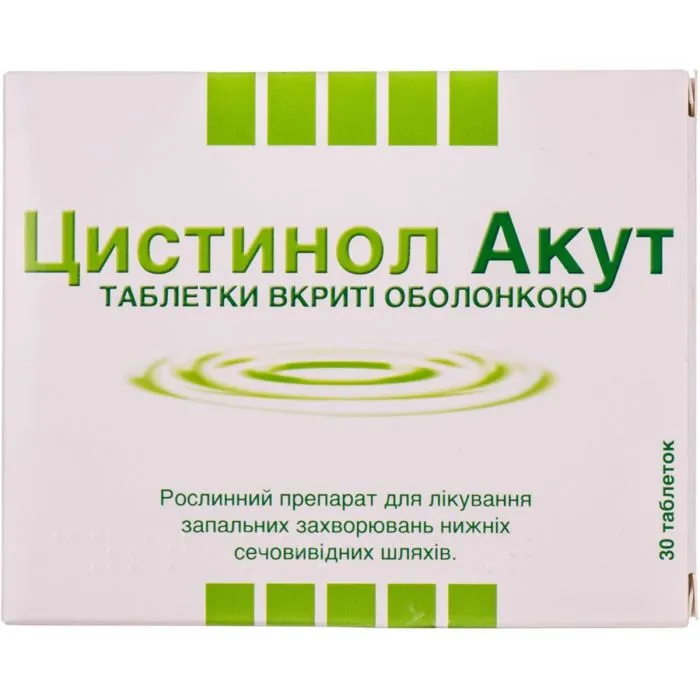
Table of Contents
INSTRUCTIONS FOR MEDICAL USE OF THE MEDICINAL PRODUCT CYSTINOL AKUT (Cystinolakut®)
Composition:
Active substance: 1 tablet contains 238.7–297.5 mg of dry extract of leaves of bearberry (Arctostaphylos uva-ursi) (3.5–5.5:1), corresponding to 70 mg of hydroquinone derivatives, expressed in terms of anhydrous arbutin; extraction solvent: ethanol 60% (v/v);
Excipients: microcrystalline cellulose; long-chain partial glyceride; hypromellose; lactose monohydrate; macrogol 6000; magnesium stearate; colloidal silicon dioxide; quinoline yellow (E 104); indigo carmine (E 132); aluminum hydroxide, titanium dioxide (E 171).
Pharmaceutical form. Coated tablets.
Main physicochemical characteristics: light green, glossy, oval-shaped coated tablets.
Pharmacotherapeutic group.
Agents used in urology. ATC code G04BP01.
Pharmacological properties.
Pharmacodynamics.
Extracts from the leaves of bearberry in vitro exert antibacterial activity against Proteus vulgaris, E. coli, Ureaplasma urealyticum, Mycoplasma hominis, Staphylococcus aureus, Pseudomonas aeruginosa, Klebsiella pneumoniae, Enterococcus faecalis, Streptococcus strains, as well as against Candida albicans.
The antibacterial effect is primarily associated with hydroquinone aglycones released from arbutin or from metabolites formed during arbutin elimination. Upon release of hydroquinone from its conjugates (hydroquinone glucuronide and sulfate), enzymatic activity of microorganisms causing urinary tract infections is inhibited.
In addition, the extract of common bearberry leaves, due to the presence of tannins, reduces bacterial adhesion to host cells.
Pharmacokinetics.
Arbutin from bearberry leaves (prodrug) is absorbed in the small intestine and undergoes fermentation, as well as metabolism in the liver. As a result, hydroquinone conjugates are transformed via second-pass metabolism into hydroquinone glucuronide and sulfate forms. These non-toxic compounds are water-soluble and excreted in urine.
In metabolism studies conducted in healthy volunteers (Cystinol Acute, coated tablets), more than 70% of the administered arbutin dose was excreted in urine as conjugated hydroquinone within 24 hours. Recovery of the active substance in the form of free hydroquinone was less than 0.5% of the administered arbutin dose.
Microbiological studies with E. coli have shown that conjugate fermentation occurs over a broad range of intrabacterial interactions and is independent of urine pH. Furthermore, antiseptic activity increases only at sites where bacteria are present.
Clinical characteristics.
Indications.
Inflammatory diseases of the lower urinary tract.
Contraindications.
- Hypersensitivity to bearberry leaf or to other components of the medicinal product.
Interaction with other medicinal products and other forms of interaction.
Cystinol Acut, coated tablets, contain an extract of bearberry leaf; therefore, they should not be used concomitantly with agents that increase urine acidity, as a reduction in the antibacterial effect of bearberry leaf cannot be excluded.
Special precautions for use.
If blood is present in the urine, in case of high body temperature, or if symptoms persist for more than 5 days, a doctor should be consulted.
This medicinal product is contraindicated in patients with hereditary galactose intolerance, lactase deficiency, or glucose-galactose malabsorption.
Use during pregnancy or breastfeeding.
Do not use during pregnancy or breastfeeding.
Ability to influence reaction rate while driving or operating machinery.
Does not affect.
Method of Administration and Dosage.
For adults and children aged 12 years and older: take 2 tablets three times daily. The tablets should be taken with a large amount of liquid, preferably water, after meals.
Unless otherwise prescribed by a physician, the medicinal product containing arbutin must not be used for longer than 1 week or for more than 5 courses per year.
Children.
Do not use in children under 12 years of age.
Overdose.
Symptoms: when the drug is used in doses exceeding the recommended ones, gastrointestinal disturbances may occur, such as vomiting, nausea, hematuria, and liver damage.
Treatment: discontinue the drug immediately and seek medical advice. Symptomatic therapy should be administered.
Side effects
The adverse effects are classified according to the frequency of their occurrence as follows: very common (≥ 1/10), common (≥ 1/100, < 1/10), uncommon (≥ 1/1000, < 1/100), rare (≥ 1/10,000, < 1/1000), very rare (< 1/10,000), not known (cannot be estimated from the available data).
Very rarely, patients with gastric sensitivity may experience gastrointestinal symptoms (nausea, vomiting, abdominal pain, diarrhea).
Nervous system disorders: dizziness.
Allergic reactions such as rash and itching may occur in rare cases.
If any adverse effects occur, treatment should be discontinued and medical advice should be sought. The physician will assess the severity of the adverse effects and decide on further necessary actions.
Shelf life.
3 years.
Storage conditions.
Store in the original packaging at a temperature not exceeding 25 °C.
Keep out of reach of children.
Packaging.
15 tablets in a blister pack, 2 blisters per cardboard box; 20 tablets in a blister pack, 2 or 3 or 5 blisters per cardboard box.
Pharmaceutical category.
Over-the-counter (without prescription).
Manufacturer.
Schaper & Brümmer GmbH & Co. KG.
Manufacturer's address and place of business.
Bahnhofstraße 35,
38259 Salzgitter, Germany